
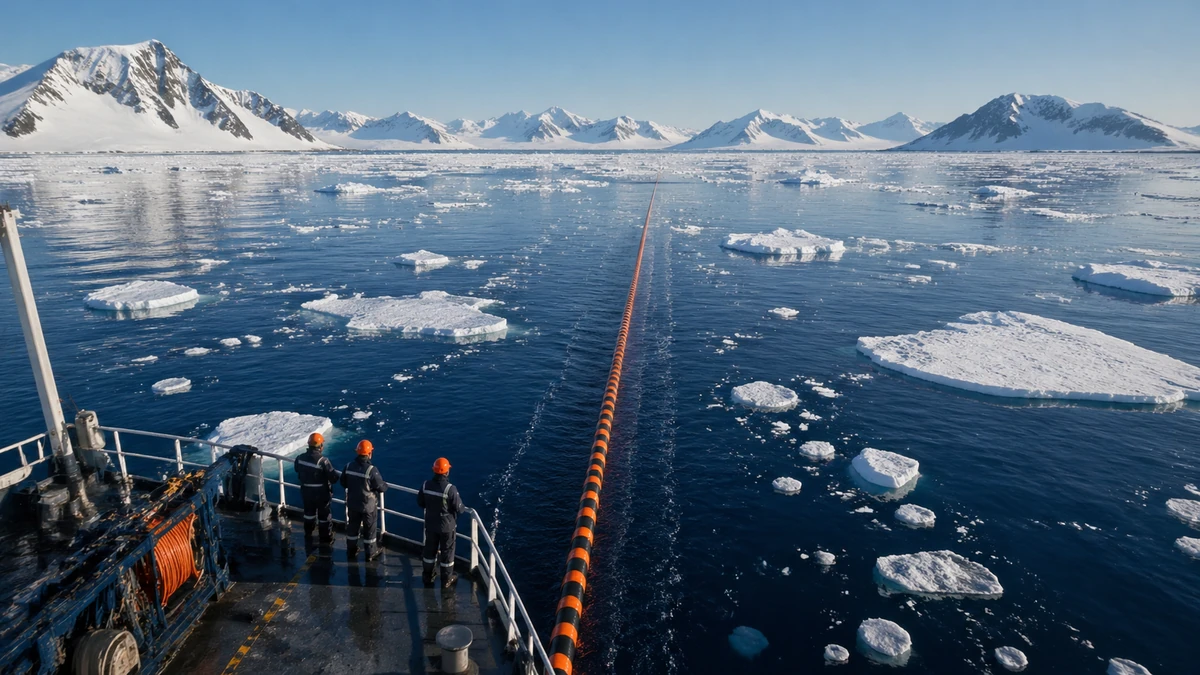
A new cable is only part of the story
Europe and Japan are discussing a new undersea communications link through the Arctic, but the real significance of the proposal goes beyond adding another cable to the ocean floor. At stake is something more strategic: building a digital detour that avoids waters near Russia, speeds up data traffic between Japan and Europe, and gives both sides another layer of protection in an era when the physical routes carrying the world’s internet traffic are increasingly treated as matters of national security.
The proposal, reported by Japan’s Nikkei newspaper, is being discussed as part of broader cooperation between the European Union and Japan on digital infrastructure. According to the report, the two sides are considering language for a joint statement at a ministerial-level digital partnership meeting next month that would include closer coordination on the installation and maintenance of undersea cables, including a new route through the Arctic Ocean north of the North American continent.
For many American readers, undersea cables may sound like niche telecom infrastructure — the sort of thing that matters to engineers and not much to anyone else. In reality, these cables form the backbone of the modern internet. They carry the overwhelming majority of international data, including financial transactions, cloud computing traffic, video calls, corporate communications and the digital plumbing behind streaming, artificial intelligence services and global supply chains. Satellites play a role, but the world’s everyday digital life mostly runs through fiber-optic cables laid across the seabed.
That makes the route of a cable almost as important as the cable itself. If a new Arctic line is built, it would not simply create more capacity between Japan and Europe. It would offer a way to reduce dependence on routes that pass near Russia and potentially improve communications speed by around 30%, according to the report. In other words, this is not just a story about technology. It is a story about geopolitics, economic resilience and the growing realization among U.S. allies that data routes can be as strategically important as shipping lanes or oil pipelines.
Why the Arctic matters now
The most immediate reason Europe and Japan are looking north is risk diversification. That phrase can sound dry, but the logic is simple and familiar to Americans who think about backup power grids, alternative shipping routes or supply-chain redundancy after the pandemic. If too much of a critical system depends on one vulnerable pathway, governments and companies start looking for a second or third option.
That is what appears to be happening here. Existing communications routes between Europe and Asia have long raised concerns about chokepoints, political uncertainty and vulnerability to disruption. A cable that runs through the Arctic and north of the North American landmass would help avoid Russian coastal waters and lessen reliance on a smaller number of existing paths. The point is not necessarily to replace current lines. It is to make sure there is more than one viable way for data to move when tensions rise, accidents happen or infrastructure is damaged.
This is a major shift in how governments talk about the internet. For years, digital policy discussions often focused on abstract issues such as data governance, privacy rules, platform regulation and technical standards. Those issues still matter. But the new emphasis is on physical resilience — on where the hardware sits, who maintains it, what waters it crosses and how quickly it can be repaired if something goes wrong.
The Arctic adds another layer of complexity. For decades, many people thought of the region mostly in terms of climate change, scientific research or competition over energy resources. Increasingly, it is being viewed as a strategic corridor. Melting sea ice and improving technology have made Arctic routes more imaginable for shipping and infrastructure, even if they remain technically difficult and expensive. A trans-Arctic cable would fit into that broader trend: the far north is no longer just a remote frontier. It is becoming part of the map of global commerce, communications and strategic competition.
For Washington, the development should sound familiar. U.S. policymakers have spent years talking about “de-risking” supply chains and reducing overdependence on vulnerable routes and strategic rivals. Europe and Japan now appear to be applying similar thinking to digital infrastructure. The language may be diplomatic, but the message is straightforward: when it comes to internet connectivity, resilience is becoming as important as efficiency.
The internet has entered the age of geopolitics
One reason this discussion matters is that it reflects a larger change in how countries view communications networks. Security used to be discussed mainly in terms of troop deployments, naval access, energy imports and missile defense. Those issues still define the hard edge of international politics. But today, the path taken by data is also treated as a strategic asset.
That change did not happen overnight. It has been building over the last decade as governments confronted cyberattacks, semiconductor shortages, sanctions, dependence on a handful of suppliers and growing tensions among major powers. Russia’s invasion of Ukraine sharpened European concerns about vulnerability in nearly every domain, from natural gas to undersea infrastructure. Meanwhile, competition between the United States and China pushed allies to think harder about trusted vendors, secure networks and who controls key nodes in the digital economy.
Undersea cables occupy a special place in that conversation because they are both invisible and indispensable. Most consumers never think about them. Yet they are among the most critical pieces of infrastructure in the world. A break, sabotage incident or maintenance failure can disrupt communications across entire regions. Even without dramatic incidents, the simple possibility of disruption can reshape how governments and corporations plan their networks.
That is why the Europe-Japan talks carry more weight than a standard diplomatic announcement. If the proposed route is included in a joint ministerial statement, it would signal that both sides are moving beyond lofty language about digital cooperation and into the harder, more expensive realm of infrastructure planning. A cable cannot be created through a press release. It requires route design, environmental review, financing, construction, specialized vessels, maintenance plans and long-term operational coordination.
In that sense, the announcement — if it comes — would be less a finish line than a starting gun. The real work would begin afterward: deciding who pays, who builds, who owns, who repairs and how the system would function during emergencies. Those details have not yet been made public. But the fact that officials are already discussing maintenance cooperation, not just construction, suggests a more serious approach than symbolic diplomacy alone.
What a 30% speed gain could mean in the real world
The reported estimate that communications speed between Japan and Europe could improve by roughly 30% may sound like a technical footnote, but in advanced economies it has real commercial implications. In industries where milliseconds matter — finance, advanced manufacturing, cloud services, high-end design, gaming, research collaboration and increasingly AI-driven applications — lower latency and more direct routes can translate into competitive advantage.
Think of it as the digital equivalent of a more direct air route between two business capitals. The passengers, in this case, are packets of data. If those packets arrive faster and more reliably, companies can synchronize operations more efficiently across continents. Multinational manufacturers can manage supply chains with tighter precision. Financial firms can move information more quickly. Research institutions can collaborate across borders with less delay. Media and entertainment companies can distribute and process large volumes of content more smoothly.
This matters especially for Japan and Europe because both are advanced industrial economies with strong manufacturing bases, significant research and development capacity and growing ambitions in cloud computing, semiconductors, AI and digital services. They are not building out infrastructure merely to make web browsing feel a bit faster. They are trying to support the next generation of high-value economic activity.
American readers have seen a version of this logic at home. Debates over broadband, data centers, semiconductor plants and electric grid reliability are not just about convenience; they are about national competitiveness. The same principle applies internationally. Undersea cables are no longer just telecom utilities. They are foundational economic infrastructure, every bit as important in the digital era as ports, rail corridors and interstate highways were in earlier ones.
It is also notable that officials are reportedly citing a quantitative benefit at this early stage. When governments start talking in numbers rather than slogans, it often suggests that internal planning has advanced beyond general political interest. That does not mean the project is finalized, or even guaranteed. But it does indicate that the conversation has moved into more practical terrain, where speed, cost and resilience are being weighed together.
A route around Russia, without saying the quiet part too loudly
The most politically sensitive part of the proposal is also the easiest to understand: the desire to avoid Russian coastal waters. Officially, the argument is framed in terms of diversification and resilience. Diplomatically, that makes sense. Governments often prefer the language of risk management to the language of confrontation, especially when discussing infrastructure that will operate for decades.
Still, the strategic implication is difficult to miss. Europe and Japan appear to be treating geopolitical uncertainty involving Russia not as a temporary disturbance but as a structural condition that must be designed around. That is a significant judgment. It suggests that even in the digital domain, governments are recalculating the costs of proximity, dependence and exposure.
This is not just about the possibility of direct interference. Infrastructure planners also worry about legal jurisdiction, operational uncertainty, political leverage and what happens during crises. In a tense environment, the question is not simply whether a route works under normal conditions. It is whether it remains trustworthy under abnormal ones.
That concern has become more urgent worldwide as reports of damage to undersea cables and pipelines in different regions have fueled fears about the vulnerability of seabed infrastructure. Not every outage is sabotage; fishing activity, anchors and natural causes can also break cables. But the broader effect has been to remind governments that critical infrastructure lying out of sight on the ocean floor is still highly exposed. Resilience, therefore, is not just about physical protection. It is also about having alternate routes available when the unexpected happens.
There is a broader diplomatic balancing act here as well. If Europe and Japan frame the Arctic cable too explicitly as an anti-Russia project, they risk escalating the political message and potentially complicating the regional response. If they present it only as a technical efficiency upgrade, they risk understating the strategic rationale that likely helps justify the investment in the first place. The challenge is to do both: build a practical commercial case while quietly embedding a security logic into the network’s design.
Japan’s infrastructure mindset is getting more strategic
The cable discussion also fits a wider pattern in Japan’s policy thinking. Tokyo has spent the last several years rethinking national security in a broader sense, moving beyond traditional military questions to include supply chains, economic security, critical technologies and the protection of strategic infrastructure. For American observers, the change resembles the way U.S. debates increasingly blend defense policy with industrial policy and infrastructure resilience.
That does not mean every project is military in nature. The undersea cable proposal is a civilian digital infrastructure initiative. But it exists in the same strategic universe as other Japanese efforts to harden facilities, distribute risk and strengthen partnerships with like-minded countries. Recent reporting on Japan’s consideration of how to support stronger protection for U.S. military facilities in the country points to the same underlying concern: critical systems, whether military or digital, cannot be treated as separate from the broader security environment.
The common thread is resiliency. How do you make sure essential functions continue even when circumstances become unstable? In one case, that may mean better protection for bases or logistics. In another, it means more diversified digital routes and stronger maintenance cooperation for communications infrastructure. Different sectors, same strategic instinct.
This matters because Japan is not acting alone. The EU has been moving in a similar direction, especially since the war in Ukraine underscored the danger of depending too heavily on fragile or politically exposed systems. Brussels has become more active in discussions of economic security, trusted connectivity and strategic autonomy — terms that can sound bureaucratic, but often boil down to a simple idea: build networks that allies can rely on, and reduce exposure to routes or suppliers that could become liabilities.
If Europe and Japan are now aligning around undersea cable infrastructure, it suggests their digital partnership is maturing. What began as a framework for discussions about standards, data and technology governance may be evolving into something closer to an infrastructure alliance.
What comes next, and why this matters beyond Europe and Japan
For now, key details remain unknown. The precise route, construction timeline, financing structure, participating companies and total investment have not been publicly disclosed. That means the project should not be treated as a done deal. At this stage, the most concrete development is that Europe and Japan are discussing stronger cooperation and may include the Arctic route concept in a joint statement at next month’s ministerial meeting.
Still, even at the proposal stage, the initiative deserves attention far beyond Tokyo and Brussels. It offers a preview of how the next phase of globalization may work: less centered on pure efficiency, more shaped by resilience, trust and geopolitical hedging. The cheapest route is no longer always the preferred route. The fastest route is valuable, but so is the route least likely to become politically compromised.
That has clear implications for the United States and its allies. Washington has its own stake in the security of global digital infrastructure, particularly as it deepens coordination with Japan and Europe on technology, trade and security issues. An Arctic cable linking major democratic economies would not just be another engineering project; it would be part of a broader architecture of trusted connectivity among partners that increasingly see digital dependence as a strategic vulnerability.
The proposal also underscores how much the definition of infrastructure has expanded. In an earlier generation, governments worried primarily about roads, bridges, ports and pipelines. Today they must think just as seriously about server farms, chip fabrication plants, cloud capacity and the undersea fiber lines that make cross-border digital life possible. That is the reality of a world in which commerce, communications and national power are deeply intertwined.
The immediate test will come with the language used at the upcoming EU-Japan digital partnership meeting. If the joint statement offers only a broad nod to cooperation, markets and policymakers may treat the proposal cautiously. If it includes more specific references to route planning, maintenance frameworks or next steps, it will suggest a more serious push toward implementation. Either way, the direction of travel is already becoming clear.
Europe and Japan are not simply talking about laying a new cable. They are talking about redesigning the map of trust in the digital age. The route itself — through the Arctic, around Russia, and toward a faster connection between two major economic centers — is a reminder that the internet is no longer just a network. It is infrastructure, strategy and foreign policy all at once.
And that may be the most important takeaway for American readers. The future of global power will not be determined only by aircraft carriers, energy markets or trade balances. It will also be shaped by quieter decisions about where data flows, whose systems carry it and how many alternate routes exist when the world becomes less stable. In that sense, the Arctic cable proposal is not a narrow telecom story. It is a snapshot of how countries are preparing for a more contested, more interconnected century.


0 Comments