South Korean Defender Seol Young-woo Seals Serbian Title for Red Star, Underscoring Korea’s Growing Footprint in European Soccer
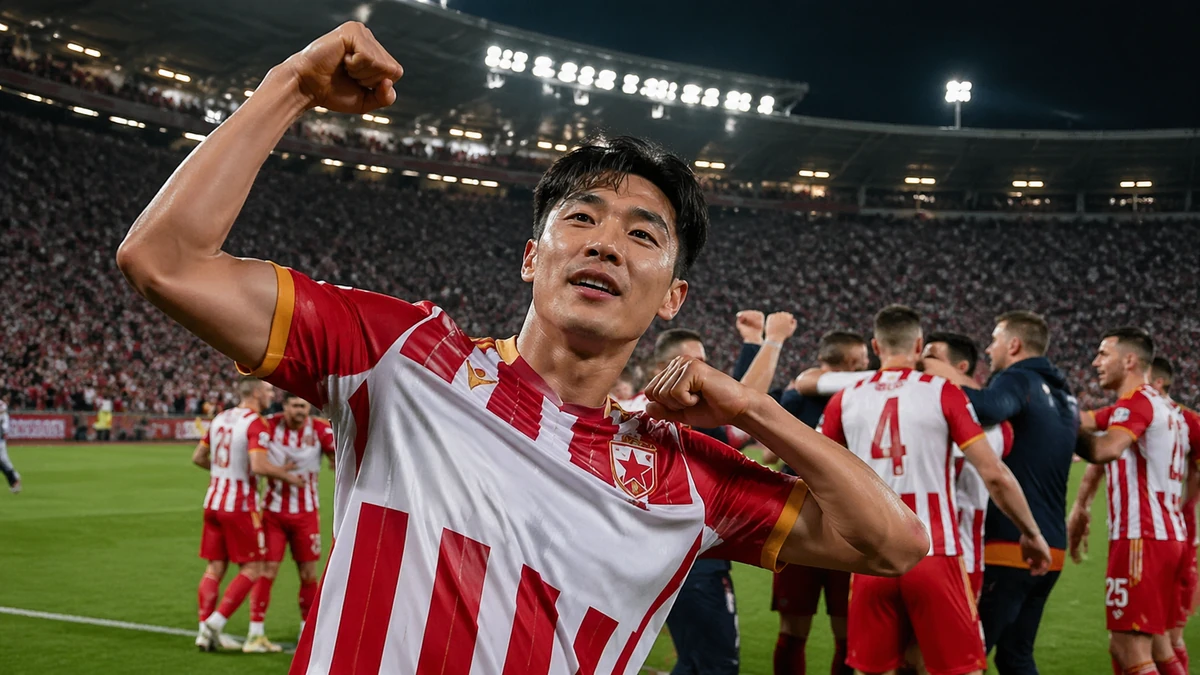
A title clinched with a rival on the other side
For American sports fans, the easiest way to understand what happened in Belgrade this week is to imagine a first-place team not only wrapping up its league title early, but doing it by beating its biggest rival in convincing fashion — and having a South Korean national team player score the goal that effectively slammed the door shut. That is the moment Seol Young-woo delivered for Crvena zvezda, better known in English as Red Star Belgrade, in Serbia’s top soccer division.
Red Star beat Partizan Belgrade 3-0 on Sunday, pushing its lead to an uncatchable 17 points with four matches still left in the season. The result mathematically secured the Serbian SuperLiga championship and did so in the most emphatic way possible: by defeating the club directly beneath it in the standings. Seol, a South Korean fullback and national team regular, scored the clinching goal, turning an already important derby into a career-defining snapshot.
That matters because title races are often remembered less for the standings sheet than for the image that survives after the confetti settles. In this case, the image is of a Korean defender, playing in a packed, emotionally charged stadium in Serbia, delivering the goal that transformed a likely championship into an undeniable one. It was not merely another appearance by a Korean player abroad. It was a decisive contribution on the night a league title became official.
For South Korean fans, that distinction is significant. Korea has produced a long line of players who have made careers in Europe, from household names in the Premier League and Bundesliga to less-publicized professionals in leagues that do not always command American television attention. But even in that broader story, there is something special about a player being at the center of the exact game that locks up a championship. Those moments tend to linger because they fuse individual achievement with club history.
And this was no ordinary opponent. Partizan is not just another team in the table. It is Red Star’s fiercest domestic rival, and matches between the two are among the most emotionally loaded events in Balkan soccer. So when Red Star finished off Partizan to secure the title, it was not simply efficient. It was theatrical, symbolic and impossible to dismiss as a quiet march to the finish line.
Why Seol’s goal stands out
Seol’s position makes the goal even more notable. He is a fullback, a role that in modern soccer requires a player to defend wide areas, support the midfield, overlap in attack and often cover enormous ground over 90 minutes. In American terms, it is something like asking a player to be both a shutdown defender and a constant transition threat. It is one of the sport’s most demanding jobs, and one in which consistency often earns more respect than highlight-reel moments.
That is why a fullback’s goal can resonate differently than a striker’s. For a center forward, goals are part of the weekly job description. For a defender, especially in a high-stakes title match, a goal often feels like a punctuation mark — the moment that confirms the balance of power already unfolding on the field. Seol’s score was described in Korean coverage as a “wedge goal,” a phrase common in Korean sports writing that refers to the goal that drives in the wedge and effectively seals the result. American audiences would recognize it as the insurance goal that removes any real suspense.
In this case, the meaning went beyond simple scoreboard padding. Red Star had already put itself in position to win, but Seol’s finish supplied the emotional finality. It was the kind of goal that tells everyone in the stadium, and everyone following from afar, that the race is over. Not close to over. Over.
For Korean fans, there is another layer. Seol is not an anonymous export trying to break through in Europe. He is part of the South Korean national team pool, which means supporters know him from international competition and track his progress with an eye toward what it means for the country’s future in major tournaments. When a national team fullback proves capable of influencing meaningful club matches in Europe, it reinforces the idea that Korea’s player development pipeline is producing professionals who can impact games in different leagues, systems and football cultures.
That broader significance helps explain why this goal landed with such force. It was not just a personal milestone, and not just a championship moment. It was another data point in the continuing globalization of South Korean soccer talent — a reminder that Korean players are no longer exceptions in European football, but recurring contributors in consequential matches.
Understanding Red Star and the Serbian stage
To many American readers, Red Star Belgrade may ring a bell only faintly, if at all. But in European soccer, it is one of the region’s historically significant clubs. Based in Serbia’s capital, the club carries deep domestic prestige and a powerful fan culture. It is also one of the best-known teams from the former Yugoslav football tradition, a region that has long produced technically gifted and fiercely competitive players.
Its home, Rajko Mitic Stadium in Belgrade, is one of those venues where local history, club identity and crowd intensity combine into something much larger than a routine sporting event. American audiences familiar with the atmosphere of a storied college football rivalry or a postseason game in a deeply invested sports town can begin to grasp the feeling, though European derby culture has its own traditions and edge. In Belgrade, the Red Star-Partizan rivalry is not a side note. It is central to the emotional life of Serbian soccer.
That is part of what makes this title-clinching performance so impressive. Red Star did not back into the championship because another result elsewhere happened to go its way. It beat the team chasing it, in the most visible domestic matchup possible, and widened the standings gap to 17 points. With only four matches left, the math became straightforward: Partizan could no longer catch them.
The structure of the Serbian SuperLiga also helps explain the achievement. The league begins with 16 teams playing a regular season. After that phase, the table splits in two: the top eight move into a championship round, while the bottom eight enter a relegation round. That means the title is not secured simply by starting fast. Teams must carry their position into a final stretch against the league’s stronger half.
Red Star had already finished atop the regular-season standings, and it then confirmed its superiority early in the championship round. Winning the title by the third game of that phase shows not just talent but stability. Many first-place teams look formidable in the middle of a season and then wobble under pressure when the schedule tightens and every match feels like an event. Red Star did the opposite. It turned its regular-season advantage into complete control.
The numbers behind a runaway season
Sometimes sports narratives can overromanticize a single moment and lose sight of the larger truth. In this case, the larger truth only strengthens the drama of Seol’s goal. Red Star’s championship was not a fluke created by one timely finish. It was the product of a season in which the club separated itself so decisively from the rest of the league that the title became official with nearly a month of soccer still left to play.
After the 3-0 win over Partizan, Red Star stood on 82 points. Partizan remained on 65. A 17-point lead with four games remaining is not a close race in disguise; it is domination made visible. Even before the title became mathematically certain, the standings already suggested a team that had imposed its quality over the course of months, not merely risen at the right time.
That distinction matters in soccer because leagues are often tests of durability more than brilliance. Cup competitions can be won by a hot streak, a favorable draw or one unforgettable night. A league title demands repeated execution over a long season, through injuries, form swings, tactical adjustments and the psychological burden of being hunted by everyone else. To lock up a championship this early says something clear: Red Star did not just survive the season. It controlled it.
And the victory over Partizan sharpened that point further. If a leader wins a title because a rival stumbles elsewhere, the celebration still counts, but the ending can feel indirect. Here, Red Star removed ambiguity by beating the nearest challenger head-to-head. There was no waiting for help, no scoreboard watching and no need for complicated permutations. The league’s best team beat the team in second place and settled the argument itself.
For Seol, that context elevates the goal beyond a line on a stat sheet. His finish came in a match that already carried the weight of rivalry, standings pressure and championship finality. In other words, this was not a comfortable late-season game with little at stake. It was the game that could authoritatively close the race. He helped write that ending.
A dynasty, not a one-off celebration
This title also belongs to a much bigger story inside Serbian soccer. With the championship now secured, Red Star has won the league nine seasons in a row, extending a run that dates back to the 2017-18 campaign. Sustained dominance in any professional sport is difficult. Doing it across nearly a decade requires more than one golden generation or one inspired coach. It requires an organizational structure that can absorb change and keep producing results.
For American readers, the comparison is not exact, but think of the way dynasties in U.S. sports are measured not just by a single trophy, but by whether they can remain the standard while rosters evolve and challengers adjust. Consecutive titles bring a different kind of pressure. Once a team starts winning regularly, every opponent treats matches against it as a measuring stick. Expectations become heavier. Familiarity breeds more targeted preparation. The champion must keep reinventing enough of itself to remain in front.
That is what makes Red Star’s latest title historically meaningful. According to the Korean summary, it is the club’s 12th Serbian SuperLiga championship since the competition began in its current form in the 2006-07 season. This is not a case of a suddenly rising club catching lightning in a bottle. It is a reaffirmation of entrenched power.
Within that framework, Seol’s contribution becomes even more valuable. Being part of a champion is notable for any player. Being part of a champion that is building a long, historic run is more significant. But scoring the goal that seals the latest installment of that run is something else entirely. It ties a player directly to the memory of the championship itself, not just to the roster that collected medals at season’s end.
That sort of symbolism matters in soccer culture, where fans often remember exact goals, exact rivals and exact title-clinching nights. Years from now, people may not recall every routine victory Red Star accumulated on the road to this championship. They are more likely to remember the derby win over Partizan, the early clinching, and the Korean defender who scored to make sure there would be no late suspense.
What it means for South Korean soccer
For South Korea, Seol’s moment fits into a broader shift in how the nation’s soccer success is discussed. There was a time when Korean football abroad was framed mostly around a few breakout stars — players whose European careers felt exceptional and therefore symbolic of national progress. That still happens, but the ecosystem has matured. Now there is a growing expectation that Korean players will appear across multiple leagues, occupy different positions and contribute in ways that go beyond marketing appeal or novelty.
That matters because not every influential player is a headline-grabbing scorer. National teams are built from specialists, grinders and tactically intelligent professionals as much as from superstars. A fullback like Seol thriving in Europe gives South Korea something tangible: proof that players outside the glamour positions can establish themselves in high-pressure environments and affect championship outcomes.
It also broadens the map for Korean fans. Much of the international attention naturally gravitates toward the biggest leagues in England, Germany, Spain and Italy. But European football is not limited to those markets, and meaningful careers are built across the continent. When a Korean player becomes central to a title-winning team in Serbia, it reminds supporters that influence is not measured only by the logo on a television broadcast Americans happen to see most often. It is measured by minutes, trust, responsibility and moments that matter.
That perspective is increasingly important for English-speaking audiences too. The global soccer conversation can become overly concentrated on a handful of famous clubs and competitions, creating the impression that everything outside them is peripheral. Stories like Seol’s challenge that assumption. They show how players from Asia are shaping decisive moments in leagues that may sit outside the mainstream U.S. viewing habit but remain intensely competitive and culturally significant in their own right.
There is also a national-team dimension. South Korean supporters tend to follow overseas-based internationals closely because club form often feeds directly into expectations for World Cup qualifiers, Asian tournaments and friendlies against elite opposition. A defender scoring in a championship-clinching derby is not just good news for his club résumé. It is the kind of form line that can strengthen confidence in what he offers the national side: composure, fitness, timing and the ability to rise in emotionally charged settings.
A night in Belgrade that will travel far beyond Serbia
In the end, the hard facts are simple. Red Star beat Partizan 3-0 in Belgrade. The win moved Red Star to 82 points, 17 clear of second place with four matches left. That made the Serbian SuperLiga title official. Seol Young-woo scored the goal that put the finishing touch on the night. The club secured its ninth straight league crown and its 12th in the current SuperLiga era.
But sports stories endure because of what those facts come to represent. This one represents a dominant team closing out a season in uncompromising fashion. It represents the emotional power of a rivalry match carrying title implications. It represents a Korean international stepping into a decisive moment in a foreign league and making himself central to it. And it represents the continuing expansion of South Korean football influence across Europe, not only through global megastars but through players who win trust, minutes and silverware in different corners of the game.
For American readers who may not routinely follow Serbian soccer, the takeaway is not that they should suddenly memorize the entire league table. It is that one of South Korea’s national-team defenders just authored the kind of moment athletes dream about: scoring in the rivalry match that officially wins a championship for one of the biggest clubs in his league. That translates in any sporting language.
In a media environment crowded with goals, highlights and transfer rumors, some moments still cut through because they combine stakes, symbolism and timing. Seol’s goal did exactly that. It was the last stroke in a 3-0 win, the final shove in a runaway title race and the most memorable frame of Red Star’s latest championship celebration. In Belgrade, it sealed a trophy. In Korea, it offered a surge of pride. And for the wider soccer world, it served as another reminder that the Korean presence in Europe’s game continues to grow deeper, steadier and harder to ignore.
Comments
Post a Comment