South Korea’s Amphibious Landing Drill Sends a Clear Message About Readiness in a Tense Neighborhood
A beach exercise with a broader purpose
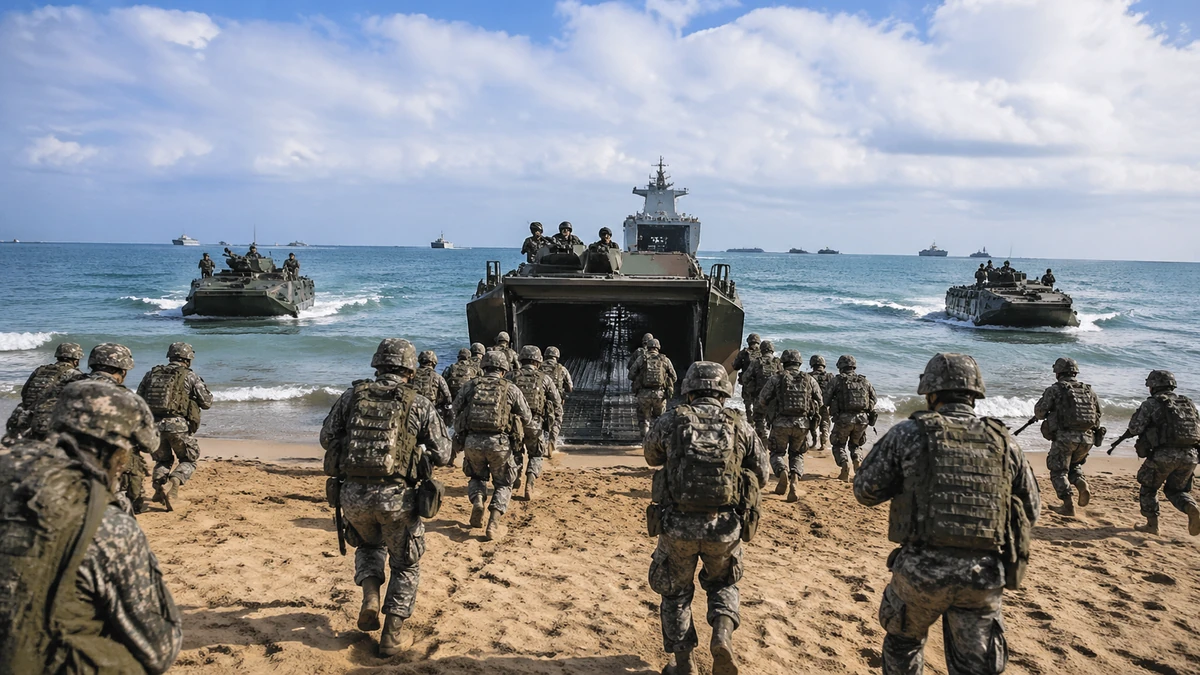
On a stretch of coastline near Pohang on South Korea’s east coast, the country’s navy and marine corps this week carried out the centerpiece of a large joint amphibious landing exercise, offering a rare public look at how Seoul prepares for one of the military’s most complex wartime missions. The maneuver, described by South Korean authorities as the exercise’s “decisive action,” unfolded as part of an eight-day training schedule running from June 23 to June 30 and featured the coordinated movement of ships, aircraft, helicopters, armored vehicles and ground troops.
For American readers, the easiest comparison may be the kind of high-visibility joint training the U.S. military conducts to prove that different branches can operate as a single system under pressure. Amphibious operations are not simply about putting troops ashore. They require forces at sea, in the air and on land to move in sequence, often within minutes of one another, while commanders maintain communications, timing and situational awareness. In that sense, what South Korea displayed near Pohang was less a one-off show of force than a stress test of military integration.
That matters because South Korea lives in a security environment unlike almost any other advanced democracy. The country is technically still at war with North Korea because the 1950-53 Korean War ended in an armistice, not a peace treaty. North Korea’s growing missile and nuclear programs have kept the Korean Peninsula under chronic military tension, while wider regional uncertainty — including sharpening rivalry among the United States, China and Russia, as well as military activity around the East Sea, which is also known internationally as the Sea of Japan — has made readiness an enduring national priority in Seoul.
South Korean officials did not frame the drill as a response to a single crisis or a direct warning to a particular country. But military exercises often serve more than one purpose at once. They train forces internally, reassure the public domestically and communicate credibility externally. By opening part of this drill to public view, South Korea appeared to be doing all three: demonstrating competence to its own citizens, signaling preparedness to allies and showing potential adversaries that its forces are practicing for the hardest kind of combined operation, not just the easiest.
That is also why the location and scale of the event drew attention. Pohang is not just a beach town. It is a major industrial and military hub with longstanding significance for South Korea’s armed forces. A large-scale landing exercise there carries practical value, but it also carries symbolism: this is a country practicing not in abstraction, but on a real coastline tied to its defense planning, its economy and its view of national resilience.
What the military means by “decisive action”
The phrase “decisive action” can sound theatrical in English, especially to readers used to Pentagon jargon or dramatic scenes from war movies. In the South Korean military context, though, it refers to a specific operational phase rather than a slogan. According to the material released around the exercise, it is the point at which marine landing forces, supported by naval gunfire and air power, secure a beachhead and prepare to transition to operations inland.
That transition is the heart of the challenge. A landing operation does not end when troops hit the shore. In many ways, that is when the most fragile phase begins. Forces that arrive by sea have to survive the exposed approach, coordinate with ships and aircraft, secure enough terrain to bring in additional personnel and equipment, and then convert a seaborne assault into sustained ground action. Every link in that chain depends on timing and teamwork. If one part breaks down — air cover, ship-to-shore movement, communications, logistics or command handoffs — the entire operation becomes vulnerable.
Military planners in the United States have long treated amphibious warfare as among the most demanding missions any force can attempt. South Korea appears to be making the same point through practice rather than rhetoric. The purpose of the Pohang drill was not simply to move large numbers of troops for the cameras. It was to rehearse the full sequence: planning the operation, loading equipment and personnel, conducting procedural checks, moving to the objective area, carrying out sea and air assault elements, and preparing for follow-on land operations.
That holistic structure is significant. Modern militaries are often judged by the sophistication of individual weapons systems — the range of a missile, the capabilities of a fighter jet, the survivability of a warship. But in a real crisis, success depends just as much on whether those systems and the people operating them can be synchronized under uncertain conditions. South Korea’s exercise, at least as publicly described, was built around that idea. It tested not one platform, but a web of platforms and commands that have to function as one.
There is also a political layer to the language. In South Korea, as in the United States, military briefings often use carefully calibrated phrasing designed to inform without inflaming. “Decisive action” is a technical term, but it also projects control, preparedness and discipline. It suggests a military that is not improvising in a crisis but moving through rehearsed stages with defined responsibilities. For a country that faces frequent security shocks, that image can be as important as the mechanics of the drill itself.
The hardware on display points to a bigger shift
The exercise involved more than 20 vessels, including the Marado, a large amphibious ship that serves as one of the Republic of Korea Navy’s most prominent platforms for transporting forces and equipment. South Korean authorities also said the drill included Korean amphibious assault vehicles, amphibious maneuver helicopters, maritime patrol aircraft, Air Force fighter jets, attack helicopters and drones operated by the military’s drone command. The list underscores how much modern amphibious warfare has evolved beyond the classic image of landing craft heading toward the beach.
To American readers, one notable detail is the mix of manned and unmanned systems. That combination reflects a broader global military trend. Drones are increasingly used not only for strike missions but also for surveillance, reconnaissance, communications support and battlefield awareness. South Korea did not publicly spell out the drones’ exact role in the Pohang exercise, so any claim beyond that would go too far. Still, their inclusion is revealing. It suggests that Seoul sees future operations as information-heavy environments where seeing first, understanding faster and sharing data quickly may be just as important as moving troops physically.
The drill also highlighted an important truth about contemporary defense planning: capability now lies in integration. A fighter jet alone does not secure a landing. A ship alone does not guarantee a beachhead. An armored vehicle alone does not sustain inland momentum. The advantage comes from linking those assets into a sequence — surveillance, fire support, movement, insertion, beach seizure and expansion ashore. South Korea’s publicly released details suggest that this is exactly the kind of operational fusion it wanted to test.
That approach aligns with how many U.S. and allied militaries now think about deterrence. In the past, military messaging often emphasized sheer quantity: more troops, more tanks, more ships. Today the more meaningful question is often whether a force can combine sensors, shooters, mobility and command systems quickly enough to matter in the opening hours of a conflict. The Pohang exercise appears designed to address that question. It is a reminder that readiness is not merely about procurement; it is about repeated, coordinated use.
South Korea has spent years investing in indigenous defense technology while also deepening interoperability with the United States and other partners. That does not mean every exercise is directly linked to a specific alliance scenario, and officials did not present this one that way. But it does mean these drills are watched closely outside Korea. They offer clues about how the country is adapting to a military era shaped by precision weapons, unmanned systems and compressed decision timelines.
Why Pohang matters beyond the exercise itself
Geography is never just geography on the Korean Peninsula. Pohang, in North Gyeongsang province, sits on the east coast and is known both as an industrial center and as an area with longstanding military importance. For South Koreans, the city is associated with heavy industry, maritime access and the physical infrastructure that underpins both economic strength and defense capacity. Holding a major amphibious drill there makes operational sense, but it also gives the exercise a layer of public meaning.
In the American context, it would be somewhat like staging a large, public military exercise near a coastal city that combines industrial significance, transportation relevance and strategic military value. The message is not only that the military can operate there, but that national defense is tied to the protection of key economic and civic spaces. South Korea’s security planning has always had this dual character: it is about defending territory, of course, but also about safeguarding the concentrated infrastructure that powers one of the world’s largest export-driven economies.
The east coast setting adds another dimension. While South Korea’s security focus in American media often gets reduced to the Demilitarized Zone separating North and South, the country’s actual defense posture is far more geographically complex. Its surrounding seas matter enormously for trade, logistics, surveillance and military maneuver. A large landing exercise on the east coast therefore says something about coastal defense and rapid force projection within the peninsula’s broader operating environment.
It is also important that the June 27 event was part of a longer, preplanned training cycle rather than a standalone spectacle. South Korean authorities described the entire exercise as running through multiple stages, from planning and embarkation to procedures, movement and assault. That continuity matters because it suggests the military is emphasizing process and repetition, not simply the most photogenic moment. In other words, the beach landing may be the part that attracts cameras, but the real test is whether the unseen pieces before and after it hold together.
For foreign audiences, that can be easy to miss. Public military imagery often invites dramatic interpretations. But the more substantive story here is bureaucratic and operational: can South Korea institutionalize readiness in a region where uncertainty is persistent but not always immediately visible? The Pohang exercise suggests that one answer from Seoul is yes — by building routines, testing branch-to-branch coordination and normalizing high-complexity training as a regular part of defense management rather than an exceptional event.
A signal to allies, adversaries and the public
Military drills are never only military drills. They are also statements, even when officials take care not to overstate them. South Korea’s public handling of the Pohang exercise appears calibrated to deliver a message without creating unnecessary alarm. The message is not that war is imminent. It is that the country intends to remain prepared, visibly and systematically, in a region where deterrence depends partly on being believed.
For the United States, South Korea’s preparedness has direct strategic relevance. The two countries are treaty allies, and U.S. forces remain stationed on the peninsula. American policymakers often talk about burden-sharing, alliance credibility and the importance of capable partners in the Indo-Pacific. Exercises like this one feed into all three conversations. A South Korean military that can conduct complex joint operations strengthens the alliance by increasing both practical capability and political confidence.
At home, the exercise serves a different but equally important function. South Korean politics can be deeply polarized, much like politics in the United States, but national security occupies a distinct place in public life because of the enduring North Korean threat. Publicly showcasing readiness allows the government and military to reassure citizens that defense policy is not only being debated in Seoul’s political circles but also translated into repeatable action in the field.
For potential adversaries, the signal is subtler. South Korea did not identify a specific target or threat in describing the exercise, and responsible reporting should not assign one without evidence. Still, the underlying point is clear enough. A military that regularly trains for difficult, integrated operations is harder to surprise and harder to intimidate. In deterrence terms, that matters. Preparedness does not eliminate risk, but it can alter an opponent’s calculation by increasing doubt about whether coercion would work.
There is a diplomatic logic here as well. Countries often manage tension through language, issuing warnings, red lines and condemnations. South Korea, in this case, seems to be leaning on demonstration instead. The drill communicates that the country is serious about defense, but it does so through procedure rather than bombast. That can be especially valuable in Northeast Asia, where signaling has to be strong enough to reassure and deter, yet measured enough to avoid feeding a spiral of escalation.
The defense industry angle, and what comes next
Although the Pohang exercise was not presented as an industry event, it naturally intersects with a broader story about South Korea’s defense ecosystem. The platforms involved — amphibious vehicles, helicopters, patrol aircraft, fighters and drones — are not meaningful only because they exist on paper or in procurement plans. Their real value is established in operation, maintenance and repeated integration. Exercises like this one are where hardware becomes capability.
That is an increasingly important point as South Korea gains visibility as a defense producer. In recent years, the country has drawn attention for exporting military equipment and for promoting a domestic defense industry that can support both national security and economic growth. Training and industry are not the same thing, and it would be overstating the case to merge them into one storyline. But they do reinforce each other. A military that trains intensively creates demand for reliability, logistics and technical refinement; a defense sector that matures can, in turn, sustain more sophisticated operations.
Another recent development in South Korea’s policy landscape reflects this broader push: local governments and national agencies have been backing defense-related startup and technology initiatives in an effort to cultivate what is often called the “K-defense” sector, borrowing from the familiar “K” branding Americans may know from K-pop, K-dramas and Korean beauty products. In this context, the “K” label refers to South Korean-origin industries with global ambitions. While pop culture and defense obviously occupy very different moral and political terrain, the underlying national strategy — pairing domestic innovation with international relevance — is recognizable across sectors.
What comes next in Pohang is likely less dramatic than the images of troops and vehicles moving ashore. If the exercise continues through June 30 as scheduled, the remaining value will be in refinement: whether planners identified weaknesses, whether timing improved across units, whether communications and logistics held up, and whether the military can translate lessons from this cycle into the next one. Those details are rarely as visible to the public, but they are usually where the true measure of readiness lies.
For American and other English-speaking readers, the takeaway is straightforward. South Korea’s latest amphibious exercise is not just a local military event. It is a window into how one of America’s most important Asian allies manages life in a permanently tense neighborhood. The country is signaling that readiness is not a slogan, that joint operations are not improvised, and that in a region defined by uncertainty, credibility comes from the disciplined ability to connect sea, air and land power into a coherent response. In an era when deterrence can hinge on whether a military is believed to be prepared before a crisis starts, that may be the most important message of all.
Comments
Post a Comment