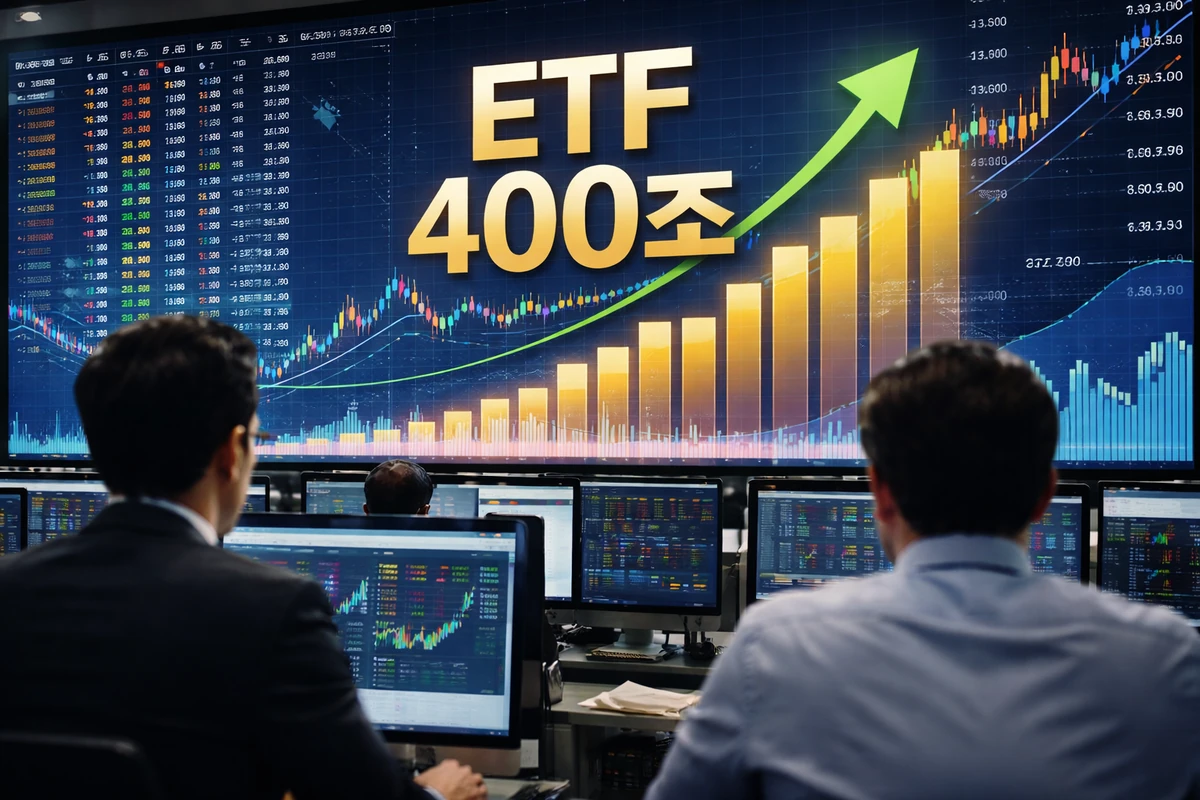
A $400 billion milestone that means more than a market record
South Korea’s exchange-traded fund market has crossed a threshold that, on paper, looks like a simple big-number milestone. In practice, it marks something much bigger: a rapid change in how one of Asia’s most retail-driven stock markets is channeling money, setting prices and shaping investor behavior.
On April 15, the total market capitalization of ETFs listed in South Korea rose above 400 trillion won for the first time, according to figures from the Korea Exchange and related market data providers. By the close, the combined value of the country’s roughly 1,000 listed ETFs stood at about 404.2 trillion won, or roughly $290 billion to $300 billion depending on the exchange rate. The benchmark Kospi closed at 6,091.39, while the tech-heavy Kosdaq ended at 1,152.43, underscoring that the milestone came during a broader market upswing.
But the headline number alone does not fully capture why market participants in Seoul see this as an inflection point. South Korea’s ETF market had only crossed 300 trillion won on Jan. 5. In roughly 100 days, it added nearly another 100 trillion won in value. Some of that jump came from higher stock prices lifting the value of existing funds. Yet the speed of the increase also points to something structural: investors are moving money into ETFs at a pace that suggests the product has evolved from a convenient side option into a central building block of Korean portfolios.
For American readers, the easiest comparison may be the way index funds and ETFs gradually reshaped the U.S. investing landscape over the past two decades, changing not just where people put their retirement savings but how markets themselves function. South Korea is not simply replaying the U.S. story on a smaller scale. It is doing so in a market with a particularly active base of individual investors, a strong appetite for tactical trading, and a financial culture in which everyday people have become unusually engaged with equities, often discussing them as closely as Americans might talk about mortgage rates, college funds or the latest moves in the S&P 500.
That is why the 400 trillion won marker matters. It is not only a sign of market growth. It is evidence that South Korea’s capital markets are shifting from a stock-picking culture toward a basket-buying culture, where investors increasingly choose themes, sectors, dividend strategies, bond maturities and currency hedges rather than individual companies.
Why the surge cannot be explained by a rising market alone
The most obvious explanation for the ETF boom is the simplest one: South Korean stocks have been rising. Because many ETFs track stock indexes or broad baskets of shares, their net asset values rise automatically when the market rallies. That dynamic helps explain why the ETF market’s overall value expanded so quickly as the Kospi recovered above 6,000 and the Kosdaq also posted strong gains.
Still, a bull market alone does not explain why ETF assets have grown this fast. ETFs have become attractive in South Korea for many of the same reasons they did in the United States: they offer diversification, lower information costs and a relatively easy way to express an investment view. But in South Korea, those advantages may be even more powerful because retail investors historically have played an outsized role in the stock market and have often traded individual names aggressively.
In practical terms, an ETF allows an investor to buy exposure to a semiconductor supply chain, a group of high-dividend blue chips, short-term government bonds, U.S. technology stocks or a currency-hedged overseas strategy without having to build that basket stock by stock. For investors exhausted by earnings surprises, corporate governance concerns or day-to-day volatility in individual shares, that simplicity has become a major selling point.
Just as important, the Korean asset management industry has broadened the menu. What was once a market dominated by plain-vanilla products tied to major indexes such as the Kospi 200 has expanded into thematic ETFs, dividend products, fixed-income ETFs, overseas-investment funds and actively managed ETFs. In other words, ETFs in South Korea are no longer just a passive way to “buy the market.” They have become a flexible wrapper through which investors can choose risk, geography, duration, yield, sector focus and even whether to hedge foreign-exchange exposure.
That is a critical shift. When investors begin using ETFs not as an accessory but as the default unit of portfolio construction, market growth can accelerate quickly. The recent leap in assets suggests that may be exactly what is happening.
What this says about Korean retail investors
To understand why ETFs are becoming so important in South Korea, it helps to understand the country’s investing culture. South Korea has one of the world’s most active retail investor communities, with individual investors long known for their enthusiasm, speed and willingness to jump into market narratives. In recent years, local media and brokerage firms have popularized the phrase “Donghak ants,” a term that emerged during the pandemic-era surge in retail participation. The phrase roughly refers to small individual investors banding together in the market, much as Americans might remember the rise of meme-stock traders on Reddit, though the Korean context is broader and more mainstream.
That culture helped make direct stock ownership a major part of personal finance discussions in South Korea. But it also created fatigue. Picking individual stocks requires constant monitoring of company disclosures, industry cycles, management decisions and often sharp swings tied to headlines. For many investors, ETFs offer a psychological advantage in addition to a financial one: they reduce the need to make repeated all-or-nothing calls on a single company.
Instead of asking, “Which stock should I buy?” investors can ask, “Which trend do I want exposure to?” That may sound like a small difference, but it changes the way people participate in the market. It moves the decision from company-level prediction to broader asset allocation. In a country where retail trading has often been highly concentrated in a relatively small set of popular names, that shift could have lasting effects.
The appeal is also easy to understand through an American lens. For U.S. investors, buying an S&P 500 ETF or a total bond market fund has become almost routine, especially in retirement accounts. South Korea is not yet identical in its long-term savings culture, but the logic is familiar: diversified exposure can lower the burden of constant research and soften the blow of idiosyncratic corporate shocks.
That does not mean ETFs are a cure-all. Diversification can reduce the chance of outsized losses tied to a single stock, but it also reduces the chance of spectacular outperformance. A thematic ETF may sound broad while actually holding a relatively narrow group of companies. Leveraged and inverse products can behave in ways that confuse less experienced investors and can be especially hazardous for long-term holding. Yet on balance, the rise of ETFs suggests Korean retail investors are moving, at least in part, toward a more systematic style of investing.
From a stock market to a basket market
The deeper consequence of ETF growth is not just that more money is flowing into funds. It is that the mechanism of price formation in the broader stock market can begin to change.
Traditionally, stock markets are imagined as places where individual companies rise or fall mainly on their own merits: earnings reports, management quality, product launches, regulatory changes and competitive pressures. Those factors still matter. But when ETF ownership becomes large enough, money often moves at the level of the basket before it moves at the level of the company.
That means when investors pour money into a semiconductor ETF, every major stock inside that basket can benefit at once, regardless of whether each company’s fundamentals changed that day. The reverse is also true: outflows from a sector ETF can pressure constituent companies even if one or more of them posted solid results. For smaller companies or less fashionable industries, the rise of ETF-driven flows can be a mixed blessing. Broad market access may improve, but attention and liquidity can concentrate disproportionately in the names that are most heavily represented in popular indexes and themes.
This is not a uniquely Korean phenomenon. U.S. markets have wrestled with similar questions for years as passive investing expanded. Critics have warned that too much index-based buying can weaken price discovery, the process by which individual stock prices reflect company-specific information. Supporters counter that ETFs improve liquidity, reduce costs and democratize market access. Both arguments can be true at once.
In South Korea, the issue may be more acute because the market is smaller and often more concentrated than the United States. A heavy shift toward basket trading could amplify the importance of index inclusion, theme membership and fund flows in driving short-term stock performance. A company may increasingly be judged not just by what it does, but by whether it belongs to the right index or the right narrative.
That creates a new kind of market logic: one where the composition of the basket matters almost as much as the contents of the company. For investors, regulators and listed firms, that is a structural change, not a passing trend.
The asset managers’ opportunity, and pressure
For South Korea’s asset management industry, the ETF boom is both an enormous opportunity and a stress test. Rapid growth gives firms a reason to launch more products and chase new investor demand. It also forces them into tougher competition on cost, liquidity and credibility.
In the early years of ETF markets almost anywhere, scale itself can look like success. More listings, more marketing and more assets under management create the appearance of momentum. But mature ETF markets tend to punish weak execution. Investors compare fees closely. They care about trading spreads. They watch tracking error, or how closely a fund actually follows the index or strategy it promises to follow. And they increasingly distinguish between products that are easy to buy and those that are genuinely useful to hold.
That is where South Korea’s next phase may become more demanding. Listing an ETF is only the beginning. The fund still needs reliable market making, careful rebalancing, transparent communication, efficient hedging when relevant and enough secondary-market liquidity to function smoothly. In a crowded market, the winners may not be the firms that launch the most products, but the ones that keep products alive, active and trusted over time.
There is also a quality problem that comes with rapid innovation. As thematic funds multiply, some begin to look similar, differentiated more by branding than by substance. U.S. investors have seen versions of this before, from niche “future of” funds to trend-chasing strategies that briefly attract headlines and then fade. South Korea now faces a similar question: can issuers clearly explain not just what is inside a product, but why that strategy deserves a place in an investor’s portfolio right now?
That matters because failed products can disappear quickly in a crowded field. As the market grows, closures and consolidations may become more common. Bigger assets do not eliminate risk for fund issuers; they can actually increase the need for discipline.
Pensions and long-term money could shape the next chapter
If the first leg of South Korea’s ETF expansion was fueled heavily by individual investors and favorable markets, the next stage may depend on longer-term institutional money. That includes pensions, advisory accounts and other large pools of capital that care deeply about diversification, cost and ease of portfolio adjustment.
For those investors, ETFs have obvious advantages. They are generally transparent, relatively easy to trade and efficient for implementing broad strategic views. A pension manager can use ETFs to adjust domestic and foreign equity exposure, tilt toward income strategies, manage bond duration or rebalance across asset classes without rebuilding positions security by security. In that sense, ETFs are not just investment products; they are portfolio-management tools.
The greater role of pensions would matter for another reason: it could make the market more stable. Retail investors often chase momentum more aggressively, while long-term institutions are more likely to use ETFs as part of a rules-based asset allocation process. If more pension and institutional money moves into ETFs, South Korea’s ETF market may become less about short-lived fads and more about steady, strategic flows.
But that shift would also raise the stakes for investor education and oversight. The word “ETF” can sound simple, especially to newcomers, but the risks vary dramatically depending on the product. An ETF tracking short-term government bonds is not the same as a leveraged semiconductor fund. A synthetic ETF that uses swaps is not the same as one that physically holds underlying securities. A currency-hedged overseas fund can behave very differently from an unhedged one, even if both are marketed as exposure to the same foreign market.
As long-term money plays a larger role, those distinctions become more important, not less. The real policy challenge after 400 trillion won may not be how to make the market bigger. It may be how to make sure investors, from first-time savers to pension decision-makers, understand what they are buying.
The bigger question after 400 trillion won: growth, but of what kind?
The symbolic force of South Korea’s ETF milestone lies in the fact that it captures multiple transitions at once. One is a transition in investor behavior, from stock selection to strategy selection. Another is a transition in market structure, from security-specific flows to basket-driven flows. And a third is a transition in financial culture, as products once seen as specialized or secondary become increasingly mainstream.
That is why the 400 trillion won figure is best understood not as an ending, but as the start of a more complicated debate. Rapid growth can be healthy if it broadens access, lowers costs and encourages more disciplined investing. It can be less healthy if it channels money mechanically into crowded themes, obscures risk under familiar labels or makes markets more sensitive to index and narrative effects than to corporate fundamentals.
South Korea now appears to be entering that debate in earnest. The country’s ETF market has reached a size where questions of quality matter as much as questions of scale. Are investors using these products to build resilient, diversified portfolios, or to chase ever more narrowly packaged trends? Are asset managers competing on thoughtful design and execution, or simply multiplying product names? Does the expansion of ETFs improve market efficiency, or does it create new forms of concentration and distortion?
These are not abstract concerns. They will shape how capital is allocated across industries, how companies experience market volatility and how ordinary Koreans build wealth over time. They will also matter beyond South Korea. The country has often served as a closely watched laboratory for retail trading behavior, technology adoption and financial-product innovation in Asia. What happens in its ETF market could offer clues for other countries where individual investors are becoming more powerful and where simple, exchange-traded products are taking over functions once handled by brokers, mutual funds or direct stock picking.
For now, the clearest takeaway is that South Korea’s ETF market is no longer just getting bigger. It is becoming systemically important. The 400 trillion won milestone is a reminder that markets can change not only through spectacular crashes or major policy shocks, but also through quieter revolutions in habit. One day, investors are buying stocks one by one. A few years later, they are buying the basket instead. And once that shift reaches critical mass, the market on the other side can look very different from the one they started with.
That is the real story behind South Korea’s ETF boom. The number is large. The transformation underneath it may be larger still.
Comments
Post a Comment