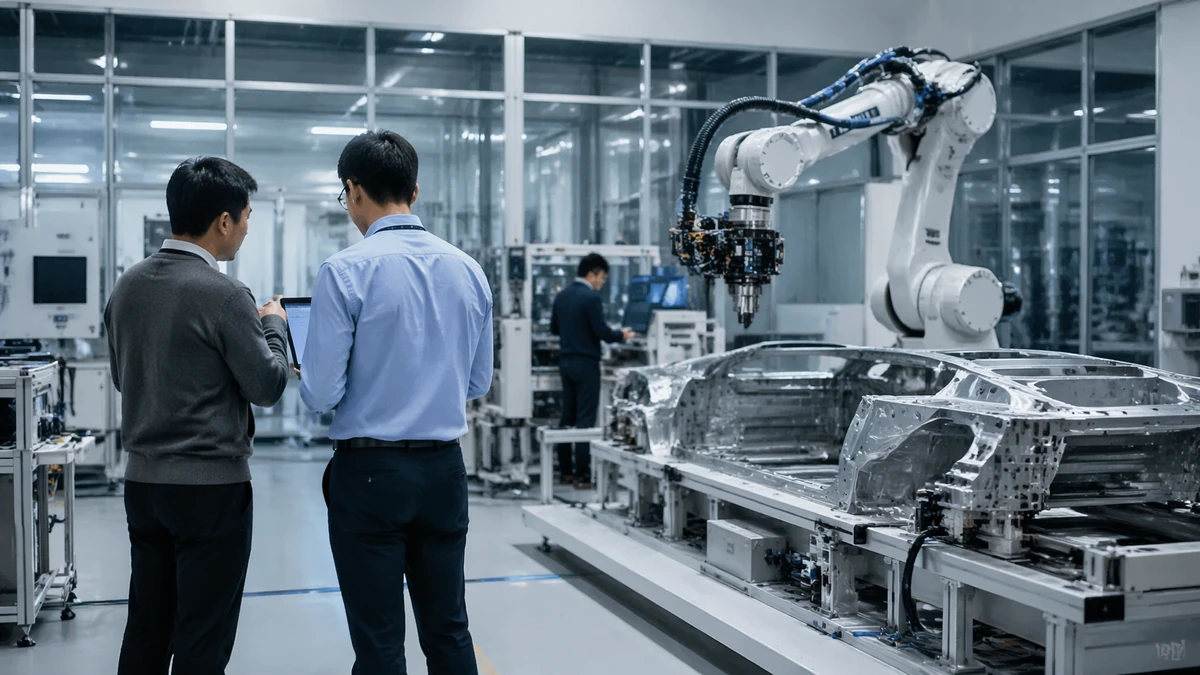
A different kind of star is emerging on South Korea’s tech stage
For years, South Korea’s biggest technology showcases have worked a bit like an auto show in Detroit once did: They were places to unveil what might be next. Visitors saw polished demonstrations, futuristic concepts and sweeping declarations about artificial intelligence, next-generation chips and smart mobility. But a new signal is coming out of South Korea’s IT sector in 2026, and it is less about spectacle than sales.
The shift is visible not only in government announcements but in the physical layout and mood of the exhibition floor itself. At industry events this year, including World IT Show 2026, known locally as WIS, the attention is increasingly moving toward small and midsize companies and startups that can do more than impress a crowd. The question now is whether they can ship products, win procurement deals, land overseas customers and keep those systems running in the real world.
That may sound like an ordinary business evolution, but in South Korea it carries wider importance. The country has long been recognized as a technological heavyweight, home to global giants in semiconductors, smartphones and displays. Yet for all the country’s engineering prowess, critics have often pointed to a familiar gap: Korean tech can look world-class in the demo hall without necessarily translating into lasting export contracts or broad international market share, especially in software, industrial platforms and integrated IT services.
Now the South Korean government appears to be signaling that it wants to narrow that gap. On the same day that officials emphasized export support for innovative small businesses and startups, 10 ICT companies in sectors including AI, semiconductors, robotics and mobility were recognized with high-level awards. At WIS 2026, domestic firms put forward technologies aimed squarely at industrial use, not just future-oriented branding. Taken together, those moves suggest the country is changing what it values. Instead of rewarding technology mainly for being novel, it is increasingly rewarding technology for being deployable, exportable and scalable.
That is a subtle but important change in a country where industrial policy still matters and where government signals often help set the tone for investors, conglomerates and regional business ecosystems. In plain terms, South Korea is telling its tech sector that the era of admiration alone is not enough. The new benchmark is whether a product can survive outside the lab and outside the exhibition hall.
Why export support matters so much now
The focus on overseas sales, especially for smaller ICT firms, reflects a hard-nosed reading of South Korea’s economy. The country remains heavily reliant on a few export champions, particularly in hardware. Companies tied to semiconductors, consumer electronics and components have proved they can compete globally. But outside those headline sectors, many Korean software companies, AI startups and industrial solution providers remain far more fragile than the country’s innovation image suggests.
That weakness becomes especially clear in fields such as AI, robotics and mobility, where adoption in real operating environments matters more than buzz. A startup making industrial vision software for factory defect detection, for example, does not build credibility simply by showing accurate results on a trade-show screen. It has to prove that its product can plug into a factory in Texas, Vietnam or Germany; comply with local security and certification rules; work with local hardware; and continue performing after installation. That proof, more than a polished presentation, is what drives enterprise value and future investment.
For Korean firms, export support therefore means far more than subsidized marketing. It can include help navigating standards, security requirements, certifications, local partnerships, after-sales service expectations and procurement channels. Those may sound like routine commercial details, but they are often what separates a technically impressive company from a commercially durable one.
American readers may recognize the same dynamic from U.S. industrial policy debates. In Washington, officials increasingly talk not just about inventing the next breakthrough but about building supply chains, domestic manufacturing capacity and the infrastructure needed to scale. South Korea is undergoing a related recalibration. The issue is no longer simply how many startups are founded, but how many can grow beyond the startup stage and become globally trusted vendors.
That matters because South Korea’s next phase of tech competitiveness cannot rely only on a handful of national champions. If the country wants to deepen its position in strategic sectors such as AI, chips, robotics and advanced mobility, it needs a thicker ecosystem underneath the household names. Smaller firms often supply the specialized software, sensors, control systems, edge computing designs, cybersecurity tools and maintenance platforms that make larger systems actually work. Without them, the industrial base remains top-heavy.
In that sense, the government’s emphasis on helping smaller ICT companies find overseas buyers is not a side project. It is a recognition that in today’s tech economy, resilience comes from layers of capable suppliers and service providers, not just a few towering brands.
The meaning behind the awards for 10 smaller companies
In many countries, government-backed innovation awards can be easy to dismiss as ceremonial. But in South Korea, the categories chosen and the types of companies honored often offer a window into the state’s industrial priorities. That is why the recognition of 10 ICT small and midsize companies in AI, semiconductors, robotics and mobility is worth closer attention.
Those four sectors are not random. They reflect a view of the future in which digital intelligence, physical computing power and real-world machines are tightly linked. AI acts as the decision-making layer. Semiconductors provide the computational and sensing foundation. Robotics and mobility are where those capabilities move from code into the physical world, whether on a factory floor, in a warehouse, on public infrastructure or inside autonomous systems.
The fact that smaller ICT firms, rather than only subsidiaries of South Korea’s giant conglomerates, were the focus matters even more. South Korea’s economy is famous for its chaebol, or family-controlled conglomerates such as Samsung, Hyundai and LG. For decades, those firms dominated the country’s industrial story. But the AI era is highlighting the strategic importance of more agile, specialized companies that can move quickly in niches large corporations do not always handle well.
That includes everything from lightweight algorithms and industrial control software to monitoring platforms, security modules, machine-vision tools and edge-chip design. In the AI economy, competitiveness does not come from one big model alone. It comes from the ability to integrate many tools into stable systems that solve specific problems. Smaller firms are often the ones stitching those layers together.
The awards also point to a changing standard for what counts as technological achievement. In earlier eras, recognition in South Korea often emphasized originality in research and development or the symbolism of producing domestic technology instead of relying on imports. Those factors still matter. But today the weight is shifting toward practical impact: Can this technology be adopted by industry? Can it scale? Can it compete internationally?
That may sound less romantic than celebrating the next moonshot, but it reflects the realities of a maturing tech market. In sectors like AI and robotics, customers are no longer buying concepts. They are buying uptime, energy efficiency, support, safety and compatibility. A company that can deliver those things consistently may do more for national competitiveness than one with the flashiest prototype.
World IT Show 2026 and the end of the demo-first era
The slogan associated with this year’s World IT Show, “AI, moving reality,” captures the new mood. South Korea’s tech exhibitions are no longer just stages for explaining the future. They are increasingly places where investors, public-sector buyers and international partners ask a more immediate question: What can be installed now?
That change in the audience’s priorities changes the kinds of companies that stand out. A firm selling a broad vision of AI transformation may still draw attention, but a company showing how its system reduces defects on a manufacturing line, automates warehouse sorting or manages fleets of industrial robots is more likely to leave with actionable interest. The center of gravity shifts from concept to implementation.
This is happening in part because generative AI, however remarkable, is no longer novel enough on its own. Around the world, the “wow factor” has faded. What businesses now want to know is how cheaply, safely and reliably AI can be deployed in their own operating environments. That is true in the United States, where companies are moving from chatbot experiments to questions about workflow integration and liability. It is also true in South Korea, where manufacturing strength gives industrial applications particular urgency.
So the technologies drawing attention in Seoul today are not just consumer-facing tools. They are systems for defect detection in factories, automation in logistics, control systems for mobile machines, collaborative industrial robotics and smart-factory analytics. These are the less glamorous but economically consequential applications that determine whether AI becomes part of the operating backbone of industry or remains mainly a presentation slide.
That raises a larger strategic question for South Korea. Will it become known as one of the fastest markets to introduce advanced technologies, or one of the fastest to make them stick on the ground? Those are not the same thing. The first is driven by launches and headlines. The second depends on operations, service, reliability and long-term support.
For a country that prides itself on speed and early adoption, that distinction is significant. South Korea has often excelled at being first or near-first in connectivity, electronics and consumer tech diffusion. But industrial embedding is a different challenge. It requires attention to issues that are less flashy but more decisive over time: system stability, cybersecurity, energy use, customer support and labor capacity. In that respect, the message coming from WIS 2026 aligns closely with the government’s policy tone. South Korea is trying to move from describing the future to operationalizing it.
The real bottlenecks: power, security and talent
One of the clearest signs of that change came from government messaging around AI strategy. Officials have stressed the need to mobilize power, security and talent to accelerate an AI-centered national strategy. That phrasing matters because it implicitly acknowledges a reality that many tech ecosystems eventually face: The main constraints are no longer the elegance of the algorithm alone.
As technology markets mature, bottlenecks shift. At first, the challenge is invention. Later, it becomes capacity. Can the infrastructure absorb demand? Can organizations operate systems safely? Are there enough people with the right skills to deploy and maintain them? South Korea appears to be entering that phase in earnest.
Power is perhaps the least glamorous but one of the most important issues. In the public imagination, AI power consumption is often associated with huge data centers in the United States. But the problem is broader. As AI inference and data processing spread into factories, logistics networks, communications systems and edge devices, energy costs become a frontline business issue for midsize and smaller firms too. Electricity is no longer just a utility expense. It is a factor that can determine whether an AI deployment is economically sustainable.
Security is even more immediate when AI is connected to robotics and mobility systems. A breach in a consumer app can expose data. A breach in industrial control or autonomous equipment can create physical risk. That changes the stakes dramatically. For South Korea, a country with advanced manufacturing and dense urban infrastructure, secure deployment is not a side concern. It is part of whether these technologies can be trusted at all.
Then there is talent. The public conversation around AI often centers on model engineers and computer scientists, but industrial AI requires a much wider workforce. It needs data engineers, embedded systems developers, cybersecurity specialists, integrators, field operators and maintenance teams. In American terms, it is closer to the workforce challenge behind advanced manufacturing than the stereotype of a handful of coders in hoodies. South Korea’s mention of talent alongside power and security suggests the government understands that reality.
This is another point with echoes in the United States. From semiconductor fabs supported by the CHIPS Act to electric vehicle plants and data centers, American policymakers have discovered that strategic industries rise or fall not just on innovation but on grid capacity, permitting, cybersecurity and labor pipelines. South Korea is now making a similar calculation in the AI era. That is a sign of a sector growing up.
Why this shift matters beyond South Korea
For outsiders, this might look like a domestic bureaucratic adjustment. In fact, it has broader implications for global tech competition. South Korea is one of the world’s most technologically sophisticated economies, and when it changes its internal benchmarks, that can affect supply chains, partnerships and competitive norms well beyond its borders.
If Korean policymakers and industry leaders place more value on exportable and field-tested technology, American companies may increasingly encounter Korean firms not just as component suppliers or hardware makers, but as competitors in industrial software, robotics integration, AI-enabled monitoring systems and sector-specific solutions. These are areas where the market is fragmented enough for nimble firms to gain ground, especially if they can leverage South Korea’s strength in manufacturing environments as a testing ground.
There is also a geopolitical angle. Governments around the world are racing to secure positions in strategic technologies, but the conversation often overemphasizes frontier breakthroughs while underestimating commercialization. In reality, countries win influence not only by inventing important technologies but by making them usable, affordable and widely adopted. Export-ready systems can shape standards, vendor relationships and long-term dependencies.
South Korea’s renewed focus on smaller ICT firms is therefore about more than helping startups survive. It is about deciding what kind of tech power the country wants to be. A nation that can consistently produce trusted industrial solutions across AI, semiconductors, robotics and mobility will have a different kind of leverage than one known mainly for dazzling launches.
That is especially relevant at a moment when the global economy is becoming more skeptical of hype. Investors are asking tougher questions. Enterprise buyers are demanding clearer returns. Governments want technologies that support strategic resilience, not just social media excitement. South Korea’s message to its IT sector seems tailored to that climate: Show what works, show what sells and show what scales.
From promotion to proof
The larger story here is not that South Korea is abandoning innovation or losing its taste for ambition. It is that the country appears to be redefining what successful innovation looks like. In this new framework, the most important technology may not be the one that generates the biggest headline. It may be the one that wins a contract, clears certification, survives installation, keeps running and earns repeat business abroad.
That is a more demanding standard, but it may also be a healthier one for an economy looking to build durable growth. South Korea has spent years proving it can create cutting-edge technology. The harder challenge is proving that more of its companies can convert that capability into globally embedded business.
The signs from 2026 suggest policymakers know that. The alignment of export support, targeted awards and exhibition themes is not accidental. It reflects an attempt to push the industry from promotion to proof, from possibility to implementation.
For American readers used to hearing about South Korea through the lens of consumer brands, K-pop or headline-grabbing chip battles, this evolution may seem technical. But it is worth watching closely. The same country that turned cultural exports into a global force is now trying to make a similar leap in industrial technology, not by shouting louder about the future, but by making sure its companies can sell into it.
In the end, the changing face of South Korea’s tech exhibitions may tell the story best. The stars of the show are no longer only the companies with the grandest demos. Increasingly, they are the ones with products ready to leave the showroom floor and enter the world.
Comments
Post a Comment