South Korea’s World IT Show Has Become More Than a Trade Fair. It’s a Window Into How the Country Wants to Sell Its Tech Future.
From showroom spectacle to export engine
SEOUL — For years, South Korea’s biggest technology expos could be read the same way many Americans read the Consumer Electronics Show in Las Vegas: as a stage for shiny product reveals, corporate branding and a little national swagger about the future. But the message coming out of this year’s World IT Show in Seoul was more consequential than a parade of gadgets or concept demos.
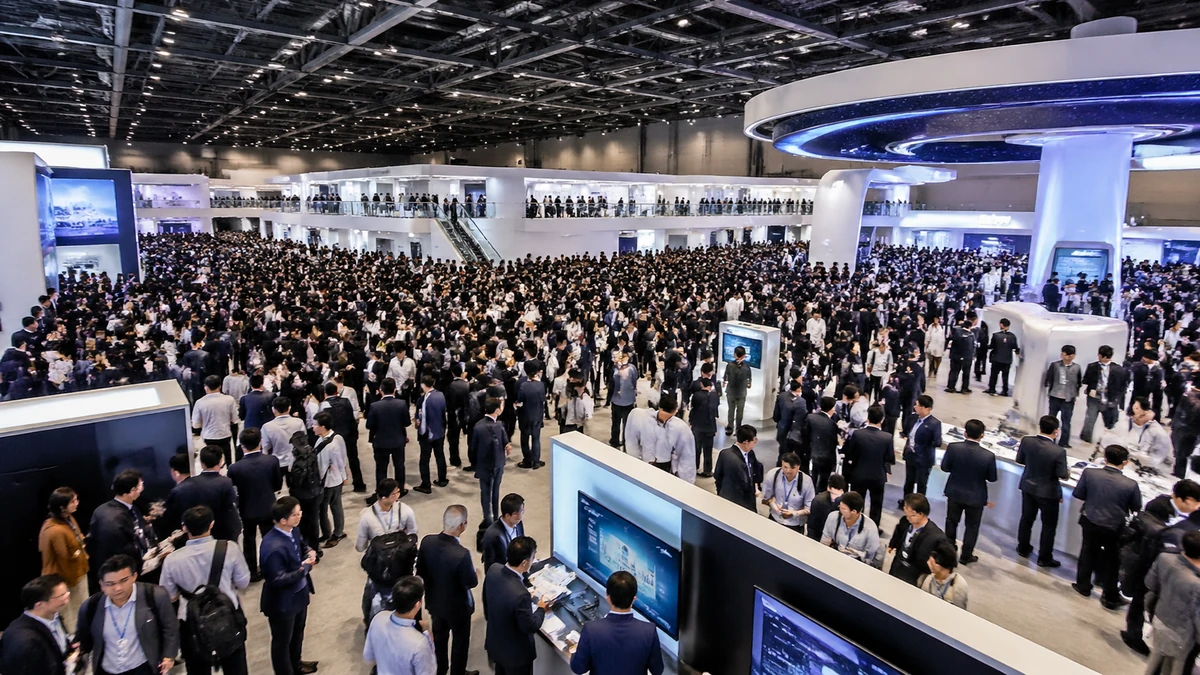
The 2026 event, which ended this week in the South Korean capital, drew about 68,000 visitors, its largest crowd since the COVID-19 pandemic, and organizers and local media described it as having produced the strongest export performance in the show’s history. That matters not simply because the turnout was large or the exhibition halls were busy. It matters because it suggests South Korea’s technology sector is changing what these events are for.
World IT Show is no longer functioning primarily as a domestic exhibition where Korean companies present themselves to one another, to local consumers or to government officials. It is increasingly being used as a market-opening platform — a place where companies court foreign buyers, test commercial demand, pitch investors, schedule distribution talks and try to turn prototypes into contracts.
That may sound like a subtle shift, but it says something larger about where South Korea sees its next phase of economic growth coming from. The country is already well known in the United States and Europe for its heavyweight global brands in semiconductors, smartphones, displays, home appliances and cars. Americans know Samsung, LG, Hyundai and Kia. They may know SK hynix because of the global chip race. What is less familiar to many outside Asia is the next layer down: the mid-sized firms, specialized software companies and startups trying to expand beyond Korea’s relatively small domestic market.
This year’s World IT Show offered a snapshot of that broader push. The headline was not just attendance. It was business intent. In economic reporting, phrases like “record export results” and “largest amount of export consultations” can sound dry, even bureaucratic. But in trade-show language, they point to a practical reality: companies were not just drawing crowds. They were trying to make sales abroad.
For a country whose prosperity has long depended on exports, that is an important distinction. It means the event is being treated less like a festival of innovation and more like a launchpad for globalization.
Why these numbers matter beyond the exhibition hall
Trade fairs rarely translate into next-day revenue. A buyer does not walk out of a convention center with an industrial AI system in a shopping bag. Deals in enterprise technology take time. They require certifications, pilot programs, integration testing, price negotiations, legal review, after-sales support and local partnerships. In many cases, they also require trust — the kind built not over email but in person, while standing in front of a working product.
That is why the strongest signal from World IT Show may not be the final dollar figure attached to consultations, memorandums of understanding or export leads. It is that the show is serving as the front end of a longer commercial pipeline. In other words, it is becoming a leading indicator.
For American readers, the parallel might be an aerospace supplier using the Paris Air Show not merely to show off engineering but to line up customers, or a medical-device startup using a major U.S. health conference to meet hospital systems, distributors and regulators all at once. The value lies in compressing an entire business-development process into a few days in one place.
South Korea’s tech sector has powerful reasons to lean into that model. The country has world-class engineering talent, a dense manufacturing ecosystem, advanced digital infrastructure and a highly connected consumer market that often acts as a real-world testing ground. But Korea also has limits. Its population is about 52 million, making it a sophisticated but finite home market. To scale, especially in business software, artificial intelligence and industrial solutions, Korean companies often need to move abroad sooner than their American counterparts.
That urgency is showing up in the design of events like World IT Show. The show floor is not just where companies seek publicity. It is where they seek proof that they can travel — culturally, commercially and technologically — into other markets. A startup that can demo a logistics AI platform in Seoul and secure serious interest from Southeast Asian, Middle Eastern, European or North American buyers has crossed an important threshold. It is no longer just a Korean startup. It is a company auditioning for the global supply chain.
The 68,000 visitors, then, represent more than recovered foot traffic after years of pandemic disruption. They suggest a revived ecosystem of buyers, investors, engineers, students, procurement teams and public officials willing to gather again in person because the stakes are real. That kind of density matters. In technology, deals are often born where multiple ecosystems overlap.
The rise of the ‘full-stack AI’ pitch
If there was one phrase that captured this year’s event, it was “full-stack AI.” That term can sound like buzzword fog, especially to audiences already saturated with artificial-intelligence marketing. But in this case, it points to a meaningful shift in how Korean companies are trying to compete.
At its most basic, “full-stack” means a company or ecosystem is not offering just one slice of the technology puzzle. It is trying to connect the layers: chips, cloud infrastructure, data processing, model deployment, security, industry-specific software and the end-use applications customers actually touch. In the early years of the AI boom, many companies could attract attention by claiming they had a model, a chatbot or a narrow feature. That is increasingly not enough.
Global customers now want to know whether an AI product can be integrated into existing systems, run at sustainable cost, comply with regulations, protect data, work reliably in industrial settings and deliver measurable business value. The market is moving from novelty to utility.
South Korea may be unusually well positioned for that transition. It is a manufacturing powerhouse, which means its companies tend to think not only in terms of software performance but in terms of deployment in real environments: factories, warehouses, hospitals, transit systems, stores and urban infrastructure. In other words, Korea’s strength has often been commercialization rather than abstract invention alone.
That matters because AI is becoming less about who can produce the flashiest demo and more about who can make the technology useful at scale. A vision model that improves factory inspection, a platform that optimizes port logistics, an AI assistant tailored for Korean and other Asian languages in enterprise settings, or a health-tech system that integrates devices, records and workflow software — those are the kinds of offerings that can move from booth demonstration to exportable business.
For years, South Korea’s innovation image abroad was closely tied to hardware. The country was the place that made the chips, screens, batteries and sleek consumer devices powering modern life. What the “full-stack AI” language suggests is that Korea is trying to move up the value chain in a different way: by packaging hardware knowledge, software capability and industry specialization into complete solutions.
That is a bigger strategic move than it may first appear. In technology, the highest margins and strongest customer lock-in often belong not to individual components but to ecosystems. If Korean firms can sell integrated AI products rather than isolated parts, they stand to capture more of the value created by the global AI build-out.
It also changes how foreign buyers perceive them. Instead of treating Korean companies mainly as reliable manufacturers or subcontractors, overseas customers may increasingly view them as partners capable of helping run critical systems. That kind of reputational upgrade can have long-term effects far beyond one trade show.
A broader Korean export story is taking shape
When Americans think about South Korean exports, the image is often concentrated in a handful of sectors: memory chips, EV batteries, vehicles, ships and consumer electronics. That perception is not wrong. Those industries remain central to the Korean economy and to global supply chains. But it can obscure how much Seoul wants to broaden the country’s export base.
That broader strategy has become more urgent as the global economy grows more unpredictable. Higher interest rates have made investors choosier. Supply chains have become geopolitical. U.S.-China tensions have forced companies across Asia to rethink manufacturing footprints, technology controls and market access. In such an environment, relying too heavily on a narrow group of corporate champions can create vulnerabilities, even for a country with South Korea’s industrial sophistication.
What World IT Show appears to show is an effort to widen the bench. Mid-sized companies, specialized business-to-business vendors and startups are being pulled more deliberately into the export narrative. This is not just about national pride or startup boosterism. It is about resilience.
An economy whose export story includes not only giant conglomerates — known in Korea as chaebol, the family-controlled business groups that have dominated the country’s industrial rise since the late 20th century — but also a deeper pool of agile tech firms is likely to be more adaptable. For foreign readers unfamiliar with Korean corporate structure, chaebol such as Samsung, Hyundai Motor Group and LG have long anchored the economy in a way that differs from the more fragmented corporate landscape in the United States. Their influence is immense, but so is the policy challenge of ensuring the next generation of growth does not remain overly concentrated.
That is where exhibitions like World IT Show become economically meaningful. They can act as bridges between startup innovation and export infrastructure. A smaller Korean company may have strong technology but weak international visibility. A large trade event can place that firm in front of buyers it could not easily reach on its own. It can also create a sense of collective national branding: Korea not only as the home of globally recognized electronics giants, but as a source of deployable AI, cloud services, robotics, mobility technology, retail technology and digital health tools.
This broader export ecosystem is also tied to jobs and investment at home. If more Korean tech firms can win international business, they are more likely to expand research and development, hire skilled workers and reinvest in product refinement. Successful foreign reference cases can then make it easier to enter additional markets. That virtuous cycle — demonstration, export inquiry, pilot project, overseas customer, domestic reinvestment — is exactly what policymakers hope to encourage.
In that sense, World IT Show is not merely a technology event. It is part of an industrial policy story.
Why in-person tech gatherings still matter in an online world
It would be easy to assume that by 2026, major trade shows should matter less than they once did. Product demos can be streamed. Investors can take Zoom calls. Buyers can compare technical specifications online. Yet the post-pandemic rebound in attendance suggests something more basic: people still want to see whether the technology works.
That is especially true in sectors where implementation is complicated and expensive. A company considering an AI-powered manufacturing solution, for example, is not just buying code. It is buying reliability, service, compatibility and confidence. A smart-city platform must reassure governments. A healthcare product must reassure hospitals. A robotics system must reassure factory operators. Those are hard to do entirely through slides and promotional videos.
There is also a signaling effect. A crowded exhibition hall communicates momentum. It tells attendees that they are not alone in believing a market is worth pursuing. For founders, that can help attract talent and capital. For government officials, it can justify continued support. For foreign buyers, it can reduce the perceived risk of working with an unfamiliar ecosystem. Nobody wants to be the only one betting on a new vendor in a distant market.
South Korea understands the theater of technology well. It has long blended engineering with presentation, whether in consumer electronics launches, esports, telecommunications rollouts or the polished global export of pop culture through K-pop, television dramas and film. That cultural confidence can spill into business settings. A strong trade show does not only showcase products; it showcases a country’s ability to convene, communicate and convert attention into opportunity.
That last point may be underestimated in the West. The Korean Wave, or Hallyu, has made South Korea legible to global audiences in entertainment and beauty. More people know Korean music, food and streaming dramas than ever before. That soft power does not automatically sell industrial AI. But it does help create familiarity with the country as a source of modern, trendsetting products. In practical terms, that means Korea enters the room with a brand halo many countries would envy.
Events like World IT Show can build on that halo and redirect it toward business credibility. The leap from watching a Korean series on Netflix to signing a software procurement contract is obviously large. Yet both are part of a wider story about national image: South Korea as not just culturally influential, but technologically dependable and commercially relevant.
What this says about South Korea’s place in the global tech race
The international technology competition is increasingly defined by scale. The United States has deep capital markets, major cloud platforms and many of the world’s most influential AI labs. China has enormous industrial capacity, state backing and a vast domestic market. Europe has regulatory clout and strengths in advanced manufacturing. Smaller but highly developed economies like South Korea have had to choose their openings carefully.
Korea’s likely path is not to outspend the United States on foundational AI research or outscale China in raw market size. Its path is to translate industrial depth into practical, exportable technology. That means being fast in commercialization, strong in engineering, comfortable with hardware-software integration and responsive to customer needs in sectors where deployment matters more than hype.
World IT Show’s reported export success fits neatly into that strategy. It suggests Korea is trying to win where many real business decisions are made: in applications rather than abstractions. The customers who matter most may not be debating benchmark scores on the latest large language model. They may be asking whether a system cuts defects, lowers energy use, improves warehouse efficiency or makes city operations more manageable.
If Korean companies can answer those questions convincingly, they do not need to dominate every headline in Silicon Valley to become indispensable. They need to become trusted providers in the messy middle layer of global technology adoption — the place where ideas become operating systems for everyday industry.
That is also why this year’s show can be read as a sign of confidence. South Korea is not retreating into its domestic market at a time of global uncertainty. It is moving outward, using trade-show infrastructure as a tool to find demand abroad. In a period when tech valuations have become more disciplined and customers more skeptical, that outward push is notable.
The deeper implication is that Korea’s economic identity may be evolving again. The country that rose through export manufacturing is now trying to ensure that its next export chapter includes platforms, services and AI-enhanced solutions. Not instead of semiconductors and cars, but alongside them.
That is a harder transition than simply making better hardware. It requires different sales channels, longer customer relationships, stronger software support, more local adaptation and often a more patient approach to revenue. But it can also create stickier businesses and higher long-term value.
For U.S. and other English-speaking audiences, the takeaway is straightforward: if South Korea once looked like an elite manufacturer with a handful of superstar brands, it increasingly looks like something broader — a country trying to turn its entire technology ecosystem into an export machine.
The next test comes after the lights go down
The true measure of World IT Show’s significance will not be the energy on the convention floor or the headlines celebrating a record year. It will be what happens in the months after the booths are dismantled.
Do export consultations become pilots? Do pilots become contracts? Do contracts lead to recurring overseas customers, local partnerships and follow-on investment? Can startups that impressed visitors in Seoul prove they can navigate compliance rules in Europe, procurement standards in the United States or infrastructure constraints in emerging markets? Those are the questions that separate event success from structural change.
Still, the signals from this year’s show are difficult to ignore. A post-pandemic attendance high. Record export-oriented activity. A strong emphasis on AI not as a science-fiction slogan but as a layered commercial offering. And a visible attempt to present Korea’s technology sector as more than the sum of its biggest conglomerates.
For a country that has repeatedly reinvented its place in the global economy — from war-torn aid recipient to manufacturing powerhouse to cultural super-exporter — that may be the most interesting part. World IT Show is starting to look less like a calendar event and more like a staging ground for South Korea’s next economic identity.
In American terms, this is not simply CES with better broadband. It is closer to a national business strategy being acted out in public: a bid to turn engineering competence, manufacturing know-how and rising AI capability into a larger, more diversified export future.
Whether that bet pays off will depend on execution. But for now, the message from Seoul is clear. South Korea does not just want to build advanced technology. It wants to package it, explain it, market it and sell it to the world.
Comments
Post a Comment