South Korea’s An Se-young storms into Asian Championships quarterfinals, underscoring why she remains badminton’s woman to beat
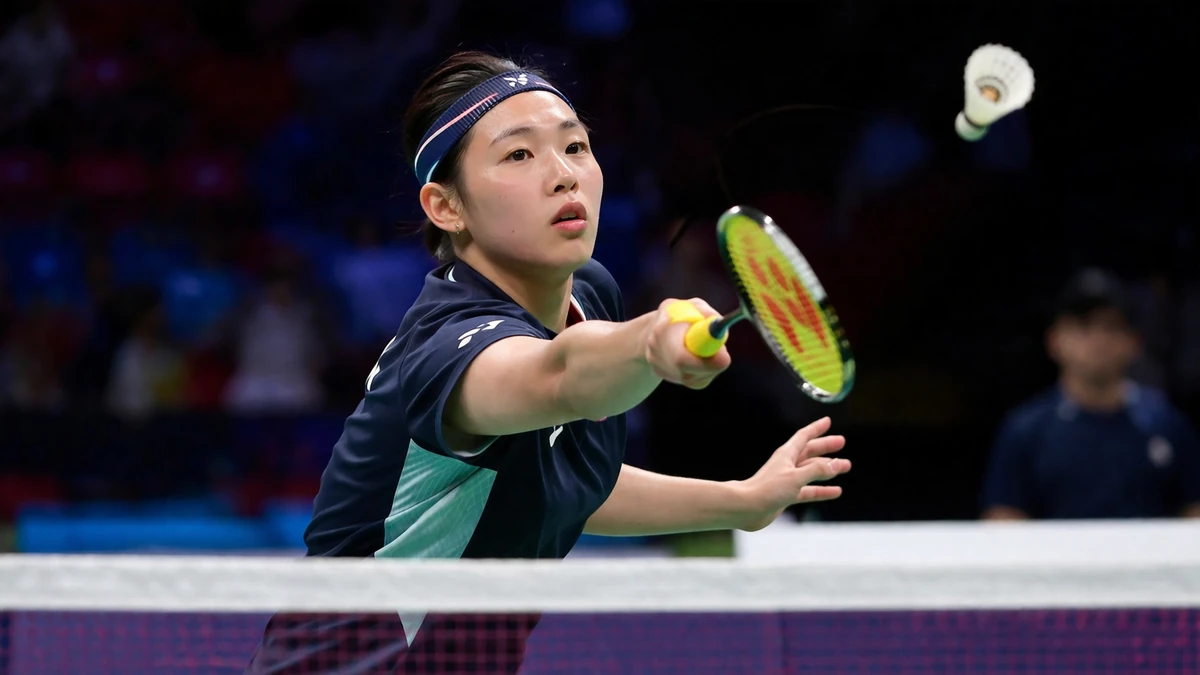
A 30-minute statement from the world’s top-ranked player
South Korean badminton star An Se-young needed only 30 minutes Thursday to make a point that went well beyond the scoreboard.
At the 2026 Asian Badminton Championships in Ningbo, China, the world No. 1 in women’s singles defeated Vietnam’s Nguyen Thuy Linh in straight games, 21-7, 21-6, to advance to the quarterfinals. In most sports, a lopsided score is enough to tell the story. In badminton, where momentum can swing quickly and elite players often grind through long rallies and extended matches, the speed and control of An’s victory made this result stand out even more.
This was not simply a case of a favorite surviving the round of 16. It was a performance that highlighted how thoroughly An controlled the match from beginning to end. According to the Korean news account, she never surrendered the lead in either game. That detail matters. It means the contest never developed into the kind of pressure-filled tug-of-war that often defines major international tournaments. There was no comeback, no wobble, no stretch where the outcome appeared in doubt.
For American readers who may be more familiar with the rhythms of tennis than badminton, one useful comparison would be a top-seeded player at the U.S. Open cruising through a middle-round match 6-1, 6-1 without ever looking threatened on serve. The numbers are dominant, but the larger message is in the structure of the match: the better player imposed her terms immediately and never let go.
That is essentially what An did in Ningbo. In a tournament that features many of the strongest badminton nations in the world, including China, Japan, South Korea and countries across Southeast Asia where the sport draws intense public attention, she did not merely win. She dictated the shape of the contest so completely that the match became a showcase for her current level.
The final score says she advanced. The way she got there says something larger: the top-ranked player in women’s badminton is not just winning matches, but winning them with the kind of authority that can alter the mood of an entire tournament bracket.
Why the Asian Championships matter so much
To many American sports fans, a continental championship might sound secondary to the Olympics or world championships. In badminton, that assumption would miss the significance of this event.
The Asian Badminton Championships carry prestige equivalent to a BWF World Tour Super 1000 event, one of the highest levels on the sport’s calendar. Because Asia is the center of global badminton power, the tournament can be brutally competitive. The women’s singles field routinely includes players from the nations that define the sport at its highest level. In other words, this is not a regional event in the casual sense of the term. It is more like a conference tournament in a sport where that conference contains most of the world’s giants.
That context helps explain why An’s performance resonated. She was not dispatching an overmatched opponent at a minor stop on the circuit. She was playing on one of the toughest stages outside the Olympics and world championships, at an event where nearly every round can feel like a deep-run match at a Grand Slam tennis tournament.
For An personally, the stakes are even more compelling. She has already built the kind of resume that places athletes in the conversation for greatness. The Korean report notes that she owns gold medals at the Olympics, the world championships and the Asian Games. In many careers, that would be enough to close the case.
But one title is still missing: the Asian Championships crown.
That absence has given this tournament an outsized symbolic value. In Korean coverage, it is framed as the “last puzzle piece” in a career that otherwise looks complete. American fans would recognize the idea. Think of a Hall of Fame quarterback who has won league MVPs and a Super Bowl but still lacks the one postseason achievement that keeps showing up in every profile. Or a golfer with multiple majors who returns every year to Augusta trying to complete the career Grand Slam. The missing title becomes more than an entry on a resume. It becomes part of the athlete’s story.
That is where An now stands. Each victory in Ningbo is not just a move through the bracket. It is another step toward closing the only major gap left in an already glittering career.
More than the score: what “never trailing” reveals
It is tempting to look at 21-7 and 21-6 and conclude that nothing more needs to be said. But in badminton, margins alone do not fully explain dominance.
Elite matches are often decided by tempo, by the ability to seize the shuttle early in rallies, force uncomfortable movement and keep an opponent reacting rather than initiating. A player can win comfortably on paper while still navigating dangerous stretches in which the opponent briefly finds rhythm. That never happened here.
According to the Korean report, An did not allow a single comeback in either game. She established control early, held it through the middle portions and closed each game cleanly. That kind of match architecture is a revealing marker of form. It suggests not just superior shot-making, but emotional steadiness, tactical clarity and physical freshness.
In a short-format tournament, those qualities matter almost as much as the win itself. Badminton at the highest level is physically punishing. Players lunge, recover, jump, twist and repeat over dozens of points that can stretch into exhausting exchanges. Preserving energy while still posting a convincing result is one of the advantages top contenders try to create for themselves. A 30-minute rout is not merely aesthetically impressive. It is also practical.
An’s straight-set dismantling of Nguyen means she reaches the quarterfinals without the kind of long, draining battle that can leave a player vulnerable later in the week. If this were March Madness, analysts would note that the favorite not only advanced but did so without logging heavy minutes. In a tournament where recovery time can be limited, that matters.
The performance also reinforced an increasingly familiar truth about An’s game: her version of control is not passive. She does not simply wait for opponents to make mistakes. She creates pressure that shrinks the court for them, turning ordinary exchanges into uncomfortable ones and making high-risk decisions feel necessary. When that pressure is working from the opening points, the match can become one-sided very quickly.
The Korean report described the contest as a virtual one-woman show. That may sound dramatic, but the facts support it: world No. 1, a 2-0 victory, a 30-minute match, and games that never once swung back in the opponent’s favor. It is hard to find a more compact summary of sporting control than that.
The making of a modern Korean sports star
For readers outside Asia, An may not yet be a household name in the way global tennis or soccer stars are. But in South Korea, she occupies a prominent place in the country’s sports culture, and her success reflects several larger patterns in Korean athletics.
South Korea has long punched above its weight in international sports, especially in disciplines that reward technical precision, repetition and elite training systems. Americans often think first of archery, speed skating, taekwondo or women’s golf. Badminton belongs on that list as well. Korea has produced world-class doubles teams and singles players for decades, and major international events are closely followed by dedicated fans.
An represents the latest and perhaps most complete expression of that tradition in women’s singles. She has achieved something difficult in any sport: she has moved from prodigy to champion to standard-bearer. That evolution changes how her matches are viewed. When a rising star wins, the story is promise. When the world No. 1 wins the way An did Thursday, the story is expectation fulfilled.
There is also a specifically Korean dimension to the attention she receives. South Korean sports culture often places intense scrutiny on national stars, particularly those seen as carrying the country’s hopes against rivals from China and Japan in high-profile Asian competition. International tournaments in Asia are rarely just about an individual result. They can also be read through the lens of national prestige, federation strength and the health of a country’s sports pipeline.
That is part of what makes this performance significant beyond An’s individual bracket position. Her commanding win signals that South Korea remains a genuine force at the top of women’s badminton. She did not look like a vulnerable favorite trying to protect a ranking. She looked like a player fully capable of justifying it.
And for Korean fans, that distinction is important. Sports audiences everywhere respond differently when an athlete wins with visible strain versus visible command. One produces relief. The other produces belief. Thursday’s result belonged in the second category.
For Americans accustomed to seeing Olympic champions become symbols of national sporting identity, the dynamic is familiar. An is not simply another player on tour. She is one of the athletes through whom Korean sports fans measure the country’s standing on a major international stage.
The pressure of chasing the one title still missing
There is a peculiar kind of pressure that arrives after an athlete has already won almost everything.
In the early years of a career, success expands possibility. Later, when the major titles have accumulated, success narrows focus. What remains unfinished becomes impossible to ignore. That is the stage An has reached.
Winning the Olympics, world championships and Asian Games would be enough to define most careers. But because the Asian Championships remain absent from her list of titles, every appearance at this event carries narrative weight out of proportion to a typical tournament week. It is no longer just about how far she advances. It is about whether this is the year she closes the loop.
That can be a difficult psychological burden. Athletes in this position are often asked to compete against not only opponents, but also the story attached to them. Every round becomes a checkpoint in a larger conversation about legacy. Every stumble can be magnified because it prolongs the wait for the missing achievement.
What made Thursday’s performance notable, then, was not only that An kept the dream alive. It was that she did so in a manner that suggested she is not being squeezed by that pressure. Quite the opposite. Her play implied calm, order and conviction.
In that sense, the quarterfinal berth matters as both result and signal. The result is straightforward: she is three wins away from the title. The signal is subtler, but perhaps more telling: she appears to be approaching the tournament not as someone haunted by unfinished business, but as someone ready to finish it.
For American readers, it may help to think of the way commentators track a superstar entering the one event that still eludes them. The conversation inevitably circles back to legacy. Yet the athletes who finally break through are usually the ones who stop looking as though they are chasing history and start looking as though they are simply playing their game at the highest level. On Thursday, An looked very much like the latter.
What this means for the rest of the tournament
The Korean summary does not specify who awaits An in the quarterfinals, and it does not offer details about the full draw beyond her progress to the last eight. That limits how far any responsible preview can go. But based on what is known, the main takeaway is clear: An has placed herself in strong position and done so with minimal visible strain.
That matters because later rounds at the Asian Championships tend to become progressively more unforgiving. Elite opponents from China, Japan, Thailand, Indonesia and elsewhere are capable of turning even small lapses into decisive stretches. Matches at this stage often hinge on who can maintain discipline under pressure, adapt midstream and recover physically between rounds.
An’s round-of-16 performance suggests she checks each of those boxes. She protected the lead, controlled the tempo and got off the court quickly. Those are precisely the traits coaches want to see before the business end of a tournament.
The larger question is whether that level of command can continue against stronger opposition. Badminton fans know that the difference between a comfortable early-round win and a championship run often lies in handling the one match that refuses to follow the script. A quarterfinal or semifinal can turn into a tactical chess game, a nerve test or an endurance battle.
Still, there is a reason dominant early performances generate attention. They can indicate more than favorable matchups. They can suggest a player has entered the event in ideal competitive rhythm. The best athletes often reveal their tournament form not with emotional dramatics, but with efficiency. They shorten points when possible, avoid unnecessary energy loss and never let opponents sense an opening. That description fits An’s performance Thursday almost perfectly.
If she does go on to win the title, this round-of-16 match may later be remembered as one of those quietly revealing early moments when the eventual champion already looked a step ahead of the field. If she falls short, it will still stand as evidence of the level she brought into the tournament and of why she remains the standard in women’s singles.
Either way, the quarterfinal berth keeps the central drama intact. The last missing title in An’s extraordinary career is still in play.
A victory that resonates beyond one bracket line
It would be easy to file Thursday’s result under routine excellence: the world No. 1 beat a lower-ranked opponent decisively and advanced. But sports are not remembered only through the bare facts of progression. They are remembered through performances that reveal something essential about the athlete at that moment.
This match did that for An Se-young.
It showed a player whose ranking is backed by substance, not reputation. It showed a champion who understands how to turn a high-pressure event into a controlled working day. And it showed why South Korea continues to see her as one of its most dependable international stars.
There is also a broader message here about badminton itself, especially for audiences in the United States where the sport often receives limited mainstream coverage outside the Olympics. At the highest level, badminton is not a casual backyard pastime or a camp recreation. It is one of the fastest, most demanding racket sports in the world, combining speed, stamina, touch and split-second decision-making. A 30-minute demolition at a major championship is not ordinary. It is a sign that one elite athlete was operating at a level the other could not meaningfully disrupt.
An’s 21-7, 21-6 victory over Nguyen Thuy Linh belonged in that category. It was efficient without being merely mechanical, emphatic without requiring theatrics. In a tournament that matters deeply to her legacy, she delivered the kind of performance that sharpens expectations rather than simply satisfying them.
That may be the most important takeaway as the event moves into the quarterfinals. An is no longer just the player to watch because of her resume. She is the player to watch because, on this evidence, she is playing like someone intent on removing the final asterisk from an otherwise complete career.
For now, the facts are simple: in Ningbo on April 9, the top-ranked woman in badminton advanced to the quarterfinals with startling ease. The implications are more intriguing. South Korea’s biggest badminton star is still alive in the one major event she has yet to win, and she has reached the final eight looking every bit like the favorite her ranking says she is.
In a sport and region where margins are slim and pressure is relentless, that kind of clarity is rare. An Se-young produced it anyway.
Comments
Post a Comment