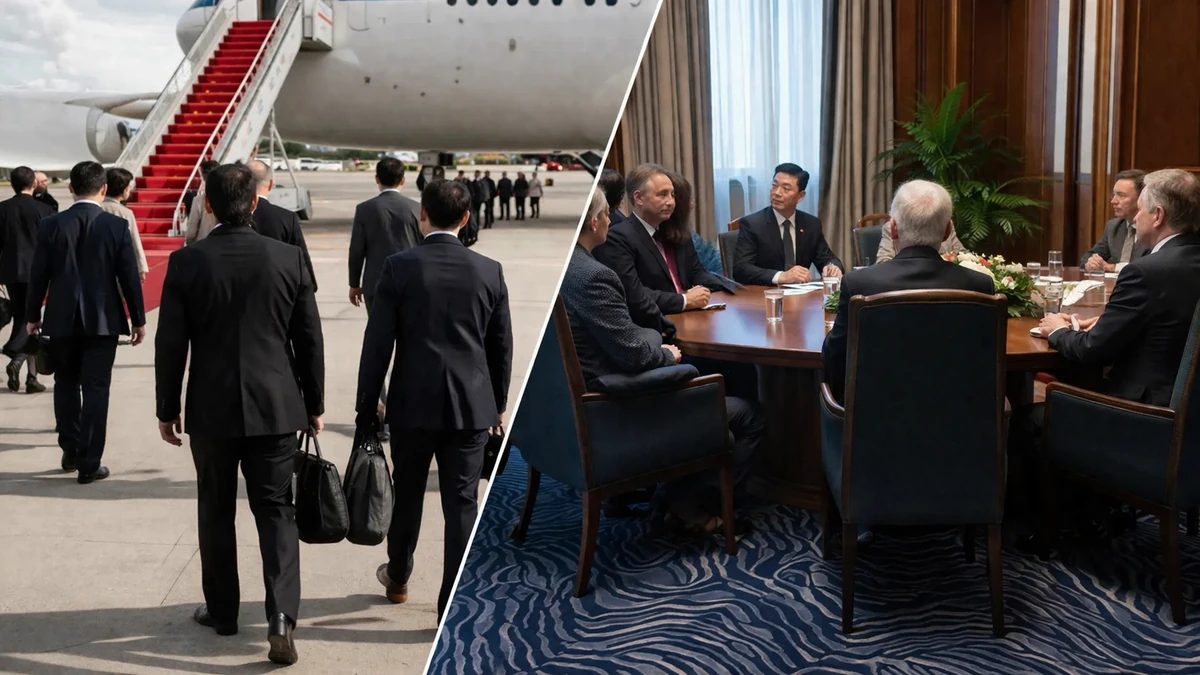
A single day, two very different messages
On the same day in Taiwan, two high-profile political scenes unfolded that together captured one of the central strategic dilemmas of the Indo-Pacific. A leader from Taiwan’s opposition camp, widely viewed as more open to engagement with Beijing, traveled to China. At nearly the same time, Taiwan’s president, who has taken a firmer line against pressure from Beijing, met with visiting U.S. Republican lawmakers.
Seen separately, each event might have looked routine: an opposition figure trying to preserve communication with China, and a president reinforcing ties with one of Taiwan’s most important international backers. Taken together, though, the images were striking. Taiwan’s most important political actors were moving in different directions at once — one toward China, the other toward the United States — and in doing so they laid bare the island’s internal debate over how to survive, prosper and maintain room to maneuver under growing pressure.
For American readers, the closest analogy may be a U.S. state or territory trying to balance relations with two rival superpowers at the same time — except Taiwan’s situation is far more consequential. Taiwan sits at the center of one of the world’s most dangerous flash points. It is a vibrant democracy of about 23 million people, a crucial node in the global technology supply chain and the self-governing island that Beijing claims as its own. Washington does not formally recognize Taiwan as a country, but it is Taiwan’s most important international supporter and arms provider. Beijing, meanwhile, has made unification with Taiwan a core national goal and has not ruled out the use of force.
That means almost every foreign policy gesture in Taipei carries more weight than it might elsewhere. A meeting, a visit, even a photo line can be read as a signal about deterrence, diplomacy, domestic politics and the likelihood of conflict. The same-day contrast between outreach to Beijing and engagement with U.S. Republicans was not just theater. It was a window into Taiwan’s strategic reality: There is no consensus on the island about the best way to protect peace, and the competing approaches are now playing out in public.
Why Taiwan’s internal divide matters far beyond Taiwan
To understand why these two events matter, it helps to understand the basic fault line in Taiwanese politics. Broadly speaking, one camp argues that because China’s military and political pressure is real and intensifying, Taiwan must deepen ties with the United States and other democracies, strengthen deterrence and resist efforts by Beijing to shape Taiwan’s future. The other camp, while not necessarily embracing Beijing’s political agenda, tends to argue that communication with China is essential to reducing tensions, stabilizing the economy and avoiding unnecessary risk.
Those positions are often simplified abroad as “pro-U.S.” versus “pro-China,” but that shorthand can obscure more than it reveals. Most people in Taiwan do not want war. Most also do not want to be ruled by the Chinese Communist Party. Polling for years has suggested that many Taiwanese voters favor some version of the status quo — neither formal independence nor unification. The complication is that “status quo” means different things to different people. For some, it means protecting Taiwan’s democratic autonomy and resisting coercion. For others, it means preserving peace and economic stability by keeping relations with Beijing from spiraling further downward.
That debate matters not just to Taiwanese voters but to the United States, Japan, South Korea, the Philippines and much of the global economy. Taiwan is home to the world’s most important advanced semiconductor manufacturing base, and any major crisis in the Taiwan Strait could disrupt supply chains for everything from smartphones to cars to military systems. For Washington, Taiwan is also a central test of U.S. credibility in Asia as competition with China deepens. For Beijing, the island is tied to nationalism, territorial claims and President Xi Jinping’s vision of China’s future.
So when Taiwan’s opposition leaders seek engagement with China while the president cultivates U.S. congressional ties, it is not merely a domestic disagreement about protocol. It is a split-screen view of two different answers to the same question: How does Taiwan preserve security without giving up prosperity, and how does it preserve prosperity without sacrificing autonomy?
The opposition’s China visit and the politics of pragmatism
The opposition leader’s trip to China can be understood first as an attempt to show that channels of communication across the Taiwan Strait still exist. In Taiwan, that message has practical political value. Relations with China affect tourism, agricultural exports, student exchanges, investment flows and business confidence. When tensions rise, those everyday links can weaken or become bargaining chips. For voters worried about their livelihoods, especially in sectors sensitive to cross-strait conditions, an opposition party that can claim it knows how to manage the relationship may offer a reassuring contrast to a government seen as more confrontational.
That argument resonates with some Taiwanese business leaders and centrist voters. The pitch is straightforward: dialogue does not mean surrender, but refusing dialogue can carry costs. If the opposition can present itself as a steadier hand capable of lowering temperatures, restoring exchanges and reducing uncertainty, it may gain political ground at home. In many democracies, foreign policy is partly judged by whether it helps keep prices stable, markets calm and jobs secure. Taiwan is no different.
But there are political risks, too, and they are significant. In Taiwan, any high-level outreach to China is shadowed by a basic concern: that economic engagement and political dialogue can become conduits for influence. Many Taiwanese are wary that Beijing does not see talks as neutral diplomacy but as part of a broader strategy to pull Taiwan closer, isolate pro-sovereignty forces and exploit divisions within the island’s democracy. Beijing has long sought to maintain ties not only with Taiwanese business groups and local officials, but also with opposition figures and civic organizations, particularly when formal communication with the ruling party is strained.
That helps explain why such visits provoke debate in Taiwan. Supporters may call them practical, necessary or stabilizing. Critics may see them as politically naive at best and dangerously accommodating at worst. The same gesture can be framed either as a mature attempt to keep peace or as an opening for Beijing to amplify internal divisions. That tension is central to the politics of cross-strait engagement, and it is one reason the opposition’s China visit drew attention well beyond the usual diplomatic circles.
There is also a domestic electoral logic. Taiwanese parties have long used relations with China as a defining campaign issue. An opposition trip to Beijing can function as proof of concept: a way to tell voters that if the party returns to power, it can reopen communication and manage the relationship more predictably. Whether voters find that persuasive is another question. Taiwan’s political identity has shifted significantly over the past generation, with more people identifying primarily as Taiwanese rather than Chinese. That trend complicates any strategy that appears too eager to accommodate Beijing’s preferences.
The president’s meeting with U.S. Republicans and the logic of deterrence
If the opposition’s message was about managing tension, the president’s meeting with U.S. Republican lawmakers carried a different emphasis: deterrence, international support and institutional ties in Washington. That matters because U.S. support for Taiwan does not depend solely on the White House. Congress plays a major role in shaping the climate around Taiwan policy, including arms sales, legislation, high-level visits and expressions of political backing. For Taipei, relationships on Capitol Hill are not symbolic extras; they are a core part of its diplomatic toolkit.
In recent years, support for Taiwan has become one of the more bipartisan issues in Washington, even as Republicans and Democrats disagree sharply on many other foreign policy questions. Both parties have largely embraced tougher stances toward China, though they sometimes differ in tone and emphasis. That has given Taiwan an incentive to build ties across the American political spectrum. Meeting with Republican lawmakers can therefore be read as part of a broader strategy: hedge against U.S. political volatility by cultivating congressional support that could outlast any single administration.
For Taiwan, congressional diplomacy serves several purposes. It helps keep the island visible in Washington at a time when crises elsewhere can crowd out attention. It reinforces the idea that Taiwan is not alone internationally. And it can influence debates over defense assistance, military training, arms deliveries and Taiwan’s participation in international organizations. Even when congressional delegations do not directly change policy, they can shape the political environment in which policy gets made.
Still, there are limits to what such meetings can accomplish. A photo op with lawmakers is not a security guarantee. American support for Taiwan, while significant, operates under a longstanding framework of strategic ambiguity — the deliberate U.S. policy of not clearly stating whether American forces would defend Taiwan in the event of a Chinese attack. That ambiguity is meant to deter both Beijing from using force and Taipei from taking steps Washington fears could trigger a crisis. In practice, it means Taiwan values every signal of support from Washington, but it also knows that congressional rhetoric and real-world intervention are not the same thing.
There is another limit as well: Beijing watches these contacts closely. China regards official interactions between Taiwan’s leaders and American politicians as challenges to its “one China” principle, under which Beijing insists Taiwan is part of China. The more visible those interactions become, the more likely China is to respond with diplomatic protests, military pressure or other forms of coercion. That does not mean Taiwan should avoid all such contact. It does mean Taipei has to calibrate the optics, language and timing of every engagement with Washington. In that sense, even gestures meant to strengthen deterrence can carry escalation risks.
Beijing’s likely calculation: reward dialogue, punish visibility
From Beijing’s perspective, the two same-day events are unlikely to be viewed equally. An opposition leader visiting China offers an opening. It allows Beijing to present itself as willing to engage with Taiwanese actors who accept dialogue on terms China can work with. It also lets Chinese officials reinforce a familiar narrative: tensions are not inevitable, they may argue, if Taiwan’s leaders adopt a less confrontational approach and stop leaning so heavily on Washington.
That is useful to Beijing for several reasons. First, it helps sustain the image that there are still “reasonable” partners inside Taiwan with whom China can deal. Second, it can sharpen contrasts within Taiwan’s domestic politics by suggesting that one camp brings stability and another invites danger. Third, it allows China to continue a long-running strategy of working through multiple channels — local officials, business communities, opposition figures and civic groups — even when top-level ties with Taiwan’s ruling leadership are poor or nonexistent.
By contrast, Beijing is far more likely to react sharply to meetings between Taiwan’s president and U.S. politicians, especially when those contacts appear to deepen the island’s political profile in Washington. China has repeatedly signaled that such interactions are among its greatest red lines. Depending on the broader regional climate, Beijing’s response could range from harsh rhetoric and diplomatic complaints to increased military activity near Taiwan, including fighter jet sorties, naval patrols or other demonstrations of force.
But China’s response is rarely one-dimensional. Beijing often mixes warning with selective outreach. It may denounce the Taiwanese government’s engagement with Washington while simultaneously welcoming opposition figures who argue for restoring dialogue. That dual-track approach is designed not only to pressure Taipei but also to influence public opinion within Taiwan and shape the narrative abroad. To American observers, the tactic may look familiar: reward those you consider cooperative, isolate those you do not, and make the costs of resistance visible.
The challenge for Taiwan is that this strategy can intensify its internal debates. If Beijing responds positively to opposition outreach while raising pressure after U.S.-Taiwan contacts, some voters may conclude that engagement lowers risk. Others will see exactly the opposite lesson — that China is trying to dictate Taiwan’s choices by punishing democratic decisions it does not like. Either way, Beijing’s reaction becomes part of Taiwan’s domestic political conversation, not just its foreign policy environment.
What this says about Taiwan’s democracy
One of the more striking features of this episode is that it reflects not weakness alone, but democratic openness. Taiwan is not a one-party state marching in lockstep behind a single strategic doctrine. It is a democracy where competing parties offer rival visions of how to navigate existential pressure. That contest can look messy, and in moments of crisis it can appear risky. Yet it is also part of what distinguishes Taiwan from the authoritarian system across the strait.
For Americans, that distinction matters. U.S. discussions about Taiwan often focus heavily on military scenarios, deterrence and semiconductor supply chains. Those are important. But Taiwan is also a political society engaged in an ongoing democratic argument about identity, security and economic survival. The same-day contrast between outreach to China and engagement with U.S. Republicans was, in one sense, a snapshot of a healthy democratic competition over foreign policy. In another sense, it was a reminder that democracy does not eliminate hard choices. It simply moves them into public debate.
This matters because Taiwan’s leaders are responding to real and immediate public anxieties. Voters worry about war, but they also worry about wages, exports, tourism, energy security and international isolation. They are being asked to evaluate competing claims about what keeps them safest: firmer deterrence and closer ties with Washington, or steadier communication with Beijing and fewer opportunities for confrontation. Neither side can fully resolve the contradiction because Taiwan’s predicament itself is unresolved.
That is why episodes like this one carry such weight. They are not merely about protocol or partisan symbolism. They reveal how foreign policy in Taiwan is inseparable from domestic politics. Every party is trying to persuade voters that it understands not just geopolitics in the abstract, but the practical costs of insecurity. In that sense, Taiwan’s diplomacy is not only conducted in presidential offices and foreign ministries. It is also conducted in campaign messages, television panels, business forums and kitchen-table conversations about what kind of future feels survivable.
The view from Washington and why Americans should pay attention
For the United States, the lesson of this moment is not that Taiwan must choose one path once and for all. It is that Washington should understand how complicated Taiwan’s strategic environment really is. American officials and lawmakers often speak about support for Taiwan in moral and strategic terms, and those arguments are real. Taiwan is a democratic partner, and its fate would have enormous implications for the regional balance of power. But Taiwanese politics cannot be reduced to a simple pro-America versus pro-China binary. The debate on the island is often about means rather than ends: how to protect democracy without triggering catastrophe, and how to preserve economic normalcy without opening the door to coercion.
That nuance is especially important in a U.S. election-driven political culture, where Taiwan can sometimes become a talking point in broader debates over being “tough on China.” Taiwanese leaders know that support from Congress matters. They also know that American domestic politics can be volatile and that statements made in Washington do not always translate neatly into policy execution in a crisis. For that reason, Taiwan’s effort to engage Republicans, Democrats and the broader U.S. policy establishment is as much about continuity as ideology.
Americans should also pay attention because the stakes extend well beyond diplomatic etiquette. A misread signal in the Taiwan Strait can affect energy markets, stock indexes, shipping routes and the availability of critical technologies. The region is not some distant chessboard. It is tied directly to the economic and security architecture that underpins daily life in the United States. If Taiwan’s internal divisions over how to handle China and the United States intensify, they could shape the tempo of cross-strait tensions in ways that matter globally.
In the end, the two images from Taiwan on that same day — one politician heading to China, a president welcoming U.S. Republicans — offered a concise summary of the island’s predicament. Taiwan cannot ignore China, because China is too powerful, too close and too deeply intertwined with its economy and security environment. Taiwan also cannot turn away from the United States, because American support remains essential to deterrence, diplomatic space and international visibility. The dilemma is not choosing between two easy options. It is managing dependence on both while trusting neither completely.
That is the hard reality of Taiwan’s cross-strait diplomacy. It is not a tidy contest between engagement and resistance, or between pragmatism and principle. It is an argument over how to live in the shadow of a great-power rivalry that Taiwan did not create but cannot escape. And as the island’s politicians continue to send different messages to Beijing and Washington, the rest of the world is being reminded that Taiwan’s future may be shaped not only by what the superpowers do, but also by how Taiwan’s own democracy negotiates its narrow and perilous middle ground.
Comments
Post a Comment