Trump’s NATO Exit Talk Rattles Europe — and Forces South Korea to Rethink What U.S. Alliances Really Mean
A campaign-era threat with real-world consequences
Former President Donald Trump’s reported consideration of withdrawing the United States from NATO is not just another splashy campaign-season provocation. In Europe, it is being treated as a flashing warning light. And in South Korea, a country thousands of miles from the Atlantic alliance, it is prompting a familiar but increasingly urgent question: How dependable are American security guarantees when U.S. politics itself has become a strategic variable?
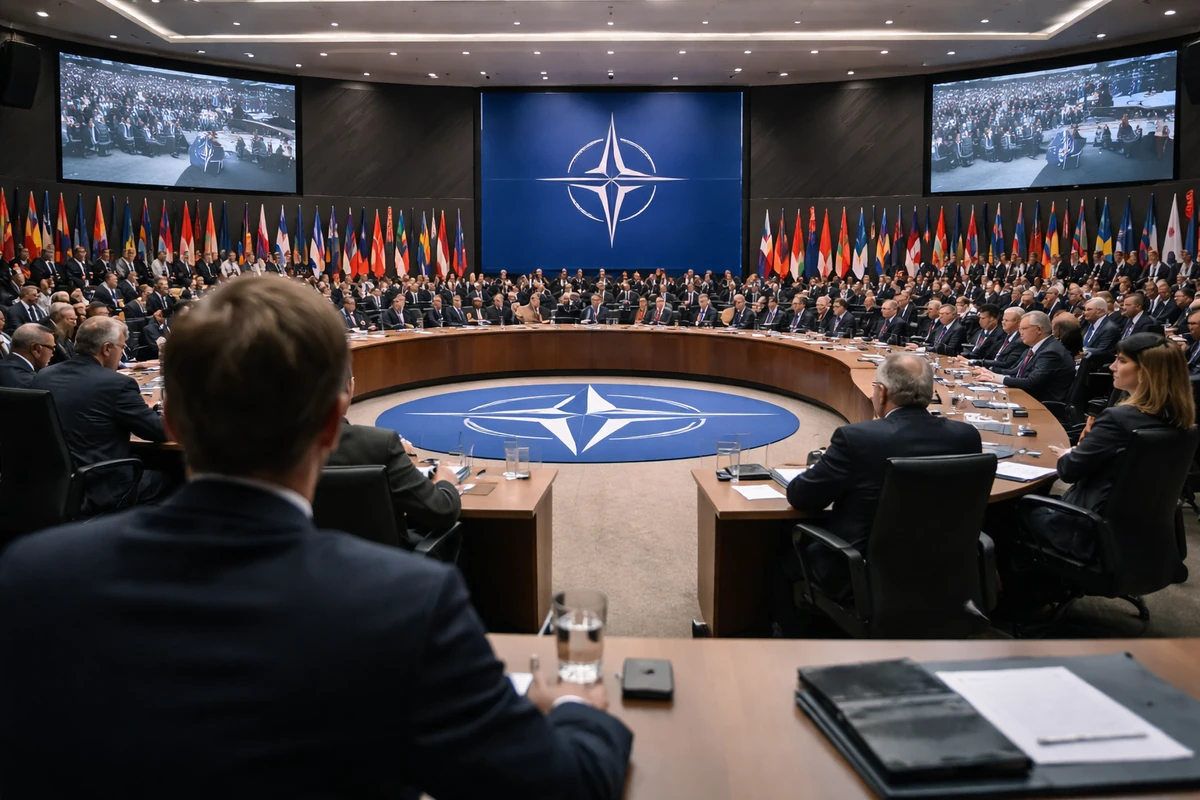
According to reporting cited by South Korean media, Britain’s Daily Telegraph said Trump is strongly reviewing the possibility of pulling the U.S. out of the North Atlantic Treaty Organization, the 32-member alliance that has anchored European security since 1949. No formal withdrawal process has begun, and there is no official U.S. government decision to leave the alliance. Even so, the political shock wave is already significant. In modern alliance politics, signals matter almost as much as formal action. When the leading military power in a coalition appears willing to reconsider the arrangement, allies and adversaries alike start recalculating.
For American readers, it helps to understand why this hits such a nerve overseas. NATO is not just a diplomatic club or a symbolic commitment to the “free world.” It is a working military structure built around the assumption that the United States would provide the backbone in any major crisis: intelligence, logistics, command-and-control, strategic airlift, missile defense and, most importantly, nuclear deterrence. Article 5, the alliance’s collective defense clause, says an attack on one member is considered an attack on all. But that promise has always rested heavily on a simpler assumption: that the U.S. would actually show up.
Trump has challenged that premise for years. During his presidency, he repeatedly criticized NATO allies for failing to meet the alliance guideline of spending 2% of gross domestic product on defense. He argued that Europe was freeloading under the American security umbrella and that U.S. taxpayers were carrying too much of the burden. Those complaints were not invented out of thin air; successive American administrations from both parties have pushed Europe to spend more. What made Trump different was not the grievance itself, but the transactional way he framed the alliance — less as a long-term strategic commitment and more as a deal that could be revised, or abandoned, if the other side did not pay up.
That distinction matters. Allies can absorb sharp rhetoric. What they fear is conditionality. If a treaty commitment begins to sound like a subscription service that can be canceled after a billing dispute, deterrence weakens long before any legal withdrawal takes place.
Why Europe is worried about more than money
At first glance, Trump’s criticism of NATO sounds like an argument over budgets. In reality, Europe’s anxiety is about military credibility. The issue is not simply whether Germany, Italy, Spain or Canada spend enough on defense. It is whether Washington still sees European security as a core American interest worth defending even at high cost and risk.
That question has taken on greater urgency because Europe’s post-Cold War security architecture was built on deep U.S. involvement. Many European countries reduced defense spending after the Soviet Union collapsed, assuming the peace dividend would last. Even after Russia annexed Crimea in 2014, many governments moved slowly to rebuild military capacity. Russia’s full-scale invasion of Ukraine in 2022 changed that. Defense budgets have risen. Ammunition production is expanding. Finland joined NATO, and Sweden followed, reshaping the security map of Northern Europe. Poland and the Baltic states have sharply increased defense investments.
But even with that renewed effort, Europe cannot easily replace the United States in the short term. American military power offers capabilities that many European states either do not possess or cannot scale quickly: long-range transport, satellite and surveillance assets, integrated missile defense, high-end command systems and the credibility of a nuclear umbrella. Britain and France have nuclear weapons, but Europe’s security posture remains deeply tied to U.S. strategic guarantees.
This is why the debate does not reduce neatly to fairness. If a family complains that one roommate is not paying enough rent, the household may be annoyed. But if that roommate also controls the locks, the alarm system and the emergency phone line, the stakes are much higher. That is essentially Europe’s dilemma with the United States. Washington is not just the loudest member of the alliance; it is the indispensable military center of gravity.
The countries most alarmed are often those closest to Russia. Poland, Estonia, Latvia and Lithuania do not hear talk of NATO retrenchment as an abstract Washington argument about burden sharing. They hear it as a possible change in Moscow’s risk calculations. In those capitals, deterrence is not a seminar topic. It is the line between stability and coercion.
What message Moscow could take from American uncertainty
Russian leaders have long tried to exploit fractures inside the West. For years, the Kremlin has sought to magnify political polarization in the United States and Europe, betting that democratic fatigue, economic strain and election-season discord could weaken the coalition opposing Russian aggression. Any suggestion that the U.S. might downgrade or abandon NATO fits neatly into that strategy.
That does not mean Russia would automatically launch a direct attack on a NATO member if Trump returned to office or if American commitment appeared less certain. Military action is never that simple, and the costs of testing the alliance head-on would remain enormous. But deterrence is not only about preventing tanks from rolling across borders. It is also about discouraging the gray-zone tactics that fall below the threshold of full war — cyberattacks, sabotage, political interference, disinformation, energy pressure and calculated military intimidation.
If Moscow concludes that the alliance is divided, or that Washington’s support for Europe is increasingly conditional, the temptation to probe those seams could grow. The Baltic region, the Black Sea, undersea cables, energy infrastructure and digital networks could all become arenas for more aggressive pressure. In that sense, alliance uncertainty can be destabilizing even without a dramatic battlefield escalation.
Since the war in Ukraine began, Europe has learned the hard way that security vacuums invite risk. Finland’s and Sweden’s decisions to join NATO reflected exactly that lesson. Both countries had long traditions of military nonalignment, but Russia’s invasion changed the political math. Their accession was widely seen as a strengthening of the alliance. Yet that strengthening presumed continued U.S. engagement. If America itself begins to look uncertain, one of the central strategic gains of the post-2022 period becomes harder to consolidate.
There is also a psychological effect. Alliances work in part because they shape expectations. Markets, military planners and political leaders all make choices based on what they think the U.S. will do in a crisis. Repeated suggestions that America might walk away can raise the cost of planning even if Washington never formally leaves. Strategic trust, once damaged, is expensive to rebuild.
How much of this is campaign talk — and how much could become policy?
There are good reasons to be cautious about assuming the U.S. is on the verge of exiting NATO. Leaving the alliance would be vastly more complicated than using it as a campaign talking point. NATO is woven into decades of U.S. military planning, defense-industrial cooperation, intelligence-sharing arrangements and overseas basing structures. Congress, the Pentagon, the State Department, allied governments and major parts of the American defense establishment all have stakes in preserving the alliance.
There are also constitutional and legal questions. A president can shape alliance policy dramatically, but a full U.S. withdrawal from NATO would almost certainly trigger a fierce political and institutional confrontation in Washington. Lawmakers in both parties, though divided on many foreign policy questions, have often been reluctant to cede sweeping authority over treaty abandonment. Even if the White House tried to move in that direction, the process would be messy, contested and far from guaranteed.
Still, Europe and Asia are not overreacting by taking the threat seriously. International politics does not wait for legal paperwork. In alliance management, perception can drive behavior before statutes and procedures catch up. If foreign governments believe a future administration may place a lower value on long-standing security commitments, they begin hedging now — buying more weapons, strengthening local military industries, exploring alternative arrangements and, in some cases, quietly questioning whether Washington’s word still carries the same weight it once did.
That is one of the deeper lessons of this moment. The core issue is not simply whether Trump could withdraw the U.S. from NATO. It is whether American alliance policy is becoming more conditional across the board. For decades, U.S. alliances were often described as force multipliers — systems that amplified American power and extended deterrence at relatively sustainable cost. Trump’s camp has often described them differently: as bargains that must produce immediate, measurable returns. Those are not just different talking points. They are competing theories of how American power should work.
That debate is likely to intensify in the U.S. election season. It overlaps with arguments Americans already know well: internationalism versus restraint, confronting Russia versus prioritizing China, sustaining forward deployments versus reducing overseas commitments, and whether defense dollars are better spent at home or through alliance networks abroad. However voters sort through those questions, allied capitals are hearing a broader message: U.S. security guarantees may no longer be politically automatic.
Europe’s likely response: Rearm, coordinate and try to hedge
European governments do have options, though none are easy and none can fully substitute for American power in the near term. The most obvious response is to spend more on defense and spend it more effectively. Several governments are already moving in that direction. Hitting or exceeding the 2% benchmark has become both a practical and political priority. But raw spending totals tell only part of the story. Europe must also address readiness, ammunition stocks, air defense integration, logistics, recruitment and defense manufacturing capacity.
That last point is especially important. The war in Ukraine exposed the limits of Europe’s defense industrial base after years of relative underinvestment. Rebuilding arsenals is not like flipping a switch. Factories, supply chains, skilled labor and long-term contracts all matter. If European leaders conclude that U.S. policy could become more volatile, they may double down on domestic and regional production to reduce dependence not just on America’s troops, but on America’s political calendar.
A second response is deeper security cooperation within Europe itself. The European Union has long talked about “strategic autonomy,” a phrase that can sound vague or technocratic to American ears. In plain English, it means building the ability to defend European interests even if the U.S. is distracted, divided or less willing to lead. That can include joint weapons procurement, common standards, more interoperable forces and stronger regional planning.
But Europe’s internal politics make that difficult. Threat perceptions differ across the continent. Eastern members tend to view Russia as the immediate overriding danger. Southern European states often juggle concerns including migration, instability in North Africa and budget pressures at home. Britain’s exit from the EU complicated institutional coordination even though London remains one of Europe’s key military powers. France has long pushed for more European strategic independence, while Germany has often moved more cautiously. In other words, Europe can talk about autonomy more easily than it can execute it.
A third path is not separation from the U.S., but insulation against U.S. unpredictability. That means designing alliance structures robust enough to withstand shifts in any one American administration. Long-term contracts, regularized joint exercises, stronger regional command structures and more durable planning frameworks could all help. The goal would be less to replace Washington than to reduce the degree to which every U.S. election sends shock waves through allied capitals.
Why this matters in South Korea, far from the Atlantic
At first glance, NATO may seem far removed from the Korean Peninsula. South Korea is not a NATO member, and its most immediate security concern remains North Korea, backed by its growing missile and nuclear capabilities. Yet in Seoul, debates over NATO and U.S. alliance credibility are never merely European questions. They are watched closely as indicators of how Washington may treat security commitments everywhere.
South Korea lives under one of the world’s most heavily militarized security environments. Roughly 28,500 U.S. troops are stationed on the peninsula, and the U.S.-South Korea alliance remains central to deterrence against North Korea. But the logic of reassurance is strikingly similar to what Europe worries about: not just whether a treaty exists, but whether the United States would act decisively in a crisis and whether that commitment would remain stable across administrations.
That concern is hardly theoretical. During his presidency, Trump pressed Seoul hard on defense cost-sharing, demanding that South Korea contribute far more for the presence of U.S. forces. His language sometimes suggested that alliances are negotiable business arrangements rather than strategic relationships grounded in mutual security interests. That approach unsettled many South Koreans even as the military alliance itself endured.
For readers in the United States, a useful comparison might be this: Imagine if every few years America’s fire insurance company publicly hinted it might not renew coverage unless the homeowner paid a dramatically higher premium, while a known arsonist lived next door. Even if the policy technically remained in place, the household would not feel especially secure. That is the kind of uncertainty allies fear when Washington frames defense commitments in overtly transactional terms.
There is also a larger geopolitical angle. If American commitment to NATO appears shakier, Asian allies may ask whether they could face similar pressures. Japan, South Korea and Australia all rely on U.S. alliance commitments as part of the regional balance against China and North Korea. A perception that America’s alliance policy is narrowing to a strict cost-benefit test could encourage hedging behavior across Asia — stronger domestic militaries, more independent strategic planning and, in some debates, even discussion of options once considered taboo.
In South Korea, that could intensify long-running arguments over self-reliance in defense, including calls for stronger indigenous strike capabilities or a renewed public debate over nuclear armament. South Korea does not currently have nuclear weapons, and the government remains committed to the alliance framework and extended U.S. deterrence. But political discourse on the issue has become more open in recent years as North Korea advances its arsenal and as uncertainty about global order grows. Any sign that Washington might loosen commitments in one theater can reverberate in another.
Seoul’s diplomatic calculation is broader than the question of U.S. troops on the peninsula. South Korea is increasingly active in global security diplomacy, supplying arms to partners, deepening ties with NATO members and aligning more openly with democratic coalitions on technology, sanctions and Indo-Pacific security. If the U.S. role in Europe becomes less predictable, South Korea may face harder choices about how to balance its economic ties with China, its security reliance on the United States and its growing political role in wider U.S.-led strategic networks.
The broader lesson: Alliances run on credibility, not just paperwork
The immediate facts remain limited. There is a report that Trump is strongly considering NATO withdrawal, not a formal move by the U.S. government to leave. But even at this stage, the episode is revealing. It shows how much of the current global order still depends on confidence in American continuity — and how much disruption can follow when that continuity comes into doubt.
For Europe, the lesson is that outsourcing too much deterrence to Washington carries growing political risk, even if U.S. military support remains indispensable for now. For South Korea, the lesson is that alliance maintenance requires preparing not only for threats from adversaries, but also for shifts in the priorities of the ally on which its security most depends. And for the United States, the moment raises a more fundamental question: Are alliances still viewed as strategic assets that extend American influence, or are they increasingly treated as optional contracts subject to renegotiation every election cycle?
That is not a niche foreign policy debate. It goes to the heart of how the U.S. exercises power in the 21st century. After World War II, Washington helped build a system of alliances that tied America’s security to Europe and Asia in exchange for a broader stable order favorable to U.S. interests. Critics have always argued that the arrangement lets allies free-ride. Defenders argue that it prevents bigger wars, deters rivals and gives the U.S. unparalleled reach. The question now is not merely which side has the better theory. It is whether the rest of the world still believes the U.S. has made up its mind.
That uncertainty is the real story. Europe hears it as a warning that deterrence cannot depend indefinitely on American domestic consensus. South Korea hears it as a reminder that the credibility of one U.S. alliance affects confidence in another. And adversaries hear it as an invitation to test where rhetoric ends and resolve begins.
In that sense, the political fallout from Trump’s NATO comments extends far beyond Brussels or Washington. It reaches into the strategic calculations of Seoul, Moscow and capitals across the democratic world. Whether or not the United States ever takes formal steps toward leaving NATO, the mere possibility has already done what alliance uncertainty always does: It has forced friends to plan for a future in which American commitments may no longer feel unquestioned.
Comments
Post a Comment