
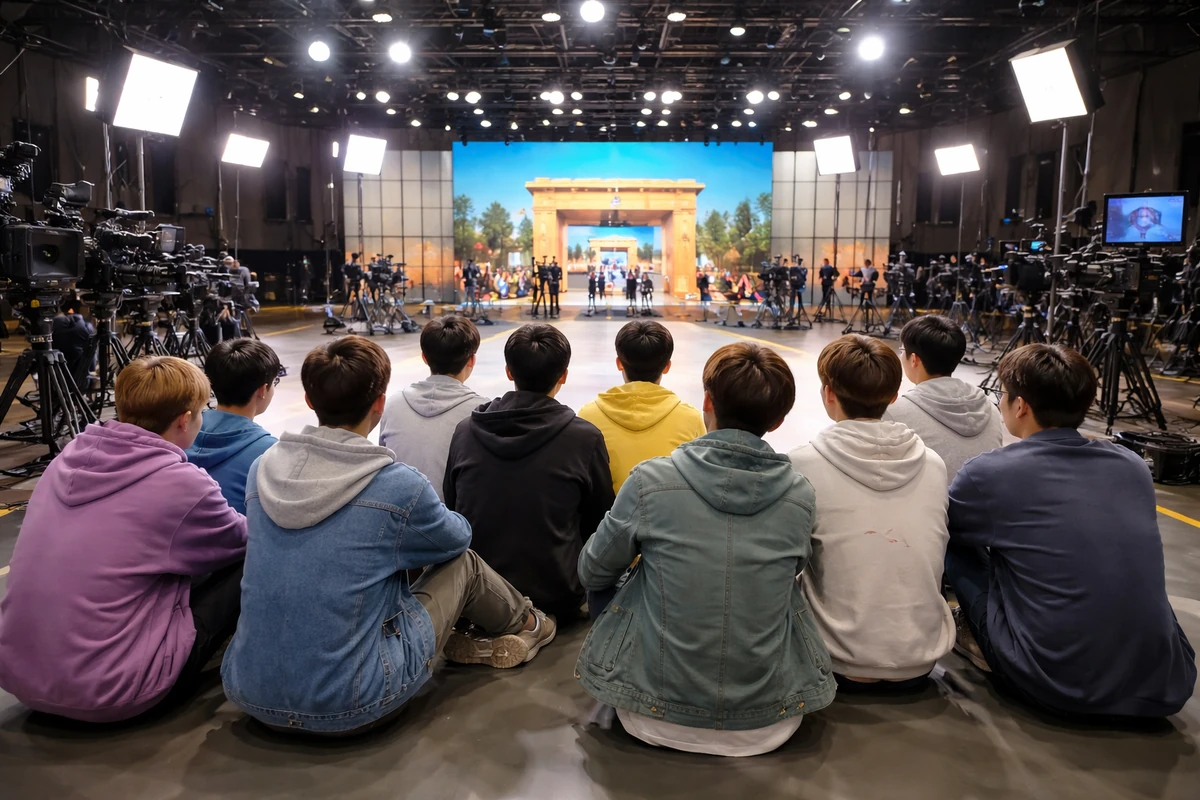
A K-pop brand from another era returns in a new form
For many American pop fans, a comeback usually means one thing: new music. A band reunites, announces a single, maybe books a late-night TV appearance and heads out on tour. But in South Korea’s K-pop industry, where fandom operates as both emotional community and economic engine, a return does not have to begin with a song. Sometimes it begins with a familiar title, a teaser and a carefully calibrated reminder of who once mattered — and still might.
That is why the announcement surrounding Wanna One, one of the biggest K-pop project groups of the late 2010s, deserves more attention than a quick nostalgia headline. According to South Korean reports, the group’s reality content series “Wanna One Go” is set to return for the first time in seven years, with its first release scheduled for April 28. On the surface, the news sounds straightforward: a popular group from the past is revisiting a beloved format. But in practice, the move says far more about how K-pop now manages legacy acts, fan memory and intellectual property than it does about any confirmed musical reunion.
For readers who did not follow the peak years of Korean survival audition shows, Wanna One was not a conventional boy band built slowly by one company over many years. It was a project group formed through a televised competition, a structure that turned the group’s creation into serialized drama. Fans did not simply meet the members at debut; they watched them compete, struggle, rank and ultimately win their places. That origin story mattered. It meant the group was always more than its songs. It was also a narrative product — one shaped by aspiration, rivalry, friendship and the countdown clock built into its temporary contract.
That temporary quality is central to why the name still resonates. Wanna One’s active lifespan was short, but its impact was outsized. The group generated strong album sales, commercial endorsements, television buzz and a fan intensity that helped prove just how powerful the project-group model could be in Korea. In American terms, imagine if a massively successful reality-competition cast became a platinum-selling act almost overnight, fully aware from day one that its time together was limited. The scarcity would not diminish the attachment; it would intensify it.
So when an old title like “Wanna One Go” reappears after seven years, the real story is not simply that fans get to see the members together again. The story is that a dormant brand is being reactivated through non-musical content — and that choice appears deliberate. Rather than announcing a new album or full-scale group promotion, the industry seems to be testing whether memory itself can once again be packaged, refreshed and monetized.
Why Wanna One still matters in a fast-moving K-pop marketplace
K-pop is often described in the United States as an industry obsessed with the next thing. That reputation is not entirely wrong. New groups debut constantly. Social media algorithms reward novelty. Chart competition is relentless. Yet the market is also increasingly sophisticated about preserving and reviving older properties. In Hollywood, studios mine established franchises because familiarity lowers risk. In K-pop, agencies and platforms are learning a similar lesson: a known fandom with dormant passion can be as valuable as a new audience that has not yet formed a deep emotional bond.
Wanna One remains useful in that context because it occupies a particular place in K-pop history. It was a flagship example of the project-group boom, and it embodied a kind of compressed stardom that fans rarely forget. Unlike long-running idol groups that accumulate years of variety clips, tours, albums and member dynamics, project groups often stop with unusual finality. Their archives feel sealed off. That gives the past a different weight. Instead of blending into ongoing activity, those memories harden into something closer to a completed era.
That matters commercially. The less available a group’s shared present becomes, the more valuable its documented past can feel. Fans who followed Wanna One during its initial run are not only remembering the music; they are revisiting a specific period in their own lives. For many, the group may signify adolescence, college years or a time when K-pop itself was becoming more globally visible. In this sense, the group functions less like a current chart act and more like a cultural timestamp.
There is also an intergenerational aspect to its appeal. Older fans remember the group firsthand. Younger K-pop fans, even if they arrived after Wanna One disbanded, may know the name as part of the genre’s canon — the way younger basketball fans know the Chicago Bulls of the Michael Jordan era or younger pop listeners understand that One Direction represented a particular phase of global boy-band mania. They may not have lived through it, but they recognize its importance. That broadens the group’s afterlife beyond simple fan service.
The name “Wanna One,” then, still carries weight not just because of historical sales or media attention, but because it combines several ingredients that help old brands survive: high member recognition, a built-in origin story, a short and therefore concentrated period of activity, and a long silence that turns any official return into an event. Even without a new song, the brand can still command attention.
Why a reality show makes more sense than a full musical comeback
To outsiders, the absence of a music announcement may sound like a letdown. But from an industry standpoint, reality content is arguably the more practical and revealing move. A full group comeback in K-pop is expensive and complicated under the best circumstances. It requires alignment on music, concept, choreography, schedules, contracts, distribution plans, promotional windows and often delicate negotiations among multiple management companies. Those challenges only grow when former group members have spent years building separate careers.
Reality programming, by contrast, is more flexible. It allows companies to capitalize on the chemistry fans miss most without forcing every other piece of the old machine back into place. In fact, one of the quiet truths of idol fandom is that many supporters do not necessarily need a new single to feel emotionally satisfied. They want to see the members in the same room. They want the awkward jokes, the familiar rhythms, the references only longtime fans understand. The image of togetherness can be more immediately powerful than a tightly managed promotional cycle.
That is especially true for a group like Wanna One, whose appeal was always bound up in relationships as much as performance. Performance proves polish. Reality content reveals texture. It can show how people have changed, how they speak to one another after years apart, what remains instinctive and what now feels careful. For fans, that can produce a different but equally potent reward: not the thrill of a polished stage, but the deeper emotional pull of seeing time itself become part of the story.
It also creates more room for authenticity — or at least for a version of authenticity that audiences find persuasive. A reunion single invites immediate comparison to the past. Is it as good as before? Does the choreography still work? Do the voices match the old dynamic? A reality series operates on different terms. It can frame distance, change and maturity as strengths rather than liabilities. Members do not have to pretend nothing has changed. In fact, the content becomes richer if they do acknowledge what has changed.
From a business standpoint, this format is even more attractive. A reality series is not just one piece of media. It is a hub for trailers, short-form clips, behind-the-scenes footage, livestream tie-ins, fan-community engagement, merchandise and advertiser integrations. In a fragmented digital ecosystem, that kind of layered release strategy is valuable. Platforms can track viewership, engagement time, subscription conversion and social response in ways traditional television once could not. In effect, a reality revival can function as a focus group at scale.
That is why it may be premature to describe this as a reunion in the way American readers typically understand that word. It is better understood as a content experiment with reunion-like emotional stakes. If the response is strong enough, more steps could follow — a special stage, a live event, a limited collaboration, perhaps even a larger commemorative project. But the current announcement points first to content, not to a new chapter of formal group activity.
The business of nostalgia is now central to K-pop
The return of “Wanna One Go” also highlights a broader shift in the entertainment economy: nostalgia is no longer an occasional strategy. It is infrastructure. American audiences see this everywhere, from rebooted sitcoms and reunion tours to legacy movie franchises that rely on viewers’ affection for familiar worlds. K-pop, despite its youth-oriented image, has become equally adept at selling memory.
In K-pop, though, nostalgia has a particularly participatory dimension. Fans do not just consume old songs. They buy photo books, limited-edition merchandise, archived footage, digital messages, pop-up store exclusives and collectible items tied to highly specific emotional moments. The value lies not merely in ownership but in reliving the feeling associated with a certain era, lineup or relationship. This is where reality content becomes powerful: it puts relationship consumption at the center.
That phrase may sound clinical, but it helps explain the economics at work. Fans are not simply paying for information. They are paying for access to group dynamics — for evidence that the bonds they invested in still hold meaning. A reality series provides that in a way music alone sometimes cannot. Even a brief exchange among members can become a widely shared clip, a meme, a talking point and eventually a reason to buy related goods or sign up for a platform membership.
Still, nostalgia is not automatically successful. Audiences can tell when a revival is too mechanical. Re-creating old formats beat for beat may produce a short burst of sentiment, but that feeling fades quickly if the content offers nothing new. The challenge for any legacy revival, in Seoul or Los Angeles, is to balance recognition with evolution. Viewers want the old warmth, but they also want proof that the people involved have lived real lives in the meantime.
That may be the true test facing “Wanna One Go.” If the new content simply mimics the past, it risks becoming a decorative throwback. If it captures what only seven years of distance can reveal — changed priorities, matured identities, different professional instincts and the odd tenderness of seeing former bandmates become adults — then it may resonate far beyond the core fandom. The most durable nostalgia is not about pretending time stopped. It is about making time visible.
Advertisers and streaming platforms have reasons to care as well. A reactivated fandom brings more than purchasing power. It brings dwell time, discussion and repeat engagement — metrics that matter in a subscription and algorithm economy. If this release succeeds, it could encourage more investment in archival K-pop brands, including documentary-style programming, anniversary projects, live fan experiences and curated digital collections. In other words, the return of one old reality series could help model how former groups remain commercially active long after their formal end.
How individual careers complicate — and enrich — any return
One reason a full musical reunion is so difficult is that former idol-group members do not remain frozen in the identities fans remember. Over time, they become soloists, actors, television personalities, musical theater performers or entrepreneurs. Their public images sharpen in different directions. Their agencies pursue different strategies. Their fan bases evolve. Reassembling them under a single group banner requires not only logistical coordination, but also a careful balance between collective nostalgia and individual accomplishment.
That balancing act is especially delicate for project groups. Because the group was never meant to last indefinitely, members often move quickly into separate lanes once the contract ends. In Wanna One’s case, that dispersion may actually enhance the emotional appeal of a shared appearance. The members’ time together now feels rarer than it would for a group that had years of overlapping activity. But it also means any new group content must respect who they have become outside the group.
Reality programming is well suited to that problem because it does not demand uniformity in the way a comeback concept often does. Members can appear as themselves, with their present-day careers acknowledged rather than suppressed. A reality series does not need to decide who is center stage in the same way a song promotion might. It can let different personalities and trajectories coexist. For longtime fans, that can feel more honest.
There is also a subtle emotional appeal in seeing distance itself play out on camera. American reunion specials often lean on the joy of old castmates instantly falling back into familiar routines. But a more compelling truth sometimes emerges when that ease is not immediate — when viewers can sense both comfort and unfamiliarity. In idol reunions, that tension can be especially meaningful. Fans are not only looking for proof that the old chemistry survives. They are looking for evidence that the members’ current selves are recognized and respected.
Handled well, that makes the group narrative stronger, not weaker. The shared past does not erase individual growth; it frames it. The old story becomes a reference point rather than a prison. That is likely one reason the reality format is attractive here. It allows the team story and the solo stories to operate in parallel. No one has to sacrifice a carefully built personal brand for the sake of a sentimental exercise. Instead, the content can present reunion as coexistence.
For viewers, that kind of approach may carry more emotional credibility than a conventional comeback would. The most moving moments may not come from dramatic declarations or polished performances, but from smaller signs: who teases whom, who still remembers the same routines, who pauses before speaking because seven years is both a long time and, in another sense, no time at all.
What this signals for the next phase of the Korean Wave
The larger significance of the announcement is that it reflects a maturing Korean entertainment industry. K-pop is still often discussed abroad as if it were driven entirely by youth, speed and perpetual replacement. But the return of “Wanna One Go” suggests a more complex reality. The industry is increasingly acting like a long-horizon media business, one that understands the value of archives, emotional continuity and franchise management.
That is a notable development in the broader Korean Wave, or Hallyu, the term used to describe the global spread of Korean popular culture across music, television, film, beauty and fashion. Earlier phases of Hallyu focused heavily on export growth — getting new shows, new stars and new songs into overseas markets. The current phase looks more mature. It asks how Korean cultural products can sustain value over time, across generations of viewers and across formats that go beyond the original hit.
In that sense, the Wanna One content revival resembles a strategy long familiar in American entertainment. A hit does not disappear when its original run ends; it becomes a library asset, a streaming title, a collectible property, a reunion vehicle, a documentary subject, a nostalgia brand. What K-pop is doing now is adapting that playbook to fandom systems that are unusually intense and digitally networked. The result could be an era in which even disbanded groups remain economically alive through periodic, carefully structured returns.
That does not mean every legacy revival will work. Some names are remembered more fondly than actively loved. Some fandoms have fragmented. Some members may have no interest in revisiting a shared past. But when the ingredients align — strong brand recognition, emotionally rich archives, visible member careers and a fan base eager for reconnection — reality content may become one of the industry’s preferred reentry points.
For American readers, the easiest comparison may be the difference between a reboot and a reunion documentary. One tries to continue the story as if the old machinery still functions. The other recognizes that time has passed and uses that fact as part of the appeal. “Wanna One Go” appears to belong firmly in the second category.
And that may be why the announcement has generated interest even without promises of new music. It offers something more strategically useful: a way to measure whether a famous K-pop name can still organize attention, emotion and spending in the present tense. If the answer is yes, it will not just tell us something about Wanna One. It will tell us something about where K-pop is headed — toward an ecosystem where memory is not the afterglow of success, but one of its most durable products.
For now, the most important thing is restraint. The announcement confirms the return of a reality title. It does not, at least not yet, confirm a full-fledged group comeback. But perhaps that distinction is exactly the point. In today’s K-pop economy, content is no longer secondary to music. Sometimes it is the opening move, the market test and the main event all at once.



0 Comments