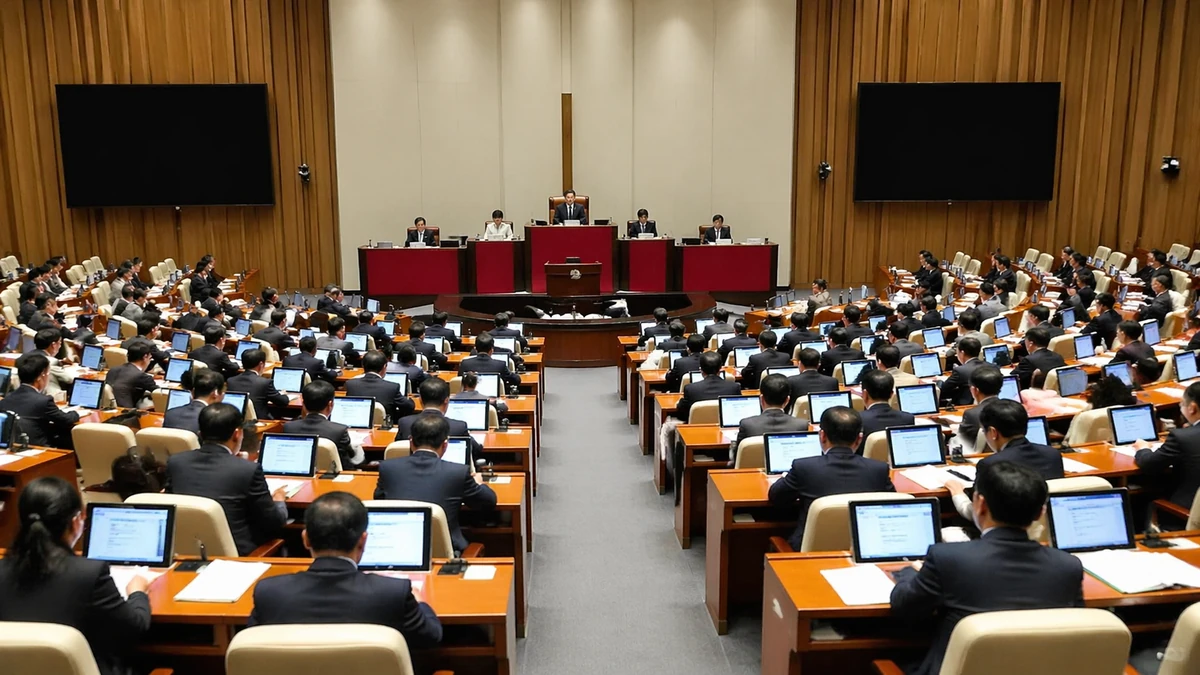
A revealing day in Seoul
In a country where political headlines are often dominated by presidential feuds, party infighting and North Korea-related tensions, South Korea’s National Assembly offered a different kind of drama on April 24, 2026. Lawmakers passed two measures on the same day that, at first glance, seem to have little in common. One dealt with relief for victims of so-called jeonse fraud, a housing crisis that has devastated renters across the country. The other addressed long-term service in public institutions, creating a formal pathway meant to recognize and reward people who have spent 15 years working in the public sector.
For American readers, the pairing may sound unusual. One bill centers on tenants who were caught in a uniquely Korean real estate system and then blindsided by fraud. The other focuses on how the state should compensate and retain long-serving public employees. But taken together, the bills tell a bigger story about where South Korean politics is heading. They raise the same core question: When ordinary people face risk, sacrifice or loss inside systems the government helped build, how far should the state go to step in?
That question is hardly unique to South Korea. Americans have seen versions of it play out after the 2008 housing crash, in debates over student debt relief, in arguments about aid for veterans, first responders and public servants, and in the long-running fight over whether government should simply regulate markets or also actively cushion people from market failure. In South Korea, the same tensions are now being expressed through legislation that combines bread-and-butter concerns — housing security, financial loss, public service careers — with a broader struggle over public trust.
The significance of the day was not just procedural. It suggested that after years of political combat over elections, appointments and ideological identity, both major parties are under pressure to show they can still respond to daily anxieties. In an era of high living costs, economic uncertainty and deep public fatigue with partisan theatrics, visible action on livelihood issues carries more political weight than rhetoric. The simultaneous passage of the two bills was not a random scheduling quirk. It was a snapshot of a political system acknowledging that voters are asking, with growing urgency, what government is actually for.
Why the jeonse fraud crisis matters so much
To understand the emotional and political force of the tenant relief law, Americans need a little context on jeonse, one of the most distinctive features of the South Korean housing market. Under a traditional jeonse lease, instead of paying monthly rent, a tenant puts down an enormous lump-sum deposit — often worth a large share of the home’s value — and gets that money back at the end of the lease. Landlords, in turn, use the deposit as capital. For years, the system functioned as a central part of Korean housing finance, especially for middle-class households and younger renters trying to avoid monthly payments.
But the system also depends heavily on trust, accurate property valuations, stable prices and timely repayment. When those conditions break down, the consequences can be catastrophic. In recent years, South Korea has been rocked by waves of jeonse-related fraud and deposit losses, with renters discovering that landlords had taken on too much debt, falsified information or left properties so financially entangled that tenants had little chance of recovering their money. The victims were not just a narrow slice of the population. They included young adults, newly married couples, first-time workers and households without property of their own — exactly the kinds of voters that every political party claims to champion.
For an American comparison, imagine if millions of renters had to hand over a giant security deposit equivalent to a down payment on a home, and then, when the landlord collapsed financially, they discovered there was no practical way to get it back. That would be more than a private contractual dispute. It would quickly become a public outrage over regulation, disclosure, enforcement and consumer protection. That is essentially what happened in South Korea. What looked like a string of private transactions came to be seen as a systemic failure involving weak oversight, information asymmetry, risky financing and a housing market structure that exposed renters to dangers they could not realistically assess on their own.
That is why the new support law carries meaning beyond the dollar amount of relief or the technical details of eligibility. It amounts to a renewed admission by the state that jeonse fraud is not merely a case of bad luck or isolated criminal behavior. It is a public-risk event born from institutional weaknesses. Once lawmakers accept that premise, the political debate shifts. The question is no longer whether the government should respond at all, but how quickly, how broadly and on what terms.
More than financial aid, a test of public trust
The tenant relief law is also politically important because it addresses something more fragile than money: confidence in the government’s basic competence. Many victims of jeonse fraud have not simply accused bad actors of cheating them. They have asked why the state failed to see the danger earlier and why a system so central to everyday life left them so exposed. That makes this kind of legislation a test of whether the government can repair damaged legitimacy, not just damaged bank accounts.
In South Korea, housing is not merely an economic issue. It is one of the most emotionally charged subjects in public life, closely tied to class mobility, family formation and generational frustration. High home prices, intense competition for urban housing and the social pressure associated with secure living arrangements have made real estate a permanent political fault line. When jeonse fraud spread, it struck at the heart of that anxiety. Victims often were people who had done what society asked of them: worked, saved, signed formal contracts and tried to build stable adult lives. Instead, many found themselves financially trapped and politically invisible.
That is one reason both conservatives and liberals in South Korea have treated the issue as too explosive to ignore. Delay carries a cost. Every month that passes without tangible relief risks deepening the impression that politicians understand housing only as an abstract policy domain, not as a daily source of fear. Yet intervention also comes with complications. Once lawmakers decide to help, they must define who qualifies as a victim, what losses merit support, whether compensation creates moral hazard and how taxpayers should share the burden. Those debates are familiar to Americans from federal disaster relief, bank rescues and student loan disputes: sympathy for victims can coexist with fierce argument over precedent and fairness.
That is where the South Korean law may ultimately succeed or fail. Passing the measure is only the beginning. If implementation becomes bogged down in paperwork, narrow definitions or disputes between agencies, the law could come to symbolize another delayed promise. But if relief is delivered clearly and quickly, it may do more than help tenants. It may show that the Korean state can still translate public anger into responsive governance. In an era when democracies around the world are struggling to prove they can act before cynicism hardens, that is no small thing.
The other bill and the politics of public service
The second measure passed that day has received less international attention, but it may prove just as revealing. According to the Korean account, the bill creates a formal opportunity structure for people who have spent 15 years serving in public institutions. On the surface, that sounds technical — the kind of human-resources or civil-service adjustment that rarely makes front-page news. Yet its political implications are larger than the dry legislative language suggests.
At stake is the value a modern state places on long-term public service. In the United States, debates over public-sector incentives usually center on pay, pensions, recruitment shortages, teacher retention, veterans’ benefits or the pipeline into public leadership roles. South Korea is wrestling with a related question: How should the government reward people who have devoted a significant portion of their working lives to public institutions, often in roles that may not command private-sector salaries or prestige but are essential to keeping public systems functioning?
The new law appears to frame long-term public service not just as employment but as a form of commitment deserving structured recognition. That matters in a country facing demographic strain, regional inequality and rising concern about whether the public sector can continue to attract and keep experienced workers. Expertise and institutional continuity are hard to maintain if the state relies only on salary competition. In some fields, the value of long service lies in accumulated knowledge, operational stability and the willingness to remain in roles that may be stressful, geographically inconvenient or less lucrative than private alternatives.
At the same time, this kind of measure carries obvious political risk. Any special pathway for one group can be attacked as favoritism if its rationale is not clearly explained. In South Korea, as in the United States, fairness is not just a policy consideration; it is a political battlefield. Citizens who already feel squeezed by credential competition and limited social mobility are quick to question whether new benefits are being distributed equitably. If the law is seen as a narrowly tailored reward for insiders rather than a carefully designed tool for strengthening public capacity, it could trigger resentment instead of respect.
That makes the bill about more than personnel management. It is part of a larger argument over whether public dedication should be measured only by market logic. If the answer is no, then governments need mechanisms to acknowledge sacrifice and retain talent. The challenge is building those mechanisms without undermining broader confidence in equal opportunity. South Korea’s lawmakers have now signaled that they are willing to move in that direction. The harder part will be persuading the public that the design serves the common good rather than a protected class.
Why both parties could agree, at least for now
One of the more striking aspects of the day in parliament was that two very different bills cleared together despite South Korea’s sharply polarized political environment. That does not mean lawmakers have discovered a new era of bipartisan harmony. It means they have recognized the political danger of being seen as paralyzed on matters voters experience directly.
In Washington, members of Congress often battle fiercely over ideology while still trying to claim credit for local projects, disaster funds or constituent services. The logic is similar in Seoul. Parties can continue to clash over investigations, foreign policy, appointments and electoral strategy while also deciding that total inaction on tenant losses or public-sector stability would be too costly. When inflation is high, housing is unstable and job prospects feel uncertain, symbolic politics loses some of its power. Voters want proof that institutions can still solve problems.
That helps explain the shared minimum ground behind the two bills. Relief for jeonse fraud victims had become difficult to postpone because the social anger was already well established. Likewise, a measure tied to long-term public service could be framed under the politically safer banner of strengthening public responsibility. Neither bill erases partisan division. Each side is still likely to tell a different story about what happened. One party may emphasize compassion and state protection; the other may stress responsible administration, targeted support and preserving fiscal discipline. But both clearly saw the risk of doing nothing.
This is where the day’s legislative symbolism becomes especially important. In many democracies, the public has grown accustomed to governments that are very good at conflict and much less convincing at follow-through. By passing these bills together, South Korean lawmakers were not ending political combat. They were repositioning it. The next phase of competition will be over who can claim to have protected ordinary people more effectively, more fairly and more responsibly. The battlefield moves from whether government should act to how it acts and who gets to define success.
The real fight begins after passage
Legislation is often treated as the climax of a political story. In practice, it is usually the end of one argument and the start of a more consequential one. That is especially true here. For the tenant law, success will not be measured by press releases or floor votes. It will be measured by whether victims can navigate the system, whether applications are processed without punishing delays, whether eligibility rules capture the full range of harm and whether people who have already lost money do not get trapped in another maze of bureaucracy.
Anyone who has dealt with insurance claims, FEMA paperwork or complicated compensation programs in the United States will recognize the danger. A law can be generous on paper and frustrating in real life. The more difficult the forms, the narrower the definitions and the slower the agencies, the more relief becomes a symbolic gesture rather than a meaningful intervention. South Korea now faces that familiar administrative test. The National Assembly has made a promise. The executive branch must make it tangible.
The same is true for the public-service bill. If the criteria are vague, the selection process opaque or the program poorly explained, the measure could quickly become fodder for controversy. Policies meant to honor commitment can backfire if the public suspects they are creating backdoor advantages. That means the details — eligibility, procedures, oversight, public justification — matter at least as much as the legislative principle.
In both cases, execution will shape the political narrative. If the tenant law reaches victims efficiently and the public-service measure is administered transparently, the government may be able to argue that politics can still respond to lived insecurity. If not, critics will have an easy line of attack: that lawmakers passed two headline-friendly bills and then left citizens to sort out the fine print alone. For a political class already struggling with trust, the margin for administrative failure is thin.
A broader shift in Korean politics
What happened in the National Assembly also points to a larger trend in South Korea: the return of protection and state responsibility as organizing principles of political competition. That does not mean South Korea is moving toward a European-style welfare consensus, and it certainly does not mean ideological conflict is fading. But it does suggest that voters are increasingly judging leaders by how they respond to vulnerability — in housing, labor, demographic decline and public services — rather than by abstract slogans alone.
The two bills passed on April 24 fit neatly into that shift. The tenant relief law expands the idea that housing-market failures can become matters of public obligation. The public-service measure, in its own way, expands the idea that the state has duties to those who sustain public systems over time. Both push the boundary of what government is expected to recognize, compensate and stabilize.
Those expansions come with unavoidable tradeoffs. Broader protection means higher fiscal pressure and harder debates about precedent. More formal rewards for public service invite disputes about equal treatment and access. Yet democracies do not get to avoid those questions indefinitely. They can only decide whether to confront them directly or wait until public frustration makes them unavoidable. South Korea’s lawmakers appear to have chosen the former, at least for now.
For American readers, the lesson is a familiar one in an unfamiliar setting. When trust in institutions weakens, the most politically powerful issue is often not ideology in the abstract but whether government can still provide basic security in the areas that shape everyday life. Housing, employment, fairness and recognition of service are not side issues. They are the ground on which democratic legitimacy is increasingly fought.
That is why the day’s twin votes mattered. They showed a parliament responding, however imperfectly, to the pressure to prove that the state’s promises still mean something. In one bill, that promise concerns renters who believed the system would protect their life savings. In the other, it concerns workers who believed long service to the public should count for more than a line on a resume. Different constituencies, different policies, same underlying demand: Show us that the government sees the risks we carry and is willing to bear some of them with us.
South Korea’s political class has not resolved that demand. It has only acknowledged it in law. Whether that acknowledgment becomes real relief, real recognition and renewed trust will depend on what happens next. But for one day in Seoul, amid all the familiar noise of modern politics, lawmakers made clear what the public increasingly wants from them: not simply argument, but protection; not simply promises, but proof.
Comments
Post a Comment