
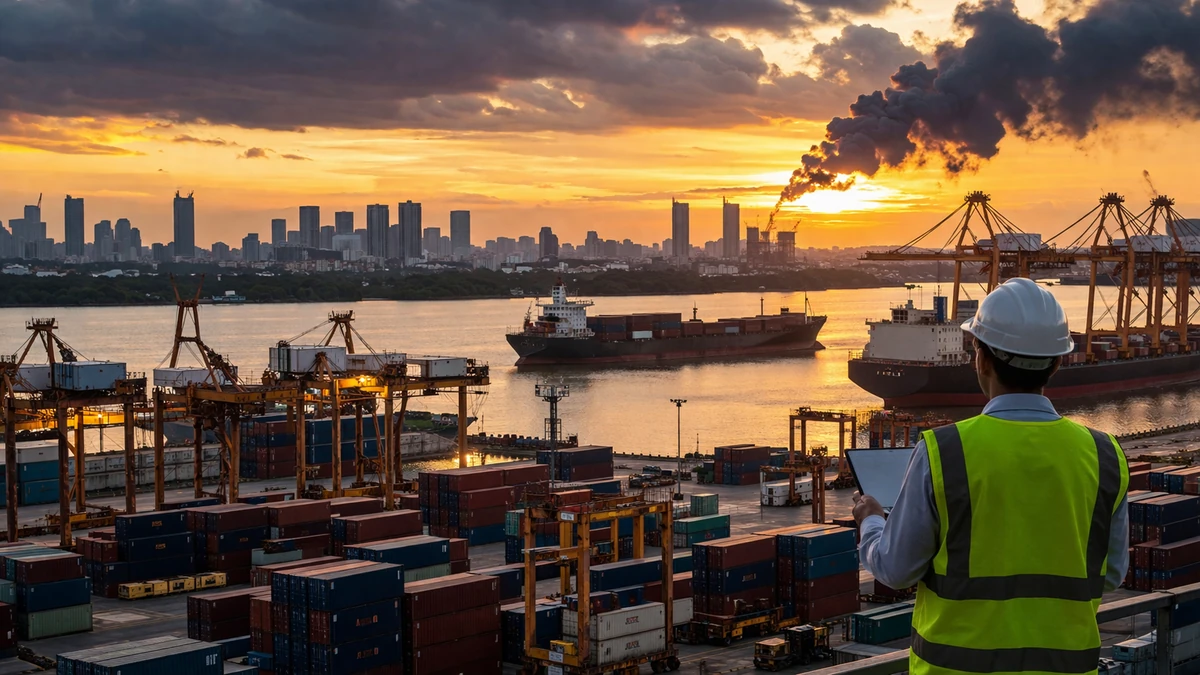
Vietnam’s early-year slowdown is a warning sign, not yet a crisis
Vietnam, one of Asia’s most closely watched manufacturing economies, is showing fresh signs of strain as the fallout from war in the Middle East reaches far beyond the battlefield. New figures reported by Vietnamese and regional media indicate that the country’s first-quarter growth rate came in 0.63 percentage points lower than a year earlier, a modest-looking shift that nonetheless carries outsized importance for investors, exporters and multinational companies that rely on Vietnam as a critical production base.
For American readers, Vietnam occupies a place in the global economy somewhat similar to what Mexico does for U.S. manufacturing: It is deeply integrated into international supply chains, heavily dependent on trade and increasingly central to how global companies diversify production. Over the past several years, Vietnam has emerged as a favored destination for foreign investment as businesses sought alternatives to concentrating too much manufacturing in China. Electronics assembly, garments, footwear, furniture and consumer goods have all helped turn the Southeast Asian nation into one of the world’s more dynamic export stories.
That is why even a relatively small deceleration matters. It suggests not simply a weak quarter, but renewed evidence that Vietnam’s economic model remains highly exposed to events far outside its borders. The same openness that helped the country grow quickly, attracting factories, tourists and foreign capital, also leaves it vulnerable when oil prices climb, shipping routes become less predictable and consumers in the United States and Europe pull back on spending.
At this stage, the slowdown does not amount to an economic emergency. Vietnam is not facing the kind of financial panic or sharp contraction that would immediately upend the broader regional outlook. But the first quarter’s softer performance serves as an early signal that downside pressures are building. Markets, manufacturers and policymakers are paying attention because the question now is not whether Vietnam can grow, but whether it can keep its momentum if global instability persists through the rest of the year.
The concern is especially acute because Vietnam’s economy tends to transmit external shocks quickly. When transport costs rise, factories feel it. When energy becomes more expensive, margins tighten. When consumers in wealthy markets delay purchases, export orders can weaken with little warning. A country built on trade, industrial production and foreign direct investment can expand rapidly in good times. It can also feel global stress sooner than larger, more insulated economies.
Why a war in the Middle East matters to a country in Southeast Asia
Vietnam is not a party to the conflict in the Middle East, and geographically it is far removed from the fighting. But geography offers limited protection in a global economy organized around energy markets, shipping lanes and investor confidence. The most immediate channel of pressure is oil. When conflict heightens fears of supply disruption, crude prices often rise or remain elevated. For Vietnam, which depends on imported energy and energy-intensive manufacturing, that creates a chain reaction touching factories, transportation firms, retailers and households.
Americans have a familiar frame of reference here. Just as higher gasoline prices can reshape family budgets and business costs in the United States, rising fuel prices in Vietnam can filter through the economy quickly. But the effects may be even more concentrated there because Vietnam’s growth relies so heavily on export manufacturing. Factories making phones, textiles, shoes or furniture must keep production lines running, move inputs around the country and ship finished goods abroad. Higher fuel and electricity costs can cut into already thin margins, particularly for suppliers competing on price.
The second transmission channel is shipping. Tensions in and around the Middle East have increased uncertainty for global maritime logistics, including insurance costs, rerouting risks and freight rate volatility. Vietnam, situated at a key junction of Asian supply chains, depends on dependable ocean shipping to bring in materials and send finished products to customers in the United States, Europe and elsewhere. When sea transport becomes more expensive or less predictable, the problem is not only the added cost. It is the loss of planning certainty.
That loss matters enormously in manufacturing. A delayed shipment of components can disrupt production schedules. A late outbound container can push back delivery dates, delay payment and create cash-flow stress. Even when end demand remains intact, uncertainty in logistics can force companies to hold more inventory, revise production timetables and operate more cautiously. For smaller firms, especially those without the balance sheets of large multinationals, that can become a serious burden.
There is also a financial channel. Prolonged geopolitical turmoil tends to make global investors more cautious. Money flows toward perceived safe havens, and emerging markets can face tighter financing conditions or more selective investment. Vietnam has spent years cultivating an image as a reliable destination for foreign manufacturers and long-term capital. If companies slow expansion plans or investors become more hesitant, the effects can spill over into hiring, construction, industrial park development and supplier networks.
In other words, the impact of war is not limited to headline oil prices. It spreads through transport, insurance, capital allocation, corporate planning and consumer psychology. That broad exposure helps explain why analysts are taking Vietnam’s first-quarter slowdown seriously even if the topline number alone does not suggest a dramatic break.
Export factories and tourism are likely to feel the pressure first
The sectors most exposed are the ones that have done the most to power Vietnam’s rise: export-oriented manufacturing and travel-related services. In manufacturing, Vietnam plays an important role in global supply chains for electronics, apparel, footwear and furniture, all industries that are highly sensitive to swings in transport costs, input prices and overseas demand. These are not niche sectors. They are core pillars of Vietnam’s development model.
For U.S. consumers, the connection is direct even if it is often invisible. Products assembled or manufactured in Vietnam reach American stores and e-commerce warehouses every day, from sneakers and clothing to furniture and consumer electronics components. When costs rise in Vietnam, companies may absorb them, pass some of them on to buyers or trim orders. Any of those responses can affect production decisions and employment on the ground.
The problem becomes more complicated if demand from major export markets weakens at the same time. If American and European households cut discretionary purchases, retailers may scale back inventory orders. That would hit Vietnam’s factories at the same moment they are dealing with higher operating and shipping costs. Industries like apparel and footwear, where margins can be slim and price competition intense, are especially vulnerable. Furniture producers, which depend heavily on housing-related and discretionary consumer spending abroad, can also feel pressure if buyers turn cautious.
Not every manufacturer faces the same level of risk. Companies producing basic consumer essentials or operating under long-term supply contracts may be better positioned to weather a short period of disruption. Firms with more efficient equipment, stronger logistics planning or a greater ability to source locally may also be more resilient. By contrast, smaller exporters that rely on seasonal orders or have little room to absorb rising costs could face much sharper strain.
Tourism and services are another area of concern. Since the COVID-19 pandemic, Vietnam has worked hard to revive international travel, banking on visitors to support hotels, restaurants, transportation providers and retailers. Geopolitical instability can disrupt that recovery in multiple ways. Airfare may rise. Travelers may become more cautious about long-haul trips. Households facing higher living costs at home may scale back vacation spending.
Even if Vietnam itself is not viewed as unsafe, global travel sentiment can deteriorate when conflict dominates headlines. In the travel business, perception matters almost as much as destination-specific risk. Travelers may shorten trips, choose cheaper destinations or simply postpone travel. That can ripple through the broader service economy. Premium tourism may prove somewhat more resilient, but middle-market and group travel often weakens first when consumers start watching their budgets.
The likely result is not a collapse in any one sector, but a more subtle, cumulative drag across several parts of the economy at once. That pattern matters because broad, moderate weakness can be harder to reverse than a single isolated shock. It does not produce one obvious emergency. Instead, it slowly erodes momentum.
Inflation and the currency could leave Vietnam’s government with limited room to maneuver
For Vietnamese policymakers, one of the most difficult challenges is managing slower growth without allowing inflation or currency instability to take hold. Rising oil prices can feed into higher import costs, which then spread to transport, production and consumer prices. That creates the classic policy dilemma seen in many countries: growth softens just as living costs threaten to rise.
American policymakers have faced similar tensions in recent years. The Federal Reserve, for example, has had to balance the risk of inflation against the risk of weakening growth. Vietnam’s challenge is different in scale and structure, but the underlying tradeoff is familiar. If authorities move too aggressively to stimulate growth, they could worsen price pressures. If they prioritize inflation control too heavily, they risk further slowing domestic demand and investment.
The currency is another major factor. In periods of global uncertainty, the U.S. dollar often strengthens as investors seek safety. For emerging markets, that can put pressure on local currencies. If Vietnam’s currency weakens, exporters may gain some price competitiveness abroad, but the benefits come with important costs. Imported fuel, raw materials and industrial inputs become more expensive. Companies carrying debt denominated in foreign currencies may face higher repayment burdens. Consumers can also feel the impact through more expensive imported goods.
Exchange-rate stability matters for reasons beyond accounting. It also affects business confidence. Companies planning production, sourcing or investment decisions place a premium on predictability. Sharp currency swings can complicate contract pricing, inventory decisions and financing. In a country that has built much of its growth on attracting global manufacturers, preserving confidence is a policy objective in its own right.
The government may turn to targeted tools rather than broad, dramatic intervention. Those could include managing fuel prices, adjusting taxes or fees, supporting industries deemed strategically important and trying to cushion vulnerable businesses from temporary shocks. But such measures can only do so much if the global backdrop remains unfavorable. Vietnam’s deeper challenge is structural. Its economy has long depended on imported energy, labor-intensive assembly work and external demand. Each time the world turns unstable, those vulnerabilities become more visible.
That does not mean Vietnam’s model has failed. On the contrary, it has delivered substantial growth, industrialization and foreign investment. But the latest slowdown underscores a recurring question for many export-led economies: How do you preserve the benefits of openness while becoming less fragile when the outside world turns rough?
Why this matters for South Korean and global companies — and for American supply chains, too
Vietnam is not only important in its own right. It is also a major production base for foreign companies, including a large number from South Korea, Japan, Taiwan, Europe and the United States. South Korean firms in particular have built a significant presence in Vietnam across electronics, displays, components, textiles, retail and consumer goods. That makes Vietnam’s softer growth relevant not just for local policymakers but for boardrooms across Asia and beyond.
The impact on these companies may come less from headline GDP growth than from deteriorating predictability. Businesses can often manage higher costs if they can plan around them. What is harder to manage is a constant need to revise shipping timetables, sourcing strategies and production schedules. If components arrive late, companies may need to carry more inventory. If freight rates spike unexpectedly, profit forecasts may no longer hold. If customers in the West cut orders while input costs are rising, managers face difficult choices about staffing, production volumes and investment.
For South Korean companies with manufacturing operations in Vietnam, the issue is particularly consequential because many use the country as an export platform to markets such as the United States and Europe. A disruption in Vietnam can therefore affect not just local sales but global supply chains tied to some of the world’s biggest consumer markets. Smaller suppliers may be especially vulnerable because they often lack the leverage to renegotiate prices or the cash reserves to absorb prolonged cost increases.
American companies also have reason to watch closely. As Washington and corporate America have talked increasingly about “China plus one” strategies — the practice of diversifying manufacturing into other countries rather than relying overwhelmingly on China — Vietnam has often ranked near the top of the list of alternatives. If the country becomes more expensive or less predictable in the short run, some businesses may reconsider the pace of expansion, even if they remain committed to Vietnam over the long term.
At the same time, disruption can create openings. Companies with more energy-efficient facilities, stronger local supplier networks or better logistics systems may be able to outperform competitors. Businesses that have already diversified shipping routes or raised the share of locally sourced materials could be better insulated. If Vietnam’s government responds by strengthening investment incentives or accelerating infrastructure spending, sectors tied to industrial parks, logistics technology, power systems and transport improvements may even see new demand.
Still, those opportunities depend on how long geopolitical stress lasts and whether consumer demand in major export markets recovers. If energy prices ease and shipping normalizes, Vietnam’s strengths — its skilled workforce, competitive labor costs, improving infrastructure and strong foreign investor base — could reassert themselves relatively quickly. If the shocks persist, businesses may shift into a more defensive posture.
What to watch in the months ahead
The central fact for now is straightforward: Vietnam’s first-quarter growth rate was lower than it was a year earlier, and analysts are linking that deceleration in part to spillover effects from the Middle East conflict. That does not settle the question of where Vietnam’s full-year economy is headed. It does, however, put several indicators under an intense spotlight.
The first is exports. Vietnam’s economy remains heavily dependent on overseas demand, so any sustained weakness in export growth would be a more serious warning sign than the first-quarter GDP figure alone. Closely related is the pace of new manufacturing orders. If factories continue to see softer demand or more erratic order patterns, it would suggest that the slowdown is not just a passing adjustment.
The second is tourism. A continued rebound in international arrivals could help cushion some of the pressure from manufacturing, while a loss of momentum in travel would remove an important support for hotels, restaurants, retail and transportation. The third is inflation, especially the extent to which higher energy costs feed into broader consumer prices. Vietnam’s authorities will want to avoid a situation in which slower growth coincides with a noticeable rise in household living costs.
The fourth is the currency and broader financial stability. A manageable exchange-rate adjustment is one thing; persistent pressure that undermines confidence is another. Investors will also be watching foreign direct investment commitments and disbursements for signs that multinational companies remain willing to expand in Vietnam despite current turbulence.
Finally, there is the question of resilience. Vietnam has repeatedly shown an ability to recover from external shocks, in part because global companies still see long-term advantages in building there. Its manufacturing ecosystem has deepened, its international trade ties are broad and its role in supply-chain diversification remains important. If oil prices calm, shipping disruptions ease and demand in the United States and Europe steadies, Vietnam could regain momentum faster than more pessimistic scenarios suggest.
But the latest slowdown is a reminder of how exposed fast-growing, trade-dependent economies can be in an era of overlapping geopolitical risks. For Vietnam, the issue is not simply whether a distant war affects local growth. It is whether the country can strengthen the parts of its economy that remain most vulnerable to disruptions in energy, shipping and external demand. That challenge will not be resolved in one quarter, and it will not be solved by short-term policy tweaks alone.
For American readers, Vietnam’s story offers a broader lesson about the modern global economy. A conflict in one region can quickly influence fuel prices, freight routes, factory decisions and tourism flows in another. The consequences can show up in places consumers rarely think about when they buy a pair of shoes, a wooden table or a smartphone accessory. Vietnam’s first-quarter slowdown is one more illustration that in today’s interconnected trading system, distance matters less than dependence.
That is why the next few months will matter so much. If Vietnam can stabilize costs, preserve investor confidence and keep its export engine humming, the first quarter may end up looking like a manageable stumble. If not, this could become an early marker of a more challenging year for one of Asia’s most important manufacturing hubs.



0 Comments