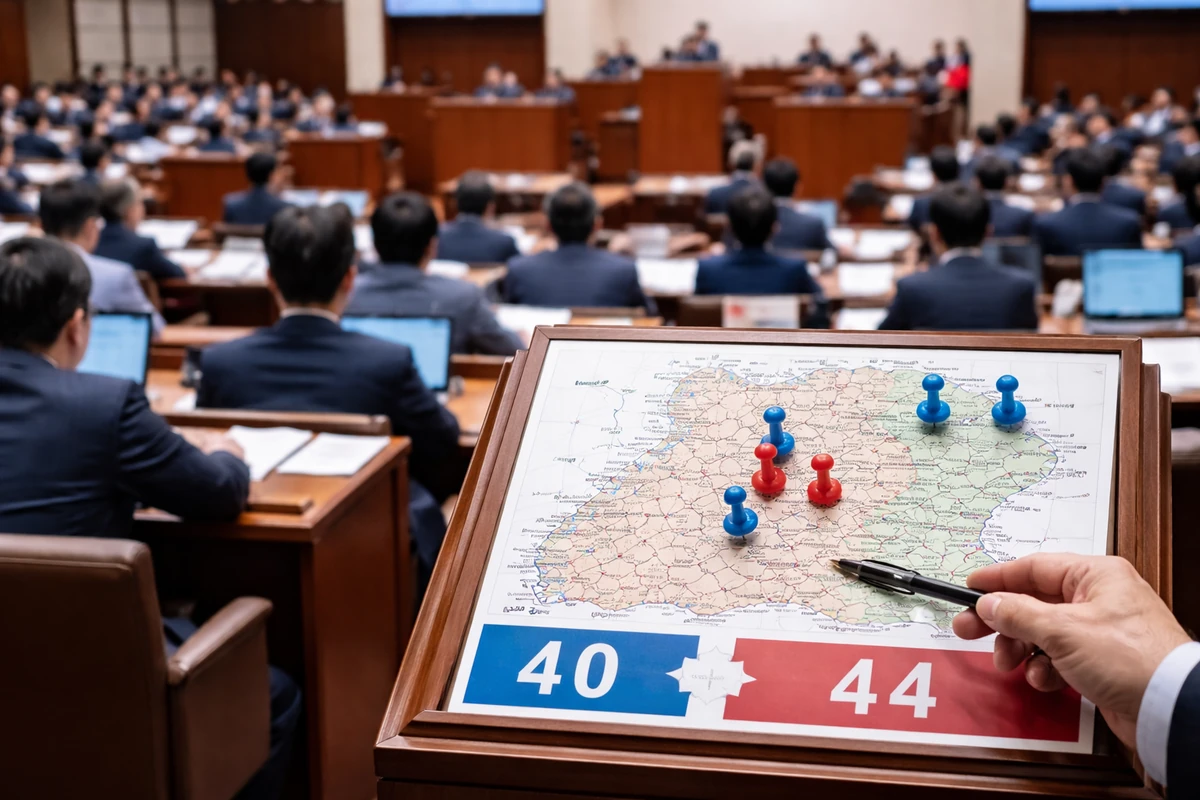
A local vote change with national meaning
At first glance, the decision to add four seats to the provincial council in Jeonbuk, a southwestern region of South Korea, can sound like the kind of procedural political story that rarely travels far beyond local government. The province’s council is expected to grow from 40 seats to 44, with one new district seat each going to the cities of Gunsan and Iksan and two more seats added through proportional representation, a party-list system that allocates seats based on overall vote share rather than a winner-take-all district contest.
But in South Korea, where electoral maps, constitutional rulings and regional identity often intersect in unusually visible ways, this is more than a bookkeeping exercise. The move, approved April 17 by a special parliamentary committee on political reform, reflects a broader argument about whose voices count in local democracy, how rural areas can remain politically visible in a country marked by population decline outside Seoul, and how local legislatures should evolve as regional governments take on bigger roles.
For American readers, a useful comparison might be a state legislature in a largely rural state suddenly gaining seats after years of arguing that its residents were underrepresented compared with similarly sized states. Now imagine that the change arrives not because lawmakers simply wanted to be generous, but because a court effectively forced the political system to confront a mismatch between old district lines and constitutional standards. That is closer to what is unfolding in Jeonbuk.
In South Korea, representation questions can quickly become existential for local politicians and deeply symbolic for residents. A seat in a provincial assembly is not merely a title. It can determine whether a farming county, a mid-sized industrial city or a shrinking rural community has someone pressing its case on budgets, transportation, welfare, schools and development planning. In Jeonbuk’s case, the added seats come as the region is also redefining itself under a new administrative identity: It recently became a “special self-governing province,” a status meant to give it more tailored authority and policy flexibility.
That means the stakes are larger than the number four suggests. The seat increase is a test of how South Korea balances population-based fairness with geographic representation, how political parties adapt when new opportunities open up, and whether local democracy can better reflect a province whose needs span farms, ports, industrial zones, small cities and communities confronting long-term population loss.
Why Jeonbuk has argued it was underrepresented
Jeonbuk, formally known as Jeonbuk Special Self-Governing Province, has long complained that it did not have enough seats in its provincial assembly relative to its population. Local officials and political figures have argued that the imbalance weakened the province’s political voice and limited the assembly’s ability to reflect diverse local interests. That claim was not just about prestige. In a local legislature, too few members can mean each lawmaker is responsible for too broad an area, too many issues and too many competing demands to represent any one community in detail.
The case resonated in part because Jeonbuk’s situation looked especially stark when compared with other provinces. According to the figures cited in the Korean reporting, Jeonbuk has roughly 220,000 more people than Gangwon Province but had nine fewer provincial lawmakers. It has about 50,000 fewer people than South Jeolla Province, another largely rural region, but had 21 fewer lawmakers. Those are the kinds of comparisons that can fuel a sense of institutional neglect, especially in regional politics, where residents often already feel overshadowed by Seoul and the surrounding capital area.
To understand why that matters, it helps to know how South Korea’s local politics work. Provincial councils oversee budgets, review ordinances and monitor the executive branch of local government. They do not command the same international attention as the National Assembly in Seoul, but they shape many of the decisions that affect everyday life. In a place like Jeonbuk, where communities range from agricultural counties to industrial cities and where local concerns differ sharply from one district to another, representation density can shape whether policy debates are broad and strategic or narrow and overloaded.
Jeonbuk’s local identity also adds to the sensitivity. The region is historically significant and culturally distinct, with a reputation for agriculture, food traditions and a slower-paced provincial life that contrasts with the hyper-centralized growth of metropolitan South Korea. Yet like many non-capital regions, it has faced the demographic and economic pressures of young people leaving for Seoul, uneven development and persistent concern that national policy is too concentrated on the capital region. In that context, underrepresentation in a provincial legislature becomes a symbol of a larger anxiety: that regions outside Seoul are asked to manage complex challenges with too little voice.
The seat increase therefore lands as a form of institutional recognition. It suggests that complaints once treated as local grievance have now been translated into the language of formal reform. For Jeonbuk, that does not solve every structural disadvantage, but it does represent a notable acknowledgment from the political system that the province’s representation problem was real enough to warrant redesign.
The court ruling that forced action
The immediate trigger for the overhaul was not simply political lobbying. It was legal pressure. The background to the reform includes a ruling by South Korea’s Constitutional Court finding parts of the existing electoral arrangement incompatible with the constitution. In particular, seats tied to the counties of Jangsu and Muju were reportedly at risk of being lost under the old structure.
That point matters because it changes the story from one of special treatment to one of institutional necessity. Rather than simply handing Jeonbuk extra power, lawmakers were responding to a system that could no longer be maintained without running afoul of constitutional standards. In other words, the old map was no longer legally stable.
Americans are familiar with versions of this logic through redistricting fights and court battles over equal representation. The details differ, but the underlying tension is recognizable: Should districts be drawn as strictly as possible around population equality, or should geography, community ties and the protection of sparsely populated areas also matter? In South Korea, as in the United States, those questions rarely have clean answers. They involve tradeoffs, and every tradeoff creates winners, losers and new arguments.
In Jeonbuk’s case, the redesign was crafted to preserve representation for smaller counties while also expanding the total number of seats provincewide. That is a politically important choice. Eliminating rural seats in the name of population parity might have satisfied one standard while inflaming another concern: that depopulated farming and mountain communities were being erased from the political map. Instead, the reform attempts to hold onto those rural voices while also adding seats where population and urban activity are more concentrated.
This is one reason the decision has drawn attention well beyond Jeonbuk. It offers a practical example of how constitutional law can drive local political change. In many democracies, election reform is often delayed because the stakes are too high and too many interests are invested in the status quo. But when a court ruling makes delay harder, lawmakers are forced to negotiate not in theory but in real institutional terms. Jeonbuk has become a case study in what happens when legal necessity collides with local demands for fairer representation.
Why the seat distribution is politically revealing
The way the four new seats are being distributed says as much as the total number itself. Two are district seats, one each for Gunsan and Iksan, two of Jeonbuk’s most important cities. The other two are proportional representation seats, which are allocated according to party vote totals and often used to broaden representation beyond strictly local district contests.
That split appears carefully calibrated. Giving new district seats to Gunsan and Iksan addresses a straightforward representation issue: both cities are major population centers with political and economic importance inside the province. Gunsan is a port city with an industrial profile, while Iksan has long been one of Jeonbuk’s key urban hubs. Adding one seat to each can be read as a recognition that urban residents in the province needed more direct representation.
At the same time, allocating half of the increase to proportional representation signals that lawmakers were not trying to solve the issue solely through district-based politics. In South Korea, proportional seats are often where parties can elevate candidates who may not fit the mold of a traditional local machine politician. That can include women, younger figures, policy specialists or candidates meant to reflect underrepresented interests. The practical effect varies from election to election, but the symbolic message is clear: representation is not only about geography. It is also about whether party vote share is translated more fairly into seats and whether the legislature includes people with expertise that district politics alone may not reward.
For Americans, this distinction is worth pausing over. South Korea’s electoral systems often blend district representation with forms of proportional representation more common in Europe or parts of Asia than in the United States. While Americans are used to thinking of seats primarily in terms of district winners, proportional seats create another route into office, one based less on neighborhood-level personal networks and more on party strategy and broader public appeal. That makes the addition of two proportional seats especially significant in a provincial assembly, where politics can otherwise become heavily dominated by local patronage and regional factionalism.
The distribution also reflects the balancing act at the heart of the reform. Rural representation in places like Jangsu and Muju is preserved. Urban representation in larger cities is strengthened. Party-list representation is modestly expanded. No one side gets everything, but several constituencies get enough to claim partial victory. In the contentious world of election reform, that is often how durable deals are made.
What this means for parties ahead of local elections
More seats do not always mean less political tension. Often they mean more. In Jeonbuk, the increase is likely to intensify jockeying within political parties ahead of the next local elections because new seats create new entry points into office. That can invite not only fresh faces but fiercer competition among established politicians, party committees, activists and aspirants who have been waiting for an opening.
Jeonbuk has long been seen as favorable terrain for South Korea’s liberal camp, particularly the Democratic Party and its predecessors. In regions where one party is dominant, the decisive battle is often not the general election itself but the party nomination. That reality has a distinctly American echo: In heavily Democratic or Republican districts in the United States, the primary can matter more than the November election. In Jeonbuk, the same logic often applies. A new seat is not just a new race. It can be a new internal power struggle.
The two new district seats are likely to sharpen competition among local political organizations in Gunsan and Iksan. Incumbents may try to shape the field. Newcomers may argue that the added seats were meant to broaden access and should not simply be absorbed by the same old networks. Women and younger politicians may press for a bigger role, especially given South Korea’s recurring debate over how male-dominated and seniority-driven local politics remains. Professionals from outside traditional party organizations may also see an opening, arguing that a province confronting industrial shifts, aging communities and policy complexity needs expertise as much as loyalty.
The two proportional seats could prove even more politically delicate. Party-list slots are often coveted because they depend heavily on party decisions and can be used to reward key constituencies or send strategic messages. A party might use them to boost female representation, showcase policy credentials or appeal to younger voters. But because such seats are allocated through internal ranking decisions, they can also become flashpoints for factional bargaining. Who gets placed high enough on a party list to have a real chance of winning can reveal a great deal about who actually holds power inside a regional party apparatus.
Smaller parties and independents may also see a modest opening. The odds remain difficult in a region with entrenched political habits, but proportional seats can lower the barrier to representation at least somewhat. Even if the immediate beneficiaries are still likely to come from major parties, the reform broadens the theoretical space for issue-based politics, not just personality- and organization-based politics. That matters in a province where debates over agriculture, transportation, welfare, youth out-migration and industrial redevelopment cannot easily be reduced to old patronage formulas.
Why Jeonbuk’s new special status raises the stakes
The seat increase is unfolding at a moment when Jeonbuk’s own governmental role is changing. The province recently transitioned into a special self-governing province, a status intended to give it more room to tailor policy and administration to local needs. For readers unfamiliar with South Korean administrative language, the label does not mean Jeonbuk is independent or separate from the national government. Rather, it points to a model in which a region is expected to exercise more specialized authority and pursue more customized policy design than a standard province might.
That shift makes the composition of the provincial assembly more important than before. As local authority expands, so does the need for oversight, scrutiny and policy capacity. A stronger governor’s office or a more empowered provincial administration can move faster, but speed is not always the same as democratic accountability. A legislature with too few members, too little expertise or too narrow a social base may struggle to keep up.
This is where the debate over the added seats intersects with a deeper question about local democracy in South Korea. Is a provincial assembly merely a venue for handling district complaints and budget requests, or is it a serious political institution capable of debating regional strategy? In Jeonbuk, that question is especially pressing. The province faces overlapping challenges: rural depopulation, the future of its industrial base, competition for investment, transportation development, social welfare demands from an aging population and the broader issue of how to remain economically and politically relevant in a country dominated by the Seoul metropolitan area.
A larger and potentially more diverse assembly could help address those issues with greater nuance. District lawmakers can bring local concerns from farms, towns and cities. Proportional members may be better positioned to focus on cross-regional policy themes such as education, industrial planning, social services or youth retention. That does not guarantee better governance. More seats can also mean more fragmentation, more patronage and more political theater. But the reform at least creates the possibility of a provincial legislature better matched to the complexity of the province it governs.
Critics, of course, may still ask whether adding seats merely expands the political class. That is a familiar complaint in democracies everywhere, including the United States. The answer will depend on performance. If the larger assembly uses its new capacity to more effectively represent residents, sharpen oversight and develop policy expertise, the reform will look justified. If it simply produces more insider competition without better governance, skepticism will deepen.
A broader lesson about democracy outside the capital
The Jeonbuk case also speaks to a wider reality in South Korea and beyond: The health of democracy is often tested not in national headlines but in whether people outside major metropolitan centers believe the system still sees them. In the United States, that debate plays out through fights over rural representation, statehouse maps and whether smaller communities feel heard by political institutions centered on large cities. In South Korea, the divide is often framed through the outsized pull of Seoul and the concern that non-capital regions are losing not just population and investment, but also political leverage.
That is why the Jeonbuk reform carries symbolic force. It tells residents of a province that has often felt structurally disadvantaged that their representation claims were not simply rhetorical. It also shows how constitutional rules, local demands and party calculations can converge to reshape institutions in ways that seem small on paper but significant in practice.
There is no reason to romanticize the change. Four seats will not transform Jeonbuk overnight. They will not reverse population decline, erase regional inequality or eliminate factional politics. But institutions are often altered incrementally, and the meaning of an increment depends on the conditions surrounding it. Here, the conditions include a court-driven need for reform, a longstanding sense of underrepresentation, a newly elevated provincial status and an approaching election cycle that will force parties to decide what kind of candidates they actually want to send into local government.
In that sense, Jeonbuk’s four new seats are not just about arithmetic. They are about who gets to shape the next phase of local politics in a province trying to redefine its place in South Korea. For a region balancing rural preservation, urban demands and the responsibilities of greater self-governance, representation is not an abstract concept. It is the machinery through which policy becomes visible, disputes become negotiable and communities decide whether democracy still feels close enough to matter.
For outside observers, the lesson is straightforward: Pay attention to local institutions, especially in places that rarely dominate international coverage. They often reveal the deeper pressures inside a political system. In Jeonbuk, a four-seat increase in a provincial assembly has become a window into how South Korea is wrestling with constitutional fairness, regional identity and the uneven geography of democratic voice. That is far more than a numbers story.
Comments
Post a Comment