
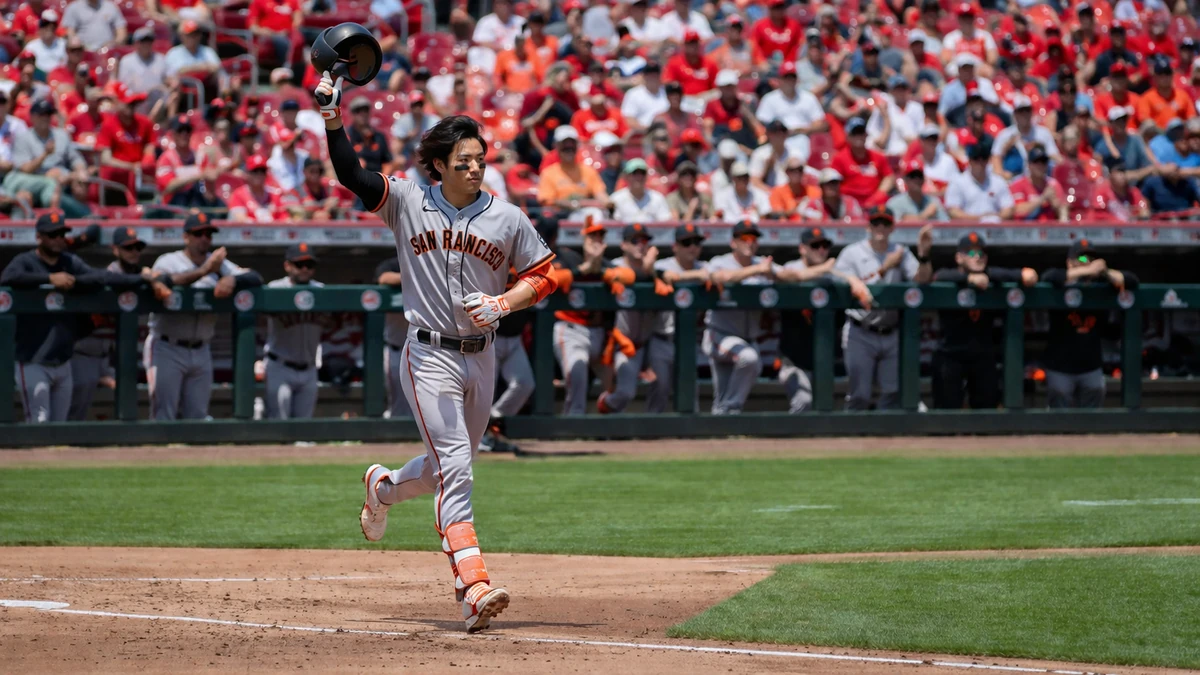
A spring box score with outsized meaning
For most Major League Baseball regulars, a three-hit game in April is worth noting but rarely worth romanticizing. The season is too long, the sample sizes too small, and the rhythms of a six-month schedule too unforgiving to declare anything after one good night. But when San Francisco Giants outfielder Lee Jung-hoo went 3 for 4 with an RBI in a 3-0 win over the Cincinnati Reds at Great American Ball Park, the performance carried more weight than a routine line in the morning agate.
That is partly because of where Lee’s season stood entering the game. Before first pitch, his batting average sat at .213, a number that can feel especially loud in the early weeks of a season when every empty at-bat seems to linger. By the end of the night, after three hits pushed him to 16-for-65, that average had jumped to .246. In raw mathematical terms, early-season averages can move dramatically in a single game because there are still so few plate appearances. But baseball people know not every statistical jump feels the same. One hit that nudges the number upward is one thing. Three hits in a low-scoring win, from a player hitting in a run-producing spot, suggest something more substantial: timing, confidence and usefulness all reappearing at once.
For American fans still getting acquainted with Lee, that distinction matters. He did not arrive in San Francisco as an anonymous rookie trying to stick on a 26-man roster. He came from South Korea as one of the most accomplished hitters in the Korea Baseball Organization, or KBO, the top professional league in South Korea and an increasingly familiar pipeline for MLB teams. Lee’s transition has been watched closely not only by Giants fans but also by a trans-Pacific audience that has seen him as the son of a former star, a national team fixture and one of the most polished contact hitters to come out of Korea in years. Nights like this do not prove that transition is complete. They do, however, show what it looks like when the game begins to resemble the version of Lee that made him such a coveted player in the first place.
San Francisco did not need an offensive explosion to beat Cincinnati. In some ways, that made Lee’s night stand out even more. On a night when the Giants scored only three runs, his three hits were not decorative. They were central. In a 10-8 game, individual contributions can blur together. In a 3-0 game, nearly every baserunner and every timely swing feels like part of the story. Lee was not just padding his own line. He was helping shape the outcome.
Why early numbers can mislead — and still matter
Baseball has always had a complicated relationship with small samples. The sport is built on accumulation, and almost every meaningful judgment asks for patience. That is why executives and analysts caution against overreacting to batting average in mid-April. A handful of bloop hits, a few line drives caught at the warning track, a bad week against hard-throwing pitching — any of it can distort the picture before the season has time to settle.
Still, saying the numbers are unstable is not the same as saying they are meaningless. Early statistics may not tell the whole truth, but they do shape the mood around a player. A low average can start to invite questions about adjustment, comfort and pressure. For a newcomer to the majors, especially one arriving with international attention and a multiyear contract, those questions can come fast. Every slump becomes a referendum. Every good game can feel like a rebuttal.
That helps explain why Lee’s jump from .213 to .246 matters in practical terms even if no serious observer would call .246 a final destination. Numbers affect psychology. Hitters talk constantly about rhythm — not just mechanics, but tempo, decision-making and the ability to trust what they see. When a player is scuffling, that rhythm can break down. He starts chasing correction instead of letting the game come to him. A three-hit performance can interrupt that spiral. It can restore not just a stat line, but a sense of normalcy.
Lee’s recent stretch adds to the significance. He has now hit safely in three consecutive games, going 6 for 11 over that span, a .545 clip. No one should confuse 11 at-bats with a definitive trend line. But in baseball, recovery often announces itself in fragments before it shows up in season-long totals. A hitter starts squaring up fastballs again. He stops looking rushed with two strikes. He finds ways to stay productive against different pitch types or in different ballparks. The larger numbers lag behind the feel of it. In Lee’s case, the feel has started to improve before the full-season line has had time to catch up.
That is often how rebounds begin. Not with a grand declaration, not with a single towering home run that changes a narrative overnight, but with a cluster of professional at-bats that suggest a player has found his footing again. For a contact-oriented hitter like Lee, whose value is tied less to all-or-nothing power and more to barrel control, bat-to-ball skill and situational consistency, a three-hit night is an especially telling sign. It suggests the process is stabilizing.
A second three-hit game turns a flash into a pattern
The game against Cincinnati was Lee’s second three-hit game of the young season. His first came April 1 against the San Diego Padres, when he went 3 for 5 and offered an early glimpse of the hitter the Giants believed they were signing. The importance of the second one is easy to miss if all you see is the duplicate number in the hits column. In reality, the second can mean more than the first.
One standout game can be dismissed as a flash. Two starts to look like a template. For any player adapting to the major leagues, repeatability is the real test. The challenge is not whether you can have one good night against one pitcher in one series. The challenge is whether you can reproduce your game after the league adjusts, after scouting reports circulate and after the grind of travel and unfamiliar ballparks begins to wear on you.
That is particularly relevant for international hitters coming from Asia to MLB, where the style of play can differ in subtle but important ways. KBO baseball is highly competitive and technically polished, but major league pitching depth is relentless. Velocity is greater on average, bullpens are deeper, and every series brings a new mix of hard stuff, spin and specialized matchups. Position players who dominated in Korea or Japan often need time to recalibrate timing, strike-zone decisions and even their recovery routines over a longer, more physically demanding schedule.
For American audiences, the easiest comparison may be a highly touted college quarterback adjusting to the speed of the NFL. Talent does not vanish. But windows close faster, mistakes are punished more sharply, and success has to be re-earned at a different pace. Lee’s second three-hit game does not erase the challenges of that adjustment. It does suggest his success is not limited to one isolated burst.
That distinction also matters because Lee entered the season under an unusually bright spotlight for a player still introducing himself to a new fan base. In South Korea, he was already a household name. He is the son of former KBO star Lee Jong-beom, often nicknamed the “Son of the Wind,” and that lineage has followed him throughout his career. In Korea’s sports culture, family legacy can be a powerful part of public identity, not unlike the way American fans track the sons of former NBA or NFL stars. But legacy cuts both ways. It brings recognition, and it also raises expectations. When Lee signed with the Giants, he was not simply another import. He was arriving with pedigree, reputation and the weight of representing Korean baseball on one of the sport’s biggest stages.
That makes repeatable success more meaningful than any one-off performance. The first three-hit game said he could do it here. The second says he can get back to it.
More than hits: The importance of the No. 5 spot
Lee was in the lineup as the Giants’ No. 5 hitter and started in right field, a role that says something about how the club wanted to use him that night. Batting fifth is not merely about getting plate appearances. It is a spot that often asks for run production, for extending rallies and for delivering quality at-bats when men are on base. It is not enough to look comfortable. A hitter in that part of the order is expected to help cash in opportunities or keep innings alive for the bottom half of the lineup.
Lee did exactly that. His final line — 3 for 4, one RBI — reads efficiently, but its value is better appreciated in the context of a 3-0 game. In low-scoring contests, each quality plate appearance carries more leverage. An RBI is not just one more statistic in a stack of offense. It can be the difference between a tight game and a manageable one, between pressure on the bullpen and a little breathing room.
This is where the American baseball cliché about “productive outs” and “moving the line” actually applies. Teams do not need every middle-of-the-order hitter to launch tape-measure home runs every night. They need reliability. In a game dominated by pitching, Lee provided the kind of offense that translates directly to winning: contact, traffic on the bases and a timely contribution when opportunities appeared.
His defensive assignment adds another layer. Right field is not the game’s most glamorous outfield position, but it can be demanding in major league parks, particularly with the attention and concentration required over nine innings. That Lee was able to handle the defensive side while producing one of the team’s most important offensive performances underscores a broader point: this was not just a lucky night at the plate. It was a full game in which he held his place in the lineup and in the field without letting one side of the job compromise the other.
For players trying to establish trust with a new club, that kind of complete performance matters. Managers and teammates notice the details that do not always make headlines — whether a player stays engaged when the ball is not finding him, whether he looks rushed, whether he contributes to the overall rhythm of the game. Lee’s night against Cincinnati offered a strong answer on all fronts.
The Korean context behind the attention
To understand why Lee’s performance resonates beyond the Bay Area, it helps to understand the place he occupies in Korean sports culture. Baseball remains one of South Korea’s most popular spectator sports, and the KBO is not some niche developmental circuit. It is a deeply rooted professional league with passionate fan bases, highly organized cheering sections and a game-day atmosphere that can feel more like a college football Saturday crossed with a summer festival. The chanting, songs and coordinated support are part of the appeal, and Korean stars often arrive in MLB with both a polished competitive background and a sizable following back home.
Lee is one of the latest faces in that continuing exchange between Korean baseball and the majors. American fans may remember earlier KBO-to-MLB names such as Shin-Soo Choo, Kim Ha-seong, Hwang Jae-gyun or Ryu Hyun-jin, each of whom helped broaden the visibility of Korean baseball in the United States. More recently, Korean-born players have not just appeared in the majors; they have arrived with expectations to contribute meaningfully. That raises the stakes for every early success and every early struggle.
There is also a broader Korean Wave element at play, even if sports occupies a different lane from K-pop and Korean television dramas. American awareness of South Korea has expanded dramatically over the past decade through music, film, television, food and beauty brands. For many Americans, that cultural expansion has created a new curiosity about Korean public figures across industries, including athletes. A player like Lee enters an American sports market at a moment when more people are primed to care who he is, where he came from and what his success might signify.
That does not mean every at-bat carries geopolitical meaning. But it does mean Lee’s development is being watched through multiple lenses at once: as a Giants story, as a major league adaptation story and as part of the growing visibility of Korean talent in American public life. In that environment, a three-hit game lands differently. It reassures local fans who want production. It reassures international followers who want evidence that the transition is taking hold. And it reminds everyone that the player beneath the narrative is still, first and foremost, a ballplayer trying to establish his ordinary daily standard.
That last point is important. Too often, international athletes are discussed only as symbols. Lee’s night against the Reds mattered because it looked like baseball, not because it needed to symbolize something larger. He got hits, drove in a run and helped his team win. The cultural context explains the interest. The baseball itself explains the significance.
What comes next is more important than what just happened
If there is one temptation to resist after a game like this, it is the urge to declare a full revival. Baseball punishes certainty, especially in April. Three hits can start a climb, but they do not guarantee one. Pitchers adjust. Schedules thicken. Travel accumulates. A hitter can feel locked in one week and spend the next one rolling over sliders and flying out to left.
So the right way to frame Lee’s performance is not as proof that all early concerns were misplaced, nor as evidence that the season has permanently turned. It is better understood as the clearest recent marker that his season may be bending in the right direction. A game like this gives shape to a rebound before the full body of work has had time to confirm it.
What would confirmation look like? More of the same, but not necessarily in identical form. It would mean continuing the hit streak another few games. It would mean keeping quality at-bats even on nights when the hits do not fall. It would mean remaining useful against different types of pitching and in different lineup situations. Over time, the statistics that matter most — on-base ability, extra-base impact, batting average, run creation — would begin to stabilize around a stronger level.
For now, the key is sustainability rather than spectacle. In a sport that reveres hot streaks but ultimately rewards consistency, Lee does not need to be sensational every night to shift the conversation around his start. He needs to be dependable often enough that one three-hit game starts to look less like a detour and more like the road.
The Giants, meanwhile, will gladly take the simpler version of this story. On a night in Cincinnati, they got strong pitching, enough offense and a meaningful contribution from a player they need in the middle of their lineup. That alone is useful. If the game also ends up being remembered as the point where Lee’s early numbers began to normalize and his season started to settle, all the better.
Sometimes a spring breakout is obvious. Sometimes it arrives quietly, disguised as a 3-for-4 line in a 3-0 win. For Lee Jung-hoo, this looked like the latter: not a final answer, but a persuasive beginning.




0 Comments