A familiar line in an unexpected place
In a country often held up as a global model of high-speed internet, smartphone adoption and cashless convenience, one of the most revealing scenes in South Korea lately has not been inside a semiconductor plant or a cutting-edge startup. It has been at the local bank branch.
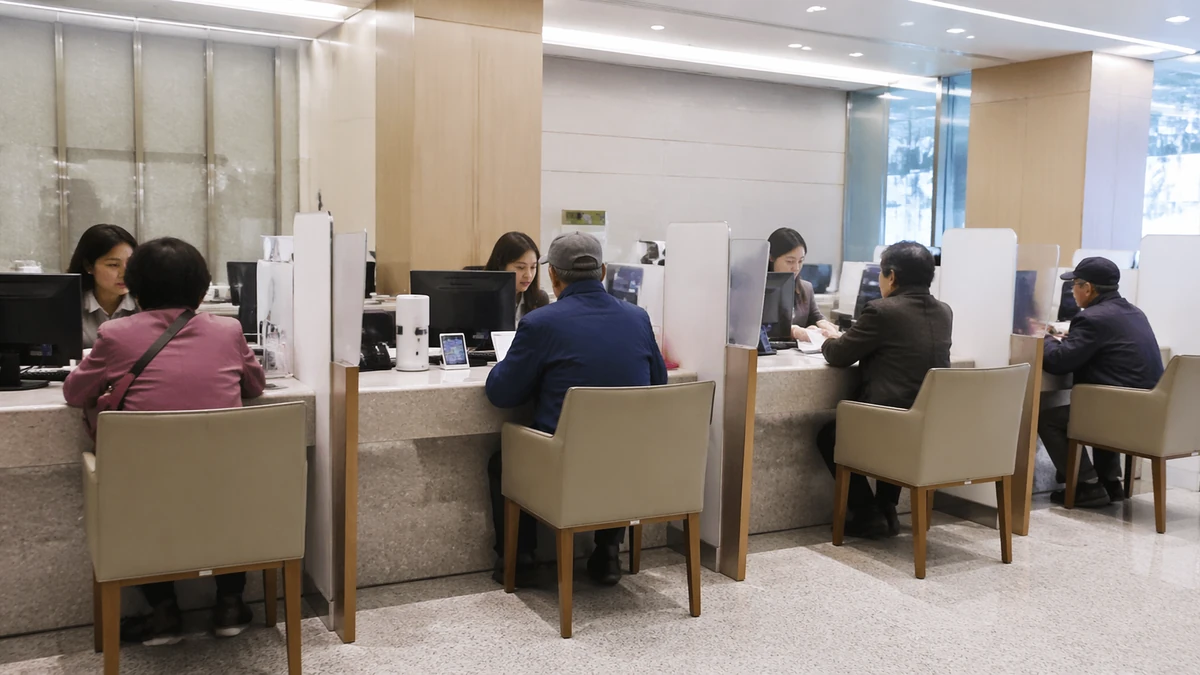
On April 25, 2026, reporting from South Korea highlighted a quiet but telling reality: Many middle-aged and older customers are still walking into bank offices for basic tasks such as withdrawing cash, transferring money and exchanging bills. At first glance, that may sound like a simple matter of habit, the kind of generational divide Americans might recognize when an older relative prefers visiting a teller instead of using a banking app. But the Korean case points to something deeper. These visits are often less about nostalgia than about anxiety — not vague technophobia, but a rational response to the way modern digital finance has been built.
South Korea is one of the world’s most wired societies. It has some of the fastest broadband speeds anywhere, one of the highest rates of smartphone penetration, and a culture that embraced mobile payments, online shopping and app-based services far earlier than many Western countries. To outsiders, that can create the impression that digital transition is complete. Yet the line at the teller window tells a different story: Even in a hyperconnected society, trust in financial technology is not evenly distributed, and access is not the same thing as confidence.
That matters because banking is not like browsing social media or ordering takeout. A mistake in a messaging app can be shrugged off. A mistake involving a bank transfer, a security certificate or an account authentication process can mean real financial loss, or at least the fear of it. For many customers, especially older ones, the issue is not whether they know how to tap an icon on a phone. It is whether they feel safe navigating a maze of security steps, warning messages and exception cases without another person beside them.
The scene at Korean bank counters offers a broader lesson for other countries, including the United States, as banks push more services online while reducing physical branches. The future of finance may be digital, but people still need systems that make them feel secure, legible and included.
Using the app is not the same as trusting it
South Korea’s digital banking expansion has usually been described in the language of convenience. With a smartphone, customers can check balances, pay bills, send money, apply for loans and manage investments without commuting to a branch. That promise is real. Anyone who has deposited a check on a U.S. banking app or paid a friend through Venmo understands the appeal. For people with mobility issues, long work hours or limited transportation options, digital access can be liberating.
But the promise rests on an assumption: that users can not only follow the main path of an app, but also understand what happens when something goes wrong. That distinction is central to what South Korean customers are now revealing. Many can handle routine actions. They can log in, check a balance, maybe even send a small transfer. The trouble begins in the exceptions: a mistyped password, an expired security certificate, a new phone, an unfamiliar warning popup, an account lockout, a verification failure. In those moments, the user is no longer just completing a task. The user is being asked to interpret risk.
That gap between being able to use an app and being able to rely on it independently is easy to overlook in policy debates. In both Korea and the United States, public conversation about the digital divide often assumes a binary: either someone is connected or disconnected, either digitally literate or not. Real life is much messier. Plenty of people own smartphones, download apps and manage parts of daily life online while still feeling deeply uneasy about financial transactions that carry serious consequences.
That unease is not irrational. Banking apps increasingly combine multiple layers of authentication, biometric prompts, one-time passwords, security alerts and terms that are meant to deter fraud. In theory, more security should reassure users. In practice, too many steps can overwhelm them, especially if the app does little to explain why a step is necessary or what to do after an error. Many systems are designed for the “average” or “confident” user — someone who assumes that a warning is manageable, that a failed login can be fixed, that support can be found somewhere in a FAQ. For customers who do not operate with that assumption, every unfamiliar prompt feels like a possible trap.
That is one reason bank employees in South Korea told reporters they often end up walking older customers through app screens and verification steps one by one. Even after such in-person explanations, many customers say repeating the process alone at home is difficult. They want to see, confirm and understand what is happening in real time. The physical branch, in that sense, is not merely an outdated channel surviving on inertia. It remains a safety mechanism.
The shadow of scams and financial fraud
Another force driving people back to the counter is fear of fraud. In South Korea, as in the United States, scams involving fake calls, phishing links, hacked accounts and fraudulent text messages have become part of the background noise of everyday life. Korea’s version of this problem is often discussed under the term “voice phishing,” which generally refers to scams in which criminals impersonate prosecutors, police officers, bank employees or other authorities over the phone to pressure victims into transferring money or revealing sensitive information.
American readers will recognize the pattern. It resembles the fake IRS call, the grandparent scam, the text pretending to be from a delivery company, or the bank alert that tries to panic a customer into clicking a malicious link. Once those threats become common enough, financial decision-making changes. People stop asking, “What is the fastest way to do this?” and start asking, “What is the least risky way to avoid making a terrible mistake?”
That shift is especially pronounced among middle-aged and older customers, but it is not limited to them. Even younger users who conduct most of their day-to-day banking on mobile devices may prefer an in-person visit for a large transfer or another transaction that feels weighty. Clicking “confirm” on a screen may take one second, but the emotional burden of that click can be substantial. The legal and financial responsibility still belongs to the customer. When the amount is large, the recipient is unfamiliar, or the transaction cannot easily be reversed, many people want the reassurance of a human being.
In South Korea, the atmosphere of vigilance around scams appears to be intensifying the appeal of in-person service. A suspicious text, an unknown phone number or a strange security warning can turn a routine banking task into a moment of dread. And that dread is not just about losing money. It is also about blame. Users understand, correctly, that in many digital systems they are expected to detect danger, interpret security language and avoid mistakes on their own. If they fail, they may feel they have no one to hold accountable but themselves.
That is a heavy burden to place on ordinary consumers. Knowing how to use a device is not the same as knowing whether a situation is safe. Yet digital finance often assumes that end users can make that judgment unaided. As scammers become more sophisticated, the line between a legitimate banking message and a fraudulent one is not always obvious, especially to someone who already feels uncertain. Seen from that perspective, the branch counter becomes more than a service point. It becomes a place where risk can be shared, verified and, at least psychologically, contained.
When branches disappear, the cost does not disappear
The return of some customers to teller windows comes at a moment when banks, in Korea and elsewhere, have strong incentives to shrink their branch networks. From a corporate perspective, the logic is straightforward. If most customers are using mobile and online channels, maintaining a large physical footprint can look inefficient. U.S. consumers have seen a similar pattern for years as banks close branches, consolidate service areas and encourage digital self-service for everything from deposits to customer support.
But branch reduction does not eliminate demand. It redistributes the cost of access. In South Korea, the customers still visiting branches are often not doing so because they simply enjoy the old way of doing things. They are going because certain procedures remain difficult to solve alone at home. Resetting authentication tools, reinstalling apps, distinguishing legitimate messages from suspicious ones, reading dense on-screen text, managing tiny buttons and complex navigation — each of these tasks can become a serious barrier, especially for older people or anyone with vision, dexterity or cognitive challenges.
When nearby branches close, those barriers compound. Customers may need to travel farther, spend more on transit, wait longer and endure more physical strain simply to perform a basic financial function that others can complete in seconds. That is not just an inconvenience. It is a redistribution of labor and risk from institutions to individuals. The bank gains efficiency. The user pays in time, stress and vulnerability.
In South Korea, where urban density can make branch access easier than in many parts of the United States, that tradeoff is already visible. In the U.S., where rural bank deserts and branch closures have become a longstanding issue, the implications are even easier to imagine. If a person without reliable internet, transportation or tech support loses the nearest branch, the result can be financial exclusion in all but name. That exclusion does not always show up as total unbanked status. It may instead appear as delayed transactions, dependence on family members, avoidance of certain services or a persistent fear of doing something wrong.
The Korean case underscores an important point often missed in conversations about modernization: Efficiency for the system is not always ease for the customer. If the benefits of digitization flow mainly to banks while the costs of adaptation fall heavily on older or more vulnerable users, then what looks like neutral innovation begins to look more like an equity problem.
This is a design problem, not just a generational one
One of the easiest mistakes in discussing digital exclusion is to frame it as a personal shortcoming. People say some version of the same thing in many countries: Everyone uses smartphones now. It is not that hard. They just do not want to learn. That explanation is appealing because it makes the problem seem simple and individual. It is also incomplete.
Financial services demand far more precision and trust than many other digital tools. Learning to use a chat app is not the same as learning to manage bank transfers, identity verification, security alerts and account recovery. The consequences of error are different. So is the emotional pressure. When a banking app is confusing, it does not merely frustrate users. It can frighten them.
That is why the question should not only be whether older customers know how to use technology. It should also be whether the technology has been designed with enough empathy for people who are more vulnerable to error. Why do authentication procedures change so often? Why are warning messages written in language that can be hard to interpret? Why is it often difficult to reach a human quickly when something fails? Why do apps so rarely explain, in plain terms, where a user got stuck and what exactly should happen next?
These are design choices. They are not inevitable features of modern finance. A well-designed system does more than protect against fraud. It also helps users understand what is happening and recover safely when they make mistakes. A humane digital system is not one that merely functions for expert users. It is one that remains usable under stress, by ordinary people, in exceptional circumstances.
That is where the Korean bank counter reveals something important. When an employee sits beside a customer and walks through a problem step by step, the employee is doing more than providing service. The employee is translating the system. He or she is helping the customer connect abstract security procedures to concrete action. In an era of digital-first finance, that translation function may become more important, not less.
Americans have seen versions of this elsewhere. Think of how many people still need an in-person tax preparer even though software exists, or why patients continue to depend on clinic staff to navigate online medical portals. The issue is rarely pure inability. It is the complexity of systems whose designers assume too much confidence, too much time and too much margin for error.
Cash still carries meaning in a nearly cashless society
One striking detail in the Korean reporting involved a middle-aged man who visited a bank to withdraw cash and request a large quantity of 1,000-won bills, roughly the Korean equivalent of asking for many one-dollar bills. He said he needed cash for everyday expenses such as parking. That small scene matters because it complicates another common assumption of digital life: that cash is simply fading away.
South Korea has moved rapidly toward digital payments. Credit cards, QR payments, mobile wallets and app-based transfers are deeply embedded in everyday commerce. But “mostly digital” is not the same as “fully cashless.” Many practical situations still call for bills and coins, and some consumers continue to prefer them because cash offers a sense of direct control. The money is visible. The spending is tangible. The limits are immediate.
That preference is not necessarily backward-looking. For some people, cash is a budgeting tool. It helps them divide household spending into categories, track small outflows and avoid the abstraction that digital balances can create. Anyone in the United States who has used the envelope budgeting method, or knows someone who relies on cash to manage discretionary spending, will understand the logic. In a world where money increasingly exists as numbers on a screen, physical currency can still feel more real — and therefore more manageable.
To dismiss that preference as old-fashioned would miss the broader point. Cash use, branch visits and requests for employee assistance are not isolated relics. They are signals about how different groups experience economic life. For some, digital finance feels seamless. For others, it feels opaque, precarious or overly abstract. The persistence of cash is one reminder that financial behavior is shaped not only by technological availability but also by habit, trust, self-discipline and the desire for control.
In the United States, this debate surfaces whenever cities, retailers or transit systems move away from cash and consumer advocates raise concerns about exclusion. Korea’s experience adds another dimension: Even where digital infrastructure is world-class, not everyone wants every financial interaction to become invisible and frictionless. Sometimes a little friction — a teller, a receipt, a stack of small bills, a verbal confirmation — is precisely what makes the interaction feel secure.
What South Korea is telling the rest of us
The broader lesson from South Korea is not that digital finance has failed. Far from it. Mobile banking has delivered genuine convenience, widened access for many users and become a normal part of modern life. The lesson is that technological adoption can coexist with deep insecurity, and that policymakers and financial institutions make a mistake when they treat remaining in-person demand as mere resistance to change.
What is happening at Korean bank branches should be read as a diagnostic signal. It tells us where systems remain too complex, where risk is being pushed onto consumers, and where a supposedly universal service still depends on confidence that many people do not fully possess. If a person can technically open a banking app but does not trust himself or herself to resolve a security warning, reset an authentication tool or verify whether a transaction is safe, then access remains partial.
For banks, the implications are practical as well as ethical. Branches may need to be understood less as expensive leftovers from an analog era and more as support infrastructure for a digital one. Apps may need clearer language, more forgiving recovery processes and better built-in guidance. Fraud prevention may need to focus not only on adding more warnings, but on making those warnings understandable and actionable. Customer service may need to be redesigned around moments of confusion, not just routine use.
For governments and regulators, the issue touches on consumer protection and social equity. If the transition to digital finance imposes disproportionate burdens on older adults, people with disabilities or those without reliable support networks, then the question is no longer simply one of market preference. It becomes a matter of fair access to essential services.
And for the rest of us, the image of people once again standing at the bank counter offers a useful corrective to the mythology of seamless technological progress. Modern systems do not become inclusive simply because they are widespread. They become inclusive when they account for fear, error, ambiguity and the ordinary human need for reassurance.
In South Korea, one of the most digitally sophisticated countries in the world, that reassurance is still often found across a desk, with a bank employee guiding a customer through the process step by step. That should not be read as a failure to modernize. It should be read as evidence that finance, however advanced its tools, remains fundamentally about trust. And trust is not something every app knows how to build on its own.
Comments
Post a Comment