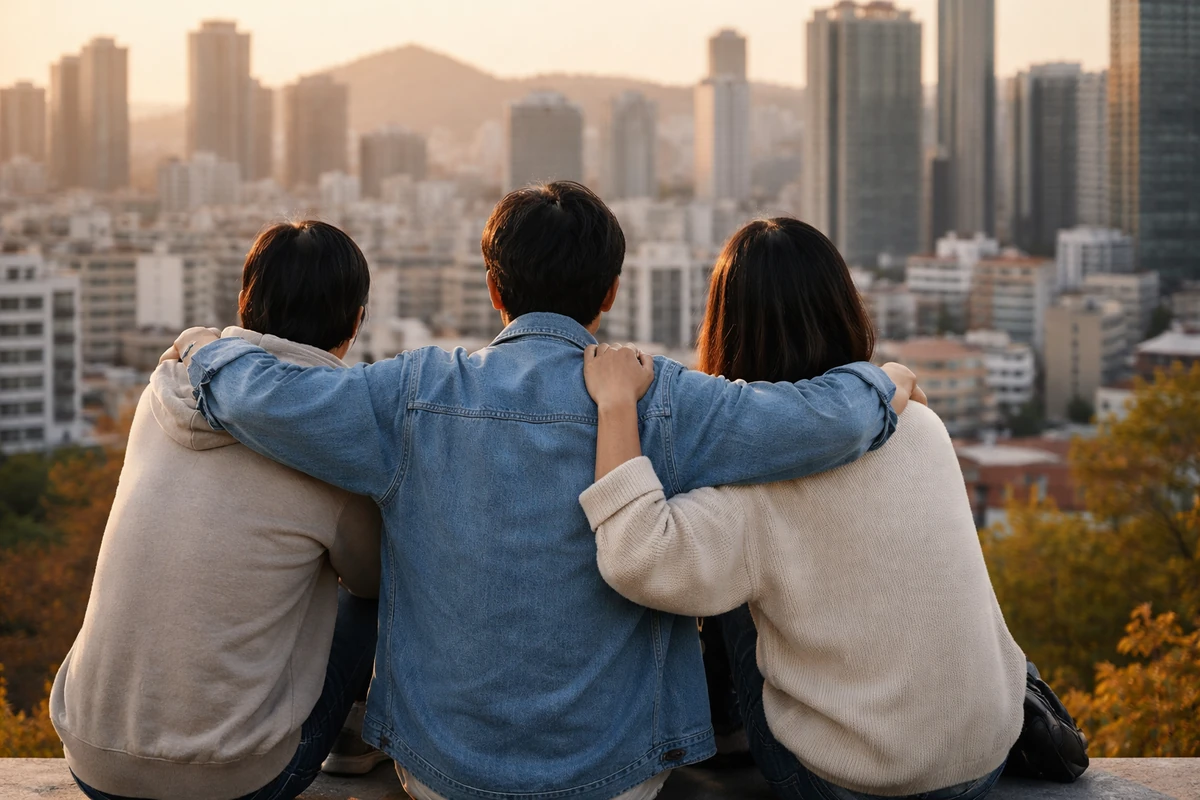
A Korean drama about feeling like a failure arrives at exactly the right moment
South Korean television has built a global reputation on high-concept storytelling: survival thrillers, revenge sagas, twisty crime series and romances so emotionally precise they travel across borders with ease. But a new drama premiering on JTBC is drawing attention for doing something quieter and, in some ways, riskier. Instead of promising catharsis through victory, it is offering solace through recognition.
The series, whose Korean title translates roughly to “Everyone Is Fighting Their Own Worthlessness,” is set to debut April 18 in a prime-time weekend slot. That title alone is striking. In the United States, a network drama is unlikely to put a word as blunt as “worthlessness” front and center. It is the kind of emotion most commercial entertainment circles around rather than names directly. But that is precisely why the show has become one of the more closely watched premieres on Korea’s spring television calendar.
According to details shared at the production presentation in Seoul, the show centers on Hwang Dong-man, a man who has spent 20 years trying to make his debut as a film director while wrestling with envy, insecurity and the humiliating feeling that everyone around him has moved on without him. In another era, that setup might have been treated as the first act of a comeback story, the kind where the underdog finally proves the doubters wrong. Here, the appeal appears to be something different: not a spectacular reversal, but the slow recovery of inner peace.
That shift matters, and not just in Korea. It says something about where television is headed in a culture saturated with pressure, comparison and public performance. In an economy where people are constantly asked to optimize themselves, where social media turns every milestone into a scoreboard and where success stories can start to feel less inspiring than exhausting, a drama about not measuring up may be more relatable than one about finally winning.
For American viewers who know Korean entertainment primarily through breakout hits like “Squid Game,” “Parasite” or the glossy emotional sweep of many streaming-era romances, this new series points to another equally important current in Korean culture: the rise of stories that do not flatter ambition so much as interrogate its cost.
From revenge fantasies to emotional recovery
One of the clearest changes in the Korean drama landscape in recent years is that the goal of the story is often moving away from victory and toward recovery. That does not mean triumph narratives have disappeared. They remain popular, for obvious reasons. Audiences everywhere still respond to stories in which a wronged protagonist defeats a corrupt system, outperforms a rival or claims love and recognition at the same time. Korean dramas have long excelled at delivering that kind of emotional payoff.
But repeated often enough, those formulas can begin to create distance instead of comfort. The more intense the fantasy of triumph, the more obvious the gap between the story and the viewer’s daily life. For people who are not getting justice, not getting ahead and not becoming exceptional despite their effort, the promise of total narrative resolution can feel increasingly artificial.
That is where a series like this one enters. Its central emotional terrain is not heroic suffering. It is comparative disappointment. The protagonist is not merely struggling in objective terms; he is struggling in relation to other people who seem more accomplished, more secure, more recognized. That distinction is crucial in South Korea, where social comparison is a powerful organizing force in public and private life.
Americans will recognize versions of this, too. It is the feeling of watching college classmates become startup founders, bestselling authors or homeowners while you are still patching together freelance work and wondering whether your twenties or thirties somehow slipped by. But in South Korea, those pressures are often intensified by a culture shaped by intense educational competition, steep labor market anxieties, status-conscious social norms and a relatively compressed urban environment where career and class markers can feel particularly visible.
In that context, a show that treats envy and inferiority not as moral failure but as ordinary human emotion is doing more than setting up a character arc. It is naming a social mood. The appeal is not that the story will magically solve that mood. It is that it will acknowledge it without condemnation.
At the show’s press event, director Cha Young-hoon described the drama not as a brisk, exhilarating success story but as one built on warm comfort and empathy. That may sound like marketing language, but it also reads as a strategic diagnosis of the moment. Viewers are increasingly looking not just for plot but for language that explains their inner lives. A series that says your shame, disappointment and self-doubt are not yours alone can have a durability that flashier entertainment sometimes lacks.
Why this creative team matters in Korea
A major reason expectations are high is the pairing behind the series. Cha Young-hoon, the director, previously helmed “When the Camellia Blooms” and “Welcome to Samdal-ri,” dramas known for balancing warmth, community and emotional nuance. Park Hae-young, the writer, is one of the most respected screenwriters working in Korean television, with credits including “Another Miss Oh,” “My Mister” and “My Liberation Notes.” For viewers in Korea, that is not just an impressive résumé. It is a creative signal.
Park, in particular, has become known for dialogue that does not chase immediate dramatic explosion. Her characters often speak in half-finished thoughts, swallowed resentments and hesitant admissions. Instead of packaging trauma into neat monologues, she tends to let emotional sediment rise slowly to the surface. It is one reason her work has resonated so strongly with audiences who feel that more conventional dramas often oversimplify pain.
For Americans unfamiliar with her influence, one useful comparison is to prestige TV writers who build reputations not around cliffhangers but around emotional exactness — creators whose work gets discussed less for “what happened next” than for how uncannily it captured a feeling viewers had struggled to articulate for themselves. Park’s dramas can be deeply Korean in texture, but their emotional mechanics are widely legible: fatigue, loneliness, class frustration, longing for dignity, the ache of ordinary life.
Cha’s directing style complements that sensibility. Rather than forcing viewers toward easy moral judgments, his work often allows characters room to remain contradictory. He is less interested in clean categories of good and evil than in the ambiguous spaces where most people actually live. That matters for a story centered on jealousy and inadequacy. A lesser drama might turn those feelings into pathology or melodrama. A more patient one can reveal them as part of the emotional weather of everyday life.
That pairing also says something about the economics of Korean television right now. In the streaming era, fast-moving plots, genre hooks and big twists often dominate the attention economy. Traditional broadcasters and cable channels such as JTBC have to compete not only with each other but with global platforms that reward spectacle and immediacy. One way to stand apart is through emotional density rather than narrative speed — through dramas that may not trend as explosively in the first weekend but can build strong, long-lasting attachment.
In other words, this series appears to be making a wager that slow-burn empathy can still cut through in a market crowded with sharper hooks.
The significance of casting Koo Kyo-hwan
The lead role goes to Koo Kyo-hwan, one of the more distinctive actors in contemporary Korean screen acting. International audiences may know him from projects that showcased his unpredictable energy and unusual screen presence, but in Korea he has built a reputation as an actor who can inhabit unstable emotional territory without reducing it to cliché.
That quality seems essential for a character like Hwang Dong-man. On paper, he could easily slide into stereotype: the middle-aged dreamer who never made it, the bitter almost-artist, the man whose ambitions have curdled into resentment. But Koo’s strength has often been his ability to hold opposing states at once. He can register fragility without self-pity, awkwardness without caricature and pride without heroism. That combination is likely why the casting has generated so much interest.
The role itself is especially rich. Spending 20 years trying to debut as a filmmaker is not simply a story of professional delay. It is also a story about suspended identity. To say you are still preparing implies that you have not given up. But it also means repeatedly confronting the fact that the life you imagined has not yet materialized. That limbo can be psychologically brutal. It turns hope into its own kind of burden.
There is also an intriguing contrast between the actor and the character. Koo is widely seen as successful, even elite, within the Korean entertainment industry. Watching a recognized actor play a man consumed by worthlessness may sharpen the drama’s larger point: insecurity does not belong only to people the world would label failures. It can attach itself to anyone, including people who appear admired, accomplished and publicly affirmed.
That is one reason the premise has resonance beyond Korea. In the United States, where the language of self-worth is often tied to productivity, influence and visible achievement, many viewers will recognize the idea that external validation does not cancel private inadequacy. If anything, being surrounded by high performers can intensify it. The emotional logic is familiar whether you work in Hollywood, journalism, tech or any profession where your peers’ success is constantly visible.
In that sense, the drama’s focus is not provincial at all. It is rooted in South Korea’s social climate, but it touches a broader transnational condition: the exhaustion of living in permanent comparison.
Why the title feels unusually blunt
In Korean television, titles often gesture toward romance, mystery, family ties or a central character’s name. Even when the subject matter is dark, the branding is often indirect or symbolic. That makes this title’s emphasis on “worthlessness” especially bold. It is not a safe commercial word. It sounds heavy, severe and potentially off-putting. And that may be exactly the point.
By naming the feeling outright, the series refuses the usual softening mechanisms. It does not hide behind euphemism. It does not promise viewers that their discomfort will be prettified before being presented back to them. In a commercial entertainment ecosystem, that is a notable choice. It suggests a confidence that audiences are ready for emotional directness, and maybe even hungry for it.
The term also lands with particular force in South Korea because of the country’s deeply entrenched comparison culture. That phrase can be overused, and it is important not to flatten Korean society into stereotype. Still, there is broad public awareness in Korea of how much status competition shapes everyday life. Educational achievement, employment at prestigious firms, home ownership, marriage timing, appearance and cultural capital can all become measures through which people evaluate not just success but personal worth.
Americans are hardly immune to this. Anyone who has scrolled through LinkedIn updates or Instagram life milestones knows the corrosive power of comparison. But in South Korea, where social expectations can be highly codified and economic mobility feels increasingly difficult for younger generations, the sense of being left behind often carries an especially sharp edge.
That is why the title functions as more than a hook. It identifies a common but often unspoken emotional state: not simply “I failed,” but “I must be fundamentally lacking because others are moving forward and I am not.” The distinction is psychologically important. A setback can be external. Worthlessness feels internal, totalizing and harder to discuss openly.
What the series appears to promise, however, is not an embrace of despair. The message from the production event emphasized comfort rather than resignation. That suggests the drama is less interested in glorifying helplessness than in loosening shame’s grip. Its core proposition seems to be that peace begins not when life becomes impressive, but when painful emotions are acknowledged as human rather than disqualifying.
What this says about Korea now
The timing of the show matters. South Korea remains one of the most culturally dynamic countries in the world, a place that has exported music, film, television, beauty products and fashion with extraordinary success. But that outward glow coexists with deep internal strain. Young people face punishing housing costs, difficult job markets and a social atmosphere in which overwork and self-optimization are often normalized. The country’s low birthrate, persistent burnout and widespread discussions about loneliness and exhaustion all form part of this backdrop.
None of that means Korean audiences want only somber stories. Escapism still sells. So do romance, comedy and fantasy. But there has been a notable appetite for dramas that do not treat emotional struggle as a temporary obstacle on the way to a more glamorous self. In some of the most acclaimed Korean series of recent years, the real breakthrough has not been status ascent but emotional articulation — the ability to say, finally, what hurts.
That helps explain why Park Hae-young’s previous work has resonated so strongly. Her dramas often take feelings that modern life encourages people to privatize — depletion, alienation, vague humiliation — and render them speakable. In a culture that can prize composure and endurance, there is something quietly radical about that. It creates community not through spectacle but through recognition.
For American audiences, this may be one of the more illuminating aspects of contemporary Korean drama. The global conversation around Korean entertainment can sometimes emphasize extremes: brutal inequality, thrilling plots, dazzling production value. Those elements are real, but they are not the whole story. Another major current in Korean storytelling is the attempt to give language to ordinary psychic wear and tear.
That is part of what makes this new JTBC series significant. It is not simply another TV premiere. It is a cultural marker of a society asking whether people can keep living under constant pressure to prove that they matter. Rather than answering with a motivational slogan, the drama seems poised to offer a gentler response: maybe the first step is admitting how many people are quietly losing that fight.
A distinctly Korean story with broad appeal
There is, of course, a reason Korean dramas travel so well when they get this balance right. The best of them are highly local without becoming inaccessible. They do not dilute Korean social realities for foreign audiences. Instead, they trust that specificity can open into universality. A story about a struggling aspiring film director in Seoul is not identical to a story about a stalled creative in Los Angeles or Brooklyn. But the emotional engine — shame, envy, fatigue, hope that refuses to fully die — is immediately legible.
That may be why a drama built on “comfort” does not have to mean a drama without tension. In fact, for many viewers, emotional recognition can be more destabilizing than a plot twist. It is one thing to watch a villain get punished. It is another to hear a character say something so precise about self-doubt that it feels uncomfortably familiar. Korean television has become especially skilled at that second kind of impact.
American viewers may also find the show’s underlying argument timely. In a media culture that still often prizes reinvention and hustle, there is growing fatigue with stories that reduce human worth to measurable achievement. Shows that emphasize healing, community and emotional honesty — whether in comedy, drama or so-called comfort television — have found loyal audiences in the United States as well. The forms differ, but the hunger is similar.
The question, then, is not whether this Korean drama will offer the usual satisfactions of success. It is whether it can offer something more difficult and perhaps more useful: the feeling of being seen before being fixed. If it succeeds, it will tap into one of the defining emotional currents of the present, in Korea and far beyond it.
That makes “Everyone Is Fighting Their Own Worthlessness” more than an intriguingly titled new release. It makes it a sign of where a mature television culture goes when audiences no longer want to be told that hard work always wins, that talent inevitably gets recognized or that perseverance neatly resolves insecurity. Sometimes what viewers want most is not triumph. It is relief — relief from the idea that everyone else is doing better, relief from the pressure to turn pain into inspiration, relief from the suspicion that falling behind means there is something inherently wrong with you.
For years, Korean entertainment has excelled at dramatizing systems that humiliate people. This series appears ready to explore what comes after that humiliation: not revenge, not reinvention, but the fragile work of making peace with yourself. In the current moment, that may be the more radical story.
Comments
Post a Comment