A Barn Fire in Rural South Korea Killed 600 Piglets in 15 Minutes. The Loss Says More Than the Timeline
A brief fire, a lasting loss
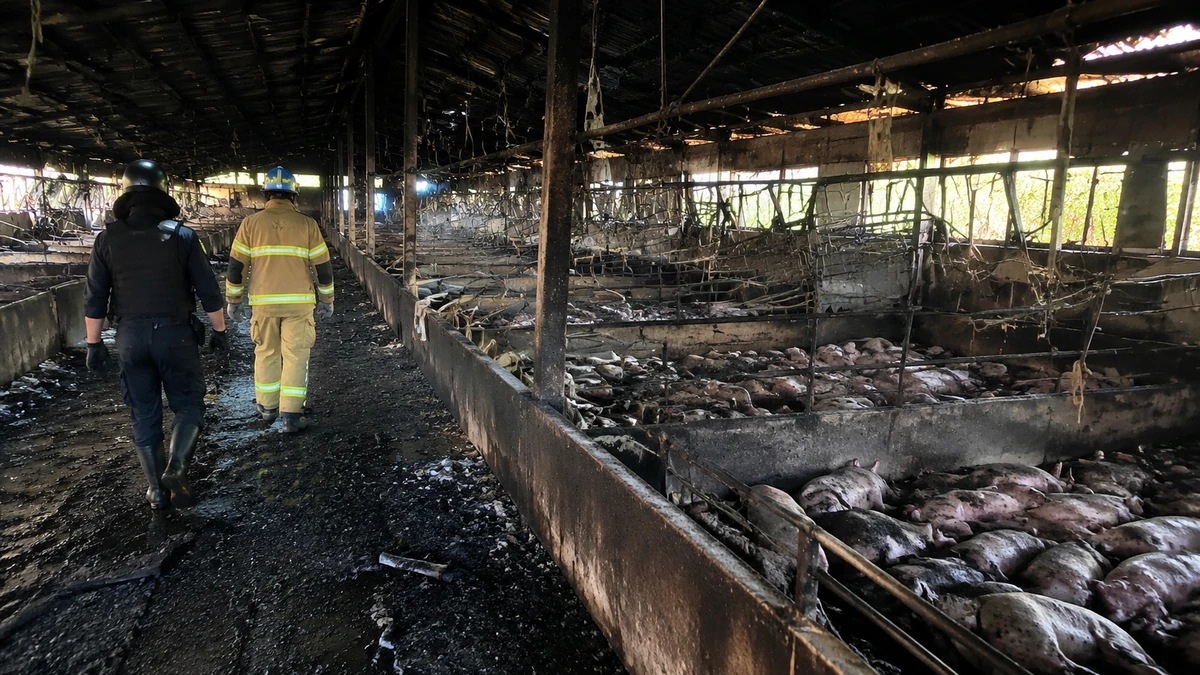
A fire that burned for only about 15 minutes at a pig farm in South Korea has left behind a far larger story about agricultural safety, animal welfare and the quiet fragility of rural economies. According to South Korean authorities, the blaze broke out at about 6:55 a.m. on May 16 at a swine facility in Sunchang? No — in Sinsong? Actually, the location reported by local authorities was Sunseong-myeon, a rural township in Dangjin, a city on South Korea’s west coast in South Chungcheong Province. By the time firefighters arrived after an emergency call, the flames had already died out. No people were injured. But 600 piglets were killed, and property damage was estimated at 35 million won, or roughly $25,000 at current exchange rates.
On paper, that may read like a relatively small industrial accident, especially when compared with the kind of disasters that dominate international headlines. There was no apartment tower engulfed in flames, no mass casualty event, no dramatic rescue operation carried live on television. Yet for the farm operator and for the agricultural community around Dangjin, the incident is not minor. In livestock production, a loss like this can wipe out months of work, disrupt breeding and sales schedules, and deepen anxiety in an industry already under pressure from rising costs, disease risks and volatile consumer demand.
South Korean police and fire officials say they are investigating a possible electrical cause. Investigators reportedly found signs of damaged or severed wiring inside the barn, a clue that has pushed the inquiry toward electrical failure rather than arson or some other source. No final conclusion has been announced, and in any fire investigation, early physical evidence can point in a direction without yet proving a definitive cause. Still, even at this preliminary stage, the case highlights a familiar danger in agricultural settings everywhere: when electrical systems fail in buildings packed with animals, heat, dust, moisture and ventilation equipment, the window to prevent catastrophe can be alarmingly narrow.
For American readers, the basic contours of this story may sound familiar. Across the United States, barn fires and equipment-related fires are a recurring concern in poultry houses, dairy barns and hog operations, especially where heating systems, fans, feeders and electrical wiring are under constant strain. The Korean case is a reminder that the same tensions shaping rural life in Iowa, North Carolina or Minnesota — efficiency, scale, cost control and infrastructure risk — are playing out in South Korea too.
Why a pig barn fire matters beyond one farm
It is tempting to measure the severity of a fire by how long it burns or whether it causes human casualties. That is often how breaking news is framed: How many people died? How large was the building? How long did firefighters battle the flames? But in agricultural facilities, those metrics can obscure the real scale of the harm. A fire does not have to rage for hours to be devastating. If it starts in an enclosed livestock structure, damage can be concentrated almost immediately.
That appears to be the case in Dangjin. Authorities said there were no human injuries, a fact that would normally move a story like this down the news agenda. Yet the death of 600 piglets is not a footnote. Those animals represented both living creatures and economic assets, part of a production system that depends on timing, survival rates and continuous operations. In modern hog farming, piglets are especially vulnerable because of their age, their dependence on controlled temperatures and the difficulty of evacuating large numbers of animals quickly from confined spaces.
For readers in the United States, think of it as something closer to a factory loss combined with a herd loss. A livestock barn is not just a shed. It is a workplace, a production site, a climate-controlled environment and, in practice, a place where the lives of animals depend entirely on the integrity of the structure around them. If something goes wrong with the wiring, heat lamps, ventilation or other equipment, the consequences can be swift and irreversible.
That is one reason these incidents can feel undercounted in public conversation. Urban fires tend to draw broader attention because they happen in visible places and threaten human populations more directly. Rural industrial fires often remain local stories, even though they can be financially ruinous and emotionally shattering for the people who depend on those facilities. In both Korea and the United States, the distance between city consumers and the farms that produce their food can make these losses easy to overlook.
But the numbers matter. Thirty-five million won in estimated damage may not sound enormous in national economic terms, but for an individual operation, particularly a family-run or mid-sized farm, it can be destabilizing. And direct property estimates rarely capture the full cost. There may be cleanup expenses, structural repairs, interrupted production cycles, veterinary or disposal costs, insurance complications and the longer-term burden of rebuilding capacity in a sector where margins are often thin.
The rural Korean context Americans may miss
To understand why this fire resonates beyond one farm, it helps to understand where it happened. Dangjin is a coastal city in South Chungcheong Province, southwest of Seoul, known for a mix of industry, farming and port-related activity. Like many parts of nonmetropolitan South Korea, it sits at the intersection of old and new: traditional rural life, industrial-scale agriculture, and the economic pressures that come with a rapidly modernized country whose population is increasingly urban and aging.
When Americans think of South Korea, they often think first of Seoul’s skyline, Samsung, K-pop, Oscar-winning films or the country’s high-speed internet. Those are real parts of Korea’s global image, but they can overshadow another reality: South Korea also has extensive farming communities dealing with many of the same structural challenges as rural America. Those include labor shortages, shrinking younger populations, rising input costs and the need to upgrade infrastructure while staying competitive.
The word used in Korean reports for the building involved in this fire is “donsa,” which refers to a pig barn or swine facility. It is a practical, industry-specific term, not a quaint image of a red barn from a children’s book. Korean livestock facilities, like their American counterparts, are often enclosed and mechanized, designed for feeding, temperature management and efficient raising of animals. That makes them productive, but it can also make them vulnerable if systems fail. Enclosed layouts, electrical loads and dense animal populations can create conditions in which a small ignition source becomes deadly even before outside responders arrive.
There is also a broader social dimension to how such stories are consumed in South Korea. National attention tends to cluster around major political events, labor disputes involving conglomerates, celebrity news and major urban incidents. A rural barn fire with no human deaths can be treated as a routine local brief. Yet local reporting often carries a stronger subtext: that rural industrial spaces are essential, exposed and too easily ignored until something goes wrong.
That point would not be unfamiliar in the United States, where Americans routinely rely on farmers while paying relatively little attention to the infrastructure that supports food production. When an electrical fire hits a poultry farm in Arkansas or a dairy barn in Wisconsin, it usually does not become a national conversation unless the losses are extraordinary. The same dynamic appears to be at work here. What happened in Dangjin is local, but the underlying warning is universal.
The investigation’s focus on electricity
South Korean police and fire authorities say they are investigating the possibility that the fire was caused by an electrical problem. According to local reporting, investigators found signs consistent with broken or severed wiring inside the swine barn. That does not settle the case, but it gives authorities a logical starting point.
Electrical problems are a persistent concern in farm buildings because the environment is punishing on equipment. Moisture, dust, animal waste gases, temperature fluctuations and constant equipment use all put stress on wiring, outlets and control systems. Add heaters, fans, water systems and lighting, and the electrical network inside a barn can become both essential and vulnerable.
In pig facilities, that risk can be even more acute where young animals are involved. Piglets often require carefully regulated warmth, which can mean added heating equipment or intensive climate control. Any fault in those systems — or in the wiring supporting them — can create two dangers at once: the possibility of ignition and the failure of life-support conditions for the animals inside.
American fire officials and agricultural extension experts have long warned about these risks. Recommendations typically include regular inspection of wiring, keeping electrical systems free from dust buildup, protecting cords and fixtures from corrosion or animal damage, and ensuring that overloaded circuits are avoided. Fire detection systems, circuit breakers, surge protection and separation between heat sources and combustible materials are standard points of emphasis. The Korean investigation may eventually determine that this fire had a specific, unusual trigger. But the reason electrical causes draw immediate scrutiny is that they are a well-known source of barn fires in many countries.
What also stands out in this case is the timing. By the time firefighters reached the scene, the fire had already burned out. That detail may sound reassuring at first, as if the event was limited or self-contained. In reality, it can suggest the opposite: that the critical damage happened so quickly that the effective emergency window had already closed. In other words, the issue may not be how long the fire lasted, but how fast it became lethal inside the structure.
That distinction matters for policy. Fire departments are essential, but their role begins after ignition. Electrical maintenance, facility design and early detection are what matter before ignition. When officials and farm groups talk about prevention, this is the gap they are trying to close.
Animal loss, economic shock and the hidden costs
The death of 600 piglets is, first of all, an animal welfare issue. In any country, images or descriptions of large-scale animal deaths can provoke public discomfort, and rightly so. Even people far removed from farming tend to understand that animals trapped in a fire face a terrifying and often unavoidable fate. That moral dimension should not be ignored simply because the story is also about business loss.
At the same time, in agricultural communities the economic impact is immediate and concrete. Livestock are inventory, income and future production. Losing piglets is not like losing stored feed or a damaged machine that can be replaced on a fixed schedule. Piglets represent a stage in a biological cycle. Their deaths can affect future sales, breeding plans, barn utilization and labor decisions. Recovery is not just a matter of rebuilding walls. It may mean rebuilding an entire production timeline.
Property damage estimates after a fire also tend to understate the real burden. A 35 million won estimate is likely a baseline calculation of physical loss rather than a full accounting of business interruption. Farmers may also face costs tied to carcass disposal, sanitation, temporary shutdowns, insurance deductibles, inspections and replacement equipment. Some may have debt attached to the facility or animals that does not disappear with the fire.
For South Korea, these pressures come at a time when many agricultural producers are already operating in a difficult environment. The country’s farmers and livestock operators have faced rising feed costs, periodic disease fears and broader demographic strain as rural communities age and younger Koreans continue moving to cities. In that context, even a single-site fire can land like a major personal and professional blow.
This is one of the reasons local incidents like the one in Dangjin deserve more than a crime-blotter treatment. They sit at the crossroads of labor, food systems, animal care and infrastructure resilience. Americans who have followed stories about avian influenza outbreaks, livestock barn collapses in snowstorms or tornado damage to farm country will recognize the pattern. A single incident in an agricultural setting can ripple outward through a producer’s finances, mental health and ability to stay in business.
What this says about prevention in modern farming
There is an uncomfortable lesson in the fact that this fire appears to have ended quickly while still causing such concentrated loss. In tightly managed agricultural buildings, speed is not always a sign of limited danger. It can mean the opposite: that the system is efficient in everyday operation but unforgiving in crisis.
That is not unique to South Korea. Modern agriculture, whether in Asia or North America, often depends on consolidation, mechanization and enclosed systems designed to maximize efficiency. Those choices bring advantages in productivity and climate control, but they also raise the stakes when infrastructure fails. A broken wire, a failed heater or an overloaded circuit can become more than a maintenance problem. It can become a mass-casualty event for animals and a severe economic hit for the operator.
The Korean case may add urgency to ongoing conversations about how rural facilities are inspected and what level of preventive oversight is realistic or necessary. Should older farm buildings face stricter electrical inspection requirements? Are emergency detection systems widespread enough? How much responsibility falls on operators, insurers, local governments or national agricultural agencies to help pay for safer retrofits? These are not simple questions, especially in sectors where profit margins are narrow and producers are often reluctant or unable to absorb new costs.
Still, the logic of prevention is hard to dispute. Once a fire starts inside a livestock facility, there may be very little time to change the outcome. In that sense, the Dangjin fire is not only a local accident under investigation. It is also a case study in why routine safety work — boring, expensive, easy-to-postpone safety work — can be the difference between an isolated malfunction and a devastating loss.
For American readers, the most useful way to understand this story may be not as an exotic or distant incident from rural Korea, but as a familiar warning from a different part of the world. The labels are different, the geography is different, and the Korean cultural context matters. But the underlying issue is recognizable: food production depends on infrastructure that often stays invisible until it fails. When it does, the consequences reach beyond a burned building.
A local fire with global relevance
No one was killed in the Dangjin fire, and that fact matters. It is a relief, and it should be stated clearly. But stopping the story there would miss what happened. Six hundred piglets died. A farm operation suffered a sharp financial loss. Authorities are now looking at the possibility that an electrical fault inside a working agricultural facility set the disaster in motion. What burned in 15 minutes may take far longer to recover from.
In journalism, there is always a temptation to sort events into major and minor categories. A rural barn fire in South Korea may seem to belong in the latter. Yet stories like this can reveal the structure of ordinary vulnerability better than bigger headlines do. They show where safety systems are weakest, whose losses attract limited attention, and how quickly a problem that begins with a wire can end with dead animals and a destabilized livelihood.
That is why the pending investigation matters. If officials determine that an electrical failure caused the fire, the findings could help shape inspections and prevention measures not just for one farm, but for similar livestock facilities across the region. If they find some other cause, that too will matter. Either way, the point of establishing the facts is not only accountability after the fire. It is prevention before the next one.
South Korea is often described to the world through its exports: semiconductors, cars, pop music, prestige television dramas and skin care brands. But it is also a country with barns, wiring, livestock sheds and working rural communities facing the same practical hazards that farmers confront nearly everywhere. The fire in Dangjin belongs to that Korea — the less glamorous, highly consequential Korea that rarely shapes the international narrative but feeds the country and anchors regional economies.
For readers in the United States and elsewhere, that is the real takeaway. This is not just a local oddity from abroad. It is a reminder that modern food systems, no matter how advanced the surrounding society may be, are only as resilient as the ordinary structures that support them. And sometimes the most important warning signs come not from disasters that dominate the world’s attention, but from the smaller fires that briefly flare, go dark and leave behind damage too serious to dismiss.
Comments
Post a Comment