A Fire in the Strait of Hormuz Puts a Spotlight on the Hidden Risks Facing South Korea’s Shipping Industry
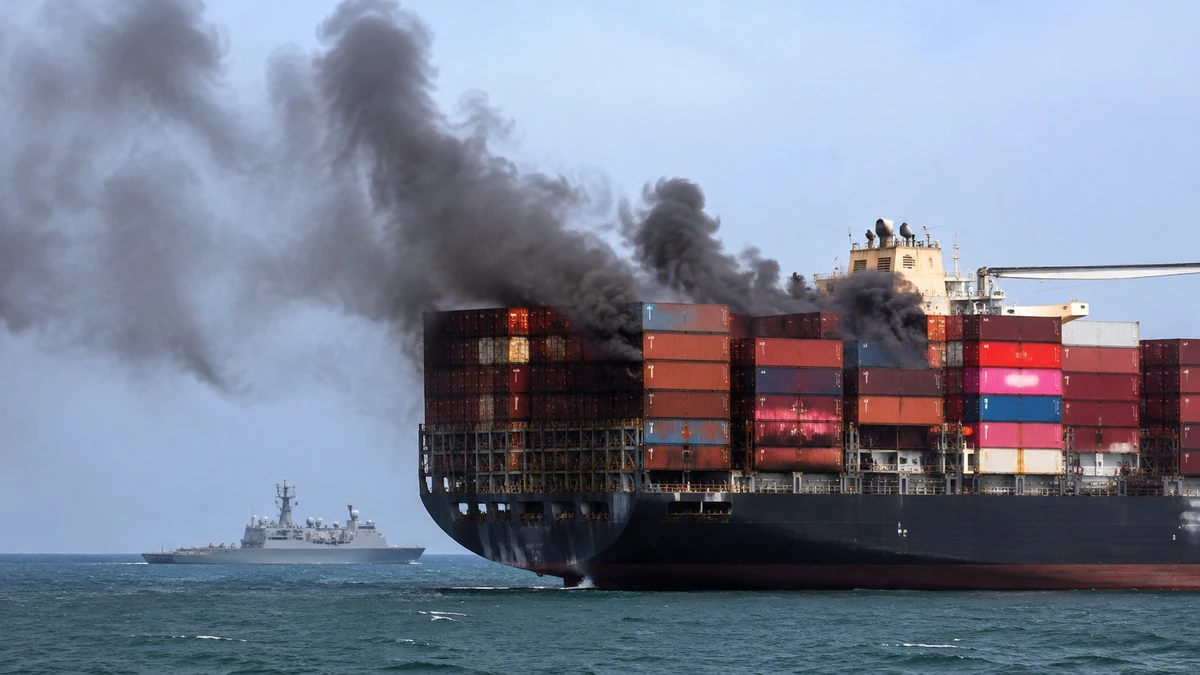
A shipboard fire in one of the world’s most sensitive waterways
A fire aboard a vessel operated by South Korean shipping company HMM in the Strait of Hormuz has become more than a routine maritime accident. It is emerging as a case study in how global trade, industrial safety and Middle East tensions can collide in a single incident far from the Korean Peninsula.
According to South Korean reporting, an explosion and fire broke out July 4 on the HMM Nuri, a ship operated by HMM, while it was transiting the Strait of Hormuz. By the following day, investigators and emergency personnel still had not entered the engine room, the part of the vessel most likely to hold the clearest clues about how the fire began. That delay has drawn attention in South Korea, where HMM is widely seen as one of the country’s flagship shipping companies and a symbol of its export-driven economy.
To American readers, the basic facts may sound technical: a ship catches fire, responders suppress it, then investigators go in and determine what happened. But on a commercial vessel, especially one operating in a narrow and geopolitically volatile waterway, the reality is much more complicated. The inability to enter the engine room quickly is not necessarily a sign of confusion or incompetence. In maritime firefighting, it can be a sign that responders are following the rules that keep rescuers and investigators alive.
The location matters. The Strait of Hormuz is not just another shipping lane. It is one of the world’s most strategically important maritime chokepoints, the narrow passage between the Persian Gulf and the Gulf of Oman through which a significant share of the world’s oil and gas shipments move. Americans often hear about it when tensions spike between the United States and Iran, or when energy markets react to instability in the Middle East. A fire involving a South Korean-operated ship there instantly carries implications beyond the vessel itself, because any incident in that corridor raises questions about trade disruption, crew safety and the vulnerability of global supply chains.
For South Korea, whose economy depends heavily on exporting cars, semiconductors, batteries, petrochemicals and consumer goods, shipping is not a background industry. It is an essential national artery. When one of its major carriers faces an emergency in a high-risk sea lane, the story resonates not simply as an accident report but as a reminder of how exposed modern economies are to dangers that occur far from home.
Why the engine room is both the key and the hazard
The engine room is often described as the heart of a ship. It houses propulsion systems, machinery, fuel-related equipment and critical control infrastructure. If there is an explosion or fire linked to mechanical failure, overheating, fuel leakage or electrical malfunction, the engine room is likely to reveal the earliest physical evidence. Burn patterns, blast damage, the sequence of equipment failure and the direction of fire spread can all help reconstruct what happened.
That is precisely why the delay in entering the engine room has become so important. The holdup does not appear to be about investigators moving too slowly. It appears to be about whether the space is safe for humans at all. South Korean fire safety experts cited in local coverage pointed to the role of carbon dioxide firefighting systems, which are commonly used in enclosed shipboard machinery spaces. These systems can be highly effective at knocking down fires because they suppress combustion by displacing oxygen. The same characteristic that makes them useful against fire, however, makes them dangerous to people.
In plain terms, a compartment may no longer be burning, but that does not mean it is breathable. If carbon dioxide remains in high concentration inside a sealed or poorly ventilated engine room, a person entering without proper clearance or equipment could lose consciousness or suffocate. In other words, the fire may be under control while the room itself remains lethal. For readers more familiar with fires in office buildings, homes or factories on land, this may seem counterintuitive. But shipboard emergency response is governed by the constraints of steel compartments, limited ventilation and the difficulty of outside access while at sea.
The danger does not end with oxygen depletion. Heat can linger. Gases can remain trapped. Damaged machinery may still be unstable. Introducing fresh air too quickly can affect the scene, and in some cases, changing airflow can alter the physical evidence or create new hazards. That is why experts sometimes argue that preserving current conditions, at least until specialists are ready to enter safely, can serve both life safety and investigative integrity.
This is one of the least intuitive aspects of accident response for the general public: moving faster is not always the safer or smarter option. The impulse in any emergency is to rush in, check damage and establish answers. But in a sealed maritime engine room after a fire suppression operation, the first question is not, “Why haven’t they gone in yet?” It is, “How can they go in without creating another casualty?”
Why finding the cause can take time at sea
Americans are accustomed to quick news cycles and rapid official updates after transportation accidents. Air crashes generate preliminary timelines within hours. Highway wrecks are documented almost immediately. Even industrial fires on land often produce early assessments the same day. Maritime incidents are different, especially when they occur far from port and inside specialized, closed-off spaces.
That difference is central to understanding this case. Determining the cause of a shipboard fire is not just a matter of opening a door and looking around. Investigators must consider atmospheric conditions inside the compartment, the possibility of re-ignition, the effect of suppression systems, the condition of power and machinery, and whether entry will disturb evidence. In a land-based fire, teams can often approach from multiple directions, bring in large external support systems and evacuate injured personnel quickly. At sea, space is limited, equipment access is constrained and even basic movement can be affected by vessel conditions.
There is also a trade-off between speed and reliability. A rushed entry could contaminate the scene or trigger secondary damage, making it harder to determine whether the fire started with a mechanical malfunction, fuel-related event, electrical issue or some other cause. If responders alter ventilation patterns, shift debris or unintentionally affect damaged systems, the physical record can become less trustworthy. That matters not only for assigning cause but for preventing future accidents.
In South Korea, experts quoted in reporting stressed that the engine room could provide critical visual clues: which equipment appears to have failed first, where blast marks are concentrated and how the flames appear to have moved. Yet those clues are valuable only if they are preserved well enough to interpret. This helps explain why accident investigations can seem frustratingly slow to outsiders. The goal is not merely to know something quickly. It is to know something accurately.
That distinction is especially important in an era when social media and geopolitical tension can push speculation ahead of evidence. Because the incident occurred in the Strait of Hormuz, any unexplained explosion or fire can attract instant theories about sabotage, conflict spillover or external attack. At this stage, based on the summary of confirmed information, there is no basis to state a cause beyond the reported explosion and fire and the ongoing delay in engine room entry due to safety risks. Responsible reporting requires holding that line between what is known and what is inferred.
The Strait of Hormuz turns a shipping accident into an international story
If this same engine room fire had happened in a less fraught part of the world, it might have remained a specialized industry story. In the Strait of Hormuz, it immediately becomes a broader international matter. The waterway has long carried an outsize symbolic and strategic weight in global politics. For Americans, it is the sort of place that appears in foreign policy briefings, Pentagon statements and financial news whenever the risk of disruption could affect oil prices or U.S. interests in the Middle East.
That strategic reputation does not prove anything about the cause of this particular fire. But it does shape the stakes. A commercial ship operating there is not just moving cargo through routine blue water. It is navigating one of the world’s most scrutinized corridors, a place where accidents, misunderstandings and geopolitical tensions can all carry amplified consequences.
For South Korea, that reality underscores how deeply its economy is woven into global maritime networks. South Korea is a manufacturing and trading powerhouse with few illusions about self-sufficiency. It imports energy, exports high-value goods and relies on long-haul shipping routes that pass through regions shaped by competition, conflict and strategic risk. A Korean company’s ship in the Strait of Hormuz is not an exotic outlier. It is the normal geography of modern commerce.
That is one reason incidents like this resonate so strongly in Seoul and Busan, South Korea’s main port city. The event is physically distant, but economically intimate. Just as Americans might view a disruption at the Panama Canal, a major West Coast port or a crucial freight rail corridor as a domestic concern with national consequences, South Koreans often see maritime incidents abroad through the lens of national industrial resilience.
The incident also illustrates a broader truth familiar to supply-chain analysts in the United States since the pandemic: globalization works efficiently until a bottleneck, shock or accident exposes how little slack the system contains. A single vessel’s emergency does not automatically trigger a crisis, but the vulnerabilities it reveals can be telling. It reminds policymakers and businesses alike that the movement of goods depends not only on logistics software and market demand, but on crews, machinery, safety systems, navigational conditions and the political stability of waterways thousands of miles away.
What this says about South Korea’s shipping sector
HMM occupies a visible place in South Korea’s shipping industry. Formerly known as Hyundai Merchant Marine, the company has been central to the country’s efforts to maintain a globally competitive container and logistics presence after years of upheaval in the sector. In South Korea, shipping is not simply another corporate business line. It is tied to national competitiveness, export capacity and strategic confidence.
That helps explain why this incident is being interpreted not just as a shipboard emergency but as a window into the real operating environment of Korean maritime firms. The lesson is not necessarily that South Korean shipping is uniquely unsafe or structurally broken. There is not enough verified information here to support such a sweeping conclusion. The more defensible reading is narrower but still significant: Korean shipping companies, like their global peers, are exposed to layered risks that combine engineering hazards, human safety concerns and geopolitical pressure.
The case also highlights how professionalized maritime safety has become. Commercial shipping may look old-world from the outside — giant steel hulls, crews at sea, cargo moving across vast distances — but in practice it is a sophisticated technical system. Ships rely on complex machinery, specialized fire suppression tools, emergency procedures, international regulations and trained personnel who must make decisions under pressure. The response to a fire is not separate from the investigation that follows. The way a fire is suppressed can affect what evidence survives, and what investigators learn will influence future prevention measures.
That linkage is important. In many industries, the emergency phase and the investigative phase are treated as sequential: first stop the danger, then figure out why it happened. At sea, they are more intertwined. On a ship, especially in an engine room, the choices made in the first hours can shape whether the underlying cause is ever fully understood. A decision to wait before entering may look passive from the outside, but it can reflect a disciplined approach to protecting lives and preserving evidence.
For South Korea’s maritime sector, that is the quieter message behind the headlines. The industry’s success is often measured in cargo volume, route networks and earnings. But its resilience is just as dependent on less visible capabilities: fire protection design, crew training, accident response doctrine, investigation standards and the ability to operate in politically sensitive waters without losing sight of safety fundamentals.
Why careful reporting matters more than ever
One of the most striking themes in this story is the need to separate verified facts from interpretation. The confirmed elements, as summarized in South Korean reporting, are relatively straightforward: an explosion and fire occurred aboard the HMM-operated vessel in the Strait of Hormuz on July 4; entry into the engine room was still delayed the next day; and experts pointed to the danger posed by carbon dioxide suppression systems and the possibility of secondary harm.
Everything beyond that requires caution. It may be tempting, especially given the location, to connect the incident to regional conflict or to use it as proof of a broad systemic failure in Korean shipping. But journalism is strongest when it resists filling evidence gaps with dramatic assumptions. The symbolic power of the Strait of Hormuz is real, yet symbolism is not proof. Likewise, a single accident can illuminate risk without automatically proving national industrial weakness.
This is especially relevant when stories cross languages and audiences. Korean readers may bring background assumptions about HMM, about the country’s dependence on shipping and about the public role of experts in disaster commentary. American readers may instead anchor on the Middle East angle, or compare the case to domestic transport disasters. Good international reporting has to bridge those frames. It should explain why Korean audiences care, while also grounding the story in terms U.S. readers recognize: supply-chain fragility, chokepoint risk, industrial safety and the discipline required in accident investigation.
There is also a practical reason for caution. Early narratives around transportation accidents have a long history of changing as evidence emerges. Americans saw this with aviation incidents, train derailments and refinery explosions, where initial speculation often gave way to more complex findings. Maritime cases are no different, and in some ways they are harder because access is limited and the environment itself can distort or destroy evidence. That is why the current delay in engine room entry, though unsatisfying to the public, may ultimately support a more credible answer.
In that sense, the most important lesson may be about process. In an age of constant updates, there is pressure to produce immediate certainty. But this case suggests that responsible crisis response sometimes looks like delay. Responsible reporting sometimes looks like restraint. And responsible analysis means acknowledging both what the incident shows and what it does not yet prove.
A single ship, a global system and a familiar modern vulnerability
At first glance, the story is about a door that cannot yet be opened safely — the engine room entrance on a fire-damaged ship. Look more closely, and it is about something much larger. Behind that sealed compartment lies the intersection of industrial technology, human risk, international trade and geopolitical exposure. A Korean-operated vessel in a strategic Middle East waterway is a reminder that the infrastructure of globalization is not abstract. It is physical, dangerous and often precariously dependent on people making correct decisions under extreme conditions.
For American readers, there is a familiar pattern here. The United States has learned repeatedly that supply chains become visible mainly when they break: empty shelves during the pandemic, port backups, semiconductor shortages, attacks on commercial shipping and swings in fuel prices tied to faraway events. South Korea lives with a similar reality, but with even greater dependence on maritime trade. What happens in the Strait of Hormuz can feel as consequential in Seoul as a freight shutdown might feel in Los Angeles, Houston or Savannah.
The HMM fire does not yet offer a final answer about cause. What it does offer is a vivid snapshot of the risks that come with operating at the front lines of global commerce. It shows why a firefighting system can save a ship while temporarily preventing people from entering the very space that must be examined. It shows why geography can magnify an accident into an international concern. And it shows why countries built on trade cannot treat shipping as invisible infrastructure until something goes wrong.
In the end, the world is not watching only a Korean ship fire. It is watching how one incident reveals the hidden architecture of modern interdependence. The cargo may belong to one company, the vessel may fly under one operator and the emergency may be unfolding in one engine room. But the underlying story stretches far wider: from Korean export industries to Middle East sea lanes, from maritime engineering to global market confidence, from the practical science of carbon dioxide suppression to the political symbolism of one of the world’s most contested waterways.
That is why this incident matters beyond South Korea and beyond shipping specialists. It is a reminder that the systems moving the global economy are only as strong as their weakest moments — the fire no one expected, the compartment no one can safely enter yet and the narrow strait where commerce and conflict travel side by side.
Comments
Post a Comment