A K-drama’s royal controversy reignites a bigger debate: How far can fiction go with Korea’s history?
A scriptwriter’s apology has become the real story
In South Korea’s highly competitive television industry, public apologies are common enough that they can sometimes blur into the background. But when the writer of MBC’s upcoming drama “21st Century Grand Lady” publicly apologized over concerns about historical accuracy, the statement did more than acknowledge a production controversy. It reopened a larger, long-running argument inside Korean pop culture: What responsibility do writers and producers have when they borrow from the symbolism of a nation’s past, even in a story that is openly fictional?
According to South Korean media reports, screenwriter Yoo Ji-won posted an apology on the drama’s official website on the 19th, saying viewers had been disappointed and troubled by the historical verification controversy surrounding the series. She acknowledged that her research had not been sufficient in the process of applying Joseon-era court etiquette to a modern setting and imagining a fictional contemporary Korean royal family. In practical terms, that means critics were not simply objecting to a costume choice or a stylistic flourish. They were questioning the judgment behind how historical symbols were used in the first place.
That distinction matters, especially in South Korea, where historical memory is deeply woven into modern identity and entertainment. For American audiences, a useful comparison might be the difference between a TV show making up a fictional White House tradition and a show casually repurposing the language, dress and ceremonial imagery of the Founding era, the Civil War or an Indigenous religious practice without showing a clear understanding of what those traditions mean. A drama can be fictional and still trigger a very real debate about cultural responsibility.
That is what appears to have happened here. “21st Century Grand Lady” is not a documentary, nor is it presented as a strict historical drama. It is a romance set in an alternate version of South Korea where a constitutional monarchy still exists. But the closer a fantasy world gets to borrowing revered or emotionally loaded elements from real history, the harder it becomes for creators to wave away criticism by saying, in effect, it is only make-believe.
Yoo’s apology turned that tension into the central issue. Rather than treating the backlash as a misunderstanding, she acknowledged that the production had failed to examine the historical context carefully enough. In the current Korean media landscape, where online criticism spreads quickly and audiences dissect not only storylines but the seriousness of the research behind them, that admission carries weight beyond a single scene.
The scene at the center of the backlash
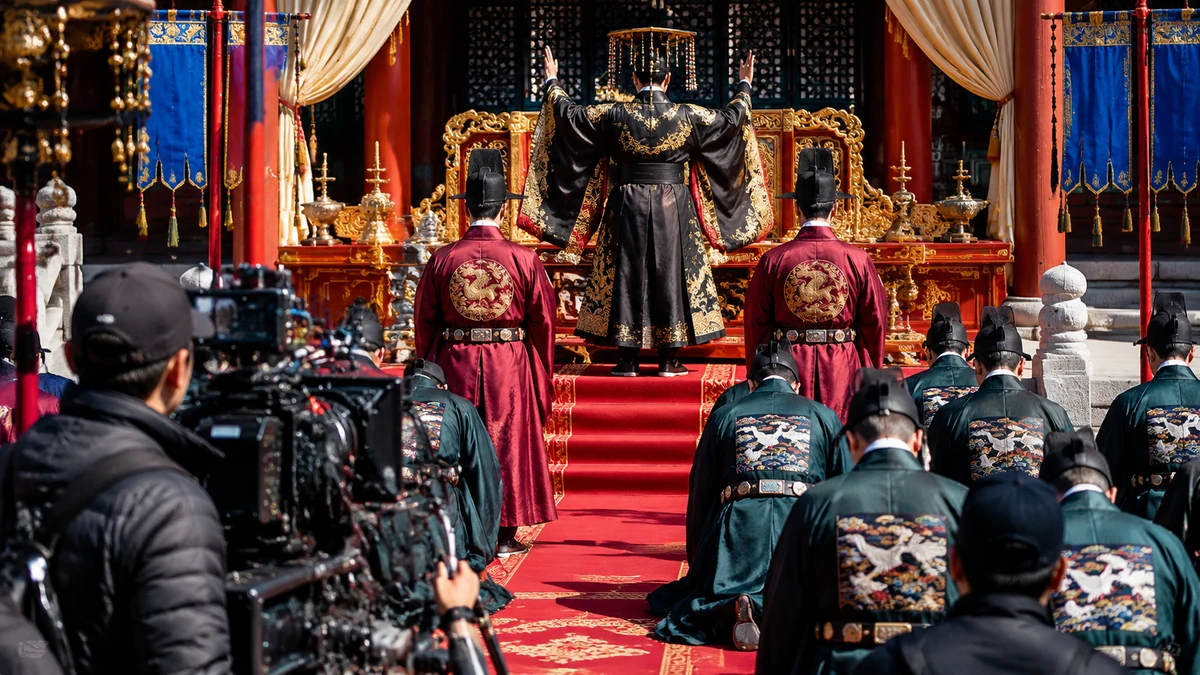
The controversy appears to focus on an enthronement scene, specifically one involving a ceremonial crown and the shouted acclamation “Cheonse,” or “ten thousand years,” a phrase historically associated with royal exaltation. Yoo reportedly cited that sequence directly in her apology, saying she had failed to consider the historical context carefully when adapting Joseon royal rituals into a contemporary fictional setting.
For viewers outside Korea, that might sound like a niche dispute over palace protocol. It is not. Royal rituals in Korean history, particularly those associated with the Joseon Dynasty, are not simply decorative relics. Joseon, which ruled the Korean Peninsula for more than five centuries until the late 19th century, remains one of the most important reference points in Korean historical consciousness. Its court customs, language, dress and hierarchies still shape how many Koreans understand their own traditions, much the way Tudor imagery or the American Revolution can still frame popular historical imagination in English-speaking countries.
That means ceremonial objects and phrases are not neutral props. They carry layers of meaning connected to monarchy, Confucian social order, colonial-era disruptions and modern Korean efforts to preserve and interpret the past. When a TV drama lifts those elements out of their original context and inserts them into a glossy modern romance, the issue is not merely whether the robe looked right or whether the set was impressive. It is whether the production understood what it was borrowing and why that borrowing might land differently for audiences steeped in those references.
The alternate-history premise complicates that further. In a wholly invented fantasy universe, creators often enjoy broad latitude. But “21st Century Grand Lady” reportedly chose to blend modern-day Korea with visual and ceremonial echoes of the Joseon court. That hybrid approach may strengthen the show’s appeal by giving it both romance-novel fantasy and historical grandeur. It also raises the bar. The more a show leans on real historical prestige to build its world, the more audiences expect that world to be grounded in something more than aesthetic convenience.
This is one reason the reaction did not end with a quick online argument over taste. Viewers’ objections seem to reflect a sense that the production used history as a dramatic shortcut without fully grappling with the meanings attached to it. Yoo’s apology, by directly acknowledging that the historical context had not been examined closely enough, effectively validated that concern.
Why fictional monarchy is not a free pass
At first glance, the premise of “21st Century Grand Lady” sounds like classic television wish fulfillment. The drama imagines a modern Republic of Korea in which a constitutional monarchy survives, then builds a romance between a commoner-turned-chaebol heiress named Seong Hee-joo and Lee An Daegun, the king’s second son. That combination of royal intrigue, modern wealth and class-crossing romance is tailor-made for the streaming era, when audiences around the world have shown an appetite for stories that feel like a cross between a palace saga and a high-end soap.
American viewers might think of the way Netflix’s “The Crown,” “Bridgerton” and even “The Princess Diaries” occupy different parts of the same broad fantasy ecosystem: elite ritual, status anxiety, romance and spectacle. But each of those examples also shows how quickly audiences start asking questions when a production claims the authority of history, class tradition or national symbolism. “Bridgerton” can take liberties because it is openly stylized, but it still sparks debate about how it reimagines the social order of Regency Britain. “The Crown” routinely draws scrutiny over what is dramatized, what is invented and what responsibilities come with retelling recent history. Spectacle invites scrutiny when it is built on recognizable institutions.
That appears to be the trap facing “21st Century Grand Lady.” The series is fictional, yes, but not fictional in a vacuum. It is using one of Korea’s most symbolically charged historical frameworks as part of its visual and narrative architecture. In that context, “it’s fictional” is less a defense than a starting point for harder questions: Fictional in what way? Borrowing from whom? And with what degree of care?
In South Korea, these questions are especially pointed because historical representation has become a recurring fault line in television and film. Historical dramas, or “sageuk,” have long been a major genre in Korean entertainment, and audiences are accustomed to paying close attention to language, clothing, manners and chronology. Even when those dramas take liberties, viewers often expect creators to show a good-faith relationship to the record. That expectation does not necessarily disappear just because a show adds a speculative twist like a surviving monarchy in the present day.
The underlying issue is not whether artists should be free to imagine boldly. They should. The issue is whether imaginative freedom includes the freedom to use history in a shallow or careless way. The backlash suggests many Korean viewers think it does not.
The weight of a writer apologizing
One striking aspect of the dispute is that the apology did not stop at performers or production staff. Reports indicate that after the lead actors and the director, the writer also apologized. That matters because it shifts the conversation away from execution alone and toward authorship itself. If the problem were simply a badly staged scene, public criticism might settle on direction, editing or design. A writer’s apology implies something deeper: that the controversy reaches into the narrative blueprint and the conceptual decisions made before cameras started rolling.
Yoo reportedly said she delayed speaking out because she was worried about causing greater discomfort and that the hesitation ended up burdening more people. That phrasing reflects the realities of today’s content environment, in which timing has become part of accountability. In the social media era, audiences do not just evaluate what a studio says; they evaluate when it says it, how directly it responds and whether the statement sounds like ownership or damage control.
In the United States, this pattern is familiar from controversies involving race, politics, religion or historical trauma in film and television. The statement itself becomes part of the story. Was it fast enough? Was it specific enough? Did the creators acknowledge the underlying issue, or only that people were upset? South Korea’s entertainment industry now operates under that same pressure, often at even greater speed because of the intensity of domestic fandom culture and the close scrutiny applied to major network productions.
Yoo also reportedly said she would take viewers’ criticism to heart and reflect on her shortcomings as a writer. That language, while conventional in Korean public apologies, suggests the controversy is being framed not just as a communications failure but as a methodological one. Research and “gojeung,” a Korean term often translated as historical verification or authentication, are not side concerns in this discussion. They are being treated as central to whether a drama has earned the right to stage certain symbols.
Whether the apology calms the backlash remains to be seen. Public trust, once shaken, does not automatically return because a statement has been posted online. But the apology has already done one important thing: It clarified the terms of the debate. The question is no longer whether some viewers misunderstood the production. The question is how far creators should go in checking, explaining and justifying their use of history before they ask audiences to accept the fantasy.
Why this show is drawing unusually intense attention
Not every historical-accuracy dispute becomes a major entertainment story. This one appears to be getting extra traction for several reasons. One is that “21st Century Grand Lady” was introduced as the winning entry in MBC’s 2022 screenplay contest and as Yoo’s debut work. That creates a split narrative. On one hand, the series can be seen as the bold, world-building swing of a new writer. On the other, the debut label raises obvious questions about whether the project received enough rigorous vetting for a concept so reliant on culturally loaded imagery.
Another factor is the show’s premise itself, which packs together class, status and fantasy in a way almost engineered for online discussion. A romance between a chaebol commoner and the second son of a king brings together two forms of social mythology that modern Korean dramas return to again and again: the dynastic power of the ultra-rich family and the lingering fascination with royal hierarchy. For global streaming audiences, that combination is easy to market. For domestic audiences, it can also make every symbolic choice feel more consequential, because the show is not just inventing a love story; it is remixing old social structures into a glamorous modern package.
The reported casting also helps explain the high level of scrutiny. The project has been associated with major stars IU and Byeon Woo-seok, names that carry enormous public interest in South Korea and beyond. Star power does not create controversy by itself, but it magnifies everything around it. Big-budget prestige and marquee casting invite heightened expectations. When the audience anticipates a major event drama, details that might pass quietly in a smaller production become national talking points.
There is also a broader reason this matters more now than it might have a decade ago: Korean dramas are no longer consumed only inside Korea. They are watched globally, often in near real time, and dissected across languages through fan communities, subtitles, social media clips and algorithm-driven commentary. That global reach makes historical borrowing even more sensitive. Domestic viewers may worry not only about what a show gets wrong at home, but also about how that stylized version of Korean history will travel abroad and shape foreign perceptions.
In that sense, the stakes are not just artistic or commercial. They are reputational. K-dramas have become one of South Korea’s most visible cultural exports, and with that success comes a sharper expectation that major productions will handle national history with care, even when filtered through romance and fantasy.
What this says about the Korean drama industry
The controversy around “21st Century Grand Lady” points to a challenge that extends far beyond one series. Any drama that borrows from the visual or ceremonial language of history, whether it is a straight period piece or a speculative modern fantasy, now operates in an environment where audiences expect to evaluate not just emotional payoff but intellectual and cultural rigor.
That shift says something important about contemporary Korean viewers. They are not simply passive consumers of entertainment. They are active interpreters, especially when it comes to depictions of history, identity and tradition. Costumes, honorific language, rituals and royal iconography are all treated as clues about how seriously a production has approached its subject. In that environment, historical verification is no longer a niche concern for scholars or hard-core fans. It has become part of the broader question of whether a show feels trustworthy.
That does not mean Korean television must become museum-grade in its fidelity to the past. Nor does it mean creativity should be boxed in by purism. In fact, many of Korea’s most successful dramas have thrived by reimagining tradition, bending genre and combining old motifs with modern sensibilities. The issue is not innovation versus accuracy. It is whether innovation rests on understanding or merely appropriation.
For American readers, the closest parallel may be the debates that surface when Hollywood reworks Civil Rights-era history, Native symbolism, the monarchy of Tudor England or the 1960s space race in a stylized entertainment format. Audiences will usually allow invention. What they resist is the feeling that history has been flattened into a mood board.
That appears to be the lesson many in South Korea are drawing now. If a fictional modern monarchy wants to borrow the legitimacy, grandeur and emotional resonance of Joseon court ritual, then its creators may be expected to show that they know what those rituals meant, how they functioned and what changes when they are transplanted into a glossy contemporary universe. In that sense, research is not the enemy of imagination. It is what allows imagination to travel further without losing credibility.
What comes next after the apology
For now, the clearest facts are limited. Yoo has apologized. She has acknowledged that the historical context was not examined carefully enough. She has accepted criticism rather than dismissing it. Beyond that, much depends on whether the production makes visible adjustments and whether audiences believe those adjustments address the substance of the complaint rather than simply the public relations fallout.
That distinction is crucial. In entertainment controversies, apologies often serve as a pause button, not a resolution. Viewers will be watching to see whether the production’s future choices reflect a deeper recalibration about how history is being used. If the apology remains an isolated statement, skepticism may harden. If it leads to clearer corrections or a more thoughtful presentation of historical references, it could become an example of an industry responding maturely to criticism.
Either way, the debate has already outgrown the show itself. What began as a dispute over an enthronement scene has become a case study in how Korean content makers navigate the intersection of national tradition, commercial fantasy and global visibility. That is one reason the story resonates beyond Korean entertainment news. It speaks to a broader question facing cultural industries everywhere: As local stories travel worldwide, do creators bear greater responsibility for how they frame the past?
South Korea’s drama industry is in many ways a victim of its own success here. The better K-dramas become at exporting emotion, style and spectacle, the more closely the world watches not only their strengths but also their blind spots. “21st Century Grand Lady” may still prove to be remembered as a romance. But at least for now, it is being discussed as something else: a reminder that in a global entertainment era, history is never just production design.
That may be the most important takeaway for English-speaking audiences trying to understand why this debate matters. The uproar is not about forbidding fantasy or punishing ambition. It is about the terms on which fantasy borrows from the past. In South Korea, where television has become both a business powerhouse and a cultural ambassador, that question is no longer academic. It is central to how the industry defines credibility, respect and creative freedom in front of the world.
Comments
Post a Comment