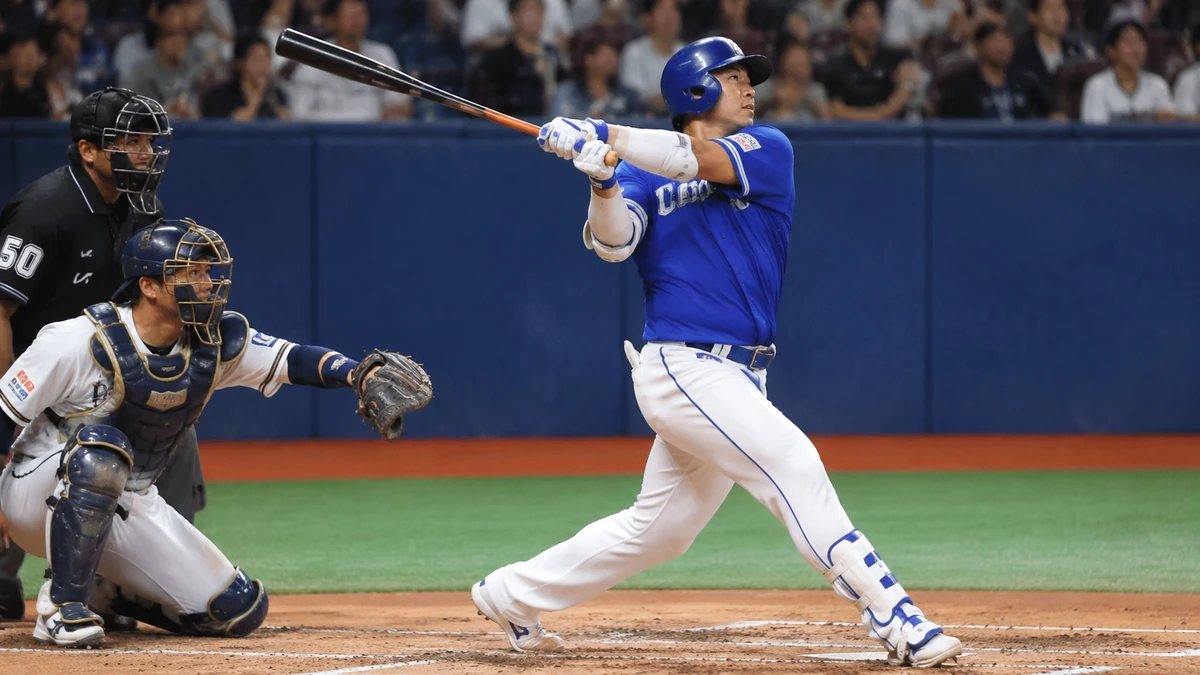
A milestone that means more than a round number
In American baseball, fans instantly understand the weight of certain numbers. Five hundred home runs. Three thousand hits. Three hundred wins, back when pitchers still had a realistic chance to chase that mark. In South Korea’s KBO League, one of the numbers that now belongs in that conversation is 550 doubles, thanks to veteran slugger Choi Hyung-woo.
Choi became the first player in KBO history to reach 550 career doubles on Friday night in Changwon, a coastal city in southeastern South Korea, as the Samsung Lions beat the NC Dinos 5-4 for their sixth straight victory. The hit itself was historic, but the larger story was about endurance, consistency and timing. Choi did not stumble into the record with a bloop single or a ceremonial at-bat. He got there the way durable middle-of-the-order hitters do: by driving the ball with authority, twice, in the middle innings of a meaningful game.
According to South Korean media reports, Choi hit one double to left-center field in the fourth inning and another down the right-field line in the sixth. Those two swings both pushed him deeper into first place on the all-time doubles list and helped fuel a Samsung win that lifted the club into sole possession of third place in the KBO standings.
That matters because doubles are one of baseball’s purest measurements of a hitter’s total game. Home runs can come in bursts. Singles can pile up through contact and luck. Doubles require enough power to split gaps or reach the wall, enough bat control to place the ball, enough speed or anticipation to take the extra base, and enough durability to keep doing it year after year. A hitter does not reach 550 doubles by accident, and certainly not in a professional league as competitive and culturally important in South Korea as the KBO.
For readers in the United States who may know Korean baseball mainly from the 2020 pandemic summer, when ESPN broadcasts introduced many Americans to bat flips, thunder sticks and late-night games from Seoul, Choi’s record is a reminder of something deeper. The KBO is not just colorful television. It is a mature league with its own legends, milestones and generational touchstones. Choi’s 550th double belongs in that history.
Why doubles tell a different story than home runs
In baseball, not all milestones carry the same emotional texture. Home-run chases can feel explosive and theatrical, built around one swing and one spotlight moment. A doubles record lands differently. It tells the story of a hitter who has survived slumps, injuries, roster turnover and changing eras while remaining dangerous enough to drive the ball into the gaps.
That is why Choi’s achievement resonates beyond the number itself. He was already the KBO’s career leader in doubles before Friday. Reaching 550 did not merely break a tie or edge him past a rival. It expanded a lead he had already built into a kind of baseball real estate all his own. Reports in South Korea said the gap between Choi and the player in second place on the career doubles list, KT Wiz veteran Kim Hyun-soo, now stands at 69. In an all-time accumulation stat, that is a striking margin.
American fans can think of it this way: when someone leads a major category by that much, the record stops feeling like a temporary possession and starts feeling like a signature. Choi has made doubles part of his identity. He is not simply first on the list. He has defined what first looks like in this category.
There is also a practical baseball reason doubles are so revealing. They reward hitters who are complete rather than one-dimensional. A batter who yanks every pitch in search of loft might produce home runs but miss chances to drive the ball to the alleys. A contact hitter might post a healthy batting average but lack the impact to stretch singles into extra-base hits. Doubles sit in the middle, where precision and force meet.
That may help explain why Friday’s accomplishment felt especially fitting. Choi’s two doubles came in different parts of the field, one to left-center and one hugging the right-field line. Even from the box score summary alone, the picture is clear: this was not a one-note performance. It was a demonstration of a veteran hitter still able to shape a game with varied, repeatable skills.
In a baseball culture increasingly dominated by velocity readings, launch-angle debates and all-or-nothing outcomes, there is something refreshing about a record built on repeatable excellence. Choi’s 550 doubles stand as a measure of baseball craft over time.
Who Choi Hyung-woo is in Korean baseball
For an American audience unfamiliar with the KBO’s stars, Choi is the kind of player whose career has gradually turned into living history. He is one of the league’s most decorated hitters and, according to Friday’s reports, extended his all-time hits total to 2,630. He also moved to the brink of another major benchmark: 4,500 total bases, sitting just one double away from that plateau.
Those numbers place him in the rare category of player whose excellence can no longer be explained by one great season or one particularly strong era. Instead, his career is measured against the passage of time itself. He has remained productive long enough to keep pushing league standards forward, and that may be the most impressive part of the whole night.
In South Korea, where baseball remains one of the country’s most popular spectator sports and a major part of everyday sports conversation, that kind of longevity carries special meaning. The KBO season is woven into spring and summer life much the way Major League Baseball once more completely framed the American sports calendar. Fans follow their clubs not just as entertainment but as a routine, a social connector and, in many cities, a symbol of regional identity. A player who keeps showing up in the middle of that routine for years becomes more than a good hitter. He becomes familiar public memory.
That is part of the cultural context American readers should understand. KBO fandom is often intensely local and deeply communal. Samsung, based in Daegu, is one of the traditional power clubs in Korean baseball. NC, based in Changwon, represents a newer but increasingly established baseball presence. Games are not just contests between uniforms; they are also expressions of civic pride, company-backed team identity and fan culture that can feel more choreographed and participatory than a typical night at many U.S. ballparks.
Within that environment, Choi’s milestone was not simply a statistical update. It was an event likely to be discussed the way American fans might discuss a veteran reaching another seemingly unreachable threshold in the middle of a pennant race. It reinforced Choi’s status as one of the defining hitters of his league and reminded fans that his career is still active, not merely ceremonial.
That distinction matters. Some records feel like museum pieces. Choi’s did not. He reached 550 doubles while directly shaping the outcome of a one-run game for a club climbing the standings. The record was attached to the present tense.
Samsung’s winning streak changes the meaning of the moment
If Choi’s milestone had come in a lopsided loss, it still would have been historic. But because it came in Samsung’s 5-4 win over NC, it became something richer: a personal landmark that also fit into a team story gathering momentum.
Samsung’s sixth consecutive victory pushed the Lions to 20-14-1 and into sole possession of third place in the KBO standings, according to the Korean reports summarized from Friday’s games. In a league race where early separation matters but does not yet decide anything, that is the kind of surge that gets attention. It signals more than a nice week. It suggests a team beginning to stabilize, stack results and pressure the clubs above it.
For American readers, it may help to think of the KBO standings in the same way one would read the MLB table in late May or early June: not definitive, but no longer meaningless. A six-game winning streak can change clubhouse tone, sharpen fan expectations and turn a veteran’s milestone into the emotional anchor for a broader rise.
That is exactly what happened here. Choi’s doubles were not isolated fireworks. They were part of the competitive engine that drove Samsung’s win. Another strong offensive performance, including contributions from Jeon Byung-woo, helped the Lions secure a one-run result that carried both symbolic and practical value.
There is a reason milestones feel bigger when they happen inside victories. Sports fans instinctively sort memories into two categories: beautiful losses and lasting wins. The latter endure more cleanly. They are replayed not only because something historic happened but because the history helped produce a result that mattered.
Friday’s game fits that pattern. Samsung did not just celebrate a famous number. It left Changwon with a sixth straight win, a higher position in the standings and a stronger sense that this stretch is not a fluke. When a team is climbing, every defining moment becomes amplified. Choi’s 550th double now belongs not only to his own record book but also to Samsung’s season narrative.
That dual meaning is one reason such nights travel well across borders. Fans everywhere understand the emotional combination of personal history and team urgency. A veteran reaches a major milestone, the team wins a close game, and suddenly the box score reads like the first chapter of a larger summer story.
A Korean baseball scene Americans can appreciate
For some American sports fans, the KBO still exists at the edge of familiarity, remembered from an unusual moment in global sports. During the early months of the coronavirus pandemic, when many U.S. leagues were shut down, Korean baseball became a welcome live alternative for American viewers starved for games. The league’s energetic fan culture, synchronized cheering songs and visible emotional style stood out immediately.
But to reduce Korean baseball to novelty would miss the point. The KBO is not interesting merely because it is different. It is interesting because it is fully itself: a league with established traditions, strong regional loyalties, dramatic postseason races and a statistical history deep enough to produce landmarks like Choi’s.
There are cultural details worth explaining for readers who have not followed it closely. Korean teams are often associated with major corporations, so names like Samsung Lions, LG Twins and KT Wiz can sound unusual to American ears. Yet the teams are anchored in cities and local fan identity in ways U.S. readers would still recognize. The corporate branding is prominent, but the emotional relationship between city, club and fan is every bit as real as what Americans see in St. Louis, Boston or Philadelphia.
Game-day atmosphere also differs from the more individualized vibe common at many MLB parks. In Korea, cheering sections often move in unison, with organized chants, songs tied to individual players and a sense that spectators are participating in the contest rather than simply observing it. That can make milestone nights feel almost theatrical. A record is not just announced. It is absorbed by thousands of fans in a shared, highly audible ritual of recognition.
So when Choi reached 550 doubles in Changwon, the achievement landed in a sporting environment that values both cumulative excellence and collective memory. Korean sports coverage, like American coverage, loves records. But there is often an added emphasis on longevity as proof of character and discipline, especially in a league where careers can be long, public and intensely scrutinized.
That context helps explain why Friday’s story resonated so strongly in Korean sports news. Choi’s night checked every box. It featured a record no one else had reached. It widened the distance between him and the field. It happened in a close game with standings implications. And it came from a player whose career already spans multiple major offensive categories.
To U.S. readers, the closest comparison might be watching a veteran MLB star add another layer to a Hall of Fame resume while his team reels off wins and creeps into contention. Even if the names are less familiar, the structure of the story is universal.
Three numbers that define one night
The easiest way to understand Friday is to see it through three numbers: 550 doubles, 2,630 hits and nearly 4,500 total bases. Each captures a different dimension of Choi’s standing in Korean baseball history.
The 550 doubles are the headline because they represent a first in league history. No one had reached that mark before. And because Choi was already the career leader, the milestone did not just create a record; it reinforced a hierarchy.
The 2,630 hits matter because they speak to precision and sustained contact. Hit totals are baseball’s long-form proof of relevance. They show a hitter has remained productive across ballparks, lineups, pitching trends and years of wear. Choi adding to his all-time hits lead on the same night made the doubles record feel less isolated and more like part of a complete offensive legacy.
Then there is the approach to 4,500 total bases, a number that combines every kind of hit into one broad measure of offensive output. If hits tell you how often a player succeeds and doubles tell you something about the force of that success, total bases tell you how much damage he does overall. Choi finishing Friday just one double shy of that threshold added another layer of suspense. The record he achieved also positioned him for the next one.
That stack of milestones is what gave the night its unusual density. It was at once a celebration of what Choi has already done and a preview of what may happen next. In sports, that combination is gold. Fans love closure, but they love anticipation too. Friday offered both.
It also underscored a broader truth about how athletes become legends. Rarely is it one category alone. Instead, a player’s reputation hardens when multiple leaderboards begin telling the same story. Choi’s hits, doubles and total bases all point in the same direction: toward a career defined by unusual staying power and reliable impact.
That is why the image from Changwon should matter even to international readers who do not follow the KBO every day. It was not just another line in a statistical ledger. It was a portrait of how greatness accumulates.
What comes next for Choi, Samsung and the KBO race
The immediate question after a milestone like this is whether it marks a conclusion or a launch point. For Choi, Friday looked much more like the latter. He is still adding to categories he already owns, still threatening new thresholds and still helping decide games for a team moving up the standings.
For Samsung, the challenge is to turn a six-game surge into something sturdier. In any professional season, winning streaks attract attention but do not guarantee permanence. The difference between a hot stretch and a serious contender usually comes down to whether the club can sustain pressure after the emotional bump of a signature win. If Samsung keeps getting timely offense and continues to capitalize on close games, Friday may be remembered as the night a good week became a meaningful rise.
The standings context matters here. The Lions still trail the top two clubs, KT and LG, but not by an overwhelming margin. That means every win has leverage. A one-run victory in early May does not decide a pennant, but it can shape the path toward one. The KBO season, like the MLB season, is long enough to punish overreaction and short enough to reward momentum when it is real.
As for Choi, there is a final point worth emphasizing for American readers: athletes who age into achievement often become easier to appreciate across cultural lines. A towering prospect can be local. A veteran accumulating impossible numbers becomes universal. Fans do not need to know every detail of Korean baseball history to understand what it means when one player pushes a league standard farther than anyone else has managed.
That is the real significance of 550 doubles. It is not just a Korean record, though it certainly is that. It is also one of those sports milestones that speaks a language all baseball fans understand: excellence repeated so often that it turns into history.
On Friday night in Changwon, Choi Hyung-woo gave Korean baseball one of its clearest images of the season so far. Two doubles. One narrow win. Six straight victories for a rising team. A widening lead in the record book. And, maybe most important, a reminder that in any league, in any country, the most enduring greatness is often built not on one dramatic blast but on the steady accumulation of hard-hit baseballs over time.
Comments
Post a Comment