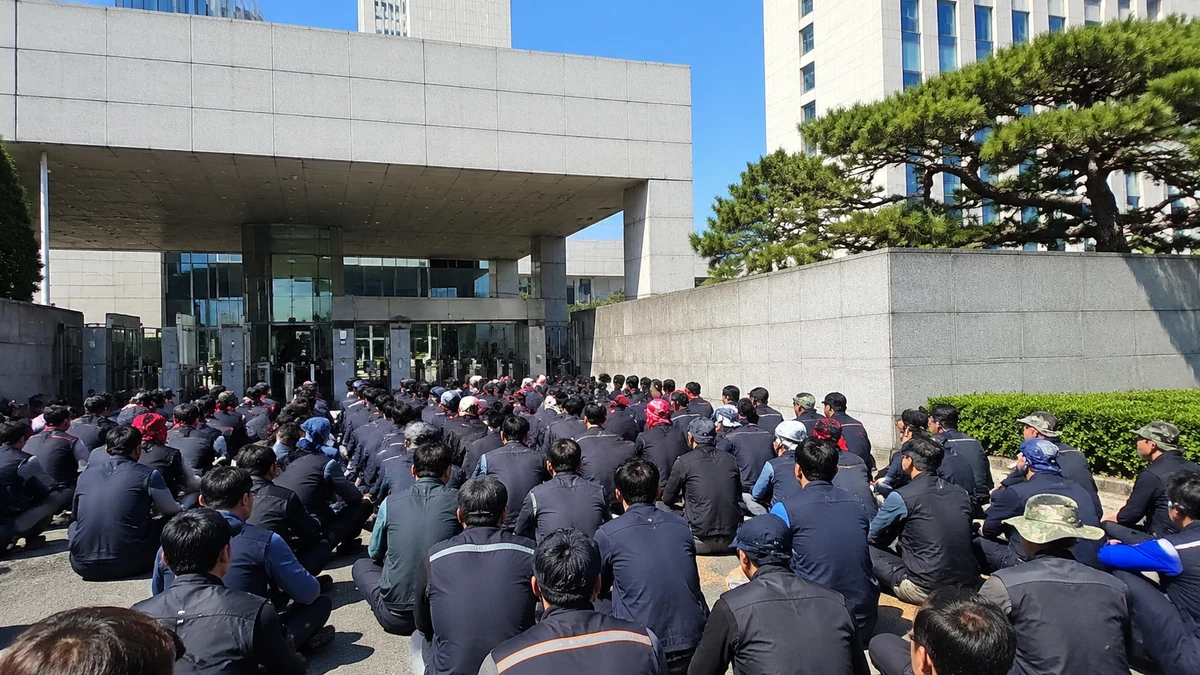
A procedural win, and a larger fight still ahead
A labor ruling in South Korea has given union organizers a partial victory in a closely watched dispute involving Hanwha Ocean, one of the country’s major shipbuilders, while postponing the more explosive legal question at the center of the case: whether the parent company can be treated as the employer of workers who are not directly on its payroll.
The decision, disclosed this week and reported by South Korea’s Yonhap News Agency, came from the Gyeongnam Regional Labor Relations Commission, a government labor body that handles collective bargaining and workplace disputes. The commission found that Hanwha Ocean could not simply leave out 450 union members from a subcontracted food-service company when posting a public notice related to bargaining demands. At the same time, however, it stopped short of deciding whether Hanwha Ocean is legally the “user,” or employer, of those workers for purposes of collective bargaining.
That distinction may sound technical, but in South Korea it has become one of the most important labor questions of the year. The case is being treated as an early test of the country’s revised union law, widely known by its nickname, the “Yellow Envelope Law,” a measure tied to a broader debate over how much responsibility large corporations bear for workers employed through layers of subcontractors, suppliers and service vendors.
For American readers, the closest comparison might be a dispute involving a major automaker, logistics giant or tech manufacturer whose cafeteria workers, janitors or warehouse staff are officially employed by contractors, but whose day-to-day working conditions may still be shaped by the decisions of the larger corporation running the site. In the United States, questions about “joint employer” status have long been central in labor law battles involving franchises, staffing agencies and subcontracted workers. South Korea is wrestling with a related issue, but in a political and industrial setting that is very much its own.
What happened this week did not settle that larger debate. Instead, it showed just how difficult it can be to translate a headline-grabbing legal reform into clear rules on the ground. The union got confirmation that workers tied to the shipyard’s food-service operation could not be excluded at the procedural stage. But the ruling left unanswered the question that matters most for actual bargaining power: Who, exactly, has to come to the table?
Why this case matters beyond one shipyard
The dispute began in March, shortly after revisions to South Korea’s Trade Union and Labor Relations Adjustment Act took effect. The amendments are often referred to in Korean political debate as the “Yellow Envelope Law,” a name that carries emotional and historical weight. The phrase traces back to a civic fundraising campaign in which supporters sent small donations in yellow envelopes to help workers facing heavy legal claims. Over time, the label came to symbolize efforts to strengthen labor protections, especially for workers caught in subcontracting arrangements and labor disputes with large companies.
In this case, the Geoje-Tongyeong-Goseong Shipbuilding Subcontractors Branch of the Korean Metal Workers’ Union demanded bargaining with Hanwha Ocean and included 450 members of a food-service union branch known as the Wellive branch. Hanwha Ocean is the main contractor at the shipyard, while the food-service workers are employed through a company that helps support operations at the site. That may sound far removed from the shipbuilding itself, but anyone who has worked in a factory, port or large industrial complex knows that such workplaces depend on an entire ecosystem of labor beyond the welders, machinists and engineers usually associated with the core business.
In South Korea, this structure is especially significant. Major industrial employers often operate through sprawling networks of subcontractors. The result is a multilayered work force in which people laboring in the same physical space may have very different legal relationships to the company whose name is on the gate. One group may be employed directly. Another may work for a supplier. Another may provide food, cleaning, maintenance or transportation services through separate contractors. Yet all of them can be affected by the production schedules, cost controls and management decisions of the lead company.
That reality is part of why this case has drawn national attention. It is not merely about whether a specific group of cafeteria or food-service workers can be counted in a bargaining notice. It is about whether South Korea’s revised labor law will meaningfully expand the scope of collective bargaining in workplaces where formal employment structures do not fully capture who holds power.
For global readers, there is also an economic angle. South Korea’s shipbuilding industry is deeply tied to international supply chains and global commerce. Hanwha Ocean, formerly Daewoo Shipbuilding & Marine Engineering before a change in ownership and branding, is part of an industry that builds vessels central to energy transport, manufacturing and trade. Labor rules inside such companies can have ripple effects beyond Korea, especially as multinational investors and buyers pay closer attention to labor standards in the supply chain.
What the labor commission decided — and what it refused to decide
The labor commission’s ruling was narrow but important. It said that in the process of consolidating bargaining channels — a system in South Korea intended to streamline negotiations when multiple unions are involved — an employer cannot arbitrarily change the reported number of union members in a bargaining demand and then post a notice reflecting that altered count.
In practical terms, the commission recognized the union’s objection to the way the bargaining demand had been handled. It signaled that the company could not simply subtract the 450 Wellive branch members and proceed as though they were not part of the demand. The ruling emphasized that an employer has an obligation, as a party to collective bargaining, to participate actively in the bargaining process. That language reinforces the principle that procedural fairness matters and that the company’s role is not supposed to be one of selective gatekeeping.
But the commission drew a sharp line when it came to the broader legal question of employer status. It declined to determine at this stage whether Hanwha Ocean is the employer of the Wellive branch workers in the legal sense relevant to bargaining. According to the summary of the ruling, the commission reasoned that if employer status were judged anew at every stage of the bargaining-channel process, different bodies or different procedural moments could produce different answers, undermining legal stability and predictability.
That logic is easy to understand from an administrative perspective. Labor disputes can already drag on for months or years. If every procedural step reopens the same foundational question, the whole system can grind to a halt. The commission also pointed to the purpose of the related rules: to promote collective bargaining quickly. In that sense, the ruling can be seen as an attempt to keep the machinery moving without litigating the largest issue at every turn.
Yet to unions, the deferral is exactly what makes the decision unsatisfying. Being included in the process is not the same as securing a binding obligation from the company with real decision-making power. If the lead company’s employer status remains unresolved, the bargaining table may still be missing the party workers believe actually controls their working conditions.
That is why the ruling is being described by many observers as a half-step. It lowers one procedural barrier while leaving the central legal boundary intact. It says, in effect, that these workers cannot simply be erased from the notice, but it does not yet say who must answer for them.
The American parallel: Think “joint employer,” but in Korea’s industrial system
To understand why this resonates beyond South Korea, it helps to translate the issue into terms more familiar to American readers. In the United States, labor and employment battles often turn on whether a large company counts as a “joint employer” alongside a contractor, staffing firm or franchise operator. The answer can determine who has to bargain, who may be liable for labor violations and how much leverage workers actually have.
Imagine workers at a massive U.S. manufacturing campus whose cafeteria is run by a contractor, whose cleaning crew is employed by another vendor and whose warehouse labor comes through a staffing agency. Those workers may wear different badges and receive paychecks from different companies. But if the lead corporation effectively controls scheduling, site access, operating standards or labor costs, unions and regulators may argue that the larger company cannot wash its hands of responsibility. Business groups, by contrast, often warn that expanding employer definitions creates legal uncertainty and imposes obligations on companies that never formally hired those workers.
South Korea’s current debate is not identical, but it is structurally similar. The Korean issue unfolds in a labor system shaped by a distinct history of rapid industrialization, powerful conglomerates known as chaebol and a long-running pattern of outsourcing and subcontracting in heavy industry. Shipbuilding, auto manufacturing and steel have all seen tensions over how much responsibility the lead company bears when work is sliced among subsidiaries and contractors.
The “Yellow Envelope Law” became politically charged precisely because it touches that nerve. Supporters have argued that without broader accountability, workers employed through subcontractors can be left bargaining with companies that do not truly control wages, staffing levels or safety-related decisions. Critics have said the law risks creating uncertainty for businesses and expanding labor disputes by blurring lines of legal responsibility.
The new Hanwha Ocean ruling does not settle that argument. What it does show is that once a law changes on paper, the next battle is over implementation. In the United States, that often happens through rulings from the National Labor Relations Board and the courts. In South Korea, labor commissions and related administrative processes play a similarly important gatekeeping role. The meaning of reform gets built case by case.
Why unions are angry, even after a partial victory
The union’s frustration is not hard to understand. On one hand, the ruling acknowledges that excluding the 450 Wellive branch members from the bargaining-demand notice was not acceptable. That gives the union a concrete procedural point in its favor and validates its complaint that workers were being screened out too early in the process.
On the other hand, the workers’ core concern is not simply whether their names appear in a notice. It is whether Hanwha Ocean, as the main company operating the shipyard, can be required to deal with them as a bargaining counterpart. If that question remains undecided, then the procedural win may have limited practical value. Workers can be told they are inside the process while still being kept at arm’s length from the entity they believe has real power over their conditions.
That tension is especially acute in industries with fragmented labor structures. In such settings, a subcontractor may be the formal employer, but the lead company can still influence budgets, staffing needs, operating tempo and site rules. From labor’s perspective, bargaining only with the subcontractor can feel like negotiating with a middleman who lacks the authority to make meaningful changes. From management’s perspective, however, treating the lead company as the employer may expand its obligations far beyond what traditional corporate boundaries would suggest.
The result is a conflict that is legal, political and symbolic all at once. For unions, this case has become an early benchmark for whether the revised law can penetrate the reality of indirect employment. For employers, it may serve as a test of whether procedural inclusion will gradually evolve into a broader theory of corporate responsibility.
That helps explain why even a seemingly technical ruling is attracting so much attention. Labor disputes often turn on procedure before they turn on substance. Who gets counted, who gets posted, who gets certified and who gets heard can shape the entire trajectory of a case. In that sense, the union won something meaningful here. But because the commission left the employer-status issue untouched, the workers did not get the clarity they were seeking most.
The legal balancing act: speed, stability and accountability
The commission’s reasoning reflects a familiar dilemma in labor law. Policymakers want bargaining systems that are predictable and efficient. Workers want systems that reach the real centers of power. Employers want legal lines that are clear enough to manage risk and operations. Those goals often collide.
By stressing legal stability, the Gyeongnam commission appears to be saying that it is dangerous to revisit employer status at every procedural checkpoint. If one stage produces one answer and a later stage produces another, the process could become unmanageable. That concern is hardly trivial. Businesses need to know who is expected to negotiate. Unions need to know where to direct their demands. Administrative bodies need a framework that does not invite constant relitigation of the same threshold issue.
At the same time, stability can come at a cost. If the system postpones the employer-status question too long, workers may spend months moving through a formal process without knowing whether the company with the most influence is actually bound to participate. A procedure designed to accelerate bargaining can end up delaying substantive accountability.
This is the core tension underlying the Hanwha Ocean dispute. The commission drew a distinction between two questions: who should be included in the bargaining process, and who counts as the employer. The first is procedural. The second goes to responsibility. The ruling makes clear that these are not the same question under Korean labor administration, at least at this stage.
That distinction may become a template for similar cases. Future disputes could cite this ruling to argue that workers cannot be excluded from bargaining-related notices simply because the employer-status issue remains contested. But companies may also rely on the same logic to argue that procedural inclusion does not automatically mean they have accepted the legal duties of an employer. In other words, the ruling may prove influential precisely because it separates access from accountability.
What this says about South Korea’s labor politics
South Korea’s labor politics are often shaped by a clash between the country’s economic success story and the inequalities embedded in the systems that helped produce it. Over the past several decades, the country has built world-class industries in shipbuilding, semiconductors, autos and electronics. But that industrial strength has also depended in part on layered contracting structures and intense workplace hierarchies.
As in many advanced economies, the rise of indirect employment has complicated older assumptions about what a workplace looks like and who truly controls it. A factory or shipyard may appear to be one workplace to the eye, yet be divided into separate legal employers on paper. That fragmentation can weaken worker bargaining power, especially when decisions are centralized at the top but obligations are pushed downward through contractors.
The “Yellow Envelope Law” emerged in that environment. Its supporters saw it as a way to make labor rights more responsive to the actual structure of modern Korean industry. Its opponents warned that it would upset settled business expectations and encourage more contentious labor disputes. The Hanwha Ocean case is now one of the first visible examples of that fight moving from politics and legislative debate into administrative practice.
There is also a reason the dispute is resonating emotionally in Korea. Questions about subcontracting are not just legal abstractions there; they have been tied for years to concerns about inequality, workplace safety and social status. In some sectors, subcontracted workers have argued that they do similar or equally essential work under less secure conditions and with weaker bargaining leverage than directly hired employees. Cases like this one therefore land in a wider public conversation about fairness in an economy dominated by large corporate groups.
What comes next
The most immediate takeaway is that this ruling is unlikely to end the dispute. If anything, it sets the stage for the next phase. The union now has official backing for its claim that the 450 Wellive branch members could not simply be omitted from the bargaining-demand notice. But the unresolved employer question means the broader confrontation over bargaining obligations remains alive.
That next phase could unfold in additional administrative proceedings, further legal challenges or intensified labor pressure on the ground. Much will depend on whether later stages of the process force a clearer determination of Hanwha Ocean’s responsibilities toward indirectly employed workers connected to the shipyard. It will also depend on how other labor bodies and courts interpret the revised union law as more disputes arise.
For companies across South Korea, especially those operating through dense contractor networks, the case is a warning that procedural handling of union demands will receive close scrutiny. For unions, it is a reminder that legal reform does not automatically deliver quick substantive victories. The terrain after reform can be just as contested as the legislative fight that came before it.
For international readers, the significance is broader still. Around the world, labor law is struggling to catch up with business models built on outsourcing, layered management and diffuse accountability. South Korea’s shipyards may seem far from a U.S. warehouse, a hospital food-service operation or a giant corporate campus run through outside vendors. But the underlying question is strikingly familiar: When workers’ lives are shaped by a company’s decisions, how far can that company stand behind the shield of subcontracting?
This week’s ruling did not answer that question. What it did do was make clear that in South Korea, at least for now, workers tied to a workplace cannot be casually written out of the bargaining process. Whether that procedural opening becomes a path to deeper accountability is the question that comes next — not just for Hanwha Ocean, but for the future of labor relations in one of Asia’s most important industrial economies.
Comments
Post a Comment