A small moment that carried a larger message
In the hierarchy of international news, summit meetings are usually judged by the big things: agreements signed, sanctions discussed, military coordination announced, trade disputes eased or inflamed. The official readouts matter. So do the joint statements, the photo lines, the body language at the lectern. But sometimes the most revealing image from a high-level diplomatic encounter is not the one taken at the conference table. It is the off-script moment that seems almost too small to matter — until it does.
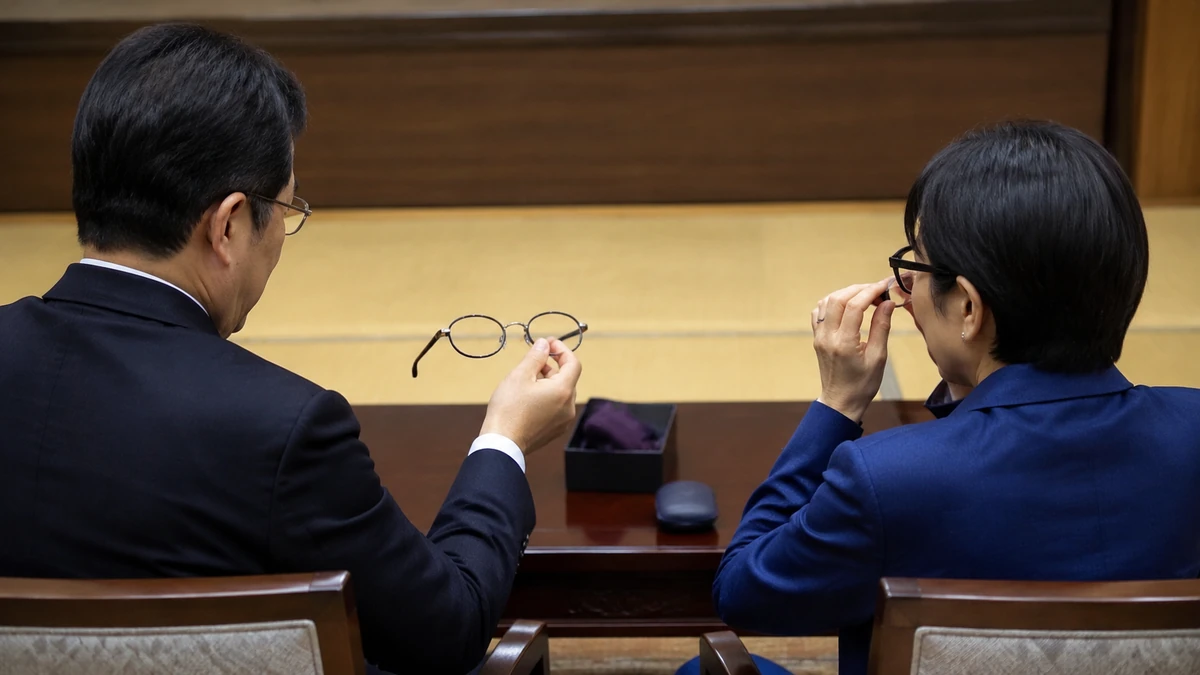
That is why a seemingly light exchange after a recent summit between Japanese Prime Minister Sanae Takaichi and South Korean President Lee Jae-myung is drawing attention in both countries and beyond. According to reports carried by South Korea’s Yonhap News Agency, Takaichi gave Lee a pair of eyeglass frames from Sabae, a Japanese city widely known for premium eyewear manufacturing. Then, in a moment that was casual enough to feel spontaneous but public enough to be unmistakably political, she briefly borrowed Lee’s glasses, tried them on and posed for a smiling photograph with him.
On paper, this is a tiny story. No treaty emerged from the exchange. No major policy shift can be traced to a pair of frames. Yet diplomacy often works through symbols long before it produces deliverables. For countries like Japan and South Korea — neighbors bound by trade, security concerns and democratic values, but also divided by painful historical memory and recurring political mistrust — small gestures can carry unusual weight. A shared laugh after a formal meeting can signal something that a carefully worded communiqué often cannot: that the leaders involved are at least trying to lower the emotional temperature.
The image matters partly because it appeared through an official Japanese government channel rather than as an accidental leak or a stray pool-camera shot. Governments do not distribute photographs like this casually. They select them. They frame them. They understand that in a digital media environment, a single image can do diplomatic work all by itself, especially when audiences around the world encounter foreign policy first through social media and headlines rather than through dense policy briefs. In that sense, this was not just a picture. It was a message.
And the message was fairly clear: whatever unresolved issues remain between Tokyo and Seoul, both sides wanted the world to see warmth rather than frost.
Why optics matter so much in Japan-South Korea relations
To American readers, it may help to think of Japan-South Korea diplomacy as a relationship in which substance and symbolism are unusually intertwined. The United States has deep alliances with both countries, and Washington has spent years encouraging closer cooperation among its two Northeast Asian partners. From missile defense and intelligence sharing to semiconductor supply chains and deterrence against North Korea, the practical reasons for Japan and South Korea to work together are obvious. Yet the emotional and political terrain between them is far more complicated.
Korea was under Japanese colonial rule from 1910 to 1945, a period that remains central to South Korea’s national memory and political identity. Disputes over wartime forced labor, the treatment of so-called comfort women, history textbooks, official apologies and territorial claims have repeatedly spilled into the present. As a result, even when Seoul and Tokyo align strategically, their relationship can still feel brittle. Domestic politics in either country can quickly reopen old wounds. A single statement by a cabinet minister, a court ruling or a shrine visit can trigger headlines and public outrage.
That history helps explain why nonverbal signals between leaders are scrutinized so closely. In many bilateral relationships, the length of a handshake or the tone of a dinner photo would be little more than color for a news feature. In Japan-South Korea relations, those details become part of the diplomatic text. Analysts, voters and foreign governments alike read them as clues. Was the interaction stiff? Was it purely ceremonial? Did the leaders seem relaxed once the formal session ended? These questions do not replace policy analysis, but they do shape the atmosphere in which policy gets made.
Atmosphere matters in diplomacy more than outsiders sometimes assume. Negotiations do not happen in a vacuum. Bureaucrats and ministers can make progress only if political leaders are willing to sustain it, defend it at home and avoid turning every disagreement into a public test of national pride. That is especially true in Northeast Asia, where historical memory, nationalism and great-power competition all overlap. A warmer tone at the top does not solve structural problems, but it can create room for officials to manage them.
That appears to be the larger significance of the glasses episode. It was not evidence that every dispute between Japan and South Korea has been tamed. It was evidence that both sides saw value in showing a relationship that looked manageable, civil and human.
The gift itself was carefully chosen
Diplomatic gifts are rarely random, and this one was unusually well calibrated. Sabae, the Japanese city associated with the gift, is famous inside Japan for its eyewear industry. For Japanese audiences, a pair of frames from Sabae signals quality craftsmanship and regional manufacturing pride — something akin to giving a visitor a well-made product from a city known nationally for a particular specialty. In the United States, the closest comparison might be presenting a guest with bourbon from Kentucky, crystal from a storied workshop or a leather product from a region whose identity is tied to that craft. The point is not just the object. It is the place, the labor and the national self-image attached to it.
The second layer of meaning is personal. Lee is known for wearing glasses regularly. That made the gift feel less generic and more observant, as if Takaichi’s team had taken note of a habit that is part of the South Korean president’s public image. In diplomatic settings, that kind of personalization matters. It suggests attentiveness rather than mere protocol. When leaders exchange gifts that reflect something specific about the other person’s daily life, the message is subtle but unmistakable: We see you as more than just a seat across the table.
Then came the moment that made the gift visually memorable. Lee was photographed wearing a different pair from the one he had on during the summit, while Takaichi — who is not typically seen in glasses — briefly tried on Lee’s pair, holding them carefully with both hands and smiling. That turned the exchange from a standard gift presentation into a scene of mutual ease. The object moved from being a symbolic item to a prop in an unscripted-seeming interaction. For diplomacy, that is gold. It creates a story ordinary people can grasp immediately.
There is also a deeper logic here. Gifts in diplomacy often serve two functions at once: they represent the giver’s country, and they create a personal connection with the recipient. This one did both. The frames represented a distinct Japanese industry and region, but they also connected directly to Lee’s everyday public appearance. That pairing of national branding and personal awareness is what makes the gift politically effective without being ostentatious.
None of this means the exchange was apolitical or naive. On the contrary, it was useful precisely because it was politically safe. Neither side had to make a concession on a sensitive issue to produce this image. No one had to compromise on historical claims or strategic priorities. But they could still project a tone of respect and good humor. In a relationship where symbolism can easily sharpen tensions, here symbolism was deployed to soften them.
Why governments release photos like this
One of the most important details in this episode is not what happened but how it was presented. The photograph was reportedly released by an official Japanese government account with a short description identifying it as a scene after the dinner. That matters because official channels are curatorial by nature. They do not simply document events; they build narratives around them.
In modern diplomacy, the image stream is almost as important as the policy stream. Leaders and their staffs know that publics consume diplomacy visually. Many people will never read the full summary of a summit, much less a technical account of trade, security coordination or historical consultation mechanisms. But they will see the picture. They will remember whether the leaders looked tense, guarded, cheerful or performative. And because the image circulates instantly across platforms and languages, its impact can outpace any written explanation.
That is especially true in Asia, where summitry often mixes rigid protocol with intensely choreographed public messaging. Official photographs are selected for mood as much as for documentation. A handshake shot says one thing. A working-table shot says another. A dinner photo, especially one that catches the leaders after the hard part is over, sends a distinct signal: the relationship extends beyond the formalities. It implies a comfort level that may or may not be deep, but is at least politically useful.
American presidents do this too, of course. White House communications teams understand the value of what might be called “human-scale statecraft” — the quick laugh in the Oval Office, the relaxed walk at Camp David, the behind-the-scenes photo that softens the edges of a difficult negotiation. The point is not to replace substance with imagery. It is to make the substance easier to sell, easier to absorb and easier to sustain.
In the case of Japan and South Korea, the communications challenge is particularly delicate. Both governments must manage not only foreign audiences and investors, but also domestic publics with strong feelings about history and sovereignty. Releasing a light, cordial image after a summit allows officials to say something important without saying too much. It conveys that dialogue is open, that contact is functioning and that neither side wants to be seen as slamming the door.
That is what makes the photo more than a curiosity. It was part of a broader act of public diplomacy, aimed not just at the two leaders’ citizens but at the international community watching for signs of stability in a strategically crucial region.
The line between genuine warmth and diplomatic theater
It is worth drawing a careful distinction here, because foreign-policy imagery is easy to overread. There are at least two levels to this story. The first is factual and straightforward: Takaichi gave Lee eyeglass frames from a famous Japanese manufacturing hub; Lee tried them on; Takaichi briefly wore Lee’s glasses; a smiling photo was taken and publicly released. The second level is interpretive: What does that scene mean?
There is no reason to assume that a pleasant moment automatically signals a breakthrough. Diplomacy is full of images that coexist with stubborn disagreements. Leaders can smile for cameras and still leave a room divided on military posture, trade safeguards, court rulings or how to address historical grievances. Anyone covering international affairs long enough learns that warmth in the frame does not guarantee harmony in the file folder.
At the same time, it would be equally mistaken to dismiss such moments as meaningless theater. Political theater is still political. Symbolism is not the opposite of diplomacy; it is one of diplomacy’s tools. Governments spend enormous effort on ceremony, staging and visual language because those things shape expectations. They influence how citizens interpret a relationship, how markets perceive risk and how allied governments judge whether coordination is likely to hold.
So the most sensible reading lies somewhere in the middle. This photo is not proof of transformed bilateral relations. It does not erase the structural issues between Japan and South Korea. But it does suggest an active choice to emphasize cooperation over antagonism, ease over discomfort and communication over distance. That choice matters, especially when governments have other options. They could have highlighted only the formal group image. They could have kept the mood rigid. They did not.
There is another reason the moment resonates. It showed a degree of improvisation, or at least the appearance of it. In an age when political events are heavily managed, scenes that seem natural often have outsized power. They invite viewers to feel they are glimpsing the real relationship rather than its script. Whether entirely spontaneous or not, the image succeeded because it looked like a human interaction first and a diplomatic artifact second.
That is often the sweet spot of effective statecraft in the media era. A gesture does not need to be grand to be useful. It needs to feel believable.
What this says about South Korea’s diplomatic image abroad
For global audiences, including many Americans who may follow East Asia primarily through stories about North Korea, China or supply chains, this episode offers a different window into South Korea’s international posture. It shows South Korean diplomacy not only as a matter of strategic positioning, but also as a practice of relationship management in a region where symbolic fluency matters.
Lee, in this image, is not merely the recipient of a gift. He appears as a leader comfortable in the performative side of diplomacy — willing to participate in a light exchange that communicates openness without trivializing the office he holds. That balancing act is not minor. Leaders in Asia are often expected to project seriousness, restraint and dignity, especially in cross-border settings shaped by historical sensitivity. To appear relaxed without appearing careless is part of the craft.
The same is true for Japan. By choosing a gift that highlighted a domestic industry and by publicizing a moment of warmth, Tokyo projected a version of itself that emphasized civility, craftsmanship and personal attentiveness. For outside audiences, the message was not only about bilateral ties. It was also about what kind of diplomatic actor Japan wants to be seen as: confident, polished and capable of pairing hard interests with soft touch.
This matters because East Asia is often portrayed abroad through the language of rivalry and escalation. Those themes are real, but they can flatten the region into a series of security flashpoints. Images like this complicate that picture. They remind viewers that diplomacy in the region is not just about missiles, summits and tensions in the Taiwan Strait. It is also about etiquette, symbolism, public emotion and the small rituals through which governments test whether cooperation can be sustained.
For South Korea especially, whose foreign policy sits at the intersection of U.S. alliance politics, regional economic dependence and historical memory, being able to project poise in that environment is valuable. The country’s diplomatic image is not built solely through major speeches or crisis response. It is also built through the moments that reveal how its leaders navigate closeness and friction at the same time.
That is one reason the glasses photo traveled beyond simple human-interest status. It hinted at a broader reality: in a region marked by recurring tension, even a modest gesture of leader-level comfort can become part of the story of stability.
A friendly image does not erase hard realities
Still, any honest assessment should end with a measure of caution. A photograph, however carefully chosen, does not settle the underlying questions that have long complicated Japan-South Korea relations. Historical disputes remain politically potent. Security coordination, though increasingly important, exists within larger regional pressures involving North Korea’s weapons programs, China’s military rise and the domestic constraints each government faces at home. Economic disagreements can reappear quickly. Legal controversies tied to history have a way of resurfacing just when diplomacy seems to be improving.
That is why it would be a mistake to treat this image as evidence of a dramatic reset. It is better understood as a barometer than a breakthrough — a sign of atmosphere rather than an announcement of resolution. In diplomacy, atmosphere is not trivial, but it is not everything. Goodwill helps leaders keep talking. It does not by itself answer the hard questions that make the talks necessary.
Even so, atmosphere can shape outcomes over time. Relationships between governments do not improve only through formal concessions; they also improve through repeated signals that dialogue is worth preserving. A photo like this contributes to that process. It gives political cover to moderation. It normalizes cordiality. It reminds audiences that engagement is possible even when full agreement is not.
For American readers, perhaps the simplest way to understand the significance of the moment is this: in some diplomatic relationships, a joking exchange over a pair of glasses would barely register. In Japan-South Korea relations, it becomes news because the emotional climate between the two countries has strategic consequences. When leaders show they can interact with warmth after the formal meeting is over, that is not the whole story — but it is part of the story.
And sometimes, in international politics, part of the story is enough to matter. The summit may ultimately be judged by what it produced on paper, or failed to. But the image likely to endure is more intimate: one leader offering a carefully chosen gift, the other trying it on, both smiling as the cameras clicked. Not because glasses change history, but because the people managing history wanted the world to see that the conversation is still open.
In that sense, the most memorable message from the meeting was not written in a policy memo. It was worn, briefly, on a face.
Comments
Post a Comment