A Small Wildfire in South Korea Was Contained in 82 Minutes. The Bigger Story Is How Fast the System Moved.
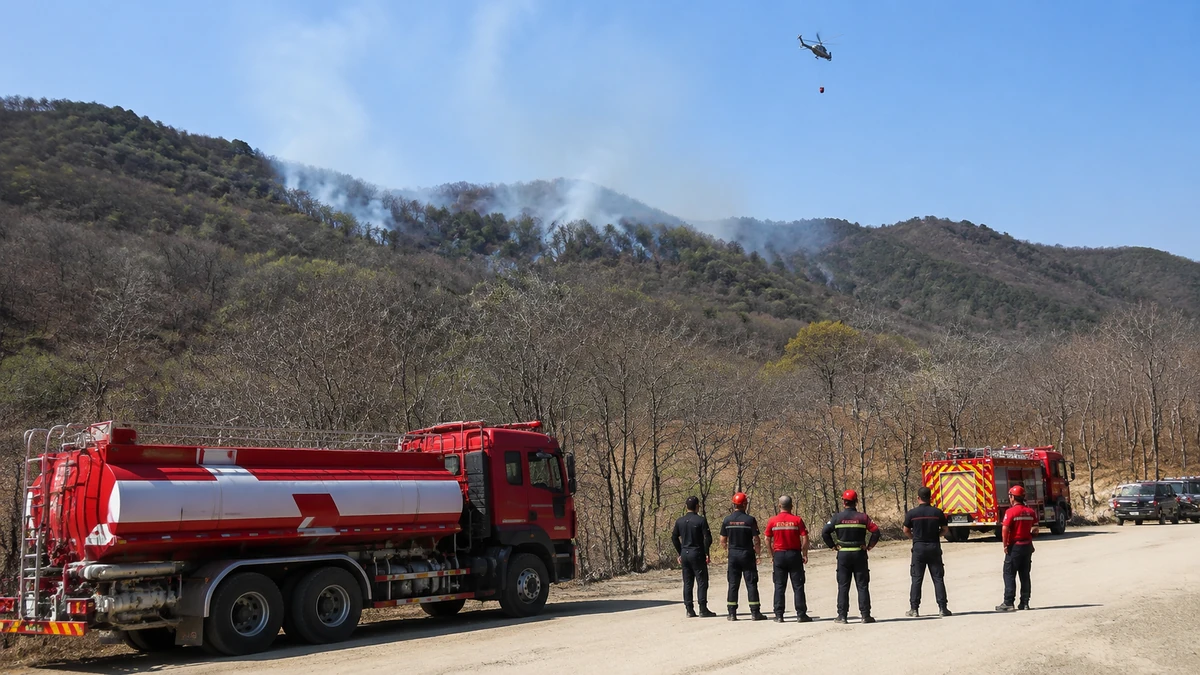
A midday wildfire, quickly contained
A brush fire that broke out on a wooded hillside in the South Korean city of Mungyeong on Monday was brought under control in about 1 hour and 20 minutes, a relatively short window that is drawing attention less for the size of the blaze than for the speed and structure of the response.
According to South Korean authorities, the fire started at 12:48 p.m. in Suye-ri, a rural area in Gaeun-eup, Mungyeong, in North Gyeongsang Province. By 2:10 p.m., officials said they had contained the main flames. Firefighting authorities mobilized seven helicopters, 37 vehicles and 98 personnel, while the city government sent emergency text alerts warning people not to enter the mountain area and urging nearby residents and hikers to watch for safety risks.
For American readers used to headlines about California megafires, Maui’s devastating urban fire, or smoke emergencies that stretch for days, a small hillside blaze extinguished in just over an hour might sound routine. In South Korea, though, the episode offers a revealing look at how local governments and forest agencies handle a particular kind of risk: fires that ignite where mountain terrain, neighborhoods and recreation areas sit close together.
Mungyeong is not Seoul, and this was not a national-scale disaster. But in some ways that is exactly why the case matters. Smaller emergencies can show how well a public system works when it must move quickly, coordinate across agencies and communicate with ordinary people in real time. In this case, the event appears to have done all three.
Officials have emphasized that the cause of the fire and the full extent of the damage remain under investigation. That caveat matters. Early success in firefighting does not answer the two questions that usually matter most after the flames are knocked down: How did it start, and what, exactly, was lost?
Why a mountain fire matters in a country like South Korea
To understand why this fire became a noteworthy domestic story, it helps to understand South Korea’s geography and patterns of daily life. South Korea is a densely populated country, but it is also deeply mountainous. Forested slopes are not remote backcountry in the way many Americans might picture wilderness. In many parts of the country, mountains begin right at the edge of residential areas, farms, small roads and local business districts.
That makes a “wildfire” in Korea somewhat different from the image many U.S. readers may have in mind. In the American West, wildfires often conjure scenes of massive fire fronts, evacuation zones stretching across counties, and long battles involving state and federal agencies. In South Korea, many mountain fires unfold on a smaller geographic scale, but they can still carry serious risks because the interface between woodland and community is so tight.
A hillside blaze in a city like Mungyeong can threaten more than trees. It can disrupt road access, put hikers and residents in danger, complicate helicopter and vehicle operations on steep terrain, and create the risk of flare-ups after the main fire is brought under control. Even when acreage burned turns out to be limited, the social footprint of the event can be larger than outsiders might expect.
Mungyeong itself is a fitting example. Located in the northwestern part of North Gyeongsang Province, it is known for mountainous landscapes, rural communities and outdoor tourism. The city is associated with hiking, scenic roads and a slower pace than major urban centers like Seoul or Busan. In places like that, the mountain is not just scenery. It is part of local routine, recreation and identity. Closing access to a mountain area, even temporarily, affects how people move through their day.
That is one reason the city’s emergency alert mattered so much. The warning was not just informational. It was behavioral. It told people to stay out of the area and exercise caution, effectively turning public communication into a frontline safety tool.
The significance of 82 minutes
In wildfire coverage anywhere, time is one of the most important numbers. A report that the main fire was contained in 82 minutes can sound like a simple measure of efficiency. In reality, that number usually reflects a chain of decisions and capacities working in sync.
For a fire to be checked that quickly, several things generally have to happen fast. Someone has to spot it and report it. Authorities have to assess it quickly enough to dispatch the appropriate resources. Aircraft and ground crews have to be available, or at least available soon enough to matter. Roads or access points have to allow vehicles to get close. The scene has to be managed in a way that prevents bystanders, hikers or passing motorists from making an already difficult operation harder.
That appears to be what happened in Mungyeong. Seven helicopters were mobilized, a substantial air response for a local mountain fire. Helicopters are particularly valuable in rugged terrain, where they can drop water on hot spots that are difficult to reach from the ground and slow the spread before flames crest a ridge or run downhill with the wind. But helicopters alone do not finish the job. Vehicles and personnel are needed to manage the perimeter, extinguish residual flames, watch for embers and secure nearby areas.
The deployment figures released by authorities — 37 vehicles and 98 personnel — suggest a layered response rather than a symbolic one. Even for a fire brought under control quickly, agencies appear to have treated the blaze as a real threat requiring both speed and redundancy. That matters because small fires can become dangerous ones if officials underreact in the first hour.
The timing of the outbreak also helps explain the urgency. The fire started just before 1 p.m., a time of day when visibility is generally favorable for air operations but when people may also be outdoors, driving nearby or hiking in the area. Noon-hour fires present a dual challenge: responders may benefit from daylight, but they also must assume there could be civilians near the scene. In practice, that means firefighting and public control happen at the same time.
For American audiences, one useful comparison may be the way local authorities in the United States increasingly treat fast-moving brush fires near suburbs or exurbs: not just as environmental incidents, but as public-safety events requiring immediate messaging, traffic control and aggressive initial attack. South Korea’s response in this case appears to follow that same logic.
South Korea’s emergency text alerts play a central role
One of the most revealing details in the Mungyeong fire was not the helicopter count or the timeline. It was the emergency text alert.
South Korea has built one of the world’s most visible and normalized public alert systems. Emergency text messages, often sent directly by local governments or national authorities, are a routine feature of life in the country. Phones can light up with alerts about heavy rain, extreme heat, missing persons, air quality, public health emergencies or fire risks. For foreigners in Korea, the alerts can be jarring at first; for residents, they are part of the country’s larger culture of rapid civic notification.
That culture has been shaped by both technology and hard experience. South Korea is one of the most digitally connected societies in the world, and its governments — national and local — have become accustomed to using mobile communication as an immediate governance tool. In moments of risk, the question is often not whether authorities will send a message, but how quickly one will arrive and what action it will ask people to take.
In Mungyeong, the city’s text alert reportedly warned against entering the mountain area and urged caution for nearby residents and visitors. That may sound mundane, but it serves several crucial purposes. First, it helps keep more people from wandering into danger. Second, it reduces the chance that roads or access routes become clogged by curiosity seekers, hikers or vehicles. Third, it reinforces the idea that wildfire response is not only the responsibility of officials; ordinary people have a role too, primarily by staying clear and following instructions.
Americans have their own experience with emergency alerts, whether through Amber Alerts, National Weather Service warnings or county-level evacuation notices. But South Korea’s system is often more ubiquitous in daily life and more comfortable issuing direct behavioral guidance at the local level. That can make a real difference in a fast-moving event, especially one that unfolds in a place where the line between natural space and lived space is thin.
The Mungyeong fire is a reminder that modern disaster response is as much about information flow as it is about hoses, engines or aircraft. Telling people where not to go can be nearly as important as telling firefighters where to go.
What “the main fire” means — and what it does not
There is an important nuance in the official language used in cases like this. Authorities said the “main fire” was extinguished at 2:10 p.m. That does not necessarily mean every risk had ended at that moment.
In wildfire response, bringing the main flames under control is a major milestone, but it is not the same as closing the book on the incident. Smoldering pockets can remain. Wind can reignite embers. Burned edges can continue to pose risks to crews and nearby residents. And in steep or wooded terrain, crews often must spend additional time checking for hidden hot spots and making sure the fire line holds.
That is why officials said they would investigate the cause and assess the exact damage after dealing with residual fire. In practical terms, the emergency phase may have passed quickly, but the administrative and forensic phases were only beginning.
This is a point that often gets lost in fast-cycle news coverage. The public tends to experience a fire as a dramatic start followed by a dramatic end. But emergency managers usually see it differently. The active flames are only one part of the event. What follows — mop-up, safety checks, damage surveys and cause investigation — can determine whether the fire was truly limited and what lessons it leaves behind.
For journalists, that distinction matters too. It is tempting to frame a short-duration wildfire as a neat success story. In some respects, Mungyeong was one. The response appears to have been rapid, organized and effective. But responsible coverage also requires clarity about what remains unknown. At this stage, authorities have not publicly established the cause of the fire, nor have they finalized the damage estimate. Any stronger conclusion would run ahead of the facts.
That restraint is not a weakness in the story. It is a strength. In an era of rumor-heavy disaster coverage and social media speculation, saying clearly what is not yet known is part of credible reporting.
A local fire with broader lessons about public systems
If this incident resonates beyond one city in southeastern South Korea, it is because it speaks to a broader question many countries now face: How do local systems respond to risk in an age of climate anxiety, dense populations and constant communication?
Wildfire stories around the world increasingly carry a climate backdrop, whether or not any single event can be directly attributed to global warming. Longer dry spells, unusual heat and shifting seasonal patterns have changed how many communities think about fire risk. South Korea is not California or Australia, but it has had its share of destructive wildfires, including major blazes on the country’s east coast in recent years. Those disasters heightened public awareness and likely reinforced pressure on authorities to respond decisively to even smaller outbreaks.
Still, the Mungyeong case is not mainly a climate story. It is a governance story. What stands out is the choreography of the response: the quick mobilization of aircraft and ground units, the use of a local alert system, the restriction of mountain access, and the insistence that an investigation will continue after the headlines move on. In other words, the fire became a test of public administration as much as a test of firefighting.
That may sound abstract, but it is deeply concrete for the people who live nearby. Residents do not evaluate disaster response only by how dramatic the flames looked on television. They judge it by whether roads were managed, whether warnings arrived on time, whether confusing rumors were avoided and whether officials followed through afterward. In a place where a mountain can sit just beyond someone’s backyard, the difference between a contained event and a neighborhood crisis may come down to those administrative details.
This is also why a small or moderate fire can become major social news in South Korea. The country’s public often pays close attention not just to the event itself but to the competence of the response. Was the government quick enough? Were the messages clear? Were resources visibly deployed? Did authorities admit what they still did not know? These are not side questions. They are part of the main story.
Why this story would matter to American readers
For readers in the United States, Mungyeong may be an unfamiliar place, and the fire may seem minor beside the scale of disasters Americans have seen in recent years. But the episode offers a useful international window into how another advanced, highly connected society handles localized risk.
At a time when Americans regularly debate the effectiveness of public warning systems, local emergency management and interagency coordination, South Korea’s response model is worth watching. The country’s governments often operate with a high expectation of speed, central coordination and direct communication to the public. That does not mean the system is flawless; no disaster response system is. But the Mungyeong fire suggests that when conditions allow, South Korean authorities can move quickly enough to prevent a small mountain fire from becoming something worse.
The lesson is not that every fire can be suppressed in 82 minutes. Terrain, weather, fuel conditions and plain luck all matter. The lesson is that the first hour counts, and public systems that can compress decision-making into that narrow window often fare better than those that cannot.
There is also a subtler takeaway. Disaster response is not only about spectacular emergencies. It is about routine competence. A helicopter dispatched on time, a road kept clear, a text message sent promptly, a cause investigation pursued after the smoke fades — these are the basic actions that build public trust long before a society faces its next major crisis.
In that sense, the Mungyeong wildfire is a small story with a large civic meaning. The flames were limited. The response was fast. The unanswered questions remain important. And together those facts describe something bigger than one hillside fire: a snapshot of how South Korea tries to manage danger at the local level, in real time, with both urgency and procedural discipline.
For now, the key known facts are straightforward. A fire broke out on a mountain slope near Mungyeong just before 1 p.m. Authorities sent helicopters, vehicles and personnel. The main flames were brought under control by 2:10 p.m. The city warned residents and hikers through an emergency text system. The cause and the exact damage are still under investigation.
That is enough to say two things with confidence. First, the initial response appears to have been swift and substantial. Second, the final story is not yet finished. In disaster coverage, those two truths often need to sit side by side. Mungyeong’s 82-minute wildfire is a case study in exactly that balance.
Comments
Post a Comment