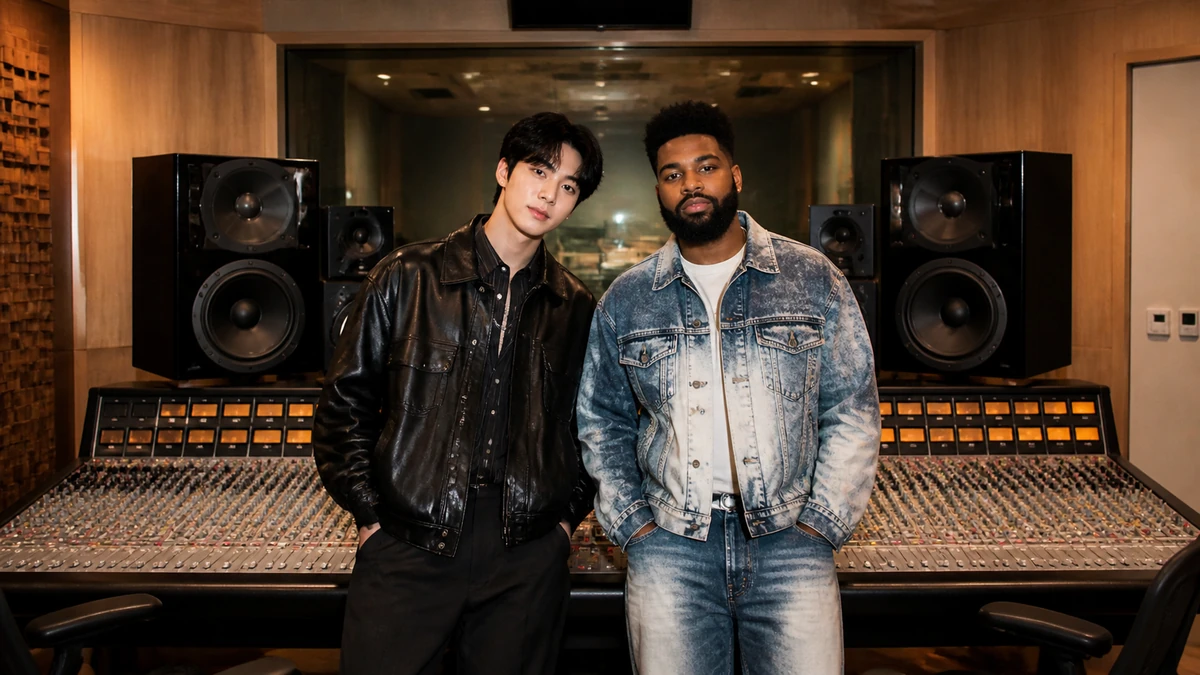
A cross-Pacific pop experiment arrives with built-in curiosity
South Korean actor Ahn Hyo-seop and American pop artist Khalid are set to release a global single titled Something Special on May 22, a pairing that says as much about where the entertainment business is headed as it does about the song itself. The announcement, first reported in South Korea by Yonhap News Agency, immediately drew attention because it brings together two figures from different corners of pop culture: a Korean drama star with an international fan base and a U.S. singer known for smooth, emotionally direct R&B-pop hits.
For American readers who may not closely follow Korean entertainment, the collaboration stands out for one simple reason: Ahn is best known as an actor, not as a conventional pop idol. In the United States, movie and television actors occasionally release music, but it is rarely treated as part of a larger industrial strategy. In South Korea, however, the lines between entertainment categories are often much more flexible. Stars can move between acting, music, variety television, advertising and digital fan engagement in ways that would seem unusual in a more siloed Hollywood system.
That is one reason this release is attracting interest before anyone has heard a note of it. Another is Khalid’s presence. The Texas-born artist built a broad international audience with songs that blend pop accessibility with R&B moodiness, a style familiar to mainstream American listeners and easy to export across borders. Pairing that sonic identity with a Korean star’s global profile gives Something Special the feel of a carefully designed crossover project, one intended from the start not for a single national market but for a streaming audience that moves fluidly between languages, genres and fandoms.
In practical terms, that is what much of the global music business looks like in 2026. Songs no longer need to fit neatly into one radio format or one country’s chart logic to matter. They need attention, replay value and the ability to spark online conversation across time zones. Ahn and Khalid’s single appears built for exactly that environment.
Why Ahn Hyo-seop matters beyond the K-drama bubble
Ahn is a familiar name to fans of Korean television, particularly those who discovered Korean dramas through Netflix and other global platforms during the last decade. He is part of a generation of Korean actors whose careers have unfolded at the same time that the “Korean Wave,” often referred to by the Korean term Hallyu, has become a sustained international force rather than a niche interest. Hallyu describes the worldwide spread of South Korean popular culture, including music, television, film, beauty products and fashion.
To American audiences, the clearest reference points might be the Oscar success of Parasite, the worldwide breakout of Squid Game, and the stadium-level popularity of K-pop groups like BTS and Blackpink. But the Korean Wave is much broader than those headline-making examples. It includes a dense ecosystem of serialized dramas, fan communities, social media circulation and celebrity branding that can turn actors into global lifestyle figures as much as screen performers.
Ahn’s involvement in a music project reflects that ecosystem. In Korea, an actor’s appeal often extends well beyond acting credits. Fans follow interviews, behind-the-scenes clips, fashion campaigns, soundtrack work and live appearances. A star’s public identity can become an all-around media presence, and entertainment companies are often willing to test multiple formats if they believe the audience is there. That does not mean every actor is becoming a singer, but it does mean the barrier between disciplines is far lower than many Americans might assume.
That flexibility has been one of Korean entertainment’s competitive advantages. Instead of treating music, drama and fan engagement as separate businesses, the industry often links them. An actor can help drive streaming interest for a show, appear in branded content, participate in soundtrack promotions and attract international press coverage, all inside one larger machine. In that context, Ahn stepping into a high-profile music collaboration feels less like a novelty and more like a logical extension of the way Korean celebrity works now.
Khalid brings an American sound with global reach
Khalid’s role in the project is equally important. Even without detailed information about the single’s arrangement or lyrical theme, the description of the track as a meeting point between K-pop production sensibilities and American R&B gives listeners a useful frame. K-pop, as understood globally, is not just a genre but a production style: polished arrangement, careful visual packaging, performance-driven marketing and an unusually sophisticated relationship with online fandom. American R&B, by contrast, carries a different set of expectations for many listeners, including emotional warmth, vocal intimacy and a looser, groove-centered feel.
Khalid has long occupied a commercially friendly space between pop and R&B, which makes him an especially effective collaborator for an international release. He is recognizable to mainstream English-language audiences but not so stylistically rigid that he cannot adapt. That matters in cross-border projects, where too much genre purism can make a song feel forced. If this collaboration works, it will likely be because the song finds a shared emotional register rather than simply placing one artist next to another for marketing effect.
That distinction matters. The global music business has seen plenty of “collaborations” that are really just brand adjacency: a familiar name added for reach, a verse dropped in to trigger playlisting, a thumbnail pairing designed to trend. The Korean reporting around Something Special suggests a more ambitious framing, one centered on the encounter between two different musical languages rather than one side merely borrowing the other’s audience.
For American listeners, that could make the release easier to approach. They do not need deep prior knowledge of Korean entertainment politics to understand the appeal of a Korean star and a U.S. singer trying to meet somewhere in the middle. It is a premise with immediate clarity, which helps explain why the announcement traveled quickly through fan communities even before substantial musical details were made public.
The companies behind the single show how global releases are built now
The structure behind the release may be just as telling as the artist pairing itself. According to the Korean announcement, the project was made possible through collaboration between Musicow, a South Korean music platform, and Roc Nation, the global entertainment company with deep experience in artist management, distribution and branding. Another company, The Present Company, disclosed the release plan and said the track is already available for pre-save on major global streaming platforms.
That corporate architecture is worth paying attention to because it reflects how the Korean Wave increasingly operates. In earlier eras, “going global” often meant a Korean act first becoming dominant at home and then trying to break into overseas markets through touring, television appearances or a strategic English-language release. Today, many projects are designed from inception for simultaneous international circulation. Instead of treating foreign audiences as an expansion market that comes later, companies now assume those listeners are part of the audience from day one.
That is where pre-save campaigns come in. For readers less familiar with music industry jargon, pre-save is the streaming-era equivalent of building opening-day momentum before release. Fans click a platform link before the song comes out, and the track is automatically added to their library when it is released. On the business side, that helps concentrate initial listening activity, increases the chances of algorithmic visibility and offers an early signal of audience interest. It turns anticipation into measurable behavior.
K-pop companies and their partners have become especially adept at this kind of digital choreography. Fans are not just waiting passively for music to arrive; they are enlisted early through teaser cycles, countdowns, social media amplification and organized streaming efforts. American pop fandoms do this too, of course, but K-pop has helped normalize a highly structured form of participation that can make the rollout itself feel like an event. The fact that Something Special is already in pre-save mode suggests the release is being handled as a global coordinated launch, not a casual side project.
Roc Nation’s involvement further underscores that point. In U.S. terms, it signals that this is not simply a Korean domestic story translated outward. It is a project being framed from the outset as a piece of transnational entertainment business, one built to function across multiple markets and fan cultures at once.
This is bigger than one song: It marks a wider shift in Korean entertainment
The broader significance of the single lies in what it says about Korean entertainment’s expanding boundaries. For years, much Western coverage of the Korean Wave focused heavily on idol groups, synchronized performances and chart milestones. Those are still important, but they no longer capture the full picture. Korean pop culture has matured into a more flexible, interconnected system where actors, musicians, platforms and multinational companies can all participate in the same project ecosystem.
That is part of why Ahn’s participation feels notable. Even in a media environment accustomed to crossover, there remains a meaningful distinction between a singer collaborating with another singer and an actor fronting a global music release. The latter suggests that Korean entertainment companies increasingly view star power as portable. If a celebrity can command loyalty across drama, social media and brand partnerships, then music can become another channel through which that connection is expressed.
Americans have seen versions of this logic before. Disney Channel stars moved into music. Actors from major franchises have launched recording careers. Social media personalities have turned followings into streaming numbers. But the Korean system often executes these transitions with more institutional coordination and less anxiety about category purity. In that sense, Something Special is not merely a song announcement. It is a small case study in how contemporary Korean celebrity is assembled, expanded and exported.
The timing also matters. Korean entertainment now produces a remarkable range of headlines at once: veteran actors being honored for decades-long careers, major film festivals spotlighting new art-house work, pop stars making philanthropic donations tied to national holidays, and younger talents entering cross-border commercial collaborations. That spectrum helps explain why the Korean Wave has proven resilient. It is not dependent on a single group, genre or trend. It works because it is diversified across industries and generations.
Within that landscape, Ahn and Khalid’s single represents one of the brightest and most accessible faces of that expansion. It does not require audiences to master Korean film history or understand the internal mechanics of Seoul’s entertainment market. Its appeal is straightforward: two recognizable artists from different cultural lanes meeting in one track, with the world invited to listen at the same time.
What fans are really reacting to before release day
Because so few specifics have been released, much of the pre-launch attention is being driven by imagination. Fans of Ahn want to know what kind of musical presence he will bring to the track: Will he sing extensively, take a softer atmospheric role, or function as the emotional concept anchor around which the song is built? Khalid listeners, meanwhile, are asking how much of his familiar sonic world will remain intact once it is filtered through the high-gloss architecture often associated with K-pop-adjacent production.
That uncertainty is not a weakness. In the streaming age, carefully managed scarcity can sharpen interest. Audiences are often more likely to discuss a project when the central question is still unresolved. What will it sound like? Whose style will dominate? Is it a one-off experiment or the beginning of a larger entertainment strategy? Those open-ended questions keep a release alive online long before it arrives.
There is also a deeper reason the news travels well internationally: it is easy to understand across cultures. Even readers relying on automatically translated headlines can grasp the core premise immediately. A Korean star known from dramas. An American pop-R&B singer with global reach. One single. One release date. One pre-save campaign already underway. In a crowded information environment, clarity is power.
That clarity gives the project unusual international elasticity. Not every Korean entertainment story translates cleanly for outsiders because many depend on local context, industry history or celebrity relationships unfamiliar abroad. This one does not. It lands with the instant logic of an all-star crossover, even if the cultural implications underneath it are more complex.
If the song succeeds, it may encourage more collaborations that use actors, not just music idols, as gateways into the global market. If it falls short, it will still have revealed how far Korean entertainment has moved beyond the older model in which global music collaboration was mostly the domain of established singers. Either way, it marks a notable point in that evolution.
Why the May 22 release carries symbolic weight
At the most basic level, the facts are simple: Something Special arrives May 22, and listeners can already pre-save it on major global music platforms. But the reason the announcement resonates goes beyond release logistics. In a news cycle often dominated by scandal, litigation and market anxiety, this is the kind of entertainment story that reminds audiences what cultural globalization can look like at its most inviting: not as a corporate buzzword, but as a creative meeting point.
For U.S. readers, the easiest way to understand the moment may be this: the Korean Wave is no longer just about whether American audiences are willing to sample Korean entertainment. That question has largely been settled. The more interesting question now is how Korean entertainment participates in shaping mainstream global pop culture on equal terms. A collaboration like Ahn and Khalid’s suggests the answer is increasingly direct. Korean stars are not simply entering the room; they are helping redesign it.
That is why this release matters even before reviews, chart positions or streaming numbers arrive. It captures a broader transition in progress. Korean entertainment is preserving its own storytelling traditions and star-making systems while also creating ever more casual, everyday links to global audiences. What once felt exceptional now feels routine enough to be announced like any other upcoming single. In some ways, that normalization is the real story.
By the time May 22 arrives, listeners will decide whether Something Special is memorable as a song. But as an industry signal, it has already done its job. It shows a Korean actor and an American pop artist meeting not at the margins of each other’s markets, but at the center of a shared one. In 2026, that may be the clearest sign yet of how fully the Korean Wave has entered pop’s global mainstream.
Comments
Post a Comment