A cultural figure steps into a historical wound
In South Korea, entertainment news often travels internationally as a stream of chart results, fashion campaigns and tightly managed celebrity appearances. But every so often, a figure from the country’s immensely influential pop culture industry enters a space that changes the meaning of what is being said. That is what happened this week in Gwangju, a city that occupies a place in South Korea’s civic imagination roughly comparable to Selma, Alabama, or Kent State in the United States: a site where the struggle over democracy is not abstract, but deeply embodied in public memory.
Min Hee-jin, the music executive best known internationally for launching the K-pop girl group NewJeans and, more recently, for a bitter and highly public corporate feud that spilled into the headlines, spoke Thursday at Chonnam National University in Gwangju. According to the South Korean news agency Yonhap, she told the audience that “change requires uprising” and emphasized both the value of resistance and the importance of staying true to what she called the “essence” of creative work.
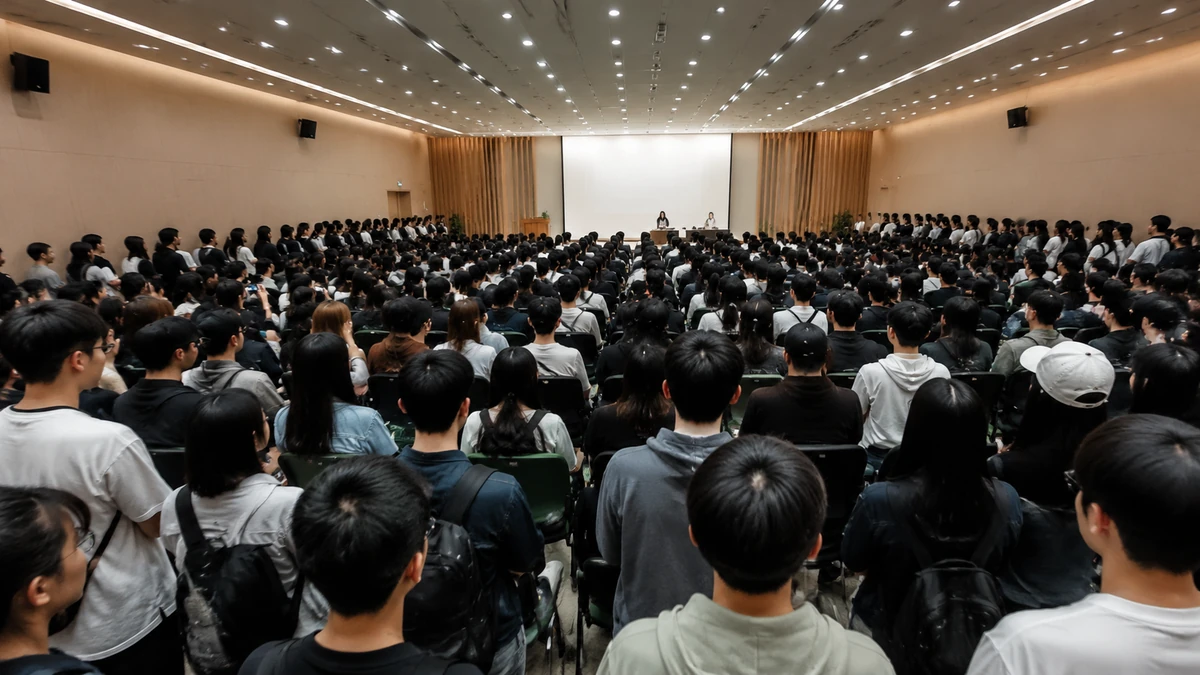
On its face, it might sound like an unusual but routine campus lecture by a celebrity insider. It was not. The talk was organized by the university’s May 18 Institute to mark the institute’s 30th anniversary and the 46th anniversary of the May 18 Democratic Uprising, one of the defining events of modern South Korean history. The venue, a convention hall on the Chonnam campus, reportedly drew so much interest that students and local residents filled not only the room but the hallways outside.
That level of attention says something larger than star power. South Korea is a country where pop culture and public life increasingly overlap, where a producer’s remarks can carry meaning far beyond fandom, and where historical memory remains contested enough that simply affirming what happened can itself be read as a public stance. When an entertainment executive speaks about resistance at a campus tied to one of the country’s most painful democratic struggles, the setting does more than provide backdrop. It becomes part of the message.
Why Gwangju still matters
For many Americans, the shorthand “May 18” may not immediately register. In South Korea, it requires no explanation. The term refers to the May 18 Democratic Uprising of 1980, when citizens in Gwangju rose up against military rule after the government violently suppressed dissent in the aftermath of a coup. The uprising was met with brutal force by the military. For years, the event was distorted, minimized or politically weaponized, even as survivors, bereaved families and democracy activists fought to preserve the truth of what had happened.
Today, May 18 occupies a central place in South Korea’s democratic narrative. It is remembered not simply as a regional tragedy but as a national turning point, one that exposed the cost of authoritarianism and helped shape the moral vocabulary of the country’s later democratic movements. To appear in Gwangju and speak about resistance is therefore not the same as invoking a generic slogan about change. The city gives the word a heavier meaning. It points not to edgy branding or fashionable dissent, but to actual political risk, civic sacrifice and unresolved national memory.
Chonnam National University is especially significant in that story. It is often described as one of the starting points of the May 18 movement, a place where student protests and state repression collided in ways that became inseparable from the broader uprising. In the American context, the closest comparison might be a major public figure giving a talk on civil rights at the Edmund Pettus Bridge, or about student protest at a campus synonymous with state violence. The point is not only what is said, but where the words land.
That historical context matters because South Korea still wrestles with how to remember May 18. While the event is widely recognized as a democratic milestone, fringe efforts to reinterpret or downplay it have not disappeared. Memory in South Korea, as in the United States, is not static. It is argued over in politics, classrooms, media and culture. Against that backdrop, public statements about May 18 can take on an edge that would be easy for foreign audiences to miss if they viewed this simply as another entertainment-world appearance.
Min Hee-jin’s message: resistance and “essence”
Yonhap reported that Min’s clearest line was this: “Even if it does not end in success, resistance has great meaning in the message it delivers to the world.” That idea carries a moral logic familiar far beyond Korea. Not every protest wins in the moment. Not every challenge to power is rewarded. Yet acts of resistance can still shape public conscience, mark a boundary against silence and become part of a larger historical arc. In American terms, it echoes a view often applied to civil rights marchers, anti-war demonstrators, labor organizers and whistleblowers: that the value of speaking out cannot always be measured by immediate victory.
She reportedly also said of May 18 that it was “a fact and history,” cautioning against political reinterpretations or attempts to tack on alternative narratives, and arguing that the public should not turn away from that history. Stripped of rhetoric, the remark is strikingly plainspoken. It does not seek novelty. It seeks affirmation of reality. But in a society where history can become a battlefield, insisting that an event happened and must not be ignored is itself a consequential form of speech.
Min linked that civic language to something more personal and professional. Explaining why she founded a label, she said, “I started a label because I wanted to do music.” That line introduces the second key term in her talk: “essence.” In South Korean discourse, as in English, the word can sound abstract or even self-serious. But in the context of the modern entertainment business, where scale, speed, metrics and online attention often dominate the conversation, it amounts to a defense of first principles. The work, Min suggested, begins with the reason for making it at all.
She reportedly argued that if the basics are strong enough, they can themselves become an industry, and that people who focus on essence inevitably change larger trends. Whether one agrees or not, the argument is notable because it rejects a common assumption of the streaming era: that virality is strategy. Instead, it treats substance, structure and creative conviction not as romantic add-ons, but as the actual foundation of durable cultural power.
Why this resonates beyond the music business
Min is not just any executive. She is one of the most closely watched creative figures in Korean pop, known for shaping concepts, aesthetics and group narratives in ways that helped define a generation of K-pop branding. Her role in launching NewJeans made her especially visible to global audiences, including many American fans who know the group’s sound and image even if they know relatively little about the machinery behind them. More recently, she became a central figure in a widely covered management dispute involving HYBE, the conglomerate behind BTS and other major acts, and ADOR, the label she led.
That dispute introduced her to a much broader audience, but not necessarily in a flattering or coherent way. In international coverage, she was alternately framed as a visionary producer, a rebellious executive, a controversial corporate player or a protagonist in one of K-pop’s most public boardroom dramas. What makes her Gwangju remarks notable is that they shift the lens. Instead of litigation, governance or industry politics, the focus falls on what kind of relationship a culture producer believes should exist between art, industry and society.
That question matters in South Korea because K-pop is no longer merely an entertainment export. It is a major soft-power engine, a commercial ecosystem and a source of national prestige. When American audiences think of Korean culture today, they may think of BTS at the White House, “Parasite” winning the Oscar for best picture, “Squid Game” dominating Netflix, or BLACKPINK headlining Coachella. These are not niche artifacts. They are mainstream global reference points. As a result, statements by Korean cultural figures increasingly land in a public sphere larger than the entertainment press.
In that sense, Min’s comments function as both entertainment news and social news. They invite a broader question: What values should accompany South Korea’s extraordinary cultural reach? If Korean pop culture is one of the country’s most visible international languages, does it also carry responsibilities toward history, memory and democratic conscience? Min did not lay out a political manifesto. But by speaking about uprising, historical fact and creative essence in the same setting, she implicitly treated those issues as connected.
The politics of memory in a pop-cultural age
There is a tendency outside South Korea to imagine K-pop as highly polished and politically cautious, a domain of choreography, commercial partnerships and fan mobilization rather than open civic engagement. There is some truth in that. The industry is heavily managed, reputationally sensitive and often wary of controversy. Yet South Korean popular culture has never been neatly sealed off from the country’s social and political life. Musicians, filmmakers, television creators and celebrities operate in a society where historical trauma, generational conflict, inequality and democratic accountability are part of everyday public conversation.
That does not mean every celebrity intervention is profound or welcome. Often it is neither. But it does mean that when a figure with Min’s profile speaks at a site associated with democratic martyrdom, audiences are not hearing the remarks in a vacuum. They are hearing them through current debates over historical denial, cultural responsibility and the commercialization of public memory. In a country that has built one of the world’s most successful entertainment industries, there is also unease about what gets lost when everything becomes content.
That is part of what makes her emphasis on “essence” resonate. The word can be read narrowly, as a philosophy of music-making. But it can also be read more broadly, as a challenge to superficiality in public life. If May 18 is not just an anniversary but an ongoing ethical obligation, then remembering its “essence” means refusing to let it become mere symbolism, ritual or branding. Likewise, if music is to be more than product, then its creators must retain some grounding beyond trend cycles and investor expectations.
The parallel is imperfect, but not accidental. Resistance, in Min’s formulation, is not only a political concept. It is also a creative one. It is the force that questions inertia, resists convenient narratives and opens the possibility of new direction. In American cultural history, one can find echoes in everything from protest folk music to punk, from hip-hop’s early social critique to independent cinema’s rejection of studio formulas. Art does not become meaningful only when it is overtly political. But it often becomes more consequential when it refuses empty consensus.
A crowd that suggests more than fandom
One detail from the Korean reports is especially telling: the venue was packed, with attendees spilling into the corridors. Celebrity draw surely played a role. Min remains one of the most recognizable names in Korean entertainment, and curiosity around her public appearances is high. But the size and apparent composition of the crowd — students and ordinary citizens, not just fans — suggests that people came for something more than spectacle.
Part of that interest likely reflects the unusual mix of subjects. A prominent entertainment executive speaking at a university institute devoted to May 18 is not a standard promotional event. It creates a different kind of anticipation: How will someone from the center of a trend-driven commercial industry speak in a space devoted to historical suffering and democratic memory? Will the result feel opportunistic, evasive or genuinely reflective? The packed room implies that many people in South Korea saw that as a meaningful question.
There is also a generational angle. South Korean students today have grown up in a fully democratized society and in the shadow of a globally dominant cultural industry. For them, May 18 is both foundational history and inherited memory — not lived experience, but not distant either. A talk that connects the language of resistance to the language of cultural production may therefore speak to a deeper tension: how to build a future in a society that prizes innovation without losing touch with the struggles that made that future possible.
In the United States, universities often serve a similar function as sites where culture, activism and historical reckoning intersect. Think of campus debates over Confederate monuments, the legacy of the Vietnam War, or the role of universities in civil rights history. What happened in Gwangju belongs to that broader family of public moments, where the speaker matters, but the audience’s desire to hear a difficult subject discussed in a shared civic space matters just as much.
What this says about Korean pop culture now
For international readers, especially those encountering Korean news through automated translation or snippets on social media, the temptation is to flatten stories into familiar templates: star controversy, corporate feud, fan reaction, political statement. This one resists easy categorization. It is partly about Min Hee-jin, partly about Gwangju, partly about the entertainment industry, and partly about the way modern South Korea negotiates memory in public.
The most important fact may be the simplest one Min stated: May 18 happened. In an era of revisionism, misinformation and algorithmic distortion, affirming the factual reality of historical trauma has become an unexpectedly urgent civic act in many democracies, including the United States. Americans do not need much help recognizing that pattern. We have our own bitter fights over how to teach slavery, segregation, indigenous dispossession, Jan. 6 and the meaning of patriotic memory. South Korea’s arguments are its own, but the underlying tension is familiar: Who gets to define history, and what happens when a society becomes tired of remembering?
At the same time, Min’s remarks underscore something else: South Korea’s cultural power is increasingly bound up not only with what it exports, but with what it chooses to remember. K-pop, Korean film and Korean television have become global languages in part because they are so good at transmitting mood, image and emotion. But they also carry traces of the society that produces them — its speed, anxieties, ambitions, hierarchies and ideals. When a cultural leader speaks from a place like Chonnam National University about resistance and essence, the message to the world is that Korean entertainment does not exist outside history.
That may be the clearest takeaway from Gwangju. This was not merely a celebrity lecture or a symbolic campus stop. It was a reminder that in South Korea, pop culture and democratic memory increasingly occupy the same public conversation. And as Korean cultural influence continues to expand across American screens, playlists and social feeds, moments like this offer a more complete picture of the country behind the export boom: not only stylish and globally savvy, but still deeply engaged in the unfinished work of remembering how its democracy was won.
Comments
Post a Comment