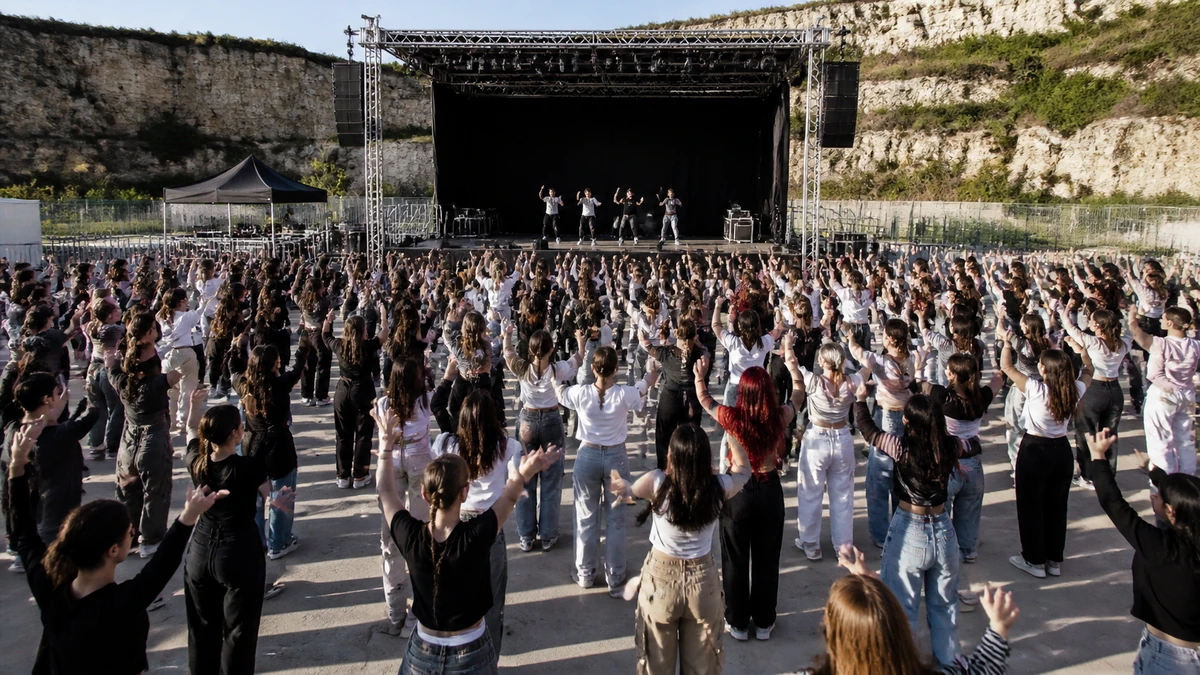
K-pop takes center stage in Naples
At a major pop-culture festival in southern Italy, K-pop was not tucked away as a niche import or a side attraction for devoted superfans. It was out in the open, loud, physical and communal — the kind of presence that suggests Korean pop music has moved well beyond the stage of being a foreign trend and into something more durable in global youth culture.
Organizers in Naples said roughly 140 fans took part in a K-pop dance workshop held in connection with Napoli Comicon, one of Italy’s best-known conventions for comics, games and broader fan culture. The program followed a K-pop cover dance competition earlier in the festival and featured instruction from RyuD, a Korean choreographer and producer who taught participants on site. The event also extended beyond dance. In the plaza outside the performance venue, attendees could try traditional Korean games, turning the gathering into a wider cultural showcase rather than a music-only promotion.
That combination matters. For years, much of the conversation around the Korean Wave — often called “Hallyu,” a term used to describe the global spread of South Korean popular culture — has focused on digital success: YouTube views, streaming numbers, social media fandoms and sold-out arena tours. Those metrics are real, and they helped make acts like BTS, Blackpink and NewJeans familiar names far beyond Asia. But what happened in Naples points to another phase of K-pop’s expansion: fans are not just consuming the music online or admiring polished performances from a distance. They are showing up in person, learning choreography with their own bodies and encountering Korean culture through participation.
For American readers, a useful comparison might be the difference between watching the Super Bowl halftime show on television and then spending the weekend at a convention where you can learn the dance routine, meet the people who helped build the performance and try activities tied to the culture that produced it. The appeal becomes less about celebrity alone and more about belonging. That is what events like this increasingly offer: not just entertainment, but entry into a community.
Napoli Comicon, founded in 1998, is a major platform for exactly that kind of community. Like Comic-Con events in the United States, it gathers people who are deeply invested in shared fandoms — comics, gaming, animation, cosplay and performance culture. In that environment, K-pop makes an almost natural fit. It is a music genre, but it is also highly visual, intensely choreographed and sustained by fan participation. Its success at a convention like this says something important about where K-pop now sits in the global cultural landscape: not on the margins, but among the main attractions.
From screen culture to body culture
One reason this story resonates beyond a single festival appearance is that K-pop has always been as much about movement as sound. In the United States, fans may first encounter K-pop through a viral music video, a TikTok dance challenge or a perfectly edited live performance clip. But K-pop’s choreography is not decorative. It is central to how songs are recognized, shared and remembered. Signature moves can be as identifiable as a chorus line or a guitar riff.
That helps explain why cover dance competitions have become such a major part of international K-pop fandom. Fans are not only listening to songs; they are rehearsing them, filming them, comparing interpretations and turning them into local performance scenes. In many places, K-pop fandom functions less like a passive fan club and more like a network of amateur dance teams, creators and event organizers. The Naples workshop built directly on that ecosystem. It was staged after a cover dance competition, meaning the event did not begin and end with spectatorship. It invited the audience to cross the line from observer to participant.
This is one of the clearest signs that K-pop’s global influence has matured. Earlier stages of international breakout often rely on novelty — a foreign-language song becomes a surprise hit, an unfamiliar style sparks curiosity, a few acts achieve crossover fame. A later stage looks different. It produces local rituals. People gather in public. They practice. They compete. They form teams and traditions. They bring friends who may not know the language but understand the energy. By that measure, the scene in Naples suggests K-pop is no longer simply being exported. It is being lived.
That shift is especially striking in Europe, where K-pop’s growth has been steady but sometimes less visible in U.S. media than its footprint in North America or Southeast Asia. Yet fan communities across European cities have built robust cover dance circuits and social networks. A competition in Naples that sends a winning team on to a larger European contest shows there is already an infrastructure in place. In other words, this was not a one-off exhibition. It was part of a ladder — local performance feeding into regional opportunity, with fans developing skills and visibility along the way.
There is also a broader cultural lesson here. In an age when streaming platforms encourage isolated, personalized media consumption, K-pop continues to generate collective experiences. Fans still gather in public squares, rehearsal studios and convention halls. They practice synchronization, arguably one of the defining aesthetics of K-pop performance. The form itself pushes people toward togetherness. That may be one reason it travels so well across language barriers. You do not need to speak Korean fluently to understand precision, rhythm, commitment and joy performed in unison.
Why it matters that a choreographer was there
The Naples workshop was led by RyuD, identified by organizers as a Korean choreographer and producer. That detail is more important than it might first appear. In much of global pop music coverage, attention naturally gravitates toward singers and idol groups, the faces audiences know best. But K-pop has always been a deeply collaborative industry. Behind every major release is a dense creative network of choreographers, producers, stylists, vocal directors, video teams and stage designers. To bring a choreographer directly into contact with overseas fans is to reveal part of the machinery that usually stays behind the curtain.
For participants, that changes the experience from imitation to transmission. Instead of learning moves from fan-uploaded clips or slowed-down tutorial videos online, they are being taught by someone who belongs to the Korean creative ecosystem itself. That can lend a workshop a kind of authenticity fans value, but it also does something more subtle: it communicates that choreography in K-pop is an artistic language in its own right.
American audiences are used to dance functioning as part of pop spectacle, from MTV-era choreography to Beyoncé’s precision stagecraft and the ongoing influence of hip-hop dance in mainstream performance. K-pop builds on some of those same traditions while pushing synchronization and visual storytelling to an especially high level. The choreographer, then, is not an accessory to the song. In many cases, the choreographer helps define how the song will circulate globally, because dance is often the form through which a track becomes socially legible.
That is why in-person instruction carries symbolic weight. It highlights one of K-pop’s great strengths: movement can communicate across borders faster than lyrics can. Songs can be translated, subtitled and explained, but a gesture, a beat change or a group formation can be understood immediately. In that sense, choreography may be K-pop’s most exportable language. A workshop like the one in Naples makes that visible in real time, as fans from another country learn not simply to admire Korean performance, but to inhabit it.
It also underscores a point often overlooked in superficial takes on K-pop’s success: this is not just a story about stars. It is a story about systems of cultural production. Fans who attend a workshop like this are not just seeing the end product. They are coming into contact with one of the people who help build the product. That can deepen appreciation, but it can also sharpen understanding of why K-pop has been so effective globally. Its appeal is rooted not only in charisma and catchy hooks, but in craftsmanship.
A competition that feeds a larger European circuit
The festival’s K-pop cover dance competition ended with a team called Sugar Crew taking first place, earning the right to advance to a European contest. That progression is significant because it shows how fan activity now operates through recognizable tiers of participation and reward. This is not just about applause at a local event. It is about pathways.
In the United States, Americans are familiar with competitive ladders in sports, arts and entertainment, from high school marching bands and cheer competitions to dance nationals and reality television audition circuits. What happened in Naples reflects a similar structure for K-pop fandom in Europe. A local team performs in one city, wins a title and moves on to a larger stage. That structure encourages training, discipline and community investment. It also turns fandom into a form of cultural production rather than mere consumption.
Cover dance, despite the name, should not be mistaken for simple copying. Yes, the goal is often to reproduce original choreography with accuracy and flair. But in practice, these teams are interpreting, adapting and restaging K-pop for different bodies, spaces and audiences. They are proving that Korean pop can generate local creativity abroad without losing its identity. That is one reason cover dance has become such a powerful engine of K-pop’s international spread. It allows fans to become ambassadors, performers and organizers all at once.
Sugar Crew’s win is emblematic of that dynamic. A Korean song and performance style are re-created in Italy, judged in an Italian event, then carried forward into a Europe-wide competitive setting. The original material remains Korean, but the cultural energy around it becomes multinational. This is how global genres endure: they are not preserved untouched in a glass case. They are activated repeatedly by people far from their point of origin.
That process also helps explain why K-pop remains resilient even as specific groups rise and fall in popularity. Fans do not need to wait for a concert tour to stay engaged. They can meet weekly to practice routines. They can upload performances. They can compete. They can teach newcomers. They can turn fandom into habit and habit into community infrastructure. In Naples, that infrastructure became visible in a highly public setting.
Traditional games as a gateway to a deeper Korea
Outside the performance space, organizers also offered visitors a chance to try Korean traditional games, including jegichagi, tuho and ddakji. For readers unfamiliar with those names, the easiest way to understand them is by analogy. Jegichagi resembles a Korean version of hacky sack, in which players keep a small paper-and-weight shuttle in the air using their feet. Tuho is a tossing game that involves throwing sticks or arrows into a container, somewhat like a festival lawn game with roots in older courtly tradition. Ddakji is played by slamming folded paper tiles against an opponent’s tile to flip it over, a simple-looking contest of angle, force and technique that some international viewers may recognize from the first episode of Netflix’s “Squid Game.”
Including those activities may sound like a small detail, but it reveals a lot about how South Korea presents itself abroad in 2026. K-pop is often the draw — the marquee attraction, the magnet that pulls young people in. But once they arrive, Korean cultural institutions increasingly try to widen the frame. Music and choreography open the door; traditional play, food, language and heritage step through it. The goal is not to replace pop with tradition but to place them in conversation.
That strategy is shrewd because it reflects how many countries hope to turn entertainment success into broader cultural familiarity. The United States has long benefited from people arriving through Hollywood and leaving with interest in American fashion, slang, sports or regional food. Japan’s global reach through anime and gaming has similarly led many fans toward language study, travel and traditional arts. South Korea is now doing something comparable, using K-pop and drama as points of entry into a fuller cultural narrative.
The Naples event made that narrative tangible. A fan might come for a dance competition and leave having learned the names of games that predate the modern K-pop industry by generations. That matters because Korea is often flattened in global media into a handful of contemporary exports: idol music, streaming dramas, beauty products and perhaps a few blockbuster films. Those are important parts of the story, but they are not the whole story. Traditional games in a public square offer a simple reminder that Korean culture did not begin with the internet age, even if the internet helped make it global.
There is another practical dimension, too. Interactive games lower the barrier to participation. Not everyone feels comfortable dancing in public or entering a cover contest. Tossing, kicking or flipping a game piece can be a more accessible way to join in. In that sense, the event’s design appears carefully calibrated. It offered multiple entry points into Korean culture, from high-energy performance to casual hands-on play. That broadens the audience and helps transform a fan event into a cultural encounter.
Why Comic-Con is the right kind of stage
There is a reason K-pop fits so comfortably inside a Comic-Con-style environment. These conventions are not only marketplaces or showcases. They are spaces where fandom becomes public identity. People wear costumes, perform their tastes and seek out others who share them. K-pop, particularly outside Korea, thrives in that same ecosystem of visible enthusiasm, collective ritual and self-expression.
For Americans, the idea is easy to grasp. At San Diego Comic-Con, New York Comic Con or Anime Expo, fans do not just consume content. They cosplay, debate, queue for panels, trade recommendations and take part in communities that blur the line between hobby and lifestyle. K-pop fandom often works the same way. Light sticks, photocards, dance covers, group orders, fan-run events and online communities all form a recognizable social world. So when K-pop appears at a convention in Naples, it is not invading an unrelated space. It is joining a family of fandom cultures that already speak a similar language of devotion and participation.
The overlap also reflects how younger audiences now move across media categories with ease. A K-pop fan may also be an anime fan, a gamer, a cosplay participant and a heavy user of short-form video platforms. The old industry boundaries — music here, comics there, gaming elsewhere — mean less to audiences who experience pop culture as one interconnected ecosystem. K-pop’s polished visuals, serialized group narratives and performance-driven identity make it especially adaptable to that ecosystem.
That is part of what makes Napoli Comicon such an effective venue. It offers an audience predisposed to active fandom. These are people already comfortable cheering loudly, dressing up, learning references and building community around shared interests. In that setting, a dance workshop is not a novelty. It is an invitation. A cover dance contest is not a curiosity. It is a natural extension of how convention culture already works.
This may also help explain why K-pop often seems strongest not only in giant arena settings but in spaces where fans can create something of their own. Stadium concerts demonstrate scale, but conventions demonstrate integration. They show whether a genre has truly embedded itself inside the habits and rituals of everyday fan life. By that standard, the scene in Naples offers strong evidence that K-pop’s place in global pop culture is becoming more rooted, not less.
The quiet power of cultural institutions
Behind the festival programming was the Korean Cultural Center in Italy, which worked with Napoli Comicon organizers on the event. That institutional role is worth noting because global pop phenomena can sometimes look spontaneous from the outside, as if fandom alone is carrying everything forward. Fandom is crucial, but it is not the whole picture. Public-facing cultural institutions often help turn scattered enthusiasm into durable exchange.
Korean cultural centers overseas, supported by Seoul, function in some ways like a mix of cultural diplomacy office, arts presenter and community hub. They promote language classes, screenings, exhibitions, performances and educational events meant to introduce foreign publics to Korea in a more sustained way. In the Naples case, that role appears to have been more than ceremonial. The program linked dance competition, workshop instruction and traditional games into one coherent experience.
That matters because it suggests intentional cultural strategy rather than one-off branding. South Korea has spent years building an international profile that leverages both private-sector entertainment power and public cultural outreach. The private sector produces the stars, songs and screen content that capture attention. Institutions help convert that attention into relationship, understanding and repeat engagement. When that combination works, a country’s image abroad becomes not just more visible but more layered.
For American readers, there is a familiar analogue in the way countries use film festivals, museum partnerships or language institutes to deepen awareness beyond commercial hits. The difference with South Korea is the extraordinary momentum provided by K-pop and Korean television over the past decade. Those industries create demand; institutions help shape what comes next. In Naples, what came next was not only applause for a performance but a space where fans could learn, move, play and connect.
That, ultimately, is why this event deserves more attention than a routine overseas culture item. It captures the current state of the Korean Wave with unusual clarity. K-pop is still a music phenomenon, but it is no longer just a music phenomenon. It is a social practice, a fandom infrastructure, a performance language and a gateway to a broader national culture. In Naples, on a Comic-Con stage and in a plaza outside it, that entire ecosystem came into view.
The significance lies not in the number 140 alone, though turnout matters. It lies in what those people were doing. They were not merely watching Korea from afar. They were stepping into a Korean cultural experience together, in Italy, through dance and play. In an era when so much culture is flattened into algorithmic recommendation and solo scrolling, that kind of embodied, collective exchange may be one of the strongest signs that the Korean Wave still has room to grow.
Comments
Post a Comment