South Korea’s Stock Market Hits a New High as Global Money Pours Into Chip Giants Samsung and SK Hynix
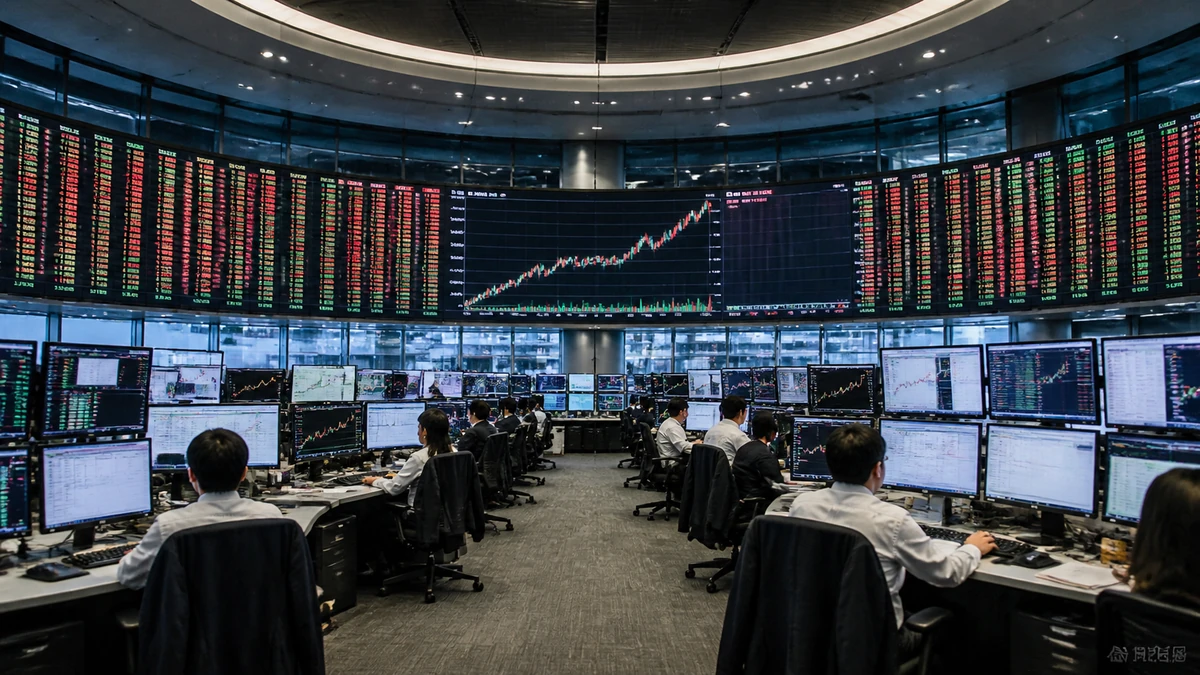
A milestone rally in one of America’s most important economic partners
South Korea’s benchmark stock index surged to a record close on May 4, breaking above the 6,900 level for the first time and putting the once-symbolic 7,000 mark suddenly within sight. The KOSPI, the main index of South Korean stocks, finished at 6,936.99, up 338.12 points, or 5.12 percent, in a single session. For U.S. readers, that kind of one-day move in a major developed market index is closer to a market event than routine volatility. It signals not just optimism, but a rapid repricing of how investors see the country’s economic future.
The rise matters well beyond Seoul. South Korea is not simply another export economy in Asia. It is home to some of the most important companies in the global technology supply chain, including Samsung Electronics and SK Hynix, two names that loom large in the memory-chip business that underpins everything from smartphones and cloud computing to artificial intelligence servers and consumer electronics. When money rushes into those companies, investors are making a statement not only about South Korea, but also about the direction of the world’s digital economy.
That appears to be exactly what happened here. According to the Korean news report, foreign investors concentrated their buying in the electrical and electronics sector, snapping up a net 3.9783 trillion won worth of shares in that segment alone. The top three most-bought stocks were SK Hynix, Samsung Electronics and Samsung Electronics preferred shares. In plain terms, global investors did not spread their bets evenly across the market. They piled into the companies most closely associated with South Korea’s technological muscle.
For Americans less familiar with the KOSPI, think of it as South Korea’s closest equivalent to a broad large-cap gauge like the S&P 500, though with sector dynamics shaped more heavily by export manufacturers, shipbuilders, automakers, battery makers and semiconductor companies. A sharp move in the KOSPI can reflect global demand expectations, currency trends, energy risks and investor appetite for Asian tech. This rally brought all of those themes together at once.
What stands out most is not merely that the KOSPI reached another record, but that it did so with unusual speed. The index had only just crossed the 6,800 level intraday the previous day. Now investors are already talking about 7,000. Round-number milestones do not change a company’s fundamentals on their own, but markets often treat them as psychological thresholds. In the United States, traders watch levels like Dow 40,000 or S&P 5,000 in much the same way. Those numbers become shorthand for momentum, confidence and the possibility that more money may follow.
Why foreign investors zeroed in on South Korea’s chip champions
The clearest message from the day’s trading was where the buying came from and where it went. Foreign investors were the dominant force, joined by institutional investors inside South Korea. That combination matters. Overseas money can move quickly and sometimes reverse just as fast, but when domestic institutions also buy aggressively, it suggests a broader consensus that the rally is tied to something more durable than a fleeting headline.
The focus on semiconductors was especially telling. SK Hynix and Samsung Electronics are not just popular stocks in Seoul; they are central to how investors tell the story of modern South Korea. Samsung, a sprawling conglomerate whose flagship electronics arm is one of the world’s largest technology companies, has long served as a bellwether for Korean industry. SK Hynix, meanwhile, has become indispensable to the global memory-chip market and is closely watched for its role in supplying high-bandwidth memory used in AI systems. When investors buy those names in size, they are betting on more than a rebound in local sentiment. They are buying into South Korea’s place in the next phase of the global tech race.
That distinction is important for American audiences. Much as Wall Street often treats Nvidia, Apple or Microsoft as proxies for broader themes such as AI, consumer demand or enterprise software spending, Seoul’s market has its own theme-defining giants. Samsung and SK Hynix function as proxies for the world’s appetite for semiconductors, data infrastructure and advanced manufacturing. Their influence on the index is so large that strong moves in those stocks can effectively pull the broader market along with them.
The inclusion of Samsung Electronics preferred shares among the most heavily bought securities also says something about the breadth of demand. Preferred shares in South Korea can trade at different valuations than common shares and often attract investors looking for exposure to a major corporate name through a different class of stock. Heavy buying there suggests investors were not merely chasing a headline but increasing exposure across the wider Samsung complex.
Seen from abroad, this helps explain why the day’s surge was not just another speculative spike. The money went to the companies investors consider the heart of Korean industrial competitiveness. If South Korea’s market story has long revolved around exports, engineering and high-value manufacturing, then this session was a forceful reaffirmation of that narrative.
What this says about South Korea’s economy in 2026
South Korea is often described as a middle power geopolitically, but economically it punches far above its weight. With a population of about 52 million, it has built a global reputation through brands and industries that most Americans encounter regularly, even if they do not always think of them as Korean. Samsung phones and TVs, Hyundai and Kia cars, LG appliances, Korean batteries, Korean steel, Korean ships and Korean chips are all part of that footprint.
At the center of this success is an export-led economic model that rewards scale, precision and relentless technological upgrading. That model has also made South Korea unusually sensitive to swings in global demand and energy prices. For that reason, market moves in Seoul often reveal something broader about how investors see international trade, industrial production and supply chains.
The significance of the KOSPI’s first break above 6,900 is that it signals investors may be assigning a higher premium to South Korean earnings power than before. Stock indexes are, in one sense, aggregates of individual companies. But when an entire index vaults into previously uncharted territory, it can also reflect a shift in how global capital values a nation’s overall growth story. In this case, the market seems to be rewarding South Korea for the very sectors where it holds strategic global advantages.
There is also a domestic context worth explaining. South Korean markets are often discussed through the lens of the so-called chaebol system, the family-controlled conglomerates that have dominated the country’s industrial rise since the postwar era. Samsung is the most famous of them. The term “chaebol” may be unfamiliar to many American readers, but it can be loosely understood as a powerful business group with sprawling affiliates across industries, somewhat analogous to an industrial empire with deep national influence. The system has long attracted both praise for driving growth and criticism over concentration of power. Yet when global investors rush into Korean blue chips, they are often buying directly into that structure.
That is one reason days like this carry symbolic weight in South Korea. A record-setting KOSPI is not viewed only as a financial statistic. It is often read as a referendum, however imperfect, on the strength of the country’s flagship industries and the global standing of its corporate champions.
The global backdrop: energy risk, geopolitics and investor psychology
The Korean report linked the rally partly to international developments, including comments by President Donald Trump about a so-called “liberation project” and growing attention to whether the closure risk around the Strait of Hormuz might ease. For American readers, the key point is not the exact phrasing of the political message, but why the Strait of Hormuz matters so much to a country like South Korea.
The strait is one of the world’s most critical oil shipping routes. Any threat to traffic there can rattle energy markets, raise shipping costs and darken the outlook for heavily industrial economies that rely on imported fuel. South Korea fits that description. It is a manufacturing powerhouse with limited domestic energy resources, meaning any reduction in Middle East shipping uncertainty can improve investor sentiment quickly.
Markets, of course, do not always move on hard facts alone. They also move on expectations. If traders believe geopolitical risk is receding, that can trigger a “risk-on” response, with money flowing into equities and especially into sectors seen as leveraged to global growth. That seems to have been part of the dynamic in Seoul. But the pattern of buying suggests the rally was not simply a broad sigh of relief over geopolitics.
Instead, global conditions appear to have acted as a catalyst for something more specific: renewed enthusiasm for Korean semiconductor heavyweights. That is a meaningful distinction. If the day had been driven purely by relief over shipping lanes or oil prices, the gains might have been distributed more evenly across the market. Instead, investors gravitated toward the electrical and electronics sector. That tells us foreign money saw a global opening and chose to express that view through South Korea’s most internationally competitive industry.
This is where American readers can think of South Korea less as a peripheral market and more as a strategic node in the world economy. In Washington, semiconductors are discussed in terms of national security, industrial policy and competition with China. In Silicon Valley, they are the foundation of AI infrastructure and consumer hardware. In Seoul, they are all of that, plus a central pillar of national wealth. So when geopolitical anxiety eases, even slightly, investors may conclude that South Korea’s chipmakers are especially well positioned to benefit.
Why 7,000 matters even if it is just a number
The next obvious question is whether the KOSPI can reach 7,000. In strict economic terms, there is nothing magical about the number. Companies do not suddenly become more profitable because an index clears a round figure. Yet markets are made of numbers and narratives, and milestone levels have a way of concentrating both.
In the United States, landmark index levels often shape media coverage, retail investor attention and even portfolio flows. South Korea is no different. The idea that the KOSPI now sits only about 63 points away from 7,000 gives traders, fund managers and television anchors an easy focal point. It simplifies a complex market story into a digestible question: Is another historic breakthrough next?
Still, the more important issue is not whether 7,000 is touched intraday or even reached on a closing basis. It is what forces are doing the lifting. Based on the Korean report, the answer is straightforward: concentrated buying by foreign and institutional investors, heavy inflows into electrical and electronics shares, and leadership from Samsung Electronics and SK Hynix. That matters because it suggests the rally is rooted in sectors that already define South Korea’s international economic identity.
For now, the market’s momentum appears to be telling a coherent story. Investors are betting that South Korea’s biggest tech manufacturers remain among the clearest ways to gain exposure to global digital demand, especially in semiconductors. The speed of the advance may raise questions about overheating or short-term exuberance, but the direction of the flows shows conviction about where the country’s strengths lie.
That is why the move above 6,900 resonates beyond the trading screen. It signals that even at record-high levels, South Korean equities can still attract fresh global capital when the market sees a favorable alignment of industry leadership and macro conditions. Put differently, investors are not treating Seoul as an afterthought. They are treating it as a place where some of the most consequential industrial bets in the world are being made.
What Americans should watch next
For American investors, policymakers and consumers, the KOSPI’s rally is worth watching for several reasons. First, South Korea remains deeply embedded in supply chains that feed directly into U.S. technology and manufacturing. If investors continue to reward Samsung and SK Hynix, that may reflect expectations about demand trends that extend far beyond Korea, including in American data centers, electronics spending and AI investment.
Second, South Korea is often one of the earliest places where global optimism or anxiety shows up in market form. Its economy is open, trade-dependent and highly exposed to shifts in semiconductors, shipping, energy and China-related demand. That can make Seoul a kind of real-time dashboard for international risk appetite. A sharp rise there can indicate that investors are warming not only to Korean stocks, but to broader themes tied to global growth and technology.
Third, the rally is a reminder that the Korean Wave, or Hallyu, is only part of South Korea’s influence abroad. Many Americans know South Korea through K-pop, Korean dramas, Oscar-winning films or beauty products. Those cultural exports are real and powerful. But beneath that soft-power appeal sits a hard-power economic engine built on chips, batteries, cars and advanced manufacturing. On days like this, the market is not cheering a cultural phenomenon. It is cheering the industrial base that helps make South Korea one of the world’s most consequential middle-sized economies.
None of that guarantees a straight path higher. Markets that rise this quickly can pull back just as fast, especially if geopolitical hopes fade or if investors decide prices have run ahead of earnings. Foreign flows can be volatile, and semiconductor stocks are famously cyclical. Even so, the meaning of this moment is hard to miss. South Korea’s stock market did not stumble into a record. It was driven there by heavy, targeted bets on the companies that best represent the country’s technological edge.
And that may be the most durable takeaway for audiences in the United States. The surge above 6,900 is not just a local market curiosity. It is a sign that in a world increasingly organized around computing power, supply-chain resilience and advanced manufacturing, South Korea’s biggest chipmakers remain central players — and global investors are willing to pay up for that position.
Comments
Post a Comment