A headlining set that felt bigger than a festival slot
On a late spring night in Seoul, as the city’s neon glow gave way to the softer darkness of an outdoor festival, sibling duo AKMU took the final stage and did something that can sound almost old-fashioned in the hyper-accelerated world of K-pop: They changed the mood of the night by telling a story in songs.
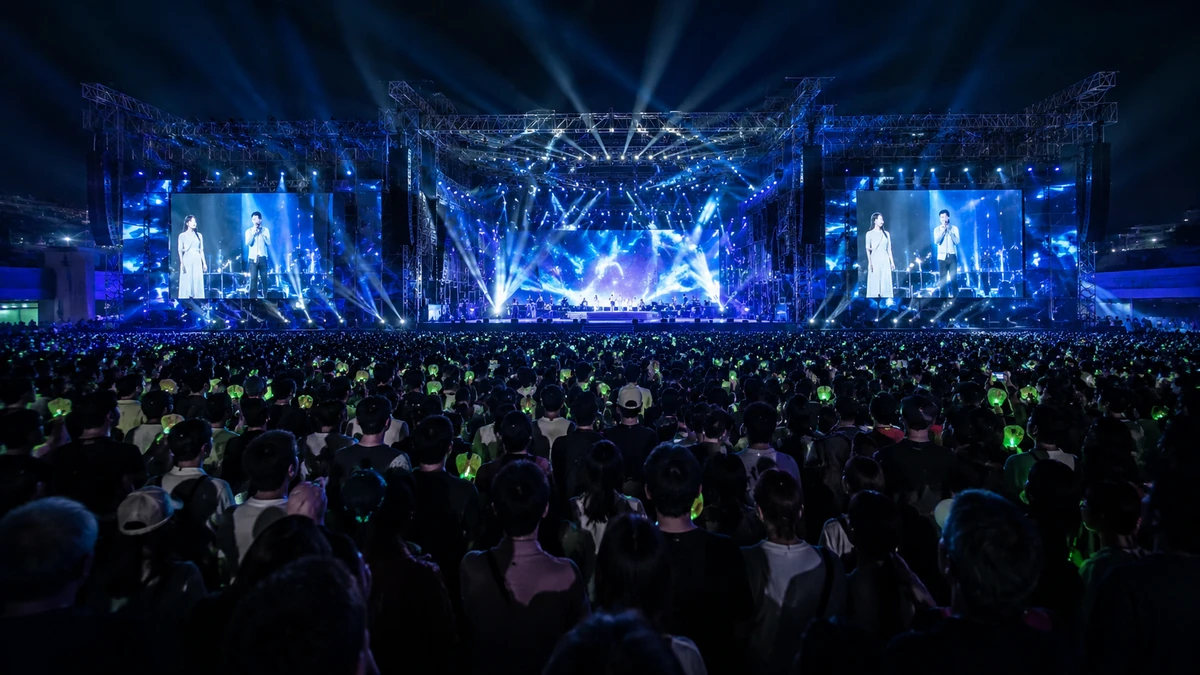
According to South Korean media reports, AKMU headlined the second day of Beautiful Mint Life 2026 on May 31 at the Oil Tank Culture Park in Seoul’s Mapo district, closing out the evening with a set built around the atmosphere of their newly released fourth full-length album. The performance opened with “Paradise Found by Rumor,” a title that sounds whimsical in English but, in context, suggests a place people hear about before they ever reach it — an imagined refuge made real through experience. By the end of the set, that idea had become the central fact of the evening.
For American readers who may know K-pop largely through stadium spectacles, precise choreography and chart milestones, AKMU offers a different entry point into contemporary Korean pop music. The duo, made up of brother Lee Chan-hyuk and sister Lee Su-hyun, has long occupied a distinctive space in South Korea’s music scene. They are commercially successful, widely recognizable and very much part of the broader Korean wave, or Hallyu, but they are not defined by the maximal polish that international audiences often associate with the category. Their music leans toward narrative songwriting, melodic detail, live-band warmth and a kind of emotional intimacy that can feel closer to indie pop, folk-pop or singer-songwriter traditions than to the most export-ready version of idol pop.
That is part of what made this festival appearance notable. It was not simply that AKMU showed up at a major outdoor event. It was that they used a high-profile headliner slot to extend the sensibility of a new album into a communal live setting, proving that the songs were not just studio constructions but living material capable of filling open air, moving a mixed crowd and reshaping a public space for an hour or more.
In the United States, there are familiar analogues: the way an artist at Bonnaroo, Coachella or Newport can suddenly transform a sprawling field into something intimate, or the way a late-night set at an outdoor summer festival can feel less like a concert than a collective mood. AKMU’s performance appears to have worked in that vein. What happened in Seoul was not simply a recital of new songs. It was a demonstration of how Korean pop can create atmosphere, not just attention.
Why AKMU matters inside — and beyond — K-pop
To understand why this set resonated, it helps to understand who AKMU is in the Korean music landscape. The duo first rose to fame through the audition program “K-pop Star,” and since then they have built a reputation not only for catchy songs but also for musical authorship. In an industry often discussed in terms of agency systems, training pipelines and tightly managed concepts, AKMU has stood out as artists whose identity is rooted in songwriting and tonal contrast.
That contrast begins with the siblings themselves. Lee Su-hyun’s voice is known in Korea for its clarity, ease and emotional brightness. Lee Chan-hyuk brings a more playful, off-center energy as both a vocalist and songwriter, often injecting rhythmic twists, unexpected tonal shifts and a slightly mischievous presence into songs that might otherwise drift toward prettiness. Together, they create a balance that is central to AKMU’s appeal: sincerity without sentimentality, polish without stiffness, whimsy with enough tension to keep it from floating away.
For readers unfamiliar with the range of Korean popular music, this matters because AKMU represents a side of the industry that is often overshadowed abroad. The global conversation around K-pop understandably gravitates toward blockbuster groups, synchronized performance and online fandom metrics. But South Korea’s pop ecosystem is broader than that, with artists who draw from folk, soft rock, jazz-inflected pop, acoustic music and lyrical storytelling. AKMU sits at a crossroads of those traditions. Their songs can still generate mainstream buzz, but they also reward close listening in ways that resemble the work of artists who build careers on craft rather than pure spectacle.
That broader context makes the Beautiful Mint Life booking especially telling. Festivals are often the best measure of an artist’s real-time relationship with the public because they draw not just devoted fans but also casual listeners, curious passersby and people who may be there for the overall experience as much as any single act. A headliner at that kind of event must do more than satisfy a fan base. They have to hold an open crowd, create a coherent emotional arc and send people home feeling like the night landed somewhere meaningful.
In that sense, AKMU’s final-slot appearance was its own kind of statement. The duo was not there as a novelty act, a nostalgic throwback or a palate cleanser between louder names. They were entrusted with the last word of the evening. In festival terms, that is an endorsement of range, reliability and public connection.
Turning a city venue into a world of their own
The setting mattered. Oil Tank Culture Park is one of those urban spaces that tells a larger story about Seoul itself — a former industrial site repurposed into a cultural venue, where the city’s past and present meet in a carefully curated public environment. It is the kind of place that can heighten a concert’s atmosphere because it already carries a sense of reinvention. In American terms, think of the appeal of concerts staged in reclaimed warehouses, waterfront piers or industrial arts complexes that preserve the bones of an older city while repackaging them for contemporary culture.
As darkness settled in, AKMU reportedly walked onstage hand in hand with their band, smiling and inviting the crowd into their world. That image — simple, warm, almost theatrical in its modesty — seems to have captured the tone of the set. Rather than using bombast to command attention, they established a shared emotional premise: Come in, slow down, listen differently.
The opening song did much of the narrative work. “Paradise Found by Rumor” begins with lyrics that evoke hospitality and escape, inviting a weary traveler to sit down to warm soup and meat and promising a kind of knowledge the city cannot offer. Even without speaking Korean, one can grasp the dramatic contrast at play: the rushed, impersonal rhythm of urban life versus a pocket of tenderness and rest. That contrast is recognizable in almost any global city, whether the setting is Seoul, New York, Los Angeles or Chicago. The difference is that AKMU turned it into a musical environment rather than a slogan.
Outdoor night shows can reveal strengths and weaknesses quickly. There is less room to hide. Vocals drift if they lack focus. Arrangements flatten if they are too dependent on studio layering. A crowd disperses emotionally if the pacing is off. By all indications, AKMU used the night air to their advantage. The imagery in the songs aligned with the actual coolness of the evening, making the performance feel less like a playlist and more like a fully inhabited scene.
This is one of the underappreciated powers of live music in the Korean festival circuit. Much of the international narrative around K-pop centers on visibility — views, streams, rankings, viral moments. But live festivals are where artists reveal whether their music can generate a social feeling that exists beyond the screen. AKMU appears to have done precisely that, turning an outdoor venue into what felt, at least for the length of the set, like a self-contained refuge from the city around it.
The new album moved from product to lived experience
One reason the performance drew attention was its relationship to AKMU’s recently released fourth studio album, “Bloom.” In the music business, new albums are often introduced at shows in a fairly predictable way: a lead single here, a teaser there, perhaps one carefully selected new track placed between the established favorites. What stood out in Seoul was that AKMU appears to have done something more assertive. They did not treat the new record as a side dish. They made it the language of the set.
Following the opener, the duo reportedly performed additional songs from “Bloom,” including tracks translated in reports as “Spring Colors” and “Paying With Bugs.” The titles alone suggest the kind of surreal, image-rich sensibility that has long distinguished AKMU’s catalog. More important than the titles, though, was the sequencing. Programming multiple recent songs early in a headlining festival set signals confidence. It says the artist believes the material is strong enough not just to survive in front of a broad audience, but to define the atmosphere from the start.
That can be risky anywhere. American festivalgoers are famous for wanting the hits, and Korean audiences are no different in their ability to instantly register when a performer is leaning too heavily on unfamiliar material. But when new songs hold a crowd, the reward is substantial. It means the album has crossed over from release-cycle obligation into genuine repertoire. The music no longer needs explanation; it has already begun to live on its own terms.
That appears to be what happened here. Rather than relying only on nostalgia or on the safe recognition factor of older hits, AKMU used the stage to argue for the present tense of their career. “Bloom” was not presented as a press release with melodies attached. It was embodied as mood, sequence, momentum and collective participation.
The album title itself suggests emergence, flowering and expansion. In a live setting, those ideas translate naturally into set design and pacing, but also into how a crowd gradually joins the performance. A song blooms differently in public than it does through headphones. Its stamina is tested. Its hooks have to land without repeat listens. Its emotional logic has to communicate across distance, distraction and ambient noise. If the reports are accurate, AKMU passed that test by letting the songs create an atmosphere robust enough to carry an outdoor headline slot.
For international audiences trying to understand the depth of Korea’s music scene, that is a useful reminder. Korean pop is not only about how a song debuts online. It is also about what happens when that song meets air, bodies, dusk and a crowd willing to go somewhere with it.
The sibling chemistry at the center of the night
No account of AKMU works without the chemistry between the two performers. Plenty of pop acts speak of balance. AKMU makes it audible. Lee Su-hyun’s singing reportedly brought a cooling brightness to the night, a tone that can seem deceptively effortless even as it anchors the emotional center of a song. Lee Chan-hyuk, by contrast, introduced playfulness, groove and small disruptions that prevented the set from becoming too neat or overly delicate.
That push and pull is part of what has allowed AKMU to appeal across age groups in Korea. The duo can sound accessible without sounding generic. Younger listeners may be drawn to the offbeat wit and melodic immediacy. Older listeners often respond to the live-band textures, vocal restraint and storytelling impulse. In the United States, one might compare the broad appeal not to any single artist but to the rare acts that can move comfortably between pop radio, festival stages and more musically attentive audiences without changing their identity for each room.
Onstage, sibling acts always carry an extra layer of narrative because the relationship itself is part of the performance. There is familiarity, shorthand and a kind of earned unpredictability. A glance, a laugh, a slight change in phrasing can tell its own story. Reports from the festival emphasize Lee Chan-hyuk’s mischievous smile and Lee Su-hyun’s gentle openness, suggesting that much of the set’s success came not from technical perfection alone but from the ease with which the two inhabited a shared world.
That distinction matters. In a pop culture economy saturated with branding, audiences still respond strongly to artists who seem to possess an internal logic independent of the market around them. AKMU’s bond is not a concept invented for a campaign. It is the basis of the act. Their differences are the sound. When those differences align in the right setting, as they apparently did in Seoul, the result is not just musical cohesion but emotional credibility.
And credibility is a powerful currency at festivals. A crowd will forgive unfamiliar songs if it believes in the performers delivering them. It will lean in when a set has a point of view. It will sing along not just because a chorus is catchy but because the artists have made participation feel natural. By the description offered in Korean coverage, AKMU achieved exactly that kind of collective release: laughing, dancing, singing and, for a little while, stepping out of ordinary fatigue into a more generous mood.
What the headliner slot says about Korean pop right now
The significance of the show also lies in what it says about the Korean industry at this moment. Headliner status at a major outdoor festival is not handed out casually. The last act of the night is expected to consolidate the energy of the day, reward the crowd for staying and leave behind a feeling strong enough to define the event in memory. That role is different from the pressure of a solo arena concert, but in some ways it is tougher. A festival crowd is more varied, more distracted and less automatically loyal.
AKMU’s placement at the top of the bill suggests a level of trust that extends beyond fandom. It indicates that organizers believed the duo could connect with a wide demographic, sustain attention in an outdoor environment and deliver the kind of emotional afterglow that sends thousands of people back into the city feeling satisfied rather than spent. That is not a minor achievement in a live market where audiences have more options than ever and where Korean festivals must compete not only with each other but also with a digital culture that constantly fragments attention.
It also underscores an important point about the Korean wave for foreign observers. Hallyu is often described abroad through its most explosive forms — blockbuster dramas, global idol groups, streaming records and internet-breaking moments. But cultural influence also grows through quieter proof: an artist’s ability to hold a home crowd, develop new work in public and expand without sacrificing identity. AKMU’s set seems to have embodied that slower, sturdier kind of influence.
There is a temptation, especially in English-language coverage of Korean entertainment, to frame every noteworthy event as evidence of competition, domination or strategic global expansion. Those angles are sometimes justified. But they can obscure the simplest and perhaps most important fact: music endures because it creates feeling in real time. By that measure, this performance mattered not because it announced a new empire, but because it showed an existing act at a moment of artistic clarity.
That may be why the scene described in Korean reporting feels so vivid. It was not built around scandal, surprise collaborations or an industry plot twist. It was built around songs, air, timing and mutual attention between stage and audience. In an era when pop culture is often consumed as a race for the next update, there is something refreshing about a story whose central claim is that a band stepped onto a stage and made people feel more alive together.
A warm reminder of what live music can still do
For American readers, the easiest way to understand the importance of AKMU’s festival finale is to think less about genre labels and more about function. What happened in Seoul sounds like the kind of set that reminds people why they go to festivals in the first place: not merely to check off a lineup, but to stumble into a mood they could not have produced alone. The songs become a setting. The setting becomes a memory. The memory lingers after the lights come up.
That idea carries particular weight in South Korea, where urban life can be intensely fast-paced and where cultural events often serve as temporary spaces of release. The invitation embedded in “Paradise Found by Rumor” — sit down, eat something warm, step outside the city’s logic for a while — lands as more than poetry. It speaks to a very modern hunger for pause, comfort and shared imagination.
AKMU appears to have recognized that hunger and answered it without overstatement. There is a lesson there for anyone trying to understand why certain artists last. Durability is not always about reinvention in the loudest sense. Sometimes it is about refining a language until it can fill a larger space without losing its intimacy. Sometimes it is about bringing new songs into a crowd and trusting that atmosphere can do the work that hype cannot.
If this performance becomes one of the more memorable live moments in Korea’s 2026 pop calendar, it will likely be for precisely that reason. AKMU did not need an extravagant narrative imposed from the outside. The narrative was already inside the set: a city night transformed, a new album tested and affirmed, and a crowd briefly gathered inside a small paradise it had perhaps only heard rumors about before arriving.
For a global audience accustomed to measuring Korean pop through numbers and headlines, that is a useful corrective. Sometimes the most revealing story is not about scale but about texture. Not about winning the internet for a day, but about owning a field after dark. In Seoul, AKMU seems to have done exactly that.
Comments
Post a Comment