Bradley Cooper Joins Bong Joon Ho’s First Animated Feature, Signaling a Bigger Moment for Korean Storytelling
Bong Joon Ho’s next move is not just another casting story
Bradley Cooper has joined the English-language voice cast of “Elli,” the first animated feature from South Korean director Bong Joon Ho, according to reports from Yonhap News Agency, Deadline and Korean entertainment company CJ ENM. On paper, that may sound like a familiar entertainment-industry headline: a major Hollywood actor signs on to a high-profile project from an Oscar-winning filmmaker. But the bigger story is not simply that Cooper is lending his voice to an animated movie. It is that a Korean creator’s project, conceived outside the traditional U.S. studio system, is drawing a global ensemble and being built from the ground up as an international pop-culture event.
That distinction matters, especially for American audiences who may still associate the Korean Wave — often called “Hallyu,” the term used for the global rise of South Korean popular culture — primarily with K-pop groups like BTS or Blackpink, or with streaming hits such as “Squid Game.” What “Elli” suggests is that Korean cultural influence is no longer confined to music, prestige television or the occasional breakout film. It now extends into the highly competitive world of animated features, where brand recognition, voice casting, international financing and distribution strategy all play a major role in whether a project breaks through.
Bong is hardly an unknown quantity in the United States. Since “Parasite” became the first non-English-language film to win the Academy Award for best picture in 2020, he has occupied a rare place in American film culture: a foreign auteur whose name alone can sell a story. That kind of stature is still unusual in Hollywood, where international directors are often celebrated by critics but not always marketed as household names. Bong has crossed that line. His next project is news not only to cinephiles, but to the wider entertainment industry.
“Elli” adds another layer to that interest because it marks a formal shift. Bong is known for live-action films that blend social satire, suspense, genre play and emotional whiplash, from “Memories of Murder” and “The Host” to “Snowpiercer,” “Okja” and “Parasite.” Animation, especially feature-length animation, is a different storytelling instrument. It changes what performance means. It changes how a world is built. It also changes how global audiences enter the story, because in animation, the voice is not an accessory to the character — it is one of the character’s most defining features.
That is why the casting matters. Not because celebrity names automatically equal artistic success, but because voice performance is central to how an animated film travels across languages and borders. And in the case of “Elli,” those borders appear to be part of the plan from the start.
A deep-sea adventure with an unmistakably global design
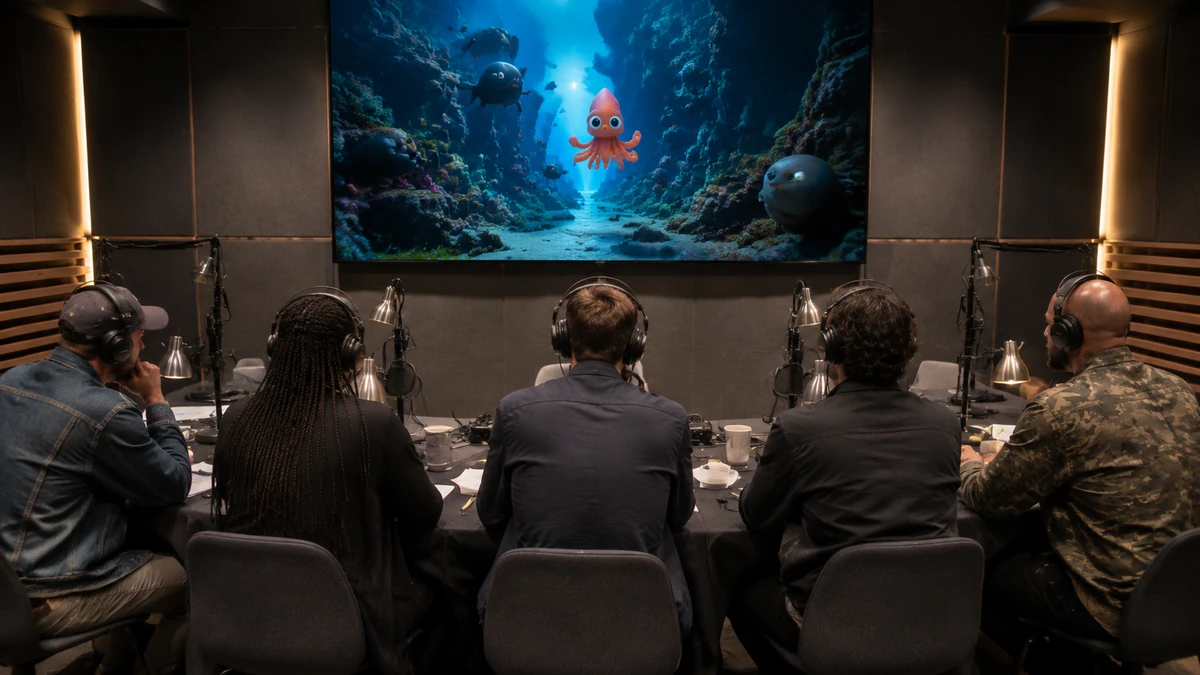
According to the Korean reports, “Elli” follows a baby pig squid living in an underwater canyon who becomes curious about the human world and sets off on an adventure with deep-sea fish. Even in summary form, the premise is striking. A baby pig squid is the kind of creature that sounds instantly memorable in the way animated protagonists often do: odd enough to spark curiosity, emotionally legible enough to invite identification. For American readers, it may call to mind the fast-recognition appeal of animated characters from Pixar or DreamWorks, where one unusual creature or high-concept setup can anchor an entire emotional universe.
But the setup also points to a deeper thematic possibility. A young being from an enclosed world looking outward toward another realm is one of the oldest narrative engines in storytelling. It is the structure of a coming-of-age tale, an outsider story and an exploration story all at once. In American terms, it has shades of “The Little Mermaid,” “Finding Nemo” and other family films built around curiosity, danger and discovery. That does not mean Bong’s film will resemble any of those stories in tone or theme. It simply means the project is drawing from a narrative framework that audiences already understand: the urge to leave home, cross a boundary and learn what lies beyond the familiar.
The undersea setting gives the film another advantage. Animation excels when it can create spaces that feel both imaginative and physically coherent. The deep ocean offers exactly that kind of canvas — mysterious, beautiful, alien and emotionally resonant. It is a place Americans often know more through documentaries, aquariums and science fiction than through direct experience, which makes it especially useful as a cinematic world. A submerged canyon populated by deep-sea creatures can be whimsical, unsettling or sublime, sometimes all at once. Bong’s live-action films have often thrived on tonal shifts, and an animated ocean world could offer him vast room to play with scale, mood and metaphor.
Still, it is important not to oversell what is not yet known. The current reporting offers the basic premise and the list of companies and actors involved, not a trailer, release date or extensive plot details. So the responsible conclusion is not that “Elli” will be a certain kind of masterpiece, children’s film or crossover hit. The conclusion is that the project’s concept is clear enough, and unusual enough, to stand out in a crowded marketplace — and that clarity matters when a movie is trying to speak to audiences across continents.
Why Bradley Cooper and this cast matter in animation
Cooper’s involvement is the headline-grabbing piece because he is one of the most recognizable actors in American film. He is known to mainstream U.S. audiences for movies including “Silver Linings Playbook,” “American Sniper” and “A Star Is Born,” as well as for franchise work and his history of balancing prestige projects with broadly commercial ones. His name signals seriousness to some viewers, accessibility to others and awards-season credibility to much of the industry. When an actor with that profile joins a voice cast for a Korean-directed animated feature, it elevates attention immediately.
But Cooper is only one part of a lineup that appears carefully designed rather than randomly star-studded. Reports say the English dub also includes Ayo Edebiri, Dave Bautista, Werner Herzog, Rachel House, Finn Wolfhard and Alex Jane Go. That is not a conventional roster. It spans generations, genres, fan bases and performance styles. Edebiri, who rose sharply in profile through the acclaimed FX series “The Bear,” brings a contemporary comic and dramatic sensibility that younger American viewers know well. Bautista, a former professional wrestler turned actor, has built real respect through films such as “Guardians of the Galaxy” and “Blade Runner 2049,” proving he is more than a franchise personality. Herzog, the German filmmaker and actor, brings a singular, unmistakable voice that carries arthouse cachet and dry intensity. Rachel House has become a familiar presence to audiences who follow international film and voice work. Wolfhard offers recognition for younger viewers who came to know him through “Stranger Things.”
In a live-action film, an ensemble like that would partly be discussed in terms of physical presence and screen chemistry. In animation, the equation is different. Viewers are not seeing Cooper’s face or Bautista’s imposing build. They are hearing rhythm, emotional shading, warmth, hesitation, menace, humor and vulnerability. Voice casting is not just a matter of attaching famous names for the poster. It is a tonal decision. A single voice can change whether a character feels grounded or cartoonish, intimate or theatrical, sincere or ironic.
That is especially true when a film is meant to cross linguistic and cultural boundaries. In Korea, where Bong’s reputation carries deep weight, audiences may approach the project through the director’s authorship. In the United States, voice actors often help define the first point of entry for casual moviegoers. An American parent deciding what to watch with a child, or a movie fan scrolling through release listings, may not know all the details of Korean financing structures or industry trends. They do know Bradley Cooper. They know Ayo Edebiri. They know the emotional shorthand that comes with a cast list.
So the casting announcement does more than advertise prestige. It tells the market how the film wants to be heard. It suggests that “Elli” is not being treated as a niche import that will be subtitled and left to specialty theaters alone. It is being prepared as a story that expects to converse with English-speaking audiences on familiar terms, without giving up its identity as a Korean-led creative work.
Bong Joon Ho’s animation debut is a turning point in itself
Even if no celebrity had joined the cast, “Elli” would still be one of the more intriguing projects in international film because it is Bong’s first animated feature. That phrase alone carries weight. When a director known for one medium moves decisively into another, the interest is not merely technical. Audiences want to know what remains constant and what changes. Does the filmmaker’s worldview survive the transition? Does the new medium unlock instincts that were less visible before?
Bong’s work has long been defined by elasticity. He moves between crime drama, monster movie, science fiction, social satire and family melodrama, sometimes within the same film. His movies often place ordinary or vulnerable characters inside systems they only partly understand, whether those systems are political, economic, scientific or familial. They are also deeply visual, often relying on architecture, spatial relationships and controlled tonal shifts to create meaning. Animation could be a natural extension of that sensibility. It allows for precise world-building and elastic mood in ways that live-action can struggle to match without massive budgets and extensive effects work.
For American audiences, one useful comparison might be how filmmakers such as Wes Anderson or Guillermo del Toro use stop-motion or other animated forms not as side projects but as alternate modes of authorship. The medium does not erase the filmmaker’s identity; it refracts it. That may be the most compelling question around “Elli”: not whether Bong can make animation, but what animation looks like once filtered through Bong’s particular imagination.
There is also an industry subtext here. South Korea is widely admired for the range and quality of its film and television production, but it has not historically occupied the same place in the American imagination when it comes to original feature animation. American viewers may know Japanese animation well, whether through Studio Ghibli, anime franchises or recent global hits. Korean animation, by contrast, has often been less visible to the average U.S. audience as a branded cultural export, even when Korean studios and artists have played important roles in production pipelines. A Bong Joon Ho animated feature has the potential to change that visibility, not by representing all Korean animation, but by drawing attention to Korea as a place where major original animated storytelling can emerge and command global resources.
That is part of why this news feels bigger than a routine project update. It is not just about a famous filmmaker trying something new. It is about where Korean creators now stand in the hierarchy of global entertainment: no longer simply producing works that are later “discovered” by the West, but launching projects that are international in structure from day one.
The financing and distribution tell their own story
The companies attached to “Elli” help explain why the announcement is significant beyond film fandom. Reports say CJ ENM, Venture Invest and French studio Pathe Films are involved in investment and distribution, while Korean production company Barunson C&C is overseeing production. North American distribution is said to be handled by Neon.
For readers outside the entertainment business, those details can sound like background noise. They are not. In global media, who finances a movie, who distributes it and who introduces it to the North American market often determines how seriously the project is positioned and how broadly it is likely to travel. Distribution is not just the act of putting a film in theaters or on screens. It shapes campaign strategy, festival visibility, awards positioning, marketing language and audience expectation.
Neon is especially notable in the Bong story. The distributor helped turn “Parasite” into a genuine American cultural event, not just a critically praised foreign-language film. It marketed the movie with confidence, wit and a sense that U.S. audiences did not need to be gently persuaded to take Korean cinema seriously. That approach paid off in historic fashion. For Neon to handle North American distribution here suggests continuity in how Bong’s work is being presented to English-speaking audiences: not apologetically, not as homework for cinephiles, but as a central part of the contemporary film conversation.
CJ ENM’s involvement is another reminder of how the Korean entertainment industry has evolved. For years, American consumers encountered Korean culture mainly as imported entertainment products after they were already successful domestically. Increasingly, however, Korean companies are participating in international entertainment as architects, not just exporters. That may sound like a business distinction, but it has cultural consequences. It means Korean-led projects can be designed from inception with worldwide circulation in mind while still retaining creative ownership at the center.
That structure reflects a broader shift in global entertainment. The old model often imagined Hollywood as the origin point and the rest of the world as downstream markets. That is not how many contemporary projects work. Now the process is more networked: financing from one place, production management from another, voice cast from several countries, and distribution strategies tailored by region. What stands out in “Elli” is that this web of international collaboration is orbiting a Korean director’s original project. That is the kind of change that signals real movement in cultural power.
What this says about the Korean Wave after K-pop and streaming
For Americans who have followed the rise of Korean culture mainly through music charts, Netflix rankings and Oscars history, “Elli” is a useful marker of where the Korean Wave is headed next. Hallyu is sometimes treated in the United States as a series of isolated breakout phenomena: first a K-drama obsession, then a K-pop craze, then a film awards triumph. But from the Korean perspective, it is better understood as an ecosystem, one in which music, television, film, technology, fandom, corporate investment and global distribution all reinforce one another.
In that ecosystem, animation has been a less conspicuous frontier. That is one reason this project is worth watching. It suggests that Korean cultural influence is maturing beyond trend status and moving into infrastructure. If an internationally recognized Korean filmmaker can attract a cast that includes major Hollywood names and work through a multinational financing and distribution arrangement, then Korean content is no longer just winning moments of overseas attention. It is helping define the terms of global collaboration.
That may not sound glamorous, but it is often how cultural shifts become durable. A hit song can be a fad. A blockbuster series can be a one-off. But when creators from one country become magnets around which other countries’ talent, capital and distributors assemble, something more lasting is happening. The center of gravity changes.
There is also an artistic lesson embedded here. For years, Hollywood has adapted or remade successful Asian stories for English-speaking audiences, sometimes productively and sometimes awkwardly. “Elli” appears to represent a different model. Rather than reworking a Korean story into an American one after the fact, it is building an international audience into the project’s architecture while preserving the identity of its original creator. In practical terms, that means English dubbing is not merely an afterthought or a localization tool. It is part of the film’s intended reach.
For American viewers, that may become increasingly common. The future of global entertainment is likely to involve fewer neat categories like “foreign film,” “domestic release” and “crossover success.” Instead, audiences will encounter more projects that are created in one national context but assembled for global circulation from the beginning. “Elli” seems to belong to that future.
What remains unknown — and why the announcement still matters
At this stage, many obvious questions remain unanswered. There is no full trailer in the reporting summarized here, and no detailed explanation of tone, release timing or how the film will balance family appeal with the more layered sensibility that Bong’s work often carries. It is not yet clear whether “Elli” will aim primarily at children, families, adult animation fans or the broad four-quadrant audience that Hollywood studios chase. The presence of major voice talent and North American distribution does not automatically answer those questions.
But early industry announcements do not need to answer everything to be meaningful. What they can do is reveal direction, ambition and scale. In that sense, the news around “Elli” is unusually informative. It tells us Bong is making a first animated feature rather than another live-action film. It tells us the concept centers on a curious baby pig squid and an undersea adventure with deep-sea creatures. It tells us the English-language dub is being assembled with a cast that blends mainstream recognizability, critical prestige and tonal range. And it tells us the project is supported by a cross-border industrial structure that includes Korean, European and North American players.
Taken together, those facts sketch the outline of a movie that wants to operate as more than a local success story. It wants to be legible, marketable and emotionally resonant across cultures. That, in itself, is newsworthy.
For American audiences, the easiest way to understand the significance may be this: imagine if a beloved international director with the stature of Bong announced his first animated feature, then secured a voice cast drawing from the worlds of prestige TV, superhero franchises, arthouse cinema and youth-oriented streaming hits, with a distributor that already knows how to sell his work to the United States. Even before anyone sees footage, that would be treated as a major cultural event. That is where “Elli” now stands.
Whether the finished film becomes a box-office success, an awards contender, a family favorite or simply an intriguing experiment remains to be seen. But the project’s outline already says something important about the state of global culture in 2025: Korean creators are not waiting for Western institutions to validate them after the fact. Increasingly, they are building the projects that those institutions want to join.
And that may be the most revealing part of Bradley Cooper’s casting. It is not just that a Hollywood star is entering Bong Joon Ho’s orbit. It is that Bong’s orbit has become one of the places where global entertainment now naturally gathers.
Comments
Post a Comment