A fatal fire in a place meant to be safe
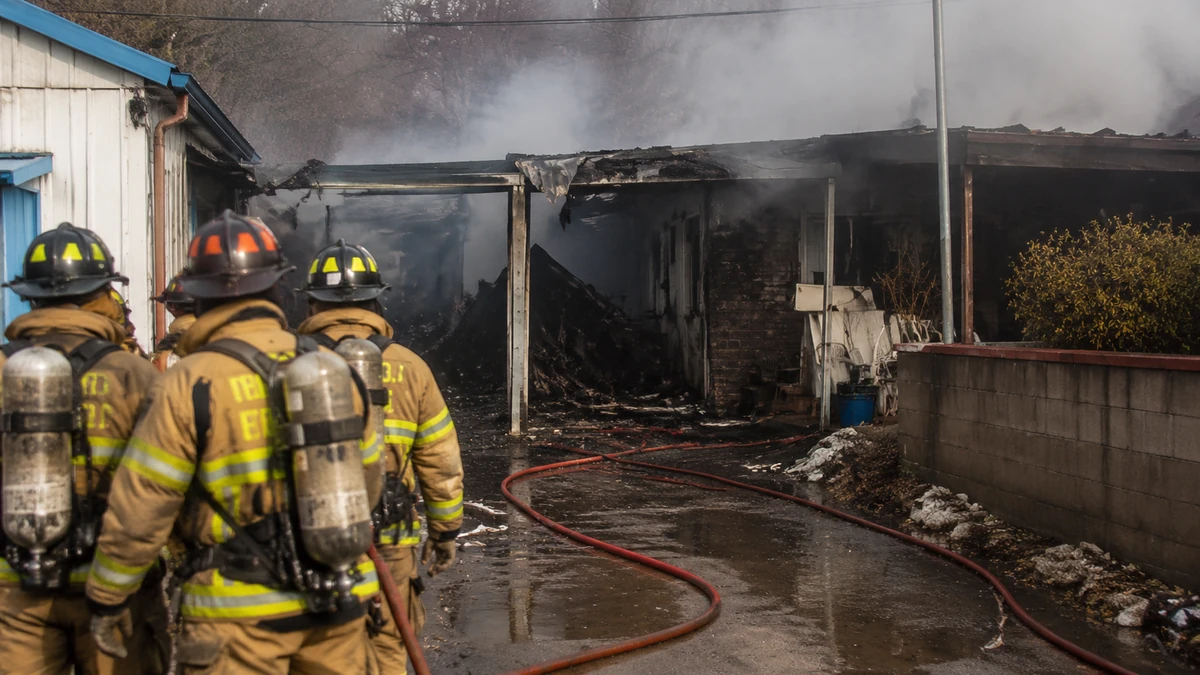
A house fire in rural South Korea has left a man in his 70s dead, renewing concern about how quickly a blaze inside a home can turn fatal — especially for older residents living outside major city centers. According to South Korean authorities, the fire broke out at about 4:08 p.m. on July 17 at a residence in Donggang-myeon, a township in Naju, a city in the country’s southwestern South Jeolla Province. Firefighters extinguished the blaze by 5:33 p.m., but the resident, identified by his surname only as A under common Korean media practice, was found at the scene in cardiac arrest. He was taken to a hospital and later died.
Officials believe the man likely died from smoke inhalation, though the exact cause of the fire remains under investigation. Authorities are also still assessing the scale of the property damage. At one level, this is a local tragedy: a deadly residential fire in a quiet part of the country. But in another sense, the case speaks to a larger issue that will be familiar to readers in the United States and elsewhere — the vulnerability of older adults during emergencies that unfold in seconds, inside homes that are assumed to be the safest places people know.
The details publicly confirmed so far are limited, and that matters. In fast-moving disaster coverage, there is often pressure to explain why something happened before investigators have completed even the earliest stages of their work. South Korean fire authorities have not determined where the blaze started or what triggered it. That absence of certainty is not a gap to be filled with speculation; it is a reminder that responsible reporting on emergencies begins with what can actually be verified. What is known is stark enough: a fire started, emergency crews responded, and one person died before the danger could be reversed.
For American readers, the story may resonate in the same way local coverage of a fatal house fire in a rural county would at home. It is not a mass-casualty disaster or a headline-grabbing industrial accident. It is the kind of event that can happen on an ordinary afternoon, behind the walls of a private residence, where age, mobility, medical condition, living arrangement and the speed of smoke spread can matter as much as the flames themselves.
That combination — an elderly resident, a home fire, an unknown ignition source and a suspected death by smoke inhalation — is what makes this case more than a brief police blotter item. It points to a broader challenge facing South Korea, a highly modern country with sophisticated emergency infrastructure that is also aging rapidly, and where the risks of living alone or aging in place are becoming increasingly difficult to ignore.
The timeline shows how fast house fires can become deadly
One of the clearest facts in the case is also one of the most sobering: the timeline. The fire was reported at 4:08 p.m. and extinguished at 5:33 p.m. That means roughly 85 minutes passed between the initial emergency response and the point at which the blaze was fully put out. Yet the fatal injury appears to have happened much earlier. By the time the resident was found, he was already in cardiac arrest.
That sequence underscores a reality well known to fire investigators and emergency responders in the United States: in residential fires, the most dangerous window often comes at the beginning. Long before a structure is fully engulfed, thick smoke and toxic gases can make escape difficult or impossible. In many fatal fires, victims are overcome not by direct burns but by inhaling smoke in enclosed spaces. Even a fire that may not appear catastrophic from outside can become lethal within minutes indoors, especially if visibility drops and breathing becomes impaired.
South Korean fire officials said they suspect smoke inhalation in this case, a conclusion that fits a familiar pattern in home-fire deaths worldwide. Smoke reduces oxygen, carries toxic combustion products and disorients anyone trying to escape. For older adults, those dangers can be compounded by slower reaction time, reduced mobility, hearing issues, chronic illness or simple delay in recognizing that a fire has already become life-threatening. A person does not need to be physically trapped by flames to be trapped by conditions inside a house.
That is why the time between ignition and rescue matters so much, and why the public often misunderstands what makes house fires deadly. Television and movies tend to train audiences to look for towering flames, broken windows and dramatic rescues. But fire safety experts routinely emphasize that smoke is often the first and worst killer. The Naju case appears to be another reminder of that principle.
The limited information released so far does not say whether the resident was living alone, whether smoke detectors were installed, whether neighbors noticed the blaze immediately, or whether the fire spread from a kitchen, electrical source or another part of the home. Those unanswered questions are central to the investigation. But even before those details are known, the timing alone suggests that once conditions inside the house deteriorated, the margin for survival may have collapsed very quickly.
That is not unique to South Korea. In American communities, especially rural ones, local news outlets regularly cover fires where first responders arrive within minutes yet still cannot prevent a fatal outcome. The reason is not always a failure of emergency response. Often it is the brutally narrow timeline of residential fires themselves. By the time 911 in the United States — or 119 in South Korea, the country’s emergency number for fire and medical services — is called, the most critical minutes may already have passed.
Why this story matters in South Korea’s aging society
The victim’s age is not incidental. South Korean reports identified the resident as being in his 70s, and that detail gives the story a broader social weight. South Korea is one of the world’s fastest-aging societies, a demographic transformation that affects everything from health care and pension policy to housing and disaster preparedness. As in the United States, officials and researchers increasingly ask not only how many emergencies occur, but who is most vulnerable when they do.
In practical terms, older adults can face particular risks in home fires. Some may have trouble moving quickly, opening doors, navigating smoke-filled rooms or making an emergency call under stress. Others may live alone, which can delay rescue or reduce the chances that someone nearby notices unusual conditions. In rural settings, where homes may be more spread out and populations older on average, isolation can deepen those risks.
South Korea’s aging trend has been well documented. The country combines world-class digital infrastructure and dense urban development with a rising elderly population and growing concern about seniors who are socially isolated, economically vulnerable or living in older housing stock. That tension is especially visible outside Seoul and other major metropolitan areas. Naju is not a remote backwater, but Donggang-myeon, the township named in the reports, reflects a more local and less urban setting than the high-rise apartment landscapes many international audiences associate with modern South Korea.
For Americans, a useful comparison might be the difference between a fire in downtown Seoul and one in a rural township in the Korean countryside. The latter may involve detached housing, fewer immediate bystanders and an older resident population, similar in some respects to how emergency risk can look different in rural Appalachia, the Great Plains or agricultural parts of California than it does in Manhattan or Chicago. The systems on paper may be strong, but the lived experience of vulnerability is shaped by age, geography and the physical realities of a home.
This is part of why even a single-fatality local fire can carry national significance. It invites uncomfortable but necessary questions: Are elderly residents receiving enough fire-safety outreach? Are smoke alarms present and functional in older homes? Do seniors living alone have regular welfare checks or support networks? Are local governments adapting emergency-prevention strategies to the needs of a rapidly aging population? None of those questions can be answered from this one incident alone. But the incident raises them naturally, and forcefully.
It is also important not to flatten older people into a single category of helplessness. Many seniors live independently and safely. But emergency planning in any aging society depends on recognizing statistical vulnerability without stereotyping individuals. The Naju fire becomes significant in that sense because it appears to illustrate how a private emergency can intersect with a well-known demographic reality: when disaster strikes, age can shape outcomes in decisive ways.
A modern emergency system does not erase private risk
International audiences often think of South Korea as a country defined by speed — fast internet, fast trains, fast delivery, fast urban development. In many ways that image is accurate. It is also a country with a dense and recognizable emergency response system. The number 119, South Korea’s equivalent to 911 for fire and medical emergencies, is widely known, and the country’s public safety infrastructure is generally considered strong by international standards.
But a house fire like this one demonstrates a harder truth: even an efficient emergency-response network cannot guarantee a life will be saved once a fire has started inside a home. That is not a contradiction. It is a reflection of the limits of response when set against the speed of fire, smoke and human vulnerability.
Authorities did respond. Fire crews were dispatched, the blaze was extinguished and the victim was taken to a hospital. Yet the outcome was still fatal. That fact does not, on its own, indicate a failure by responders. Instead, it highlights a point Americans also encounter after deadly home fires: prevention and early warning are often more determinative than response alone. Once a person is overcome by smoke, the existence of a robust public system may not be enough to reverse what has already happened.
That is one reason residential fires carry such emotional force in South Korea and elsewhere. A fire at a warehouse, factory or commercial building raises questions about labor safety, regulation and economic loss. A fire at a home strikes differently because it occurs in the most intimate space people have. Homes are where people sleep, eat, store medicine, keep family photos, care for elders and assume some measure of control over daily life. When that space becomes deadly, the story resonates beyond raw casualty numbers.
In South Korea, the symbolic power of the home is especially strong in public discourse because housing is not just shelter; it is deeply tied to social stability, family structure and economic anxiety. The country is often discussed internationally in terms of soaring apartment prices, multigenerational pressures and urban concentration. But stories like the Naju fire remind readers that housing safety is also about elemental physical protection. In that sense, the issue is more basic than real estate or policy jargon. It is about whether the place where someone lives can protect them in a moment of danger.
The case also shows why local incidents can matter even when they are not spectacular. The public tends to focus on national disasters that unfold on television or trigger broad political debate. Yet routine residential fires, especially those involving elderly people, can reveal structural weaknesses just as clearly. They do so on a smaller stage, with fewer cameras, but often with the same essential question: who is left exposed when safety systems meet the reality of daily life?
The investigation will matter as much as the initial headlines
At this stage, authorities say they are investigating the exact cause of the fire and the extent of the damage. That may sound procedural, but it is central to the story. In disaster reporting, the line between known facts and plausible guesses can blur quickly, especially online. Here, that line should remain firm. The cause has not been established. It could involve electrical issues, a cooking-related incident, heating equipment, smoking materials or another accidental factor. It could also involve circumstances not yet publicly considered. For now, none of those possibilities should be presented as fact.
This caution is more than a journalistic nicety. Cause determination affects everything that follows: whether local authorities issue safety guidance, whether fire-prevention inspections are adjusted, whether family members or neighbors gain clarity, and whether the incident becomes part of a larger pattern. If investigators determine the blaze was caused by a preventable household hazard, that may point to one policy conversation. If the cause turns out to be something less predictable, the lessons may be different. Either way, the value of the investigation lies in turning a tragic event into something society can understand accurately rather than mythologize.
The same is true of the damage assessment. The reports released so far establish the death of the resident and the fact of the fire, but not the full scope of property loss. In a single-house fire, that might seem secondary. Yet damage assessments help establish how the fire moved, what was destroyed, whether certain parts of the structure burned first and how severe conditions became before the blaze was controlled. These findings also matter for local record-keeping, insurance matters and future fire-safety planning.
There is another reason the investigation matters: it protects public trust. In both South Korea and the United States, audiences are inundated with breaking-news fragments, social-media rumor and premature theories after emergencies. By withholding conclusions until evidence is gathered, officials and responsible news organizations do something essential, even if it feels unsatisfying in the moment. They preserve the distinction between reporting and conjecture.
That distinction is particularly important here because the broader social meaning of the event — the vulnerability of elderly residents in home fires — can be discussed without pretending to know the specific ignition source. In other words, it is possible to recognize the public importance of the Naju fire while also respecting the investigative process. That balance is part of serious disaster coverage, whether in South Korea, the United States or anywhere else.
A local tragedy with national echoes
It would be easy to treat the Naju fire as a minor regional item, the kind of brief that appears in a local news digest and disappears by the next day. But that would miss why such cases matter. A single death in a home fire is not minor to the family involved, and from a public-interest standpoint it can illuminate vulnerabilities that exist far beyond one address.
That is especially true in a country where population aging is accelerating and where the contrast between highly visible national capacity and less visible private risk is becoming harder to ignore. South Korea is often described through its technological achievement, pop-cultural influence and urban sophistication. Those are real parts of the story. So, too, are the quieter realities: older adults living in ordinary homes, rural communities facing demographic change and emergencies that unfold away from the global spotlight.
The story also arrives within a broader atmosphere of seasonal and environmental strain. South Korean reports on the same day included updates about air quality and summer heat conditions in other parts of the country. Those developments are not evidence of what caused the Naju fire, and they should not be conflated with it. Still, together they help show the context in which public safety is experienced — not as one isolated danger at a time, but as an accumulation of risks that shape daily life. Heat, air quality, aging, housing conditions and emergency readiness do not merge into a single explanation, but they do form part of the wider landscape in which people live.
For American readers, the parallel is familiar. Communities do not experience risk in neat categories. A deadly house fire may occur during a heat wave, in a county with an aging population, in an older home, with a resident whose health or mobility affects the outcome. Each factor may be separate, but together they form the practical reality of vulnerability. South Korea is not exempt from that pattern simply because it is often viewed through the lens of modern efficiency.
What happened in Donggang-myeon on July 17 was, first and foremost, a human loss. A man in his 70s died after a fire broke out in his home. The cause remains under investigation. The property damage is still being assessed. Those are the facts as they stand. But even in that limited factual frame, the event says something larger and painfully clear: when fire enters a home, the difference between survival and death can be measured in minutes, in age, in smoke and in whether help can arrive before the private space of daily life becomes unsurvivable.
That is why this case deserves attention beyond the township where it happened. Not because it is sensational, but because it is ordinary in the most troubling sense. It reflects a danger every society knows and still struggles to prevent. And in a rapidly aging South Korea, as in aging parts of the United States, it raises a pressing question that will not end with one investigation: how to make sure the people most at risk are not left alone with hazards that move faster than any emergency system can.
Comments
Post a Comment