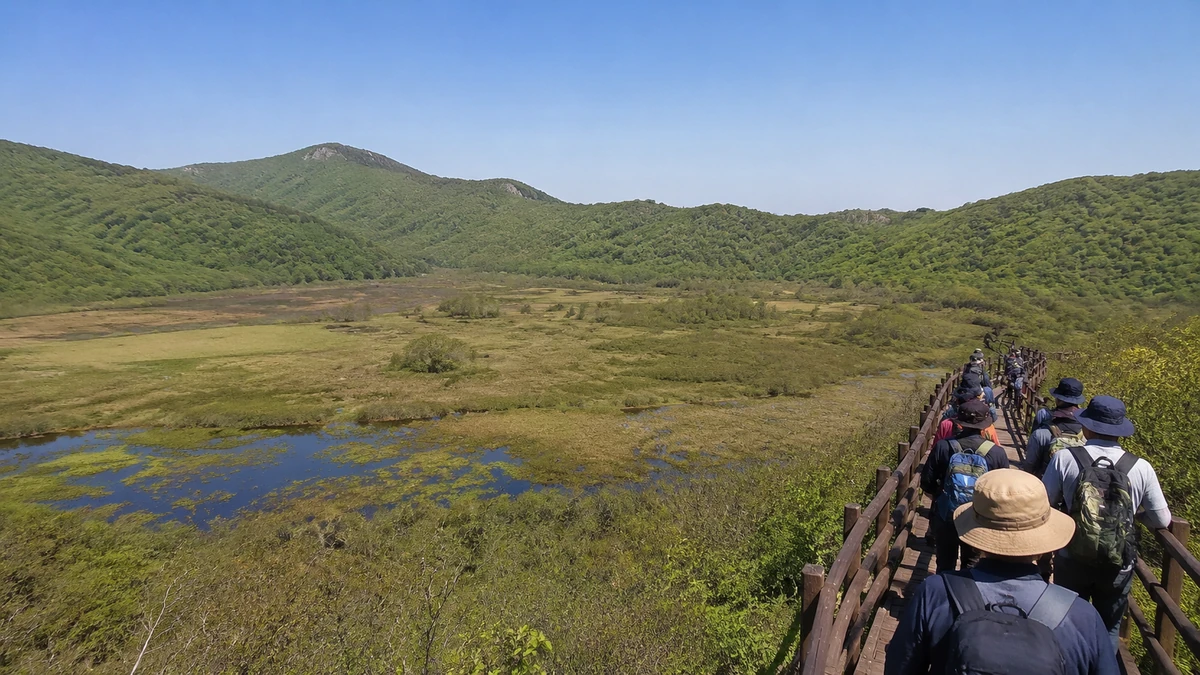
A rare landscape returns to public view
In a country better known abroad for its hypermodern cities, high-speed trains and globally dominant pop culture, a quiet decision in a mountain county east of Seoul is drawing attention for a very different reason: how to let people into a fragile natural treasure without loving it to death.
Officials in Inje County, in South Korea’s northeastern Gangwon region, have resumed guided ecological visits to Yongneup, a high-altitude wetland on Mount Daeam, beginning May 16 and continuing through Oct. 31. But there is an important condition attached. Access will be handled entirely through advance reservations — 100 percent, with no casual walk-ins.
On its face, the announcement sounds like routine seasonal tourism management, the kind of local government notice that might barely register outside the region. In reality, it points to a much bigger issue in South Korea: how a densely populated, heavily developed country manages the tension between public access and environmental protection when the place at stake is both exceptionally rare and ecologically vulnerable.
Yongneup is not simply another scenic hiking stop in a nation where mountain trails are woven deeply into everyday life. It is regarded as South Korea’s only high moor — a wetland formed at high elevation — and one believed to have taken shape roughly 4,000 to 4,500 years ago. It also carries major symbolic weight as the first Korean wetland registered under the Ramsar Convention, the international treaty focused on the conservation of wetlands.
That combination of rarity, age and international recognition makes this reopening more than a local leisure story. It is a test case in modern conservation: whether a place can remain public without becoming overrun, and whether “open” can still mean “protected.”
What makes Yongneup so unusual
To many American readers, the word “wetland” may call to mind familiar landscapes: the Florida Everglades, Louisiana bayous, marshes along the Atlantic flyway, or alpine meadows in parts of the Rockies. Yongneup is something else. Perched about 1,280 meters, or roughly 4,200 feet, above sea level, it occupies a mountaintop environment that is unusual on the Korean Peninsula.
The wetland’s Korean name is often translated as “Dragon Swamp,” though “neup” refers to a boggy or marshy landscape rather than a swamp in the American South sense. In Korean cultural imagination, dragons are not fire-breathing villains of medieval fantasy but powerful, auspicious beings associated with water, clouds and the natural world. The name therefore evokes both mystery and reverence, a fitting match for a place that seems suspended between mountain forest and prehistoric basin.
Scientists and conservation officials say the wetland formed over thousands of years, building up peat and waterlogged ecological layers slowly enough that each generation’s footprint matters. That timescale is part of what gives the site its moral force in public debate. A place that took four millennia to form can be damaged in a few seasons if visitation is poorly managed.
Its designation under the Ramsar Convention matters as well. For readers less familiar with that framework, Ramsar status is not just a ceremonial badge. It signals that a site meets internationally recognized standards of ecological importance, especially for biodiversity and hydrological value. In practical terms, it means the place is not simply a local park or county attraction. It is part of a global conversation about what kinds of landscapes should be preserved for the long term, even when public demand to see them is strong.
That helps explain why local officials are emphasizing not only that tours have resumed but how they will operate. The point is not to maximize foot traffic. It is to control it.
Why reservation-only access matters
The most revealing part of the Inje County announcement is not the reopening date. It is the operating philosophy behind the reservation rule.
South Korea is one of the most wired, organized and administratively structured societies in the world. Americans often encounter that through consumer-facing conveniences — same-day delivery, sophisticated public transit, digital services and seamless payments. But the same governing instinct also appears in environmental policy: if something is valuable and vulnerable, it is often managed through scheduling, quotas, permits and rules that make access legible to the state.
That is what the 100 percent advance reservation requirement does here. It transforms a visit from spontaneous recreation into supervised access. Officials can know who is coming, when they are coming, and in what numbers. That allows them to regulate congestion, reduce unpredictable surges in visitors and better limit cumulative ecological stress.
For visitors, especially those accustomed to the idea that nature should be freely available, the extra step may feel restrictive. But in conservation terms it is one of the most realistic tools available. You cannot protect what you cannot monitor, and you cannot manage carrying capacity if arrivals are essentially open-ended.
In the United States, there are parallels. Popular national parks have expanded timed-entry systems. Sensitive backcountry areas use permit lotteries. Certain caves, reefs and river corridors are accessible only with guides or limited daily numbers. Americans may grumble when a wilderness experience starts to resemble booking a concert ticket, but the logic is familiar: scarcity and fragility change the rules.
That appears to be the governing logic at Yongneup. The site is being presented not as untouched nature available to anyone at any time, but as public natural heritage that can be encountered only under conditions designed to keep it intact. In that sense, the reservation system is not a bureaucratic inconvenience attached to the wetland. It is the conservation strategy itself.
A Korean balancing act: access versus preservation
This issue resonates in South Korea because it sits at the intersection of several long-running national pressures. The country is geographically mountainous, highly urbanized and densely populated. Outdoor recreation is deeply ingrained in social life; hiking, in particular, is a major pastime across generations. On weekends, popular trails near cities can feel as crowded as shopping districts, complete with brightly colored hiking gear, snack stops and organized groups.
That culture of mountain access is part of what makes places like Yongneup so difficult to manage. When a scenic or meaningful site becomes widely known, demand can rise quickly. Social media only accelerates the cycle. A destination once cherished for remoteness can become famous for precisely that quality — and then lose it under the pressure of attention.
South Korea has confronted versions of this problem before. Fragile coastal ecosystems, island landscapes, forested peaks and temple-adjacent mountain routes have all faced the same question: How do you maintain public ownership in a practical sense while preventing public overuse?
The answer, increasingly, is selective openness. That means a place is not completely closed off, but neither is it treated as a limitless tourism asset. Instead, authorities set windows of access, require reservations, limit group sizes, designate trails and frame the experience as a managed ecological visit rather than free roaming.
Yongneup’s seasonal schedule through Oct. 31 fits that model. The finite operating period underscores that this is not a year-round attraction to be consumed at convenience. It is a carefully bounded encounter. Even the fact that the reopening is being publicly discussed as an issue of balance — not celebration alone — signals a broader shift in how natural heritage is being understood.
That shift is notable. In many fast-developing societies, the first instinct is to promote access as a marker of democratization: once a place is opened, more people can enjoy it, and that is treated as an unqualified good. What South Korea seems to be recognizing here is that public value can also require limitation. A natural site does not become less public because entry is controlled. In some cases, control is what prevents a nominally public place from being quietly degraded into a damaged one.
Why this story is bigger than one county in Gangwon
It would be easy to file this as a provincial story from a mountain county most foreign readers have never visited. But doing so would miss why it has wider significance.
Inje is not making a decision only for itself. When a local government manages a site described as the country’s only high moor and the first Korean wetland listed under Ramsar, it is effectively stewarding a national asset with international importance. The county may handle the logistics, but the implications stretch beyond local tourism or regional branding.
That creates a familiar tension for local officials anywhere in the world. Communities are often asked to do two contradictory things at once: attract more people and prevent more damage. One side of the public wants access, visibility and economic activity. Another wants strict preservation and minimal disturbance. In places of high ecological sensitivity, both demands can seem morally justified.
The reservation-only approach is a way of navigating that contradiction without pretending it has disappeared. It tells would-be visitors: yes, this place is meant to be seen, but not on whatever terms are most convenient. It tells conservation advocates: yes, the site is being opened, but only within a framework designed to keep limits in place.
That is why the reopening reads less like a tourism promotion than an administrative statement of values. The central message is not “come visit this beautiful spot.” It is “this place may be visited only through restraint.” That subtle difference matters.
It also reflects a broader global shift in environmental management. Around the world, governments are reconsidering the assumption that the best way to honor natural beauty is to maximize physical access to it. In fragile areas, unrestricted visitation can undermine the very qualities that made a place worth visiting. The challenge is to resist turning protection into exclusion while also resisting turning popularity into erosion.
Yongneup offers a compact example of that challenge in action.
What American readers should understand about Korean conservation culture
For Americans used to thinking about South Korea mainly through the lenses of geopolitics, technology or entertainment, this story offers another window into the country’s civic culture. It shows a society wrestling with environmental stewardship in ways that feel both distinctly Korean and broadly recognizable.
One distinctly Korean element is the cultural place of mountains. Korea’s terrain has helped shape settlement, religion, recreation and identity for centuries. Mountains are not merely background scenery. They are places for exercise, contemplation, ritual memory and seasonal escape. That means mountain landscapes tend to carry emotional and civic significance beyond their ecological characteristics alone.
Another element is South Korea’s experience with rapid industrialization and development after the Korean War. In a matter of decades, the country transformed itself economically at extraordinary speed. That growth brought prosperity and global influence, but it also intensified pressure on land and ecosystems. Against that backdrop, rare landscapes like Yongneup can come to symbolize not just biodiversity, but survival — evidence that some things have endured the velocity of modern life.
There is also the administrative style. South Korea often responds to shared public challenges with systems: reservation platforms, quotas, designated routes, layered signage and tightly defined rules. Critics can see that as overmanaged. Supporters see it as realistic governance in a country where demand for limited space is high. Either way, it is consistent with the decision to make Yongneup visits entirely pre-booked.
American readers may recognize their own debates in this story. The United States has its own arguments over overcrowded parks, permit systems, conservation funding and whether “public lands” should always mean relatively frictionless access. The details differ, but the underlying question is the same: Does public ownership guarantee physical availability, or does stewardship sometimes require rationing experience to protect the resource?
South Korea’s answer in this case is clear. Access remains public, but only under managed conditions. The wetland is not being fenced off forever. Nor is it being thrown open without guardrails. It is being treated as something that can be shared only carefully.
The deeper lesson in a small reopening
There is a temptation with environmental stories to look for drama — a wildfire, a flood, a species collapse, a legal battle. Yongneup’s reopening offers something quieter but no less important: a picture of conservation as daily governance. No grand speech, no international summit, no sweeping new law. Just a local decision about a rare place and the rules required to keep that place rare.
The numbers tell much of the story. A wetland at 1,280 meters. An ecological history stretching back roughly 4,000 to 4,500 years. A seasonal opening that ends Oct. 31. A reservation requirement covering every visitor. None of those figures is flashy. Together, they make a persuasive case for caution.
They also challenge a common assumption that opening nature is always inherently democratic while limiting access is inherently elitist. In some situations, especially with fragile landscapes, the opposite can be true over time. Unrestricted access can produce degradation that ultimately diminishes the place for everyone. Managed access can preserve the site so that it remains meaningful, rather than merely popular.
That seems to be the lesson Korean officials are trying to put into practice at Yongneup. The wetland can be seen, but it must first be scheduled. It can be appreciated, but not casually consumed. It belongs to the public, but the public meets it under rules.
For global readers, that is what makes this more than a local conservation note. In an era of overtourism, climate stress and shrinking ecological resilience, societies everywhere are being forced to reconsider what responsible access looks like. South Korea’s handling of Yongneup suggests one answer: the future of public nature may depend less on whether places are open or closed than on whether the terms of entry reflect the fragility of what lies beyond the gate.
Seen that way, the reopening of this mountain wetland is not just a seasonal announcement from a rural county. It is a small but telling statement about the values of a modern country trying to protect something ancient. And in a world where natural wonders are increasingly measured by how many people they can attract, Yongneup stands for a harder proposition: some of the most valuable places remain valuable only when access comes with limits.
Comments
Post a Comment