Fire at South Korean Petrochemical Plant Injures 3 Workers, Renewing Focus on Industrial Safety in Ulsan
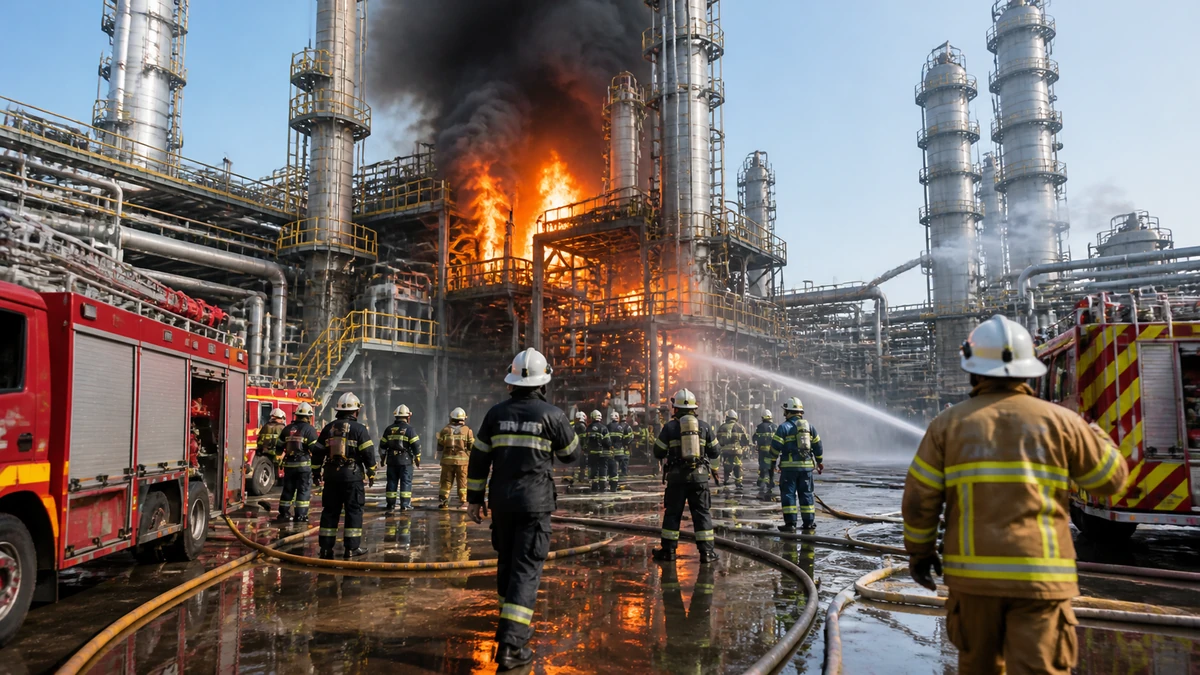
A factory fire in one of South Korea’s biggest industrial hubs
A fire at a petrochemical plant in Ulsan, South Korea, injured three workers Monday afternoon, underscoring how quickly routine industrial work can turn dangerous even when a blaze is contained before it becomes a major disaster.
According to South Korea’s Yonhap News Agency, the fire broke out at about 3:10 p.m. on May 4 at a petrochemical products manufacturing facility inside the Ulsan petrochemical industrial complex, a vast concentration of heavy industry in the country’s southeast. Officials said the fire started during the production process for polypropylene, or PP, a plastic resin used around the world in everyday consumer goods and industrial materials.
Three employees were hurt as workers nearby responded with fire extinguishers, Yonhap reported. One worker suffered second-degree burns, while two others sustained first-degree burns. The fire was put out at the scene and did not escalate into a large-scale explosion or broader industrial emergency, but the injuries illustrate a familiar truth in factory accidents: even when the worst-case scenario is avoided, the first moments of response can be perilous for the people closest to the danger.
For American readers, the setting matters almost as much as the incident itself. Ulsan is not just another city. It is one of South Korea’s signature industrial centers, often compared in importance to the kind of Gulf Coast manufacturing corridor that stretches through parts of Texas and Louisiana, where refining, chemicals and shipping are tightly woven into the local economy. When an accident happens in Ulsan, it resonates beyond a single company because the city plays an outsized role in the nation’s industrial output, exports and energy infrastructure.
That broader context helps explain why a relatively contained fire still draws attention. No deaths were reported. There was no indication of a massive blast, no evacuation on the scale seen in major refinery disasters, and no immediate sign of wider damage to the surrounding complex. Yet three workers were burned in the process of trying to stop a fire in a high-risk manufacturing environment. That fact alone raises questions that extend well beyond one afternoon’s emergency.
Why polypropylene matters far beyond the factory floor
The material involved in the production process, polypropylene, may sound technical or obscure to readers outside the chemical industry, but it is deeply embedded in ordinary life. PP is one of the world’s most widely used plastics. It can be found in food containers, automotive parts, medical supplies, packaging, textiles, household goods and countless other products. In practical terms, that means a fire in a polypropylene production line is not some niche industrial event detached from daily life; it is a disruption in the chain that helps make modern consumer life possible.
Petrochemicals occupy an unusual place in the modern economy. They are essential enough to be everywhere and invisible enough that most consumers rarely think about them. Americans encounter the end products constantly, from takeout lids and reusable storage bins to car interiors and shipping materials, but seldom see the industrial processes that create them. When those processes go wrong, even briefly, they offer a rare glimpse into the physical risks behind the convenience of mass production.
That is part of what makes the Ulsan fire significant. The incident took place not at the margins of the economy, but inside a sector that forms the backbone of manufacturing supply chains. South Korea, like the United States, depends on large-scale industrial operations to support both domestic consumption and exports. Ulsan in particular is known for shipbuilding, automobiles, refining and petrochemicals, making it central to the country’s image as an export-driven manufacturing power.
In the American context, one way to understand Ulsan is to think of it as a city where heavy industry is not a side feature but an organizing principle. The factories, ports and processing plants are part of the civic identity. That means industrial safety is never just a matter for plant managers and regulators. It is also a community issue, a labor issue and, often, a national political issue.
Even small fires in these settings can be meaningful because they expose where risk lives: not only in dramatic explosions or environmental catastrophes, but in the split-second decisions workers make when something catches fire in the middle of normal operations. Monday’s accident appears to fit that pattern. The known facts remain limited, but the outline is clear: the fire began during production, workers moved quickly to extinguish it, and people were hurt in the process.
The danger of first response inside industrial workplaces
One of the most striking details in the initial reporting is that the fire was extinguished by employees at the scene using fire extinguishers, rather than becoming a prolonged emergency requiring a lengthy outside firefighting operation. On one level, that sounds like a success story. Quick action appears to have prevented the blaze from spreading. On another level, it highlights the burden placed on workers in hazardous environments, where the line between emergency control and personal injury can be vanishingly thin.
Yonhap reported that sparks flew during the response, leading to the workers’ injuries. That detail matters. In public discussions of industrial accidents, attention often focuses on the ignition itself: what failed, what caught fire, what triggered the incident. But the response phase can be just as dangerous. Workers are often the first to detect abnormal heat, smoke or flame. They are also the first to make judgment calls under pressure, sometimes before emergency crews arrive. In facilities handling combustible materials, those moments can determine whether a problem remains localized or spirals into something much worse.
In the United States, similar debates have long surrounded refinery and chemical plant safety, especially in industrial corridors where accidents may be contained quickly but still expose workers to burns, toxic materials or long-term trauma. A contained incident does not necessarily mean a minor one for the people who were standing only a few feet away. Burns, even those medically classified as first- or second-degree, can carry significant pain, recovery time and emotional stress.
That point can get lost when injury descriptions are reduced to a few clinical words. First-degree burns generally affect the outer layer of skin, while second-degree burns can damage deeper layers and may require more extensive treatment. Neither category should be dismissed casually. To readers scanning headlines, the absence of fatalities may suggest a near miss with limited human cost. But for workers and their families, even “non-fatal” industrial injuries can be serious life events, affecting work, income and long-term well-being.
The incident also serves as a reminder that workplace safety is not solely about whether a facility has rules on paper. It is about how hazards unfold in real time and who absorbs the risk when those hazards break through normal controls. A fire extinguisher within reach is important. So is worker training. So is process design. So is the ability to identify and isolate danger before people are exposed. When injuries occur during initial suppression, it inevitably raises questions about how those layers functioned in practice, even if it is too early to draw conclusions about fault.
Ulsan’s role in South Korea helps explain the broader attention
To understand why this incident carries weight in South Korea, it helps to understand Ulsan’s place in the national imagination. The city has long been associated with the country’s industrial rise, much as Detroit once symbolized American car manufacturing or Houston became shorthand for energy and petrochemicals. Ulsan is home to major automotive plants, shipbuilding operations and chemical facilities. Its industrial complexes helped power South Korea’s rapid economic transformation in the late 20th century.
That success story, however, has always had a human dimension. Behind the image of industrial efficiency are workers laboring in settings where heat, pressure, volatile substances and complex machinery are part of everyday life. In South Korea, as in the United States, industrial accidents often spark a larger public conversation about whether productivity pressures, subcontracting structures, training gaps or weak enforcement leave workers too exposed.
There is not enough verified information in the current reporting to say whether any of those factors played a role in Monday’s fire. What can be said is more limited and more direct: the accident occurred in the middle of an ordinary production process in a major industrial complex, and the people injured were workers on site. That alone is enough to make the event socially significant.
South Korea has spent years confronting public anger over workplace deaths and injuries, particularly in construction, shipping, logistics and heavy industry. Cases involving factory accidents often carry emotional weight because they are seen not as isolated bad luck, but as tests of how seriously a modern economy values the people who keep it running. This is especially true in sectors like petrochemicals, where the gap between sleek consumer products and the hazardous conditions of production can feel stark.
For American audiences, there is also a useful cultural point of reference here. South Korea is often presented abroad through the lens of pop culture, technology and lifestyle exports: K-pop, Korean dramas, beauty products, smartphones and cars. Those industries and brands are real, but they rest in part on older foundations of heavy manufacturing and industrial infrastructure. Stories like the Ulsan fire pull that less visible side of the country into view.
In that sense, the accident is a reminder that the Korean Wave and South Korea’s global cultural presence exist alongside a powerful industrial economy that still depends on dangerous physical labor. The same country known internationally for polished entertainment exports is also a country of shipyards, refineries and factory complexes where workplace safety remains a live and sometimes urgent issue.
A contained fire can still reveal deeper vulnerabilities
One of the recurring patterns in coverage of industrial accidents, in South Korea and elsewhere, is that incidents are often sorted too neatly into two categories: disasters and non-disasters. If an explosion levels a site, kills workers or triggers a major evacuation, it becomes national breaking news. If a fire is extinguished quickly and does not spread, it can be treated as an event that ended almost as soon as it began. But that binary can obscure what smaller incidents reveal.
The Ulsan fire appears to be a case in point. It did not become a mass-casualty event. Yet the known sequence of events still matters. The fire began during an active production process. Nearby employees responded immediately. Sparks flew during suppression. Three workers were burned. That compressed chain of events says something important about the fragility of safety in high-risk industrial environments: the difference between “contained” and “catastrophic” may be measured in minutes, equipment placement, worker proximity and sheer luck.
For that reason, a contained fire should not automatically be read as a reassuring ending. It is more accurate to see it as a warning with a smaller radius. The underlying question is not only whether a major disaster was avoided, but how danger moved through the workplace in the first place and why workers had to confront it so directly.
There is also a broader labor dimension worth noting. In many industrial societies, including South Korea and the United States, frontline workers often bear the immediate physical consequences of operational failures while the public mostly notices only when disruption becomes dramatic enough to affect markets, neighborhoods or national headlines. Smaller incidents can disappear quickly from public memory even though they may expose the everyday risks that make larger disasters possible.
That is why cases like this can resonate beyond their scale. They force attention back onto the physical realities of work: protective gear, emergency procedures, staffing, training, equipment maintenance and the split-second pressures of decision-making in a hazardous environment. Those realities rarely make headlines during normal operations, but they become impossible to ignore when someone gets burned putting out a fire.
What is known, what is not, and what comes next
At this stage, the verified facts remain relatively narrow. The fire broke out at about 3:10 p.m. in a petrochemical product manufacturing plant in Ulsan’s Nam district industrial complex. It began during the polypropylene production process. Nearby workers used fire extinguishers to put it out. Sparks during that response led to burn injuries affecting three employees, one more seriously than the others. No large-scale disaster was reported.
What has not yet been established publicly, based on the summary of the Korean reporting, is the precise cause of ignition, whether there were equipment failures, whether operations at the facility were suspended, whether labor or safety authorities have opened a formal investigation, or whether any regulatory violations are suspected. Without those details, it would be premature to assign blame or draw sweeping conclusions about this specific plant.
Still, the absence of a full investigative picture does not reduce the significance of the basic facts already confirmed. Industrial safety often comes down to mundane but decisive questions: Where did the fire start? Who saw it first? How quickly could suppression begin? How close were workers to the ignition point? What barriers stood between a small flame and human injury? Those details matter not only to investigators but to the public because they reveal how risk is managed in the spaces that sustain modern economies.
In journalism, there is a temptation to treat near misses as less meaningful than outright tragedy. But near misses are often where the most useful warnings reside. They show what happened before the headline became unthinkable. In Ulsan, three workers were injured before the incident could become something worse. That does not make the story smaller. If anything, it sharpens it.
For South Korea, the fire is another reminder that industrial safety remains a pressing issue even in a technologically advanced economy. For international readers, it is a case study in how the infrastructure behind global manufacturing still depends on workers making dangerous judgments in real time. And for Americans used to their own history of refinery, warehouse and factory accidents, the story feels familiar in an unsettling way. The location is South Korea, but the underlying question is universal: when industry runs into trouble, who stands closest to the flames?
The answer, too often, is the worker on the floor.
Comments
Post a Comment