A city walked its history again
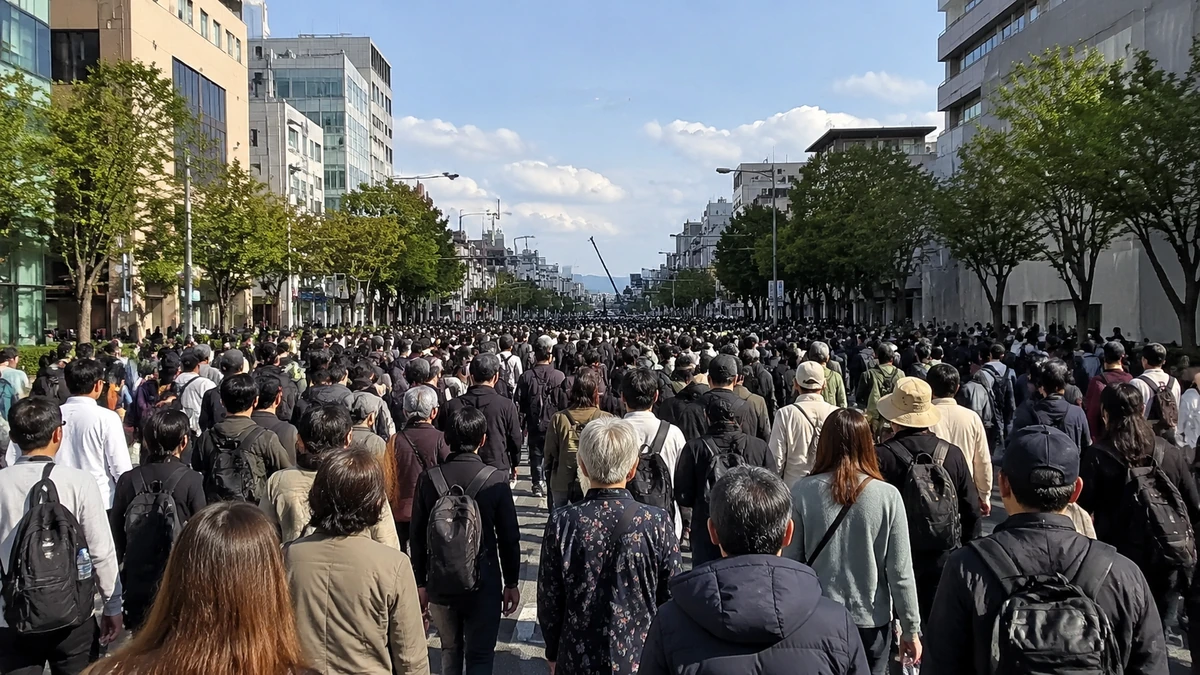
Two days before South Korea marks the 46th anniversary of the Gwangju Uprising, about 2,000 people took to the streets of Gwangju on May 16 for what organizers called a Democracy and Peace March, a public commemoration that was as much about the present as the past. According to South Korea’s Yonhap News Agency, the march began around 4 p.m. at Gwangju Station Square and moved roughly 2.3 kilometers through the city center toward Geumnam-ro 4-ga, one of the most symbolically charged stretches of road in modern Korean history.
For many Americans, the scene may be easiest to understand not as a parade and not simply as a memorial service, but as something closer to a civil rights remembrance walk layered onto the exact geography where the original struggle unfolded. The route mattered. The chants mattered. The fact that students, older residents and public figures walked together mattered. In Gwangju, memory is not treated as a museum artifact. It is practiced out loud, in public, on the pavement.
Participants repeated slogans including “Let’s go to the provincial office!” and “Put the spirit of May into the Constitution!” Those phrases carried a weight that extends far beyond the afternoon’s march. They invoked the democratic resistance of May 1980, when citizens in Gwangju rose up against military rule in one of the defining episodes of South Korea’s modern political history. To hear those words again in the same city, on the same streets, was to see how South Koreans continue to revisit a painful national chapter not only through official ceremony, but through collective movement and civic participation.
The result was a kind of living public memory. People were not merely observing history; they were stepping into it. As the front of the march reached Geumnam-ro 4-ga, residents lining both sides of the road responded with applause and cheers. That detail is easy to miss, but it reveals something important about Gwangju’s political culture. The crowd was not neatly divided between participants and audience. The city itself became the stage, and the people watching were also, in a sense, part of the act of remembrance.
That dynamic helps explain why events like this continue to resonate in South Korea. The anniversary of the Gwangju Uprising is not only about mourning those who died. It is also about asking what a democratic society owes its past, and how those obligations should appear in everyday civic life. In Gwangju on Friday, the answer was visible in the simple act of walking together.
Why Gwangju still matters in South Korea
To readers outside Korea, especially in the United States, Gwangju may not immediately carry the same emotional recognition as Selma, Kent State or Tiananmen Square. But within South Korea, it occupies a central place in the nation’s democratic narrative. In May 1980, amid a period of military control and political repression, citizens in Gwangju protested martial law and demanded democracy. The ensuing crackdown by government forces left deep trauma and, eventually, helped reshape the country’s understanding of state violence, civic courage and democratic legitimacy.
South Korea today is a vibrant democracy, an economic powerhouse and a global cultural exporter known to many Americans through K-pop, Korean film, television dramas and technology brands. But beneath that modern image is a relatively recent and hard-won history of democratization. The freedoms South Koreans now exercise in the streets, at the ballot box and in the press were not inevitable. They were fought for, and Gwangju is one of the places where that fight became impossible to ignore.
That is why the city’s name functions as more than a location. It has become a moral and political shorthand. To invoke Gwangju is to invoke sacrifice, resistance and an unfinished debate over how the state should remember those who stood against authoritarian power. The annual observances tied to May 18 therefore operate on more than one level: They honor the dead, educate younger generations and remind the broader public that democracy can be fragile even in countries that now appear stable.
Friday’s march reflected that layered meaning. It was held in Gwangju’s Dong District on Geumnam-ro, a major downtown boulevard that has long been associated with the uprising. That physical setting is essential to understanding the event. In many countries, historic memory is contained in textbooks or on plaques. In Gwangju, it is attached to blocks, intersections and public buildings. Walking those spaces is a way of refusing abstraction. It insists that history happened here, among ordinary storefronts and traffic lanes, and that citizens still have a claim on those streets.
For an American audience, there is a familiar logic in that. Places like the Edmund Pettus Bridge in Alabama or the National Mall in Washington are not just coordinates on a map. They are stages where democratic conflict became visible. Geumnam-ro carries a comparable significance in South Korea. Each return to that road renews the argument that memory belongs not just to historians or politicians, but to the public.
More than remembrance: a public lesson in democracy
What stood out most about the Gwangju march was that it was participatory. This was not a closed-door ceremony for dignitaries, nor a purely ceremonial wreath-laying event. It was a citizen-centered gathering that recreated, in contemporary form, the energy of the street demonstrations of May 1980. Yonhap described it as a reenactment of the marches in which people once cried out for democracy. That matters because reenactment, in this context, is not theatrical nostalgia. It is a civic method.
Democratic societies often struggle with how to remember moments of political trauma once the immediate generation of witnesses begins to age. Over time, events can flatten into ritual, their urgency softened by familiarity. Gwangju suggests another model. By returning to the route, the slogans and the act of collective walking, participants transform memory into an experience rather than an assignment. Younger people do not simply hear that something important happened. They move through the city in ways that make the past legible in the present.
That helps explain the significance of the crowd itself. The roughly 2,000 participants included students, local residents and figures from different sectors of society. The breadth of participation sent a clear message: The legacy of May 18 does not belong to one political faction, one age group or one grieving circle. It is treated as a democratic inheritance. Students represented generational continuity; ordinary residents embodied the local ownership of memory; public figures signaled that the event retains national relevance.
Even the chants served as a kind of civic instruction. “Let’s go to the provincial office!” was not merely a practical cue about direction. It echoed the routes and calls of earlier demonstrators, reconnecting bodies in the present to the symbolic map of the past. In a society where rapid modernization can sometimes outpace historical reflection, such acts pull memory back into common space. They remind participants that democracy is not just a constitutional arrangement or a set of election results. It is something people do together, including in how they remember.
The march also broadened the meaning of commemoration. In many countries, memorial culture can become solemn to the point of distance, as if respect requires passivity. Gwangju’s model is different. It allows grief, political language, youth participation and community response to occupy the same event. In doing so, it rejects the idea that the past is safest when it is quiet. Instead, it suggests that democratic memory must remain audible if it is to remain meaningful.
The power of a slogan: “Put the spirit of May into the Constitution”
Among the slogans heard Friday, one stood out for its directness: “Put the spirit of May into the Constitution!” To outsiders, the phrase may sound broad or ceremonial. In South Korea, however, it carries a pointed political and moral appeal. “The spirit of May” refers to the values associated with the Gwangju Uprising: resistance to authoritarian rule, solidarity among citizens, respect for human dignity and a belief that democratic legitimacy comes from the people.
Calling for that spirit to be reflected in the Constitution is not simply an act of tribute. It is a demand that the state’s highest legal and symbolic framework more clearly acknowledge the democratic lessons of Gwangju. In other words, participants were not asking only that the uprising be remembered; they were insisting that its meaning be embedded in the country’s governing principles. Memory, in this view, should shape institutions, not merely ceremonies.
This is an important distinction for American readers, because it reveals how South Korea’s debates over historical memory remain tied to current politics. In the United States, arguments over how to teach slavery, commemorate the civil rights movement or interpret the Constitution itself often become proxy battles over national identity. South Korea’s argument over the “spirit of May” functions in a similar way. It asks whether democratic sacrifice should be treated as inspirational background material or as a living standard against which the nation judges itself.
That is one reason the march carried more than local importance. The event showed that, 46 years after the uprising, Gwangju is still not frozen in the past. Its memory continues to make claims on the present. People are still arguing over what the state should affirm, what younger generations should inherit and what democracy demands from those who benefit from it today.
The slogan also underscored a broader truth: remembrance can be future-oriented. Commemorations are often portrayed as backward-looking by definition. But in Gwangju, the act of remembering is also a way of setting civic expectations. To say that the spirit of May belongs in the Constitution is to say that the sacrifices of 1980 should inform the moral direction of contemporary South Korea. It is remembrance not as nostalgia, but as a public standard.
Rice balls, applause and the language of community
Some of the most revealing moments from Friday’s event were not speeches or chants, but gestures. Students who took part in a related civic festival on Geumnam-ro handed out homemade rice balls to marchers, according to the Korean account. To an American reader, that may seem like a small detail, almost incidental next to the historical stakes of the day. In Gwangju’s memory culture, it is anything but minor.
The rice ball, or jumeokbap in Korean, carries a special association with the communal spirit remembered from May 1980. It evokes a time when ordinary people supported one another with food, labor and care under extreme pressure. Food is one of the most basic forms of solidarity in any society, and in moments of crisis it often becomes a shorthand for moral community. In the United States, people might think of church kitchens after disasters, volunteer sandwiches handed out at protest encampments, or neighbors feeding neighbors after a storm. In Gwangju, the sharing of rice balls taps into a similar emotional register.
What matters is not just the food itself, but the physicality of it. Someone made it by hand. Someone passed it from one person to another. In a commemoration centered on historical memory, that act collapses time. It connects today’s students to a tradition of mutual aid associated with the uprising, turning inherited history into something tactile. The past is not only spoken; it is held, shaped and offered.
The applause from bystanders served a comparable function. Clapping may be brief, but it is one of the clearest forms of public consent. As marchers approached Geumnam-ro 4-ga, residents on both sides of the street answered with cheers and applause, effectively joining the event without formally entering the procession. That response suggested a communal ownership of the memory being invoked. The city was not indifferent. It answered back.
Taken together, the rice balls and the applause showed how democratic remembrance can extend beyond formal political expression. Not everyone gives a speech. Not everyone leads a chant. But many people participate through smaller acts of recognition and support. Those acts matter because they reveal how a city internalizes its own history. In Gwangju, memory appears to function less as an annual obligation than as a shared language of belonging.
Why this anniversary speaks beyond South Korea
The timing of the event is part of its significance. The march took place two days before the formal May 18 anniversary, creating a wider arc of public attention rather than confining remembrance to a single date on the calendar. That structure reflects a sophisticated understanding of public memory: important histories are not sustained by one ceremony alone. They are reinforced through repeated acts, across days and across generations.
The number itself, 46, also tells a story. Nearly half a century has passed since the Gwangju Uprising. In many countries, that much time would be enough to turn a democratic struggle into a chapter studied mainly by specialists or recalled only in official rhetoric. But Friday’s event suggested that in South Korea, at least in Gwangju, time has not dissolved the urgency of the memory. If anything, it has refined the methods by which the story is passed on.
That should catch the attention of global readers at a moment when democratic institutions are under pressure in many parts of the world. One of the recurring challenges facing democracies is historical fatigue: the tendency to assume that once rights are won, the stories behind them can recede. Gwangju offers a counterexample. It shows what it looks like when a society decides that democratic memory requires maintenance, visibility and public ritual.
There is also a broader lesson here about national narratives. South Korea is often discussed abroad through the lenses of security threats, semiconductor supply chains, pop culture exports and geopolitical competition. All of those frameworks matter. But they can obscure the civic traditions that help explain the country’s political resilience. The scenes in Gwangju on Friday pointed to one such tradition: a willingness to publicly rehearse the origins of democratic legitimacy, even decades later.
For Americans, that may feel unexpectedly familiar. The United States also lives amid unresolved debates over how its history should be remembered, whose sacrifices are centered and which ideals deserve renewed public commitment. That is one reason the Gwangju march resonates beyond Korea. It raises a question that many democracies face: Is freedom something a society celebrates once, or something it must keep learning how to recognize?
In Gwangju, the answer on Friday was clear. A city gathered on one of its most historic roads. Roughly 2,000 people walked a route weighted with memory. They chanted not only about the past, but about the values they believe should shape the future. Students handed out food by hand. Bystanders clapped from the sidewalks. And a tragedy that could have been left to textbooks was instead carried forward in the most public way possible: through the voices, footsteps and shared attention of citizens.
That is why the march mattered. It was not simply a lead-up event before an anniversary. It was evidence that in South Korea, the memory of Gwangju remains active, contested and communal. It was a demonstration that democratic remembrance, when done well, does not shrink with repetition. It gains depth. And in a time when many societies are asking how to preserve civic values across generations, the streets of Gwangju offered one answer: Walk the history together, and keep it in the language of the living.
Comments
Post a Comment