In a Storm-Soaked Semifinal, a Rare North-South Korean Women’s Soccer Match Delivered Drama, Heartbreak and a Glimpse of the Sport’s Future
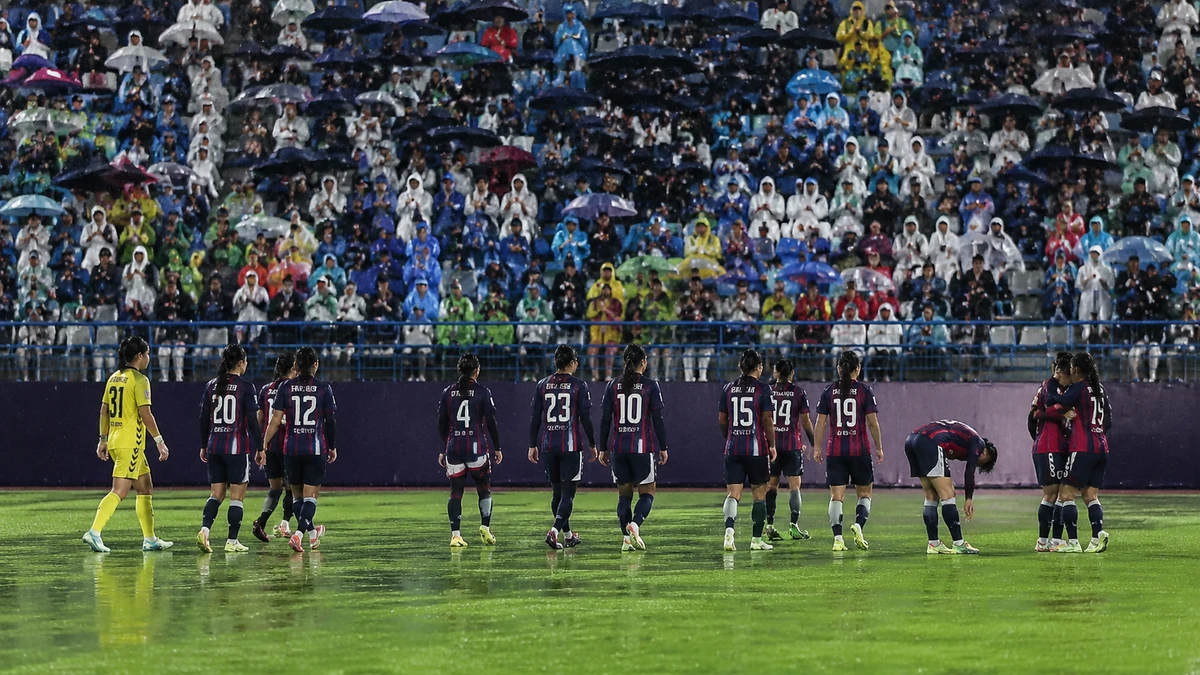
A semifinal that was about far more than a place in the final
On paper, it was a continental club semifinal: Suwon FC Women of South Korea against Naegohyang Women’s Football Club of North Korea in the 2025-26 Asian Football Confederation Women’s Champions League. In reality, it was one of those nights when sports took on a meaning bigger than the scoreboard.
Before a sellout crowd of roughly 5,700 at Suwon Sports Complex on May 20, Suwon FC Women lost 2-1 after taking the lead, a painful result that ended the South Korean club’s run one win short of the final. But the match carried a weight that is difficult to explain without understanding the Korean Peninsula, where division is not just a political fact but a living reality that touches culture, family history and national identity.
For American readers, the closest comparison might be a rivalry game layered with the symbolism of a diplomatic summit. North and South Korea remain technically at war, separated since the 1950-53 Korean War by an armistice rather than a peace treaty. Direct sporting meetings between the two sides do happen, but they are infrequent and heavily symbolic. In women’s soccer, this was the first North-South matchup held in South Korea in 12 years, dating back to the 2014 Asian Games in Incheon.
That fact alone made this event a national story in South Korea. Then came the weather: driving rain, whipping wind and a field slick enough to make every touch uncertain. Instead of thinning the crowd or dulling the spectacle, the conditions sharpened it. Fans stayed. Players pushed through. Every mistake seemed magnified; every good sequence felt earned.
And then there was the game itself. Suwon created chances, hit the woodwork, broke through early in the second half and appeared, briefly, to be on the verge of a signature victory. But Naegohyang responded quickly, equalized through a set piece and capitalized on a South Korean mistake to complete the comeback. Late, Suwon star Ji So-yun missed a penalty that could have leveled the match, a cruel twist in a game already thick with emotion.
When it was over, North Korea’s club side advanced and Suwon’s players were left with tears, apologies and what-ifs. Yet even in defeat, the evening revealed something important: women’s soccer in South Korea is drawing a bigger stage, a deeper emotional investment and a broader public audience than it has in years past.
Why a North-South game still matters so deeply
To understand why this match resonated beyond soccer, it helps to understand the way inter-Korean events are viewed in South Korea. Every encounter between the North and the South is filtered through history. Some fans come with hopes for reconciliation. Others come with caution, skepticism or curiosity. Many bring family memories. The Korean War split millions of families, and although decades have passed, the division remains personal for many Koreans, especially older generations.
That history was visible in the stands. Reports from the stadium said a jointly organized cheering section included both a 96-year-old former long-term political prisoner who was never converted from pro-North beliefs and relatives of North Korean defectors. To an American audience, that combination may sound almost impossible: people shaped by sharply different experiences of the peninsula gathered in the same section, reacting to the same match. Yet that is exactly what made the scene so striking.
Even the cheering captured the complexity of the moment. Supporters in the joint cheering section reportedly chanted mostly for Naegohyang, whose name roughly translates to “my hometown,” a phrase loaded with emotional undertones in Korean because it evokes roots, displacement and memory. But they also applauded Suwon’s dangerous moments. It was not the kind of all-or-nothing partisanship Americans might associate with, say, an NFL rivalry. It was more layered, more reflective of the moment’s symbolism.
For South Korea, the game also arrived at a time when women’s soccer has been slowly but steadily expanding its foothold. The sport still does not command the mainstream commercial power of men’s baseball or soccer, and it remains far from the media ecosystem surrounding elite women’s sports in the United States, such as the WNBA or the National Women’s Soccer League. But interest has grown, particularly when national-team stars or unusually meaningful matchups are involved.
That helps explain why tickets sold out within 12 hours, the first sellout in Suwon FC Women’s history. Certainly, the rarity of a North-South meeting fueled demand. But it would be too simple to dismiss the turnout as mere political curiosity. Fans sat through miserable conditions for a women’s club match because they cared about what was happening on the field. That matters.
In sports, there are novelty events that create a one-night spike in attention. Then there are nights that expose a deeper appetite already waiting beneath the surface. This one looked much more like the latter.
Suwon had the better start, but soccer can turn fast
If the result suggests a one-sided comeback, the game itself told a different story. Suwon FC Women were not overmatched. In the first half, they often looked like the more dangerous side, repeatedly putting Naegohyang under pressure and generating chances that might have changed the night entirely if finished more cleanly.
Several Suwon efforts either struck the post or were turned away by the North Korean goalkeeper. In poor weather, that kind of wastefulness can be especially dangerous. Soccer is a sport that rarely gives teams perfect control even on dry surfaces. Add heavy rain and wind, and the margin between dominance and regret becomes even smaller. The ball skids. Crosses drift. Defenders slip. Goalkeepers misjudge flight. A match can feel stable one minute and chaotic the next.
Still, Suwon’s strong opening had meaning. It showed a South Korean club side prepared for the occasion and able to impose itself, at least for long stretches, against a North Korean opponent that eventually proved more ruthless. For a club carrying the expectations of a home crowd and the emotional burden of the occasion, that mattered.
Then, four minutes into the second half, came what seemed like the breakthrough Suwon had earned. Haruhi scored to put the home side ahead 1-0, and the stadium, already emotionally charged, surged. This is the moment every home team in a high-stakes game chases: the release, the roar, the sense that all the pressure has finally turned into something tangible.
For a few minutes, it looked like Suwon might ride that energy into the final. But big matches often reveal a brutal truth: the moments just after a goal can be the most dangerous of all. Teams lose shape. Adrenaline distorts decision-making. The side that has just scored may relax slightly, while the side that conceded suddenly becomes urgent and direct.
That is exactly where the game began to tilt. Naegohyang did not fold. Instead, the North Korean side answered with the kind of clear-headed reaction that separates survivors from nearly teams in knockout soccer.
Naegohyang’s response showed poise, discipline and opportunism
According to accounts of the match, Naegohyang spent much of the first half chasing play. But after conceding, the North Korean club found another level. About 10 minutes into the second half, Ri Yu-jong delivered a dangerous left-footed free kick, and Choe Kum-ok met it with a header for the equalizer.
In one sense, it was just a set piece goal. In another, it was the emotional hinge of the night.
On a rainy field, dead-ball situations can become even more decisive than usual. The defense cannot rely on perfect footing. The goalkeeper must deal with a slippery ball and bodies crashing through the box. Delivery matters, but so does nerve. Naegohyang used the moment expertly. The equalizer did more than level the score; it shifted the mental balance of the match.
Suddenly Suwon, which had spent so much energy building and protecting its lead, was carrying the stress. The crowd that had lifted the home side now felt the tension too. In knockout soccer, that tension can be contagious. A team starts hurrying. Possession gets less composed. Small errors multiply.
Then came the decisive blow in the 67th minute, when Naegohyang punished a costly Suwon mistake to go ahead 2-1. That sequence spoke to a quality often associated with North Korean teams across several women’s sports: concentration under pressure and a willingness to exploit lapses immediately. Whether because of training culture, tactical discipline or simple game management, the North Korean side was sharper when the match became unstable.
Afterward, Naegohyang coach Ri Yu-il described it as an intense game and praised his players’ concentration in difficult weather and an away environment. That reads as standard coach talk on the surface, but it also rings true. Naegohyang did not dominate the entire evening. It endured, adjusted and then finished the moments that mattered most.
That is often how tournament soccer works. The better team for 90 minutes is not always the team that advances. Sometimes the winner is the one that handles the worst five-minute stretch better than the other side. In Suwon, Naegohyang owned those minutes.
Ji So-yun’s missed penalty became the most painful image, but not the whole story
No single moment from the match is likely to linger more painfully for South Korean fans than Ji So-yun’s penalty miss in the 79th minute.
Trailing 2-1, Suwon earned the chance every trailing team hopes for: a penalty with enough time left to rescue the game. The taker was not a fringe player or an untested reserve. It was Ji, one of the most accomplished figures in South Korean women’s soccer, a veteran midfielder whose career has included major success abroad and a stature that makes her one of the faces of the sport in Korea.
For American readers unfamiliar with Ji, think of her as the kind of player whose name carries immediate recognition among serious soccer fans and whose résumé gives supporters confidence in a pressure moment. When she stepped up, the stage felt almost too perfectly set. Instead, she sent the shot wide of the left post after wrong-footing the goalkeeper.
It was a brutal miss because of what it represented: not just a lost scoring chance, but perhaps Suwon’s last clear opening to change the outcome of a game already slipping away. After the match, Ji reportedly did not dodge responsibility. She said she felt a great deal of accountability for failing to convert and apologized that so many fans had come only to leave without the result they wanted.
That response is worth noting. In South Korean sports culture, public expressions of responsibility and apology after high-profile defeats are common, especially from veteran athletes and coaches. To Americans, that may sometimes sound unusually severe or formal. In Korea, it is often read as sincerity, leadership and an acknowledgment of the bond between team and supporters. Ji’s reaction fit that pattern.
But turning the entire match into a morality play about one missed penalty would oversimplify what happened. Suwon’s loss began earlier: first-half chances that did not go in, the inability to steady the game after taking the lead and the defensive breakdown that produced the winner. Penalties are dramatic because they isolate pressure into one touch. Yet they usually sit atop a stack of earlier moments that made that kick necessary in the first place.
In that sense, Ji’s miss was the sharpest pain, not the sole cause. It condensed the night’s disappointment into one image, but it did not define the whole performance.
The tears afterward said as much about the moment as the score did
After the final whistle, Suwon coach Park Gil-young reportedly grew emotional, his eyes reddening as he apologized to fans who had come out in terrible weather. He said the result was disappointing but that his players had done their best. It was a short statement, but one that captured the particular cruelty of this defeat.
Home crowd. Historic occasion. Early control. First goal. Then collapse.
Those are the kinds of losses that stay with a team because they feel both close and irreversible. For coaches, they can be even harder to process in public. South Korean sports culture places heavy emphasis on collective effort, emotional restraint and gratitude toward supporters. When those values meet a painful result in a nationally watched setting, postgame comments often carry an intensity that American audiences might more commonly associate with college sports in a football-mad region or a World Series elimination game.
What both coaches acknowledged, in different ways, was the toll of the conditions. This was not a routine night. Wind and rain altered the tempo, the surface and the players’ decision-making. Fans were soaked. Energy drained faster. Communication became harder. That shared recognition from both benches underscored how physical and emotionally expensive the match had been.
There is also something telling about the way the evening was framed in South Korea afterward. Yes, the defeat hurt. Yes, a final was lost. But there was also broad attention on the atmosphere, the attendance and the emotional texture of the game. In other words, the story did not end with elimination. The event itself had already proven something.
In many sports markets, women’s teams are often asked to demonstrate not just competitive quality but also commercial viability, drawing power and public resonance. It is an unfair burden, but a familiar one. On this night, Suwon FC Women and Naegohyang met that test. The match gripped people, and not only because of politics.
What this night revealed about women’s soccer in South Korea
The most lasting takeaway may be what the crowd in Suwon suggested about the trajectory of women’s soccer in South Korea.
For years, Korean women’s soccer has lived in a strange space: respected, occasionally celebrated, but not always fully centered in the national sports conversation. Star players such as Ji So-yun have earned admiration, and the national team has produced meaningful moments, yet domestic women’s club soccer has often struggled for the kind of broad, sustained attention that turns fans into repeat customers and single games into weekly habits.
That is not unique to South Korea. Women’s sports around the world have often faced a chicken-and-egg problem: limited exposure leads to limited investment, which in turn limits the product’s reach. In the United States, recent years have shown how quickly that equation can change when leagues, broadcasters and fans commit more seriously. The rise in visibility around women’s basketball and soccer in America has offered one example of how audience demand can accelerate once the ecosystem catches up.
South Korea is not the United States, and its sports landscape has its own hierarchy and business model. Baseball remains deeply entrenched. Men’s soccer commands larger routine attention. But the sellout in Suwon, the emotional investment in a club semifinal and the willingness of fans to endure a cold, rain-lashed night all suggest a market that is more responsive than old assumptions might indicate.
It would be naive to claim that one match changes everything. The North-South dimension undeniably made this event exceptional. Remove that element, and perhaps the crowd is smaller and the national spotlight dimmer. But even that argument proves only part of the point. Major sports grow when they capitalize on big moments, convert first-time viewers and show casual fans that the product itself is worth returning for.
By that standard, the players did their part. The match was tense, technically interesting, emotionally charged and deeply competitive. It had a comeback, a high-profile missed penalty, difficult weather, coaches overcome with emotion and a crowd invested from start to finish. In any country, that is the raw material for sporting memory.
For South Korean women’s soccer, the challenge now is what comes next: whether clubs, broadcasters, sponsors and governing bodies can build on nights like this rather than treating them as isolated spikes. Sustainable growth does not come from symbolism alone. It comes from scheduling, media access, youth development, marketing and the simple act of making it easy for fans to come back.
A loss for Suwon, but a bigger night for the sport
In the narrowest sense, this was a heartbreaking defeat. Suwon FC Women led, then watched the match slip away. A place in the Asian Women’s Champions League final disappeared with it. The players left with tears, and the home crowd went home soaked and disappointed.
But sports history is full of nights that matter even in defeat. Americans know this instinctively. Sometimes a losing performance enters the public imagination because it reveals something larger about a team, a fan base or a moment in culture. That may be how Suwon is remembered in South Korea: not simply as a semifinal loss, but as an evening when women’s soccer showed its capacity to draw, to move and to matter.
The symbolism of a North-South meeting ensured attention. The quality and tension of the game justified it. In a divided peninsula where every shared stage carries political echoes, the sight of players battling through rain while thousands stayed to watch created a scene that was unmistakably Korean but also universally legible. Anyone who has sat in bad weather because a game felt too important to leave understands that.
Naegohyang moves on, deserving credit for its resilience and execution under pressure. Suwon is left to consider how a match it controlled for long stretches ended in elimination. Ji So-yun will likely replay the penalty in her mind, even if the result was shaped by much more than that one kick.
Yet beyond the personal heartbreak and tactical turning points, the night offered something harder to quantify and maybe more important. It showed that women’s soccer in South Korea can command a stage big enough for national emotion, historical symbolism and genuine sporting drama all at once.
That does not erase the loss. It does, however, give it context. Suwon FC Women did not reach the final. But in front of a sold-out crowd, in weather that would have sent many spectators home, in a match charged with history, the team and its opponent helped produce a night that felt significant well beyond the bracket.
In the end, that may be the real measure of what happened in Suwon: a defeat that hurt in the moment, and a spectacle that hinted at a larger future.
Comments
Post a Comment