
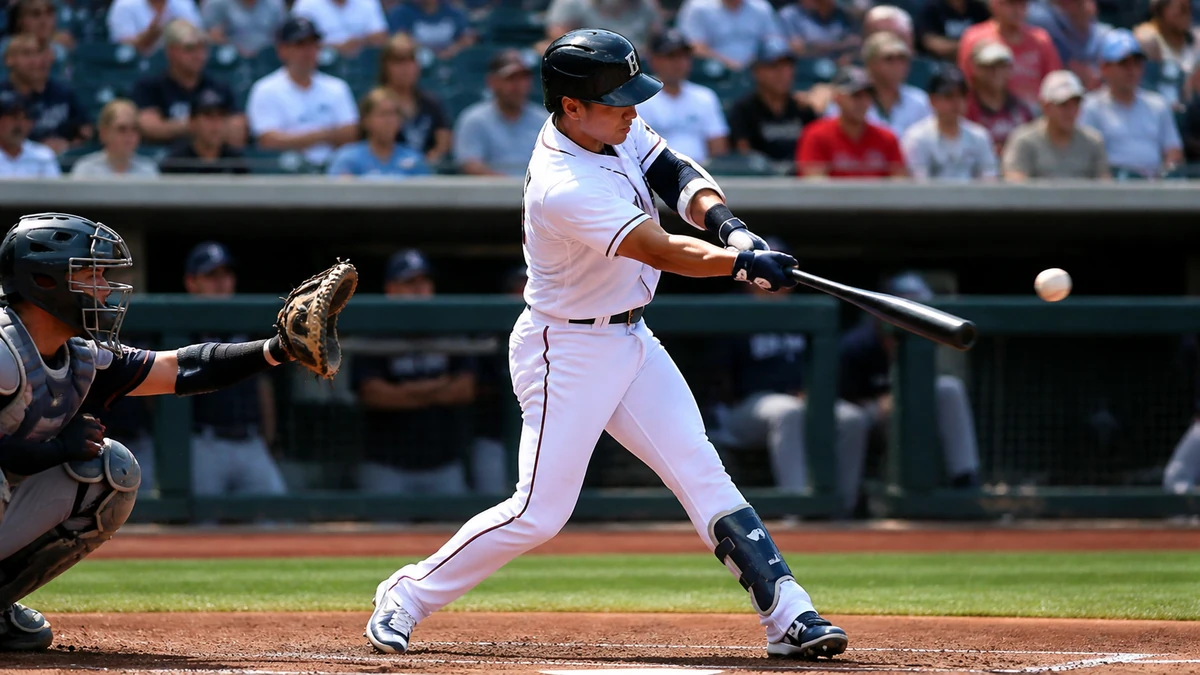
A small box score with outsized meaning
On paper, it was the kind of line that can get lost in the churn of a long baseball season: one at-bat, one hit, two walks, two runs scored. But for Kim Ha-seong, the South Korean infielder working his way back from hand surgery, that stat line carried much more weight than an ordinary minor league recap.
In his third rehabilitation appearance, Kim reached base in all three trips to the plate during the first game of a Double-A doubleheader in Columbus, Georgia, a performance that offered one of the clearest signs yet that his return is gaining traction. He started at shortstop, batted second and showed exactly the kinds of details teams look for when judging whether an injured player is truly getting back to game speed: command of the strike zone, comfort in the batter’s box, timing on contact and enough physical confidence to handle a demanding defensive position.
For American fans, rehab games can feel like baseball’s backstage area — necessary, mildly interesting and often ignored unless the player is a household name. But Kim occupies a different lane. He is not just another major leaguer trying to shake off rust. He is one of the most visible South Korean players in professional baseball, a former KBO star whose career has become part of a larger story about how Korean talent is evaluated, developed and sustained in the U.S. system.
That is why a game like this matters. Not because a one-hit rehab outing guarantees anything, and not because a perfect on-base percentage in one afternoon means the comeback is complete. It matters because rehabilitation is less about highlight plays than about signs of normalcy. Can the player track pitches without rushing? Can he avoid cheating on his swing? Can he take a walk instead of trying to force a result? Can he move through a real game, at a real position, without looking tentative?
On this day, the answers appeared encouraging. Kim’s line did not include a towering home run or a laser into the gap, the kinds of moments that instantly light up social media. Instead, it offered something more useful to coaches, front offices and the fans following every step of his recovery: evidence that the basics are returning, and that the rhythm of baseball is beginning to look familiar again.
Why getting on base matters more than slugging in rehab
There is a temptation, especially in the American sports conversation, to judge recovery through spectacle. If a basketball star can dunk again, he must be back. If a football quarterback can make one deep throw, he must be healthy. In baseball, though, a comeback often reveals itself in quieter ways.
That is particularly true early in a rehab assignment. At that stage, evaluators are usually not hunting for brute force. They want to see whether the hitter’s process is intact. Is he recognizing pitches? Is he laying off borderline offerings? Is his swing decision making synchronized with his physical recovery?
Kim’s performance checked several of those boxes. He walked in his first plate appearance, then later singled to center, and drew another walk before scoring twice. Those outcomes matter because they suggest more than simple luck. A walk, especially for a player returning from injury, can signal discipline and trust. It means the hitter did not feel compelled to chase a result. He saw the zone, stuck to a plan and let the game come to him.
That is important for any player, but especially for an infielder whose value has long extended beyond raw power. Kim’s offensive reputation has been built on versatility, plate awareness, situational intelligence and the ability to affect the game in multiple ways. A rehabilitation game that reflects those traits is more meaningful than one loud extra-base hit wrapped in several bad swings.
There is also the matter of baserunning. Kim did not simply reach base and stop there. He scored twice, once after a teammate’s home run and once after subsequent extra-base contact. That may sound routine, but it is not meaningless. Running the bases naturally — reading contact, accelerating, rounding and finishing plays without visible hesitation — is part of recovery, too. Players can sometimes regain swing mechanics before they regain game movement. When the offense flows through a returning player rather than around him, that is a useful indicator.
Baseball people often talk about “feel,” a slippery term that covers everything from timing to reaction speed to comfort under competitive stress. Rehab assignments are, in many ways, about rebuilding that feel. Kim’s 100% on-base day suggested that his feel is coming back in ways more revealing than a bigger, flashier box score might have been.
The injury behind the comeback and why it matters
Kim’s path back has not been routine. In January, he suffered a ruptured tendon in the middle finger of his right hand after slipping on ice, an off-field accident that interrupted his preparation and set off the familiar but unforgiving cycle of surgery, treatment and baseball rehab. It was the kind of injury that can sound minor to casual fans — after all, it is “just” a finger — until you consider how central the hands are to nearly every baseball movement.
For a hitter, the fingers are essential to bat control, grip strength and late swing adjustments. For an infielder, they matter in even more ways: fielding short hops, securing the ball, transferring it cleanly and making accurate throws from different arm angles. A middle finger injury on the throwing hand is not just discomfort; it can affect a player’s entire relationship with the baseball.
That context makes Kim’s start at shortstop especially notable. In the American baseball imagination, shortstop is one of the game’s premium positions, the equivalent of a soccer central midfielder or an NFL quarterback in terms of how much action flows through it. It demands quick reads, soft hands, arm strength and constant movement. When a recovering player is put there, even in a rehab setting, it suggests a level of organizational confidence in both his physical progress and his capacity to resume normal baseball tasks.
None of that means he is finished with rehab. Teams are usually careful not to draw sweeping conclusions from a single outing, and there are still layers of recovery that only reveal themselves over multiple games: how the hand responds the next morning, whether repetitive swings produce swelling or soreness, whether defensive reps remain crisp as the workload increases.
But this is where rehabilitation narratives are often misunderstood outside the sport. The goal is not simply to eliminate pain. It is to restore trust. A player has to trust the hand on a checked swing, trust it on a backhand play in the hole, trust it when jamming the bat inside on a fastball and trust it in the instinctive, split-second actions that cannot be simulated in a training room.
Kim’s stat line hinted that he is moving from medical recovery toward baseball recovery. That distinction is critical. Plenty of players are cleared physically before they look like themselves competitively. The promising sign here is not merely that Kim played. It is that he looked engaged in the flow of the game rather than like a player simply completing a medical checkpoint.
Why Kim’s rehab resonates far beyond one clubhouse
In South Korea, Kim is part of a larger sports story that extends beyond his own roster spot. He came to the United States after establishing himself in the KBO, South Korea’s top professional baseball league, where elite players often become national celebrities. For readers in America who may be more familiar with Japan’s Nippon Professional Baseball because of stars like Shohei Ohtani, the KBO occupies a similar cultural space in Korea: a major domestic league with a passionate fan base, strong regional loyalties and a talent pipeline that increasingly feeds global baseball.
That international dimension helps explain why a minor league rehab game can become news. When a Korean player succeeds in Major League Baseball, it is not viewed only as an individual achievement. It also becomes a reference point in an ongoing conversation about Korean baseball’s competitiveness, training methods and player adaptability. Conversely, when a player gets hurt, slumps or struggles to return, those developments are followed closely as part of a broader national sports narrative.
This is not unique to Korea. Americans do something similar with quarterbacks from certain college programs, or with NBA prospects from specific countries. One player can become a stand-in, fair or not, for an entire system. Kim’s progress, then, is watched not only by the people directly invested in his team but by Korean fans, baseball executives, international scouts and media outlets looking for clues about what comes next.
There is also a practical business side to that interest. MLB organizations have spent years expanding their global reach, and the evaluation of Korean talent has become more sophisticated as more players make the jump. Every case adds data. How does a Korean infielder handle the grind of an American season? How does he recover from injury inside the U.S. medical and developmental system? How quickly can he regain form? Those questions have implications far beyond one player’s short-term return date.
That is why the response to Kim’s rehab game goes beyond routine optimism. People are reading the details. Three times on base in limited opportunities. Two walks, which suggest selectivity and composure. A start at shortstop, which implies defensive readiness. Two runs scored, which indicate he is participating in offensive sequences rather than operating on the margins. Each detail becomes part of a larger file, the kind baseball builds around every player and every recovery.
For American readers, the closest analogy may be the way U.S. sports media tracks the rehab of a star college football quarterback ahead of the NFL draft. The numbers alone are not the whole story. Every movement becomes a signal. Every small success is interpreted for what it says about bigger questions.
The details of this game tell a stronger story than the headline number
The easiest headline from Kim’s day is obvious: 100% on-base percentage. It is clean, eye-catching and true. But the more revealing parts of the performance are the sequences that produced it.
In the first inning, Kim worked a walk and later scored on a teammate’s home run. Early plate appearances in rehab games can be deceptive because players often want immediate proof. They can get jumpy. They expand the zone. They try to hit their way healthy. Kim did the opposite. He took what the plate appearance gave him, reached base and let the offense unfold from there. That is the kind of composure clubs want to see from a player regaining timing.
Later, he singled to center and again came around to score, this time showing enough game awareness and movement to turn a base hit into a completed offensive trip. Hitting timing and scoring instinct are not identical skills. One concerns the batter’s box; the other involves reading the game as it develops. Seeing both in the same outing offers a more complete picture of readiness.
Then there are the two walks. Casual fans often dismiss walks in minor league settings, assuming they say more about shaky pitching than about the hitter. Sometimes that is true. But walks can also reflect something more valuable: pitch recognition, self-control and an understanding of what the hitter is trying to reestablish. For a player coming off hand surgery, a disciplined walk can be more reassuring than a hard-hit out, because it suggests the mental side of hitting remains sharp while the body catches up.
There is a reason front offices study rehab games through more than batting average. Was the hitter balanced? Did he track spin? Did he get into favorable counts? Did he appear to trust his hands? A one-for-one day with two walks is not just efficient; it shows a player who did not look overmatched, did not look rushed and did not need to manufacture confidence through reckless swings.
These are subtle distinctions, but they matter. Baseball’s most revealing comeback signs are often hidden in behaviors, not headlines. Kim’s outing offered several of those behaviors at once, which is why the performance stood out even without a dramatic swing of the bat.
What this means for Kim, and what it says about Korean baseball’s place in the global game
It would be premature to frame this as a completed comeback. Rehab assignments are designed to be incremental, and anyone who has followed baseball long enough knows recovery rarely moves in a perfect straight line. A player can look sharp one day and feel stiff the next. Organizations will want to monitor Kim’s workload, how his hand responds to defensive repetitions and whether his timing holds as the level of competition and number of plate appearances increase.
Still, there is a difference between caution and ambiguity. This game clarified the direction of Kim’s recovery. He is not stalled. He is not merely present. He is beginning to look like a player re-entering baseball’s daily rhythm.
That matters because Kim’s career has always represented more than statistical output. He is part of a generation of Korean players who have helped reshape how Americans view Korean baseball talent. The old stereotypes — that Korean position players might struggle with velocity, or that transition success would be limited to a small number of exceptional cases — have been challenged over time by players who brought not only skill but adaptability, discipline and competitive poise.
Kim’s appeal in that conversation has always been multidimensional. He is not marketed in the mold of a one-tool slugger. Instead, he has earned attention through versatility, instincts and a style of play that translates across leagues. In an era when baseball increasingly values players who can contribute on both sides of the ball and navigate multiple game situations, that profile has become even more attractive.
So when Kim shows signs of returning, the story naturally reaches beyond his own medical update. It becomes a reminder of how closely interconnected baseball has become. A rehab appearance in Georgia can carry significance in Seoul. A minor league box score can feed a larger discussion about international player development, durability and long-term value. Global fandom has made those links stronger, and social media has made them nearly instantaneous.
For American readers, that may be the most useful way to understand why this story drew attention. This is not simply about a player taking a few walks in a rehab game. It is about a Korean star whose progress is being read simultaneously as a personal comeback, a team asset update and a small but meaningful signal in the evolving relationship between Korean baseball and the major league ecosystem.
In the end, the significance of Kim’s performance lies in its restraint. It was not loud, but it was persuasive. He reached base every time. He scored twice. He handled shortstop. He looked, at least for a day, like a player moving forward rather than one testing the limits of his body.
That is what makes this a real comeback sign, even if it remains only one step in a longer process. In baseball, recovery is built on accumulation — one clean swing, one disciplined walk, one controlled defensive inning at a time. Kim Ha-seong’s latest rehab game did not settle every question. But it did provide something every player, team and fan wants during a return from injury: a credible reason to believe the next chapter is getting closer.



0 Comments