
A tense start in a high-stakes youth tournament
South Korea’s under-17 men’s national soccer team opened its AFC U-17 Asian Cup campaign with the kind of result that can feel frustrating and encouraging at the same time. After falling behind early, South Korea salvaged a 1-1 draw against the United Arab Emirates on Monday in Jeddah, Saudi Arabia, thanks to a late equalizer from forward An Ju-wan in the 88th minute.
On paper, it was only a draw and only one point in the standings. In the emotional math of a youth international tournament, though, it was more than that. South Korea spent most of the match chasing the game after conceding in the eighth minute, a dangerous position for any team and especially for one made up of teenagers on a big continental stage. Instead of unraveling, the South Koreans stayed in the match long enough to find a breakthrough late.
That distinction matters in a tournament setting. In group play, especially at youth level, a team’s opening match often says as much about its nerve as it does about its tactical sharpness. Falling behind early can distort everything that follows. It can force rushed decisions, drain composure and expose the inexperience that naturally comes with a roster of 16- and 17-year-olds. South Korea did not produce a complete performance, but it did produce something nearly as important for a first game: proof that it could absorb pressure, remain organized enough to survive and still create a decisive moment at the end.
The draw came in Group C of the 2026 AFC U-17 Asian Cup, one of Asia’s premier youth tournaments and a major proving ground for players who could become future stars for club and country. The match was played at King Abdullah Sports City, one of Saudi Arabia’s marquee venues and a symbol of the kingdom’s growing investment in global soccer. For South Korea, a nation with a deep soccer tradition and high expectations at youth level, the game was a reminder that reputation alone does not carry a team through the opening minutes of a tournament.
Instead, the day belonged to resilience. South Korea did not start well, and it did not always look in control. But by the end, it had rescued a point and, perhaps more importantly, preserved belief ahead of two crucial group matches still to come.
The early blow that changed the shape of the game
The match turned difficult for South Korea almost immediately. In the eighth minute, the UAE struck first through Buti Alzeyoudi, putting the South Koreans in a position they had likely hoped to avoid so early. A one-goal deficit that soon in an opening group-stage match can alter the psychology of both teams. The side with the lead can settle into a more compact, disciplined shape; the side trailing can become increasingly anxious, pushing numbers forward before the game has fully developed.
That dynamic appeared to define much of the contest. South Korea was not simply trying to attack. It was trying to recover emotional equilibrium after an early setback. Anyone familiar with youth sports in the United States, whether in elite club soccer, high school football playoffs or NCAA tournament games, understands how quickly momentum can shift when young athletes feel a result slipping away. The challenge is not just technical. It is mental. Can players stay patient? Can they continue following the plan? Can they resist the temptation to force the game?
South Korea’s answer, eventually, was yes, though not always comfortably. The team coached by Kim Hyun-joon had to work through the match without the immediate reward of a quick response. That meant living with the pressure of a scoreboard that favored the opponent and a clock that increasingly threatened to turn one early mistake into a full defeat.
In youth international soccer, that can be where matches break open. A trailing team may become stretched, exposing itself to a second goal on the counterattack. Defenders may step too aggressively. Midfielders may rush the final pass. For long stretches, South Korea was playing against all of those risks at once. That is one reason the late equalizer carried such weight. It was not merely a goal. It was a sign that the team had not surrendered its shape or its confidence completely, even after spending most of the game in an uncomfortable script.
From an American perspective, the result recalls the difference between a team that leaves an opener demoralized and one that leaves feeling it can still control its fate. In a three-match group stage, that distinction can matter enormously. A loss puts immediate pressure on everything that follows. A draw keeps multiple paths open.
An Ju-wan’s moment and why it resonated
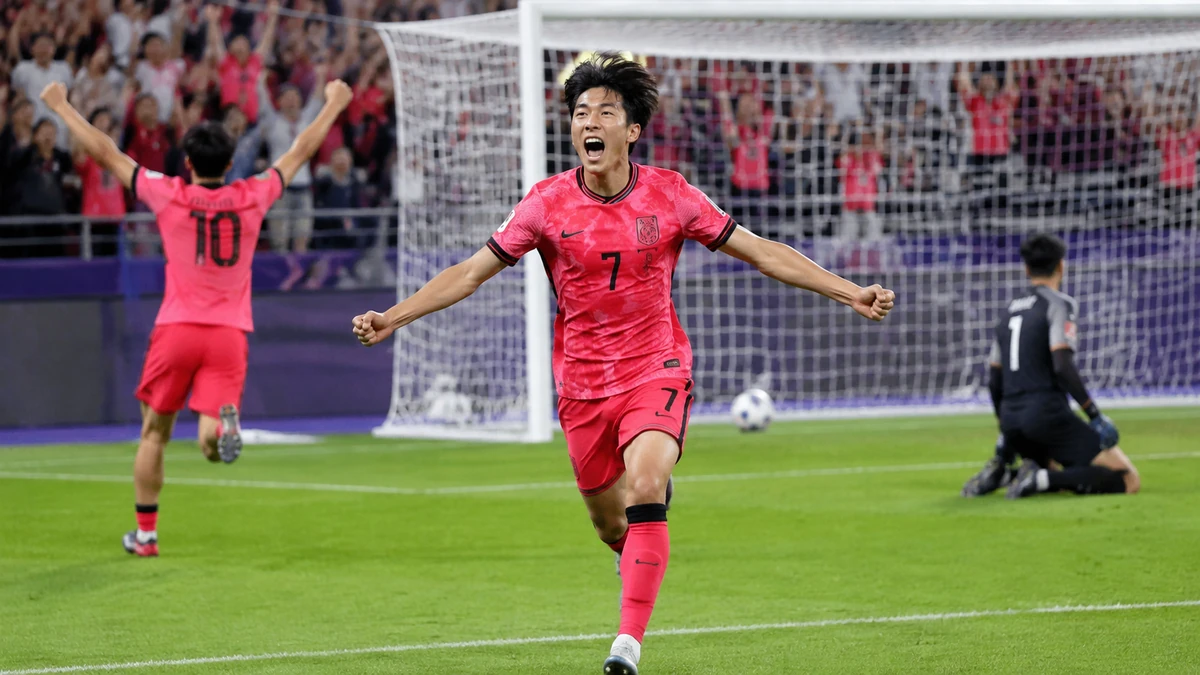
The equalizer finally came in the 88th minute, and with it came the game’s defining image. Choi Min-jun delivered the setup, and An Ju-wan made the run, breaking into the box from the left before finishing with his right foot. It was a clean, timely intervention at precisely the moment South Korea needed one. With regulation nearly over, there was little room left for a gradual comeback. The chance had to be taken, and An took it.
Late goals always change how a match is remembered. A team that trails for nearly the entire game but scores in the closing minutes leaves the field with momentum, even if the standings record only a draw. Anyone who follows sports in the U.S. knows the feeling: a last-minute touchdown drive to tie a game, a buzzer-beating shot to force overtime, a ninth-inning rally that avoids a series-opening loss. The statistical outcome may be modest, but emotionally it can feel like a pivot point.
For South Korea, the equalizer transformed the narrative. Without it, this would have been a story about a talented youth side that conceded early and never found its way back. With it, the match becomes a story about composure under pressure and the emergence of a player who looks capable of changing a game in one touch.
The timing of the goal also matters because of what it does to a locker room. Youth tournaments can be volatile. Confidence can rise and fall in a matter of days, sometimes hours. A dramatic equalizer in the opener can create a sense that the team has already survived one test together. Coaches value that feeling because it turns abstract ideas such as resilience and trust into lived experience. Players no longer have to be told they can recover from adversity; they have done it.
An’s goal was the product of both individual initiative and coordinated movement. The run was decisive, but so was the pass that released him. In that sense, the equalizer was not a random scramble or a fortunate deflection. It suggested that even in a match where South Korea was under strain, it retained enough attacking structure to produce a well-timed sequence against a set defense. That detail could become important in the matches ahead, because it offers a repeatable pattern rather than a one-off miracle.
Why An Ju-wan is a name worth knowing
An’s importance goes beyond one goal. He is the only player on South Korea’s 23-man squad currently attached to a professional club team, a distinction that stands out in a roster otherwise made up largely of youth-system players. He belongs to Seoul E-Land, a club in K League 2, the second tier of South Korean professional soccer. For readers less familiar with the Korean game, K League 2 functions somewhat like the second division in many global soccer systems: competitive, developmental and often a proving ground for young players trying to accelerate their careers.
That background gives An a different profile from many of his teammates. He has already crossed, at least in part, from youth promise into the adult professional environment. That does not automatically make a teenager the best player on the field, but it does expose him to a faster tempo, greater physical demands and a higher standard of accountability. In a youth international setting, those experiences can show up in subtle ways: better decision-making in traffic, sharper timing in a run, or the calm to finish under pressure late in a match.
An has also drawn attention in South Korea as a highly regarded prospect. He is a former recipient of the Cha Bum-kun Football Award, named after one of the most revered figures in Korean soccer history. For American readers, Cha’s stature is roughly comparable to that of a foundational national soccer icon, the kind of player whose name carries both nostalgia and authority when attached to youth development. The award signals not merely talent but broader expectation.
Earlier this year, An made another headline when he appeared as a substitute against Cheonan City FC and set a K League 2 record as the youngest player ever to appear in the league. He was 16 years, 11 months and 7 days old. Records like that can sometimes produce hype before substance. What made this performance notable is that it connected the two. An did not arrive at the tournament as merely a curiosity or an age-based statistic. He delivered a meaningful goal in a match that South Korea could not afford to lose.
That is how reputations begin to harden. Not with praise alone, but with moments that influence outcomes. In youth soccer, particularly in a country with South Korea’s expectations, the leap from prospect to trusted difference-maker is never guaranteed. An’s finish against the UAE does not complete that journey, but it gives him a serious foothold.
The significance of the youth pipeline behind the goal
Although An scored the equalizer, the move also highlighted the development system feeding South Korean soccer. The assist came from Choi Min-jun, who plays for the under-18 side of Pohang Steelers, one of the country’s better-known professional clubs. In Korea, as in many soccer nations, elite youth development is closely tied to professional club structures, school teams and long-established training pathways. When a goal like this one is created by a player from a major club academy and finished by a teenager already exposed to pro soccer, it offers a snapshot of how the pipeline is intended to work.
That is an important part of why youth tournaments matter beyond the immediate result. They are not just competitions. They are public audits of development systems. American fans have become more accustomed in recent years to viewing youth national teams in that way, especially as U.S. Soccer has tried to strengthen academy pathways and produce more players ready for Europe’s top leagues. South Korea sees these tournaments through a similar lens. Every good performance by a teenager is also evidence, fair or not, of whether the broader system is producing players who can think quickly, adapt under pressure and perform against foreign opposition.
The equalizing play suggested that South Korea still has offensive patterns it can build on. The timing of Choi’s delivery and An’s movement into the penalty area showed recognition of space and trust between players. Those are encouraging signs after a game in which South Korea spent long stretches looking like the side reacting rather than dictating.
There is also a broader cultural point here. In South Korean sports, youth achievement often carries added scrutiny because of the country’s intensely competitive academic and athletic environments. Young athletes who rise quickly can become symbols of national possibility, but they also face pressure to justify attention immediately. That pressure is not unique to Korea, of course. American basketball prodigies and teenage baseball prospects live with versions of it all the time. But in the context of international soccer, where representing the nation begins at a young age and public interest can be fierce, a goal like An’s lands with extra force.
It is not simply a highlight. It becomes a marker in the ongoing conversation about who is next, who is ready and whether the country’s future talent can carry the weight of expectation that comes with the Korean shirt.
The group-stage picture and the pressure ahead
The draw leaves South Korea with work to do in Group C. Vietnam moved to the top of the group after beating Yemen 1-0, meaning South Korea’s next match against Vietnam takes on immediate significance. In a compact group stage, opening results can compress the standings quickly. One win can move a team into control; one stumble can turn the second game into a virtual pivot point.
That is the situation South Korea now faces. The team will meet Vietnam next, then Yemen. There is no mystery about the stakes. A victory against Vietnam would steady the campaign and likely reset the group dynamics. A poor result would intensify pressure before the final match. In youth competitions, that sort of pressure can either sharpen a team or expose it.
Still, there is a meaningful difference between entering the second match after a loss and entering after a draw rescued at the end. The standings gap may be just one point, but the psychological difference can be much larger. South Korea now carries evidence that it can recover inside a match. That does not erase the flaws from the opener, particularly the vulnerability of conceding so early, but it does mean the team’s internal mood is likely to be more stable than it would have been after a defeat.
From a tournament-management perspective, this matters. Coaches often talk about controlling emotion as much as tactics in youth events. Too much panic after one bad half can distort preparation for the next game. South Korea’s late equalizer gives Kim and his staff something concrete to reinforce: the team can stay alive long enough for quality to matter. The next challenge is making sure it does not again put itself in a position where a late rescue is necessary.
Vietnam, now sitting on three points, represents a different kind of test. South Korea will not only be playing an opponent; it will be chasing the group’s early pace-setter. That can add urgency, but it can also bring clarity. The task becomes simple even if the execution is not: turn possession into chances sooner, avoid defensive lapses at the start and prevent the group from slipping beyond easy reach.
Why this result matters beyond the scoreboard
For many casual readers, a 1-1 draw in a youth tournament might seem like a niche result, far removed from the glamour of the Premier League, the Champions League or even the men’s World Cup. But games like this are often where the next phase of a soccer nation begins to come into focus. They reveal not just future stars but future habits: how a team responds to adversity, what kind of players emerge in pressure moments and whether a country’s development model is translating into competitive resilience.
South Korea has long been one of Asia’s most respected soccer nations, with a history that includes regular World Cup appearances and a 2002 World Cup semifinal run that remains one of the defining moments in Asian soccer history. For American audiences, that tournament is still the most recognizable shorthand for South Korea’s place in the global game. But every established soccer country has to keep replenishing itself. The U-17 level is where that process becomes visible.
This match offered a compact version of several themes that tend to define successful national programs. There was early adversity, a visible test of composure, a contribution from a player already touching the professional game and a reminder that youth development is only meaningful if it produces players who can decide real matches. South Korea did not dominate the UAE. It did not look finished or fully polished. But it also did not fold.
That may end up being the most useful takeaway from the opener. Tournament soccer is rarely about perfect performances from start to finish, especially among teenagers. It is often about surviving imperfect ones. South Korea did that Monday. The team left points on the table, but it did not leave the field empty-handed or emotionally deflated.
For now, the image that lingers is An Ju-wan arriving late to rescue the match, turning what looked like an opening-night disappointment into something more complicated and more hopeful. In the span of one finish, South Korea moved from staring at an avoidable loss to carrying momentum into the next round of group play. Whether that moment becomes the start of a deeper run or simply a brief reprieve will be decided in the games ahead. But in youth soccer, as in sports everywhere, the first sign of a team’s character often arrives before the first victory does. South Korea’s may have arrived in the 88th minute.



0 Comments