A familiar face returns to one of Korean television’s most enduring stages
In South Korea, there are few television formats as deeply woven into everyday life as the weekend family drama. Airing on major broadcast networks and designed to draw viewers across generations, these series often become the backdrop to Sunday dinners, multigenerational living rooms and long conversations about parents, children, money, sacrifice and starting over. So when Korean actor Lee Jung-eun signs on to lead a new KBS2 weekend drama after a six-year absence from that format, it is more than a routine casting update. It is a signal about what kind of story Korean television believes still matters.
According to South Korean reports, Lee will star in the upcoming KBS2 series “School Has Returned,” a drama about an energetic, deeply involved mother who enrolls in college later in life and begins rebuilding what Koreans often call the “second act” of her life. On paper, that premise may sound straightforward: a mother goes back to school. But within the Korean TV industry, and for audiences who have followed Lee’s career, the announcement carries unusual weight.
Lee is one of those actors whose presence can change the temperature of a project. International audiences may know her best from Bong Joon Ho’s Oscar-winning “Parasite,” where she delivered a performance that was by turns funny, devastating and unnerving. Korean viewers, however, have long recognized her as a performer with a rare ability to make ordinary people feel fully lived in. She does not simply play working mothers, neighbors or side characters; she gives them history, dignity, irritation, wit and sorrow. In a television ecosystem that often prizes glossy visuals and high-concept hooks, Lee has become shorthand for something else: emotional credibility.
That matters especially in a weekend drama, a format that depends less on spectacle than on trust. These are series that ask viewers to return week after week not for a superhero twist or a murder mystery reveal, but because the characters begin to feel like people they know. KBS2, one of South Korea’s major terrestrial broadcasters, has long been associated with this kind of programming. Lee’s return to that space suggests a renewed bet on character-driven storytelling at a moment when the Korean drama industry is also racing to serve global streaming platforms hungry for flashier, faster and often darker fare.
For American readers, the closest comparison might be if a widely respected character actor suddenly headlined a network Sunday-night drama built around family life, neighborhood politics and adult reinvention — not unlike a prestige-lite cross between “Parenthood,” “Gilmore Girls” town energy and the working-class emotional intelligence of a great ensemble dramedy. It is not a perfect equivalent, because Korean weekend dramas have their own pacing and conventions, but it gets close to the kind of audience relationship this format aims to build.
What makes the news compelling, then, is not simply that Lee has a new role. It is that she is stepping back into one of Korea’s most familiar television traditions with a character who embodies two things at once: the burdens of having spent years living for others, and the thrill — and awkwardness — of trying to live for herself.
A story about college, yes, but really about identity
The premise of “School Has Returned” centers on Yoon Ok-hee, a mother who belatedly enters college and begins redesigning her life. In the United States, stories about older students often get framed as comeback narratives, professional pivots or self-help success stories. In South Korea, the emotional register can be somewhat different. Education is not just a personal good; it is one of the most powerful organizing forces in modern Korean society, tied to class mobility, family sacrifice, social pressure and generational aspiration.
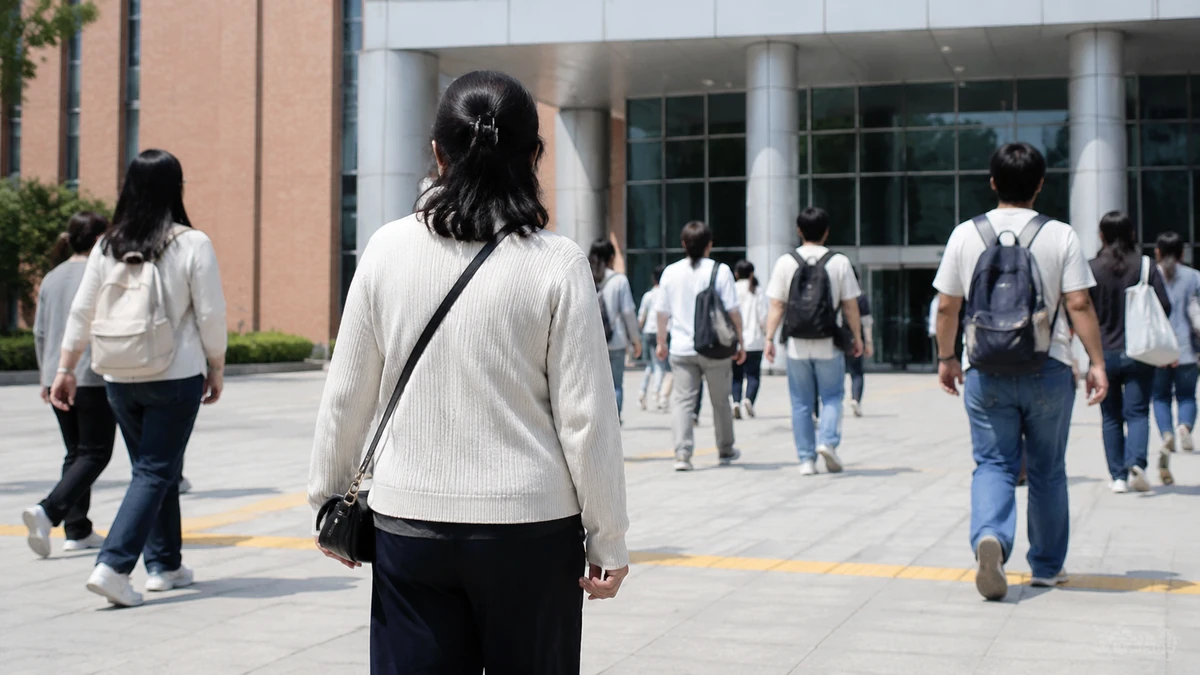
That context is important. To go to college in Korea is not merely to take classes. It is to enter one of the country’s most symbolically charged institutions, especially for someone who may have spent her youth prioritizing family needs over her own goals. In that sense, Ok-hee’s enrollment is not a gimmick. It represents a renegotiation of identity. She is no longer only a mother, spouse, business owner or neighborhood fixer. She becomes a student, which in dramatic terms means becoming a beginner again.
That shift is where the series appears to find its emotional center. The story is not just about whether she can pass exams or fit in on campus. It is about what happens when a woman who has long been competent, needed and publicly visible in her community enters a new environment where those old forms of authority may not count for much. The tension between who she has been and who she now wants to become is likely to drive the series more than any single plot device.
This is one reason the show has the potential to resonate beyond Korea. The broad feeling is easy to recognize: the parent who spent decades organizing everyone else’s life and suddenly asks what remains for her; the middle-aged worker who returns to school; the caregiver who discovers ambition has not disappeared, only been deferred. In the United States, where adult learners now make up a substantial share of higher education, that theme lands with particular force. Community colleges, night classes and second-career degree programs have become fixtures of American life. The details are different, but the emotional truth is familiar.
At the same time, the Korean version of that story brings its own texture. Korean dramas are especially adept at layering personal growth into family obligation rather than separating the two. Instead of framing self-discovery as a clean break from domestic life, they often ask whether reinvention can happen while the dishes still need washing, the store still needs opening and the family still expects dinner on time. That can make their stories feel less like fantasy and more like negotiations with reality.
If “School Has Returned” succeeds, it will likely be because it understands that going back to school is not the real fantasy. Being allowed to redefine yourself after years of service to others — and to have that redefinition taken seriously — is the deeper emotional hook.
Why Yoon Ok-hee is built for a weekend drama
Lee’s character is described as the owner of an instant tteokbokki restaurant and an enthusiastic, hyper-involved mother with a long list of neighborhood roles. For readers unfamiliar with the dish, tteokbokki is one of Korea’s best-known comfort foods: chewy rice cakes in a spicy, often sweet red sauce, sold everywhere from street stalls to casual restaurants. It is inexpensive, communal and deeply nostalgic, the kind of food many Koreans associate with school days, quick meals and social bonding. Making Ok-hee the operator of a tteokbokki place immediately situates her in a recognizable world of everyday labor, neighborhood familiarity and emotional warmth.
Just as notable is the description of her personality. The Korean word often used in this kind of context is “ojirap,” a term that can be hard to translate neatly into English. It refers to a tendency to involve oneself in other people’s affairs, sometimes too much — a nosiness or meddlesomeness, but one that can also be affectionate, communal and socially useful. In American culture, that kind of figure might be described as the neighborhood mom who knows everyone’s business, organizes the school fundraiser, settles parking disputes and starts the group chat. She can be exhausting, indispensable or both at once.
That appears to be Ok-hee’s lane. Reports describe her as a women’s association leader in her neighborhood, a school-route safety coordinator, a parking order monitor, a go-between for complaints at the local community center and the head of a local messaging group chat. In other words, she is not merely a mother in the private sphere. She is a local institution. She is the connective tissue of her block.
For a drama writer, that is gold. A character embedded in that many social networks naturally generates story. Conflicts arrive at her doorstep. Gossip flows through her. Small civic issues become character beats. Humor, frustration and tenderness all emerge from the same premise: this is a woman who cannot help showing up in other people’s lives.
The contrast built into the role is what makes it especially promising. In her neighborhood, Ok-hee may be the unofficial mayor. On a college campus, she becomes a novice. That reversal creates immediate dramatic possibilities. She may be used to giving directions, not asking for them. She may know exactly how to manage a local dispute, but have no idea how to navigate younger classmates, academic jargon or campus norms. Anyone who has returned to a new institutional setting later in life knows the feeling: your life experience is real, but suddenly you are once again the least fluent person in the room.
Lee has built a career on capturing that kind of contradiction. She can project command and vulnerability in the same scene. She can make a character funny without flattening her into comic relief. And she can render the small embarrassments of ordinary life — being out of step, being underestimated, overcompensating — with an honesty that invites empathy rather than pity.
That is why the character matters. Ok-hee is not positioned as a glamorous heroine or an aspirational fantasy. She is a “life hero,” the kind of ordinary woman many people overlook until they realize how much social labor she performs every day. Korean family dramas, at their best, have long excelled at elevating such figures. Giving one of the country’s most trusted actors that kind of role suggests the series knows exactly where its center of gravity should be.
The creative team suggests this is more than a casting play
Another reason the project has drawn notice in Korea is the pedigree of the creative team. The series is written by Yang Hee-seung, whose credits include “Oh My Ghost,” “Once Again” and “Crash Course in Romance,” and directed by Lee Woong-hee, known for “My Perfect Stranger” and other character-forward dramas. For industry watchers, those names help explain why this announcement is being treated as something more substantial than celebrity scheduling news.
Yang’s track record is particularly relevant. She has shown a knack for writing across tonal categories, from romance and family drama to school settings and emotionally layered comedy. That breadth matters because “School Has Returned” seems designed to live at the intersection of several modes at once. It is a family drama, certainly, but also a campus story, a middle-age reinvention narrative and potentially a neighborhood ensemble piece. Pulling that off requires a writer who can move between broad warmth and sharp character detail without losing the thread.
In the American TV landscape, viewers are accustomed to genre labels carrying clear expectations: a sitcom behaves like a sitcom, a prestige drama like a prestige drama. Korean television is often more porous. A single episode may contain slapstick, tears, social critique and romance. Done badly, that can feel chaotic. Done well, it can feel emotionally expansive. Yang is one of the writers whose name suggests the latter is possible.
Lee Woong-hee’s participation adds another layer of interest. Directors in the Korean system often shape not just visual style, but emotional rhythm — how long scenes breathe, how transitional moments land, how ensemble relationships are balanced. If the director is attuned to shifts in tone and interpersonal chemistry, a familiar premise can feel fresh. In a show like this, pacing will be crucial. Too broad, and Ok-hee risks becoming a caricature. Too solemn, and the drama may lose the warmth expected of a weekend slot.
Together, the writer-director pairing points to a series that could stay within the recognizable conventions of a Korean network family drama while sharpening them for contemporary viewers. That may include better calibrated emotional arcs, more nuanced treatment of middle-aged female ambition and stronger interplay between domestic and public life. None of that guarantees success, of course. Korean dramas live or die by execution, and even strong pedigrees can disappoint. But it does mean the project arrives with clearer creative intent than a typical casting blurb might suggest.
In a crowded content economy where dozens of new titles compete for attention every month, that kind of clarity matters. It tells viewers what the network thinks the show is really selling: not just Lee Jung-eun’s name, but a coherent character-driven story anchored by people known for making audiences care.
What weekend dramas mean in Korea — and why that matters globally
To understand why Lee’s return to a KBS2 weekend drama is being framed as a notable development, it helps to understand the place these shows occupy in Korean media culture. Weekend dramas have historically been broad-appeal television designed to reach family audiences across age groups. They are often longer-running than many weeknight series, with stories that unfold gradually and place heavy emphasis on family ties, marriage, generational conflict, neighborhood relationships and moral growth.
For Americans, the format may seem slightly old-fashioned, especially in an era shaped by binge viewing and algorithm-driven taste clusters. But in Korea, these dramas have served as one of the last major broadcast spaces where multiple generations still overlap in viewership. Grandparents, parents and adult children may not all be watching the same thriller on Netflix, but they may still share a weekend drama. That communal function gives the genre a cultural role beyond ratings.
It also shapes the kinds of stories told there. Weekend dramas are expected to be accessible without being simplistic, emotional without becoming alienating and rich in character relationships. They often reflect shifting social concerns in a relatively mainstream register. If a younger streaming drama might examine social change through an edgy premise or tightly compressed genre narrative, a weekend drama will more likely process that same change through family life.
That is why a story about a middle-aged mother going to college feels so apt for this slot. It speaks to aging, education, gender roles and self-worth, but through a lens broad audiences can enter. Rather than asking whether Korean society is changing in some abstract way, it asks what those changes look like in a household, a restaurant, a campus and a neighborhood association.
For global audiences, including viewers in the United States, that framework can be especially appealing. Many of the Korean dramas that break through internationally are either high-concept thrillers or romances with strong visual hooks. But one of the enduring strengths of Korean television has been its ability to dramatize social intimacy: the tiny negotiations of obligation, the coded dynamics of respect, the way food, study and shared space become emotional language. A show like “School Has Returned” may not arrive with the instant meme potential of a zombie outbreak or a revenge epic, but it may offer something more durable: a close look at how community and family actually function in contemporary Korea.
That is also where the drama’s neighborhood emphasis becomes important. Ok-hee is not confined to the home. She moves through local institutions, informal leadership roles and civic routines. For non-Korean viewers, this can offer a textured window into what might be called the “village” structure of urban and suburban Korean life — the informal webs of responsibility and interference that make community feel both supportive and suffocating. Anyone who has lived in a tightly knit town, immigrant neighborhood or heavily parent-driven school district in America will recognize parts of that world, even if the details differ.
Why this story lands now
The timing of the project may be part of its appeal. South Korea, like many countries, is grappling with aging demographics, economic pressure and shifting ideas about education, work and family responsibility. The notion of a clean life course — school, career, marriage, parenthood, retirement — feels less stable than it once did. Reinvention is no longer just a youthful theme. It is a middle-aged necessity.
That is true in the United States, too. Americans are accustomed to hearing about reskilling, second careers and lifelong learning, especially as industries change and economic insecurity reshapes adulthood. But popular culture often remains youth-focused, particularly when it comes to stories about education and self-discovery. A series centered on a middle-aged woman who enters college not as a joke or a side plot but as the main engine of her life’s reorientation feels notable for that reason alone.
There is also a gendered element here. Korean dramas have no shortage of mothers, but mothers are often defined by what they endure, what they sacrifice or how they support the growth of others. A show that keeps those realities intact while still making the mother’s own growth the central plot can feel quietly radical, even within a mainstream format. It does not reject family; it asks whether family narratives can make room for female ambition after domestic duty has already claimed so much time.
Lee is uniquely suited to carry that question. She has the authority to make Ok-hee feel representative without making her generic. She can embody a woman whose labor has gone under-credited, whose competence is taken for granted and whose emotional life is richer than the categories around her suggest. That, in turn, may be why the casting has generated real anticipation. It promises a drama about reinvention that does not require its heroine to become unrecognizable in order to become newly seen.
In industry terms, the news also suggests that Korean broadcasters still see value in investing in stories led by performers rather than pure premise. At a time when conversation around Korean entertainment often tilts toward global expansion, platform competition and flashy production trends, “School Has Returned” points back to one of the medium’s oldest strengths: emotionally persuasive storytelling about people at turning points in their lives.
No one can know yet whether the series will become a breakout hit. Early casting announcements rarely tell the whole story. But even from the basic contours now available, the appeal is easy to understand. The actor is right. The role is textured. The premise is both local and universal. And the format is built to let ordinary transformation unfold at human speed.
For American viewers increasingly interested in Korean television beyond its most exportable genres, that may be reason enough to pay attention. Not because a mother goes back to school, but because in doing so, she becomes the center of a drama about what it means to reclaim a life that was never entirely yours to begin with.
Comments
Post a Comment