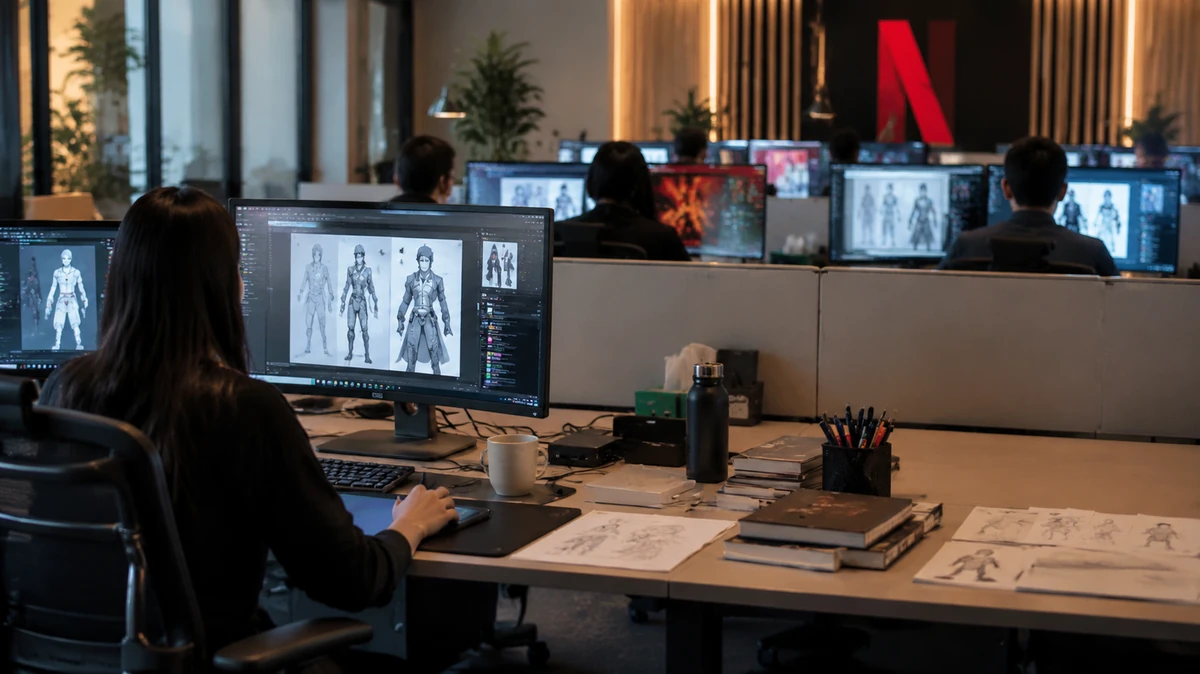
Netflix moves AI from the margins to the center of animation
Netflix has quietly taken a step that could ripple far beyond Hollywood boardrooms and tech circles: The streaming giant has set up a new internal animation studio focused on generative artificial intelligence, according to reports confirmed this week by U.S. technology outlets. The studio, called INKubator, was established in March and is described as a next-generation, creator-led generative AI animation operation — a phrase that may sound like Silicon Valley branding, but carries real weight in the entertainment business.
What makes the move notable is not simply that Netflix is experimenting with AI. Nearly every major media company is doing that in some form, whether through recommendation systems, subtitling tools, visual clean-up or postproduction workflows. What stands out here is that Netflix appears to be building a dedicated studio aimed at using generative AI in the actual creation of animation, not merely in polishing finished work after the fact.
That distinction matters. In American entertainment, AI has often been discussed in relatively narrow terms: a cost-cutting assistant, a productivity enhancer or a controversial shortcut. But a studio built from the ground up around generative AI suggests something broader. It suggests a company trying to rethink the production pipeline itself — from idea development and visual experimentation to image generation, animation workflows and possibly even the pace at which new projects can be developed.
For U.S. audiences, a useful comparison might be the difference between using Photoshop to retouch a movie poster and using AI to help design the poster concept in the first place. One is a support function. The other reaches into authorship, style and creative decision-making. Netflix’s new studio appears to point toward the latter.
That is why this development is drawing attention not only in the United States, where Netflix is headquartered, but also in South Korea and across global entertainment markets. Netflix is no longer just a distributor of shows and movies. It is one of the most influential tastemakers in the world, especially in places like South Korea, where its investment helped accelerate the global visibility of Korean drama, film, unscripted television and animation. When a company with that much reach changes how it makes content, the rest of the industry pays attention.
Why animation is the first big battleground
If generative AI is going to disrupt entertainment production, animation has long looked like one of the most likely places for that disruption to happen first. That is not because animation is simple — anyone in the industry will tell you the opposite — but because it is highly designed, iterative and tool-dependent. Characters, environments, lighting, movement and texture are all built through systems that already rely heavily on digital pipelines.
In live-action film and television, AI raises obvious questions about performances, sets, photography and the irreplaceable human elements of production. In animation, the line between art and software has always been closer. Modern animated projects already depend on complex workflows involving storyboarding, previs, modeling, rigging, rendering, compositing and effects. A new tool that can speed up concept generation, assist with visual development or help create variations in style has many more possible entry points.
That does not mean AI can simply replace the work of animators, designers or directors. If anything, animation is an especially revealing test case because it shows how much of the medium depends on taste, precision and consistency. A machine can generate images, but a feature-length animated story or series still needs a coherent look, emotional logic, timing and visual language. Those things do not emerge automatically from prompts.
Still, Netflix’s hiring plans suggest the company believes the creative and technical layers can be integrated more tightly than before. Reports say the company has been recruiting producers, technical leads, software engineers and computer graphics artists for the studio. That mix is telling. It suggests Netflix is not treating AI as a toy for a research lab or a side tool for an existing team. It is assembling the kind of cross-functional group you would need if you intended to build new production methods from the inside out.
For American readers, think of it as the difference between a newsroom using transcription software and a media company building an entirely new digital newsroom around automation, data tools and AI-assisted publishing. One changes a task. The other changes the shape of the institution.
The bigger question: Who gets to be called the creator?
The debate around generative AI in entertainment tends to move quickly from technology to ethics, and for good reason. Once AI moves from editing and administrative support into the creative core of a project, the obvious questions become harder to avoid: Who made this? Who owns the style? Who is accountable when something looks derivative, exploitative or legally questionable? And how much human labor remains behind the finished product?
Those questions are particularly sensitive in animation, where artistic identity matters deeply. A specific color palette, character design approach or motion style can define a studio’s brand for decades. American audiences instinctively recognize the distinct sensibilities associated with companies like Pixar, DreamWorks or Studio Ghibli, even if they cannot always articulate why. Style is not an incidental layer laid on top of content. In animation, style is part of the storytelling engine itself.
That is why the wording around Netflix’s studio is so important. Reports describe INKubator not as a technical back office but as a creator-led generative AI animation studio. The phrase creator-led seems designed to reassure skeptics that human artists remain in charge. But it also underscores the central tension now facing the industry. If human creators are directing the process while AI generates a meaningful share of the visuals, where exactly does creative authorship begin and end?
Hollywood has already wrestled with some of these fears. The 2023 labor fights involving writers and actors put AI squarely at the center of contract negotiations. Writers worried about studios using AI-generated material to undermine their work. Actors feared their likenesses could be scanned, stored and reused without adequate compensation or control. Animation has its own labor dynamics, but the core anxiety is similar: not simply that AI exists, but that the economic value of creative labor could be redefined around it.
Netflix’s move does not answer those questions. It makes them more urgent. A global streaming company does not create a studio like this unless it sees strategic value in bringing AI closer to production. And once one major player formalizes that effort, others may feel pressure to follow, whether out of fear of falling behind or hope of cutting costs and accelerating development.
Why this matters in South Korea, not just California
Although the reporting on INKubator emerged from the United States, the implications are especially significant in South Korea, where Netflix has become a major force in the entertainment ecosystem. Over the past several years, Netflix has helped transform Korean content from a niche international interest into a regular part of mainstream viewing habits in many countries, including the United States. What used to be a specialized corner of global pop culture now routinely lands on American Top 10 lists.
That matters because South Korea’s entertainment industry is deeply integrated with digital production trends. The country is known not only for K-dramas and K-pop, but also for webtoons, visual effects, gaming, virtual idols and other formats that sit at the intersection of storytelling and technology. In Korea, the term “K-wave,” or Hallyu, refers to the international spread of Korean popular culture. To American audiences, it is the larger phenomenon that brought shows like “Squid Game,” music acts like BTS and Blackpink, and a broad range of Korean films and series into everyday conversation.
When Netflix adjusts its production model, Korean creators have reason to pay close attention because they are not dealing with a distant American platform. They are dealing with a company that commissions Korean originals, licenses Korean programming, influences audience expectations and helps define what kinds of projects travel internationally. If generative AI becomes more central to Netflix’s animation pipeline, that could eventually affect partners, vendors, co-productions and talent markets in Korea as well.
It could also affect how Korean creators position themselves in a rapidly changing global field. South Korea’s strengths have often included speed, digital fluency and a willingness to experiment with new media formats. Those advantages could make Korean studios well placed to adapt to AI-assisted workflows. But they also raise difficult questions about labor, training and artistic identity. If the market begins rewarding faster production and scalable style generation, what happens to the premium placed on individual craft?
For English-speaking readers who follow Korean entertainment mainly through hit dramas or viral music acts, this may seem like an abstract industry story. It is not. The infrastructure behind what audiences watch is changing. And because Korean content now circulates so widely on global platforms, those industrial changes in Los Angeles can quickly become creative and economic pressures in Seoul.
From postproduction helper to creative engine
One of the most important distinctions in the reporting is the difference between using AI in postproduction and using it to create animation in the first place. That may sound technical, but it is the line that separates incremental adoption from structural change.
In film and television, audiences have already become somewhat accustomed to AI being used behind the scenes. Tools can help clean audio, automate subtitling, remove visual imperfections, assist with editing workflows or speed up repetitive effects work. These uses are often framed as practical improvements, not existential shifts. They sit in the same general category as any other software that helps artists or technicians work more efficiently.
Generative AI in animation creation is a different proposition. Here, the technology may shape the look of a scene, the range of visual options available at the concept stage or the speed with which designers can test styles and compositions. Depending on how aggressively it is used, AI could influence not just the workflow but the aesthetic character of the final product.
That is why the existence of a separate studio matters so much. Netflix appears to be signaling that this is not merely about inserting a tool into an existing assembly line. It is about exploring a new assembly line altogether. In business terms, that is a research-and-development strategy with real production ambitions. In cultural terms, it is an attempt to normalize AI as part of the authorship process.
For consumers, the immediate results may not always be obvious. Viewers may not sit down to a series and instantly identify which backgrounds, motion tests or concept images were AI-assisted. But over time, audiences could notice broader shifts: more experimentation in visual styles, faster expansion of animated offerings, a wider range of niche projects or, conversely, a sameness in imagery if studios rely too heavily on similar underlying tools. The best-case scenario is that AI lowers barriers for experimentation while artists remain clearly in control. The worst-case scenario is that efficiency becomes the primary value and artistic distinctiveness suffers.
A business decision with industrywide consequences
Netflix’s influence gives this move outsized importance. The company is not simply one studio among many. It is both a buyer and distributor with enormous leverage over what gets funded, what gets seen and what kinds of production methods become normalized. In the streaming era, platforms do more than deliver content; they help set industrial expectations.
If Netflix can use a dedicated AI animation studio to reduce development time, expand output or produce visually distinctive projects at lower cost, competitors will notice. Rival streamers, traditional studios and international production houses may feel compelled to build similar teams or accelerate existing experiments. That is how industry standards shift: not in a single dramatic announcement, but through a series of strategic moves that make one workflow start to look inevitable.
The quiet timing of the studio’s creation is also revealing. Instead of staging a high-profile launch and inviting a public debate, Netflix appears to have built the unit internally, staffed it and allowed news of its existence to surface through reporting. That suggests the company understands how controversial AI remains in creative industries. It may also suggest a practical mindset common in tech-inflected media companies: Build first, debate later.
There is precedent for this kind of behavior. Large platforms often move ahead with infrastructure changes before the broader culture fully catches up. By the time a public controversy peaks, hiring has begun, systems are being tested and institutional momentum already exists. That can leave artists, guilds and policymakers reacting to a reality that is partly in place already.
For investors and executives, this is the language of innovation. For many artists, it can feel like the language of unilateral change. Both perspectives are likely to shape the next phase of the conversation.
The tension between optimism and unease
Supporters of generative AI in entertainment argue that the technology can remove drudgery, open new creative pathways and make ambitious projects possible for smaller teams. There is some truth in that. Animation includes labor-intensive processes that can be repetitive and time-consuming. If artists can offload some of the mechanical burden and spend more energy on storytelling, design choices and refinement, the tool could be genuinely useful.
There is also a democratic argument often made in tech circles: that generative tools could lower entry barriers and let more people experiment with visual storytelling. Just as inexpensive digital cameras and editing software expanded who could make films, AI advocates say image and animation tools could broaden access to creation.
But the unease is just as real. Critics worry that AI systems are trained on vast pools of preexisting artwork without adequate consent or compensation. They worry that employers will use the language of efficiency to reduce jobs, weaken bargaining power or demand faster output from smaller teams. And they worry that entertainment companies will mistake volume and speed for originality.
Those concerns are not anti-technology. They are about power. Who benefits most from the productivity gains? Who absorbs the losses if certain kinds of labor become devalued? And who gets to define what counts as authentic creative work in the first place?
Netflix’s new studio sits directly in that tension. It embodies both the promise and the anxiety surrounding AI in media. It could become a proving ground for smarter collaboration between artists and machines. Or it could become a model for shifting value away from human creators. Most likely, as with many industry changes, the outcome will be mixed and contested rather than purely utopian or dystopian.
What audiences should watch next
For now, the creation of INKubator does not mean viewers will suddenly see a wave of fully AI-made animated hits on their home screens next month. Studios move slowly, even when technology moves fast. Projects take time to develop, pipelines have to be tested and internal experiments do not always result in public releases. But the establishment of a dedicated studio means the conversation has moved beyond theory.
The next signals to watch are practical ones. What kinds of people does Netflix continue to hire for the unit? How openly does it discuss the role of AI in finished productions? Are future animated titles labeled or described in ways that clarify how they were made? Do creative partners in Korea, Japan and other major animation markets begin adopting similar structures? And how do guilds, artists and audiences respond once real examples of this work start appearing?
For American audiences, this story is partly about Netflix and partly about the future grammar of entertainment. For Korean audiences and for those who follow the Korean Wave, it is also about how global platforms can reshape local industries through decisions made far from the sets, studios and artists most immediately affected.
In that sense, the most important part of this development is not the corporate branding behind the name INKubator. It is the signal underneath it: One of the world’s biggest streaming companies is no longer treating generative AI as a side experiment. It is building a place for it inside the creative engine. Whether that leads to better art, faster content, deeper labor conflict or some uneasy combination of all three may become one of the defining entertainment stories of the next few years.
Comments
Post a Comment