
A Korean Teen Horror Series Finds a Worldwide Audience
Netflix has spent the better part of the past decade teaching American viewers to read subtitles a little faster and think a little broader about what television can look like. First came the global crossover power of series such as “Squid Game” and “The Glory,” which helped turn Korean drama from a niche interest into a regular part of the mainstream streaming diet. Now another Korean title is drawing attention for a more specific reason: It suggests that Korean storytelling is not just exporting blockbuster hits, but also successfully moving into narrower, highly competitive genre lanes.
That title is “Girigo,” a new Netflix series that has become a standout performer in the platform’s non-English TV rankings. According to the Korean news agency Yonhap, the show climbed to No. 1 globally in Netflix’s non-English television category within two weeks of its release on April 24, then held onto the No. 2 spot into its third week in May 2026. That kind of staying power matters. On streaming platforms, a big debut can be driven by curiosity, marketing or social media hype. Remaining near the top after the initial burst suggests something more durable: viewers are sticking with it, recommending it and helping it travel across borders.
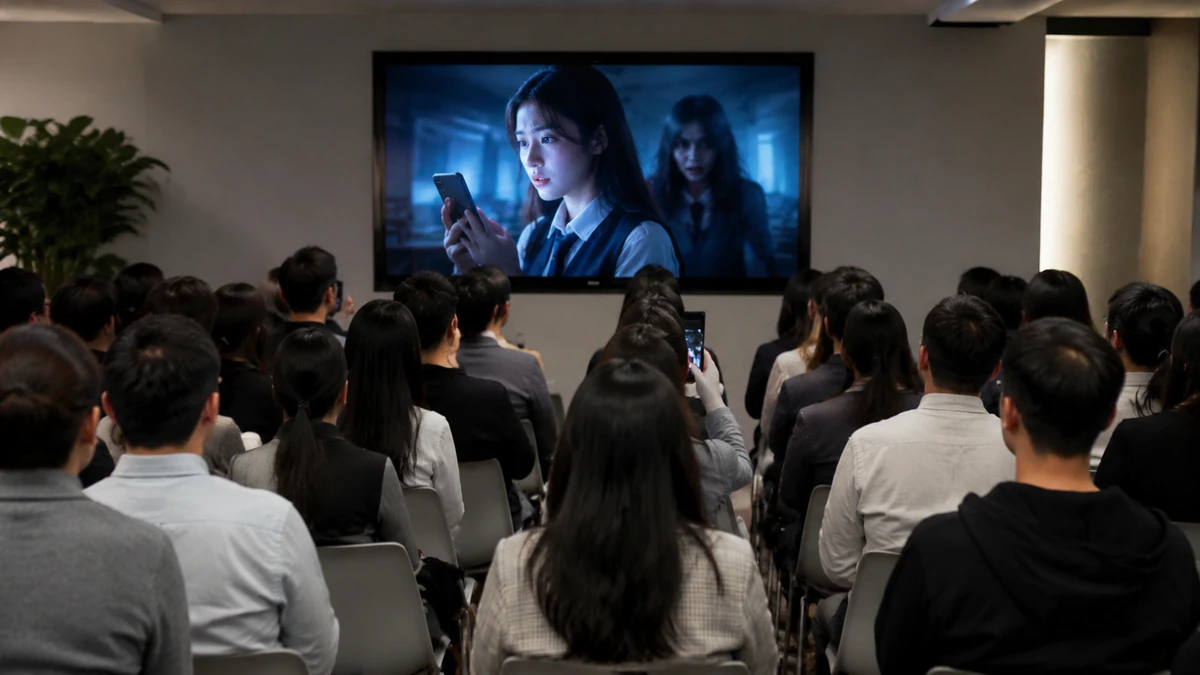
For American audiences, “Girigo” may sound like another example of the now-familiar K-drama success story. But its rise points to something more interesting happening inside the Korean entertainment industry. This is not a sweeping historical epic, a romance designed to dominate fan edits online, or a prestige crime thriller. It is a young-adult horror series — Netflix’s first Korean YA horror title, according to the Korean reporting — built around a cursed wish-granting app and five high school students trying to escape its consequences.
That premise may sound instantly legible to viewers raised on a mix of “Final Destination,” “Black Mirror,” “Buffy the Vampire Slayer,” “Euphoria” and “Stranger Things.” And that is partly the point. “Girigo” is Korean in mood, setting and emotional texture, but it is also immediately accessible in its fears: teenage desire, social pressure, digital dependence and the terrible possibility that the thing you use every day to connect with the world could also become the doorway to disaster.
In other words, “Girigo” is arriving at a moment when global audiences no longer watch Korean series simply to sample something exotic or foreign. They are increasingly watching them because they work — as thrillers, romances, revenge dramas and now, in this case, teen horror. That shift may be the most important part of the story.
What ‘Girigo’ Is About — and Why the Premise Travels So Well
At the center of “Girigo” is a deceptively simple setup. A mysterious app called Girigo grants wishes. But the wishes come with a curse, and five high school students are forced into a struggle to survive what they have unleashed. It is the kind of high-concept pitch that can be explained in one sentence, which is often a major advantage in the streaming era. Viewers scrolling through endless menus respond to instantly understandable ideas, especially when those ideas tap into familiar anxieties.
Here, the anxiety is digital life itself. In South Korea, one of the world’s most wired societies, smartphones and app ecosystems are deeply embedded in everyday routines. But that reality hardly needs much explanation for American audiences. The notion that an app could become the source of dread lands easily in a culture already shaped by concerns about surveillance, addictive algorithms, cyberbullying, data breaches and the psychological cost of online life. “Girigo” takes those modern fears and turns them into supernatural horror.
The school setting also helps. In Korean entertainment, the term “school drama” can cover a broad range of stories involving academic pressure, friendship, bullying, family expectations and social hierarchy. Those themes carry special weight in South Korea, where education is often treated as a high-stakes, all-consuming competition and students can face intense pressure around exams, reputation and future prospects. But American viewers do not need a deep knowledge of Korea’s education system to understand the emotional architecture. Adolescence is already a horror genre of its own. Add group secrets, shifting loyalties and the fear of social collapse, and the framework becomes universally recognizable.
That is one reason Korean commentators have described “Girigo” as a “Korean-style occult school drama.” The occult element matters. In Korean usage, “occult” often refers to stories involving curses, rituals, spirits or other supernatural forces woven into the real world. It is adjacent to what American audiences might think of as supernatural horror, but with a somewhat different tonal tradition. Korean occult storytelling often leans heavily on emotional buildup, atmosphere and moral consequence rather than relying solely on jump scares. The terror tends to emerge not just from what is haunting the characters, but from what the characters wanted badly enough to invite the haunting in the first place.
That structure gives “Girigo” more than a monster-of-the-week engine. A wish is never just a plot device; it is a revelation. Who wants what, and why? What are they willing to risk? What private desperation lies beneath ordinary teenage behavior? A series built around cursed wishes naturally becomes a series about longing, shame, envy and the cost of trying to shortcut pain. That is fertile ground for young-adult storytelling, especially when paired with horror.
Why the Show’s Success Matters Beyond the Rankings
The rankings themselves are impressive, but charts alone do not explain why “Girigo” is drawing attention in Korea’s entertainment press. What stands out is what the show represents in the evolution of K-drama. Korean television has already proven its global reach across several well-known categories: melodrama, family sagas, legal thrillers, zombie apocalypse stories, revenge dramas and romantic comedies, among others. “Girigo” suggests the next phase is not just more of the same, but greater specialization.
That may sound like an industry detail, but it has real implications for viewers. When a national entertainment sector becomes globally competitive, it often starts by producing a handful of broad, universally marketable hits. Over time, if the ecosystem deepens, it branches out into subgenres. American television has long done this, offering everything from teen soaps to procedural crime franchises to prestige limited series to niche horror anthologies. Korean drama is increasingly showing a similar capacity to diversify while still maintaining a distinctive voice.
In that sense, “Girigo” is not simply another successful Korean export. It is a sign that Korean creators and streaming platforms believe there is now a global audience for more finely targeted Korean stories — not just “K-drama” as a broad brand, but K-drama as YA horror, as occult thriller, as coming-of-age suspense. That is a more mature stage of international cultural influence.
It also says something about Netflix’s role in shaping taste. A platform with a worldwide recommendation engine can take a series that might once have been seen as too local or too youth-oriented and place it in front of viewers in dozens of countries at once. If the show has a strong hook and enough emotional clarity to survive translation, it can spread quickly. Dialogue can be subtitled or dubbed. Plot mechanics can be summarized in a thumbnail. Social media can do the rest.
That is especially important for non-English programming, which increasingly competes not as a curiosity but as part of the same entertainment marketplace as Hollywood output. The success of “Girigo” in Netflix’s non-English category indicates that language barriers matter less when genre expectations are sharp, storytelling is disciplined and the central fear is instantly recognizable. For international audiences, a cursed app in a high school is easy to grasp. The specific textures — the Korean classroom culture, the social etiquette, the emotional rhythms — become part of the show’s appeal rather than an obstacle to it.
A Cast of Relative Newcomers Helps Sell the Fear
Another striking part of the “Girigo” story is its cast. Rather than leaning on a giant marquee name, the series is built around younger and less-established actors, including Lee Hyo-je, Jeon So-young, Kang Mina, Hyun Woo-seok and Baek Sun-ho. In the Korean reporting, that newcomer-heavy lineup is presented as one of the reasons the show has been able to generate such immersion.
That logic makes sense. In horror, and especially in stories centered on teenagers, overfamiliar star personas can sometimes get in the way. If viewers are watching a celebrity first and a character second, the suspense can weaken. But actors who arrive without years of accumulated public image often feel closer to the fictional world they inhabit. The audience is less likely to think, There’s the star from that other hit. Instead, they can focus on the panic, confusion and emotional volatility of the characters on screen.
That is true in American entertainment as well. Some of the most effective teen genre pieces — from “It” to early seasons of “Stranger Things” — benefited from ensembles that felt fresh enough to disappear into the story. Newer actors can bring an unprocessed energy that suits coming-of-age narratives, where identity itself is unstable and every emotion feels larger than life.
Lee Hyo-je, one of the actors in “Girigo,” told Yonhap in an interview in Seoul that he had never experienced such an explosive response after a project’s release. He said he was feeling the scale of the show’s popularity through messages from overseas fans as well as reactions from people around him. It is a small quote, but it captures a much larger transformation in the entertainment business.
Not long ago, a young Korean actor might have measured success mainly through domestic ratings, local press coverage or gradual overseas attention through fan communities. Now a Netflix release can generate immediate feedback from viewers in North America, Latin America, Europe and Southeast Asia within days. That changes the speed of recognition and the shape of a career. A newcomer can move from relative obscurity to international visibility almost overnight if the algorithm, the timing and the material align.
That also changes how Korean stardom is built. The old model depended heavily on domestic broadcast success and sustained local fame before broader export. The newer model allows global platforms to introduce fresh faces directly to international viewers. If “Girigo” continues to perform, its young cast may become part of the next wave of Korean talent familiar to audiences far beyond Seoul.
Korean Culture Is Present, but the Show Doesn’t Depend on Exoticism
One of the more notable aspects of “Girigo,” based on the Korean coverage, is that its appeal seems to come not from being conspicuously foreign, but from being understandable. That distinction matters. For years, some international enthusiasm for Korean entertainment was framed through novelty: unusual storytelling rhythms, unfamiliar social customs, stylized emotional expression or genre combinations that felt different from American television. Those elements still play a role, but they are no longer enough on their own.
The most durable global series tend to balance universality with specificity. They offer emotions and conflicts that travel easily, while preserving the local details that make them feel rooted rather than generic. “Girigo” appears to follow that model. The school setting is legible everywhere. The smartphone-based premise belongs to the modern world, not to any one nation. Teenage friendship, rivalry, fear and desire need little translation.
At the same time, the Korean qualities of the series are not erased. Korean school dramas often place unusual pressure on group dynamics, reputation and the tension between public conformity and private distress. Korean horror, especially supernatural or occult-inflected work, frequently emphasizes dread through atmosphere and emotional consequence instead of simply escalating gore. Korean dramas in general are often skilled at turning moral choices into narrative engines. If “Girigo” is working globally, it is likely because it holds onto those qualities while packaging them in a concept broad audiences can enter immediately.
That combination is significant for English-speaking viewers who may still think of K-drama primarily through romance or prestige survival thrillers. “Girigo” broadens the picture. It suggests that Korean creators can inhabit the grammar of YA genre entertainment without flattening their own storytelling traditions. For American viewers, that may be the most compelling invitation: not a cultural lesson disguised as entertainment, but entertainment strong enough to carry its culture with it.
And that may be why the term “Korean-style YA horror” matters here. It is not just a label. It points to a format that could become increasingly important in the streaming era, where youth-oriented franchises, fandom culture and social media discussion can drive repeat viewing. A series built around morally dangerous wishes, tight friend-group dynamics and serialized dread is almost designed for clips, theories and online conversation. Those are precisely the conditions under which global streaming hits tend to thrive.
What ‘Girigo’ Says About the Future of K-Drama
The larger question raised by “Girigo” is not whether one show can succeed. It already has. The more important question is what kind of roadmap it offers for Korean television going forward. If the series continues to connect with international audiences, it will strengthen the case that Korean drama’s next chapter lies in sharper genre segmentation, younger target demographics and concepts that are both culturally rooted and instantly marketable.
That does not mean every Korean series needs a supernatural hook or a teen cast. But it does suggest that the industry no longer needs to rely primarily on either prestige realism or star-driven formulas to break through internationally. Story cohesion, emotional precision and genre execution can be enough. That is encouraging for writers, directors and emerging actors looking to take risks outside the safest commercial templates.
It is also a reminder that the global Korean Wave — often called Hallyu, a term used to describe the international spread of South Korean popular culture — is still evolving. For many Americans, Hallyu first became visible through K-pop, then more broadly through Oscar-winning film, viral survival dramas and high-profile beauty and fashion exports. But entertainment ecosystems do not stay static once they reach international scale. They diversify. They test new audience segments. They refine niche offerings. They stop asking whether foreign audiences will watch and start asking which foreign audiences will watch which kinds of stories.
“Girigo” appears to be one answer to that question. It tells us there is room for a Korean series that speaks directly to younger viewers’ fears about technology, belonging and desire while still satisfying older viewers who come for the craft and the tension. It shows that a newcomer-led cast can compete globally if the material is compelling enough. And it reinforces the idea that subtitles are no longer a significant barrier when the stakes are clear and the storytelling moves with confidence.
For American audiences, the takeaway is simple: If Korean television once entered the U.S. conversation as a trend, it now increasingly looks like a durable part of the entertainment landscape, capable of supplying not just breakout sensations but a widening range of genre fare. “Girigo” may not be the last Korean teen horror hit to find global success. It may simply be the first clear sign that this lane is open.
And that is what makes its performance worth watching. The show’s rise is not just about a ranking on one streaming service. It is about how a local story framework — a cursed app, a Korean high school, five teenagers pushed to the edge — can become a globally intelligible drama without losing its identity. In a crowded marketplace, that balance is difficult to achieve. “Girigo” seems to have found it, and in doing so, it offers a revealing snapshot of where K-drama is heading next.


0 Comments