
A market visit that says as much about foreign policy as it does about groceries
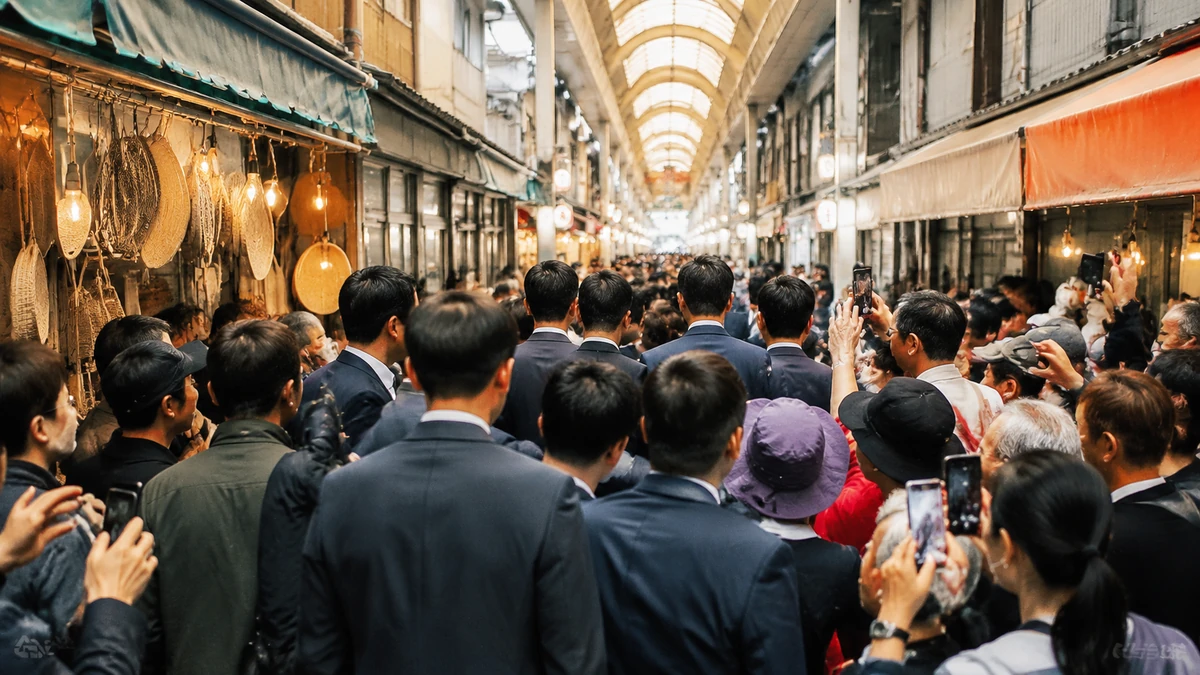
South Korean President Lee Jae-myung spent part of Sunday in a place that, at first glance, seemed far removed from the polished choreography of summit diplomacy: a traditional market in the southeastern city of Andong. He shook hands with shoppers, posed for photos, greeted children with palm-to-palm high-fives and sampled everyday foods sold by vendors, including sundae — a popular Korean blood sausage — fish cake, tangerines and bananas.
In another setting, it might have looked like a routine retail-politics stop, the kind of walk-through American voters would recognize from campaign-season visits to diners, county fairs or factory floors. But the timing gave the outing much greater weight. Lee’s visit to Andong Gu Market came one day before a planned summit in the same city with Japanese Prime Minister Sanae Takaichi, according to South Korea’s Yonhap News Agency.
That sequencing matters. In South Korea, as in many democracies, the images a president creates before a major diplomatic meeting can become part of the message itself. By showing up first in a market aisle rather than a formal state room, Lee appeared to be underscoring a familiar but potent political idea: Foreign policy is not only about strategic communiqués and closed-door talks. It must also be rooted in the daily economic anxieties and routines of ordinary people.
For American readers, it may help to think of the scene as a hybrid of local political theater and national messaging. Imagine a U.S. president heading into a consequential meeting with a major ally, but first stopping by a hometown main street or public market to talk food prices, chat with small-business owners and take selfies with families. The event would not erase the seriousness of the coming summit. If anything, it would frame the summit as something connected to the lives of citizens, not just the interests of diplomats.
That appears to be the point of Lee’s Andong visit. A spokesperson for the presidential office said the trip was designed to communicate with residents and confirm the administration’s commitment to revitalizing the regional economy. Those are simple words, but politically they carry a broader suggestion: that the legitimacy of diplomacy is strongest when it can be presented as serving the public, especially outside the capital.
In a country where politics is often read through symbolism as much as through policy text, the market stop was not a throwaway prelude. It was part of the story.
Why Andong matters far beyond local geography
The setting was central to the message. Andong, in North Gyeongsang province, is one of South Korea’s best-known historic and cultural cities. It is associated with Confucian tradition, old family lineages, preserved architecture and rituals that many South Koreans view as part of the country’s civilizational backbone. For outsiders, Andong is often introduced through images of tiled-roof hanok homes, heritage villages and regional cuisine. It represents a version of Korea that is older, slower and more rooted than the neon intensity of Seoul.
That alone would make it a noteworthy place for a summit. Diplomacy is typically associated with capitals, government compounds and international conference centers. Holding high-level talks in a regional city sends a different signal. It suggests that the nation being presented to a foreign leader is not only the modern, hyperconnected South Korea of skyscrapers, semiconductors and K-pop exports, but also the provincial, historical and culturally grounded Korea that many citizens see as equally authentic.
There is also a personal layer. According to the summary of the Korean report, Andong is Lee’s hometown. That gives the market visit an additional political charge. A president returning to his home region on the eve of a summit with Japan can be read in multiple ways at once: as a gesture of familiarity, as a grounding exercise before a major international engagement, and as an attempt to tie statecraft to a specific community rather than to an abstract national stage.
For an American audience, the hometown angle is easy to understand. U.S. politicians often rely on hometown imagery to signal authenticity, emotional rootedness and connection to the people who shaped them. The details differ, but the logic is the same. A leader standing in a place where his biography intersects with the nation’s political moment is telling voters: I know where I come from, and I have not left ordinary life behind.
Andong also offers a reminder that South Korea is not just Seoul, even though international coverage often treats it that way. Much foreign reporting on South Korea moves between the presidential office, the National Assembly, the business districts of the capital and the demilitarized border with North Korea. But regional cities matter deeply in Korean political identity. They hold economic grievances, historical pride and local sensibilities that national leaders ignore at their peril. By making Andong the backdrop for both domestic outreach and international diplomacy, Lee’s team appears to be highlighting that the country’s political and diplomatic center of gravity can, at least temporarily, shift beyond the capital.
What a traditional Korean market represents in politics
To understand why a visit to a place like Andong Gu Market resonates, it helps to understand the role of traditional markets in South Korean public life. These markets are not simply shopping venues. They function as neighborhood institutions, social gathering places and visual shorthand for the state of the everyday economy. They are where inflation is felt in real time, where small merchants measure foot traffic and where citizens experience economic confidence or anxiety in the most concrete possible form.
In the United States, politicians often use visits to small businesses, family farms or local restaurants to show they are in touch with the middle class. In South Korea, traditional markets serve a similar purpose, but often with even stronger symbolic force. They evoke a living economy that predates big-box retail and online commerce, and they remain potent political stages because they condense so many social realities into one walkable space: food prices, neighborhood vitality, household consumption and the pressures facing independent merchants.
That helps explain why seemingly casual details from Lee’s visit are politically meaningful. A president sampling fish cake from a market stall or chatting with fruit sellers is not just performing friendliness. He is entering a space that symbolizes the practical side of governing: whether people feel they can afford meals, whether regional commerce feels healthy and whether communities outside metropolitan centers believe they are being seen.
The Korean summary notes that Lee responded to photo requests from citizens and greeted children directly. Those images matter because they offer a different political language from speeches or policy briefings. They communicate contact over abstraction. The message is not delivered in bullet points but in body language: stopping, listening, tasting, smiling, engaging. Modern politics everywhere depends on image management, but in moments like this, imagery can also carry substantive meaning. A market walk before a summit suggests that international relations are being framed not as remote elite business, but as something whose ultimate justification lies in public welfare.
There is also an unmistakably Korean element here. Traditional markets remain one of the most recognizable settings in South Korean politics for demonstrating concern about what is often called minsaeng, a Korean term broadly referring to people’s livelihoods, bread-and-butter concerns and the conditions of everyday life. It is the kind of concept American politicians usually invoke with phrases like “kitchen-table issues” or “the cost of living.” When Korean officials speak about minsaeng, they are talking about the lived economy — the financial reality people encounter not in macroeconomic charts, but in groceries, rent, school expenses and family budgets.
Seen through that lens, Lee’s market stop was more than a photo opportunity. It was a minsaeng message delivered in the most literal setting possible.
Domestic concerns and Japan diplomacy in the same frame
The most striking feature of the day was its overlap of domestic and diplomatic messaging. Lee was not just making a regional appearance. He was doing so immediately before a summit with Japan’s prime minister, a meeting that carries significance in any political season because of the complexity of South Korea-Japan relations.
The Korean summary does not provide details about the summit agenda, and it would be irresponsible to infer specific policy outcomes not in evidence. But even without knowing the exact talking points, the staging tells us something about how Lee’s office wants the meeting understood. It appears to be presenting diplomacy not as an arena detached from ordinary life, but as one anchored in it.
That distinction matters especially in the case of Japan. Relations between South Korea and Japan are among the most important in East Asia, but also among the most emotionally layered. The two countries are close economic and security partners, both allied with the United States, yet they also carry unresolved historical grievances tied to Japan’s colonial rule over the Korean Peninsula from 1910 to 1945. Political atmospherics can shift quickly depending on questions of historical memory, trade, security cooperation and domestic opinion.
For Americans, perhaps the simplest comparison is to imagine a bilateral relationship that is strategically necessary, economically valuable and publicly sensitive all at once. Leaders in Seoul and Tokyo do not approach one another in a vacuum. They do so with the weight of history in the room, along with urgent present-day concerns ranging from regional security to supply chains and global economic uncertainty.
Against that backdrop, Lee’s decision to foreground a market visit before meeting Takaichi suggests a carefully chosen frame: whatever is discussed at the summit, the administration wants it understood against the backdrop of livelihoods at home. It is a reminder that diplomacy is often sold domestically not in the language of grand strategy, but in terms of whether it contributes to stability, growth and confidence for citizens.
That does not mean the market stop should be overread as a detailed policy statement. It is not one. There were no specific agreements announced in the summary, no explicit linkage drawn between trade terms and prices at the stalls Lee visited. But politics often operates through implication rather than direct declaration. By making the market the visual overture to a summit, Lee’s office created a narrative bridge between foreign affairs and the local economy. The message, at minimum, is that the two belong in the same conversation.
That may be particularly important at a moment when democracies around the world face skepticism about whether international engagement benefits average citizens. Leaders increasingly feel pressure to show not just that they can manage alliances, but that those alliances have practical relevance at home. In that sense, the Andong outing fits into a broader global pattern: foreign policy is more politically durable when it can be narrated as domestic policy by other means.
A softer stage for a relationship often burdened by history
The choice of Andong as the site of the summit itself may also shape how the meeting is perceived. A capital city can project authority and institutional control, but it can also reinforce the sense that diplomacy happens in a rarefied, official world. A regional city with a strong cultural identity sends a different signal. It humanizes the setting, broadens the national image and invites foreign visitors into a deeper, more textured version of the host country.
That may be useful in the case of South Korea and Japan, where the symbolism surrounding meetings can matter almost as much as the formal outcomes. A summit in a place known for heritage and local character can soften the atmosphere without trivializing the stakes. It says, in effect, that this is not merely a bureaucratic encounter between states but a meeting taking place within a lived society with memory, tradition and public sentiment.
The Korean summary also notes that Lee greeted foreign tourists during his market walk. On paper, that is a small detail. Symbolically, it is a revealing one. It captures the reality that even local Korean spaces are now deeply connected to global flows of travel, commerce and culture. A traditional market in a historic city is no longer just a local setting; it is also a place where Korea presents itself to the world.
That point will be familiar to anyone who has watched South Korea’s global profile expand over the last two decades. The country once often explained abroad through geopolitics — North Korea, the war, the U.S. alliance — is now also known through entertainment, beauty products, food, technology and tourism. As a result, the venues where national identity is displayed have multiplied. Diplomacy can happen in a summit hall, but national image is also constructed in a market lane, a food stall, a heritage site or a fleeting interaction with a visitor from overseas.
By choosing a setting like Andong, Lee’s government appears to be leveraging that broader reality. It is showing a foreign counterpart, and by extension the international public, that South Korea’s political life cannot be reduced to central government institutions. The country’s regional culture, local economy and public spaces are also part of the diplomatic stage.
For U.S. readers used to thinking of diplomacy in Washington terms, this is worth pausing over. Not every important international signal is sent from a capital podium. Sometimes it is sent from a sidewalk market, by a leader making the case that the nation he represents is rooted in places that still buy and sell face to face.
The politics of regional economies and everyday legitimacy
The presidential spokesperson’s emphasis on regional economic revitalization points to a larger political challenge, one that is hardly unique to South Korea. National governments can tout headline growth, technological prowess and global influence, yet still face public discontent if smaller cities and local merchants feel left behind. That gap between national success and local insecurity has become a defining issue in many advanced economies, including the United States.
South Korea’s version of that tension is shaped by the extraordinary gravitational pull of Seoul, where political power, corporate headquarters, top universities and media institutions are heavily concentrated. Regional areas often worry about stagnation, aging populations and the uneven distribution of opportunity. In that environment, a presidential appearance in a traditional market is not just about warmth and accessibility. It is also an acknowledgment that the health of the country cannot be measured only by urban skylines or export statistics.
The visual vocabulary of Lee’s visit reinforced that point. Tasting street and market foods, chatting with vendors and moving through narrow commercial alleys all conveyed a kind of political closeness that formal speeches cannot replicate. It suggested attentiveness to prices, customers and the mood of local commerce — in other words, to the micro-level realities that people experience as the economy.
In American political culture, presidents frequently try to stage similar moments, though not always successfully. A stop at a family-owned manufacturing shop or a local breakfast spot is meant to signal concern for ordinary life. The risk, in any country, is that such visits can look overly scripted. But even when carefully managed, they matter because they reveal what a leader believes is worth being seen doing. On the eve of a summit with Japan, Lee chose to be seen in a market.
That choice suggests an understanding of political legitimacy that is grounded in proximity to citizens. In democracies, leaders do not simply represent the state abroad because the constitution says they do. They sustain that representative authority by maintaining visible contact with the public at home. The market stop, especially with its scenes of casual interaction, can be read as a demonstration of that principle.
There is a practical political benefit as well. Major diplomatic meetings can sometimes feel remote or elite to voters, especially when their outcomes are uncertain or couched in technical language. By pairing a summit with a highly legible domestic scene, the administration makes the diplomatic moment easier to narrate to the public. The story becomes not just “the president meets a foreign leader,” but “the president heads into international talks after hearing directly from citizens and small merchants.”
Whether that framing yields policy dividends remains to be seen. But as political storytelling, it is coherent and deliberate.
What international audiences can learn from this moment
For global readers trying to understand contemporary South Korean politics, the Andong visit offers a revealing snapshot. It shows a political culture in which domestic livelihood issues and international diplomacy are not always presented as separate lanes. It highlights the enduring importance of regional identity in a country often internationally flattened into the image of its capital. And it demonstrates how traditional public spaces remain powerful stages for national leadership, even in one of the world’s most digitally connected societies.
It also shows how Korean presidents often communicate through layered symbolism. A market walk is never only a market walk. A hometown visit is never only a hometown visit. A summit outside Seoul is never only a change of venue. Each element can carry social, regional and diplomatic meaning at the same time.
For American readers, there is a useful lesson in resisting the urge to sort foreign politics too neatly into “domestic” and “international” categories. In practice, leaders often blend them. The same political image can speak simultaneously to inflation, national identity, alliance management and electoral legitimacy. That is what appears to have happened in Andong.
Lee’s visit did not produce a treaty, and by itself it did not resolve any of the difficult questions that shape Seoul-Tokyo relations. But it did something subtler: It illustrated how South Korea wants to present itself at a moment of diplomatic attention. Not only as a state negotiating with a key neighbor, but as a society whose diplomacy is anchored in citizens, regional communities and the lived economy.
That image matters. South Korea’s global story is often told through blockbuster cultural exports, advanced technology and strategic importance. All of those are real. But so is the quieter image of a president in a traditional market, tasting familiar foods, listening to vendors and preparing to host a foreign leader far from the capital. It is a scene that compresses many layers of modern Korea into one frame: local and global, historical and contemporary, political and personal.
On the eve of a summit with Japan, that may be exactly the point. Before diplomacy enters the meeting room, it first passes through the marketplace — through the place where citizens live with the consequences of policy, where regional identity remains vivid and where a government can signal that its international ambitions are meant to rest on something more concrete than ceremony. In Andong, South Korea’s president appeared to be making that case in the most visible way possible: by starting with the people in front of him.



0 Comments