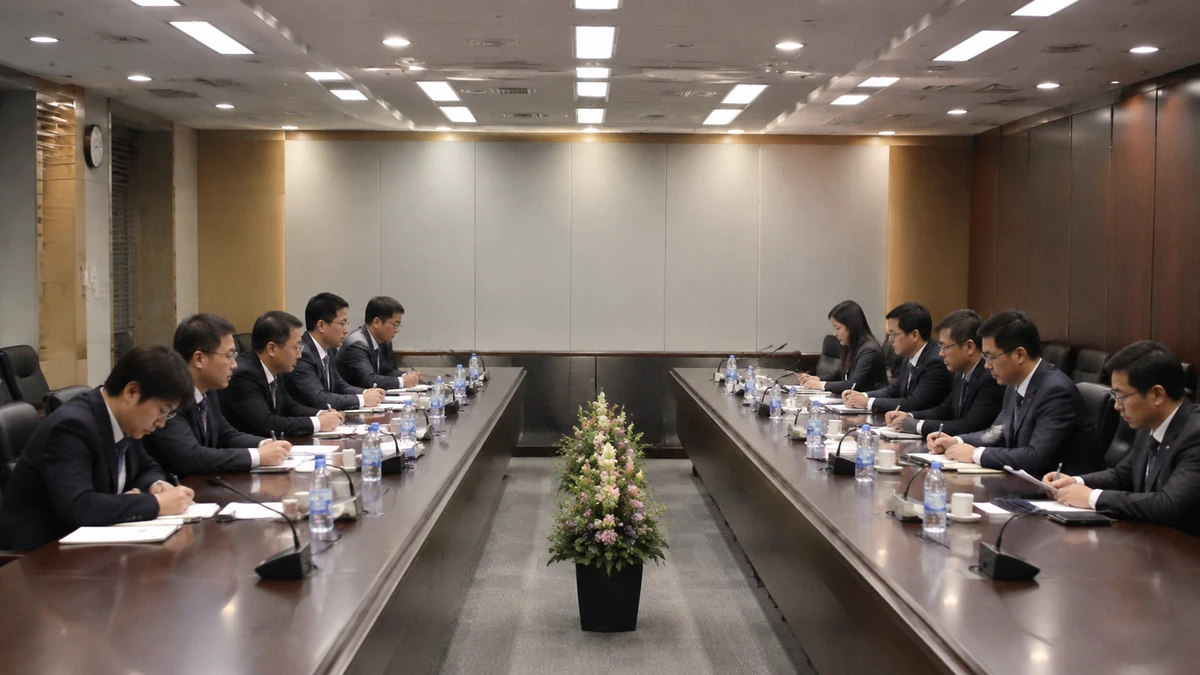
A modest diplomatic meeting with bigger economic implications
At first glance, the latest South Korea-Kyrgyzstan economic talks might look like the kind of dry government meeting that rarely travels far beyond foreign ministry press releases. There were officials in suits, standard statements about cooperation and trade, and the usual language about future opportunity. But beneath that formal setting was a message that says a great deal about how South Korea is thinking about growth in 2026: if Korean companies are going to expand abroad, they want more than warm invitations. They want predictability.
That was the central takeaway from the seventh South Korea-Kyrgyzstan Joint Economic Committee meeting, held Wednesday at South Korea's Foreign Ministry in Seoul, according to Yonhap News Agency. The meeting brought together Park Jong-han, South Korea's coordinator-general for economic diplomacy, and Bakyt Sydykov, Kyrgyzstan's minister of economy and commerce. Kyrgyzstan welcomed recent growth in bilateral trade and expressed hope for expanded investment by South Korean businesses. South Korea, for its part, emphasized something more cautious and concrete: the need for a stable business and investment environment, along with attention to the difficulties already faced by Korean companies operating on the ground.
That difference in emphasis matters. One side is asking for more capital and a deeper commercial footprint. The other is effectively saying that investment will follow only if the rules are clear, operations are sustainable and businesses believe they can navigate the local market without unexpected disruption. In other words, Seoul is not rejecting expansion. It is defining the conditions under which expansion becomes realistic.
For American readers, this may sound familiar. U.S. companies weighing new investments in emerging markets often say the same thing: market potential is not enough. What matters just as much is whether contracts are enforceable, regulations are understandable, logistics are dependable and governments respond when foreign firms run into trouble. South Korea's message to Kyrgyzstan reflects that same logic, and it shows how Korean firms increasingly approach overseas growth less as a splashy headline and more as a long-term operating question.
That makes this meeting more than diplomatic housekeeping. It offers a small but revealing snapshot of how one of Asia's most globally connected economies is trying to secure its next phase of growth.
Why this meeting matters now for South Korea
The timing is important. As of May 22, 2026, much of the attention around South Korea's economy has centered on pressures that would be recognizable to households almost anywhere: inflation, energy costs and the uneven recovery of domestic consumption. Those are immediate concerns, and they matter politically. But for companies and policymakers thinking beyond the next quarter, the larger question is where future growth will come from.
South Korea has long relied on exports as a pillar of its economic model. It is home to globally recognized companies in semiconductors, automobiles, batteries, shipbuilding, consumer electronics, construction and digital services. Yet even a highly diversified export economy eventually runs into a strategic challenge: mature markets become crowded, geopolitical risks grow and the competition for new customers intensifies. That forces governments and businesses alike to look for openings in places that may not be traditional headline markets but still offer room for trade, infrastructure, services and industrial cooperation.
That is where a country like Kyrgyzstan enters the conversation. It is not a household name for many Americans, and it is not one of South Korea's marquee economic partners in the way that the United States, China, Japan or Vietnam are. But it sits in Central Asia, a region that has drawn increasing attention from countries seeking new trade corridors, alternative supply-chain relationships and strategic influence between larger powers.
For Seoul, these relationships can serve multiple purposes at once. They can create export demand, open doors for engineering and service firms, support energy and logistics cooperation and provide Korean companies with a foothold in markets that may grow more important over time. That does not mean every meeting produces a boom in investment. It does mean South Korea is trying to turn diplomatic ties into more durable economic channels.
The language used in this week's talks suggests officials see that process as incremental. Rather than touting a major new agreement or a dramatic influx of capital, the discussion focused on trade growth, investment expectations, operating conditions and the experiences of existing firms. That may be less flashy than announcing a billion-dollar project, but it is often how serious commercial relationships are built. Trade tends to come first. Investment follows if the environment proves workable.
Kyrgyzstan's pitch and Seoul's answer
According to the South Korean Foreign Ministry's account of the meeting, Kyrgyzstan highlighted the recent increase in trade between the two countries and voiced hope that Korean companies would expand their investments. That is a straightforward and understandable pitch. When a country sees trade rising, it often wants to move up the ladder from buying and selling goods to attracting factories, technology partnerships, distribution networks or service-sector operations.
For Kyrgyzstan, courting South Korean investment is also about signaling something broader. South Korea carries a reputation in many developing and middle-income markets as a technologically capable, export-oriented partner that can bring not only money but also know-how, management systems and manufacturing expertise. Korean companies are often seen as disciplined operators, and Korean brands can carry consumer appeal shaped in part by the wider global popularity of South Korean culture, from K-pop and Korean dramas to beauty products and food. That cultural visibility does not automatically translate into investment, but it can help raise interest in Korean business partnerships.
Seoul's response, however, was tellingly pragmatic. South Korea emphasized the importance of a stable environment for business activity and investment and asked for interest and cooperation regarding the concerns of Korean companies already operating locally. In diplomatic language, that is a polite but unmistakable signal. South Korea is saying the conversation cannot stop at aspiration. If Kyrgyzstan wants more Korean capital, it must convince businesses that they can operate there with confidence.
That distinction is important because foreign investment is not just about how much money a company is willing to put in at the start. It is about whether that investment can be maintained, expanded and defended over time. A company can survive a tough market; what it struggles with is uncertainty it cannot price in. That includes sudden regulatory shifts, opaque approval processes, customs bottlenecks, weak dispute-resolution mechanisms and inconsistent treatment from local authorities.
In this sense, South Korea's position appears less like hesitation and more like discipline. Korean firms have spent decades building international footprints, and many now operate with the mindset of seasoned global players. They are not simply looking for the next place to plant a flag. They are asking whether a market is governable from a business perspective.
What a "joint economic committee" actually does
To many readers, the phrase "Joint Economic Committee" may sound like bureaucratic wallpaper, the kind of institutional mechanism governments maintain out of habit. But these committees often serve a practical purpose, especially in markets where business conditions are still developing or where foreign companies need government-level support to resolve obstacles.
Think of it as a structured troubleshooting forum as much as a venue for promotion. When companies enter a new country, their biggest problems are often not the products they sell or the customers they target. The real obstacles tend to be administrative and structural: licensing procedures, customs clearance, legal certainty, tax treatment, labor rules, land use, banking access and coordination with local agencies. Those are not always issues that a private company can solve on its own, particularly if it lacks political familiarity or leverage in the local system.
That is where government-to-government channels matter. A joint committee does not guarantee investment, and it certainly does not remove all risk. But it gives both sides a formal place to identify bottlenecks, communicate expectations and show that commercial grievances are being treated as policy matters rather than left entirely to private negotiation.
In the South Korea-Kyrgyzstan case, the very fact that concerns faced by Korean companies were raised as part of the official agenda is significant. It suggests the discussion was not limited to ceremonial language about friendship and future potential. It included the more grounded question of what currently operating businesses are experiencing and whether those experiences are likely to encourage or discourage additional investment.
For American readers, there is a useful parallel in the way U.S. trade missions and bilateral business councils often function. The most meaningful conversations are frequently not about broad slogans like innovation or partnership. They are about specific impediments: how long permits take, whether customs procedures are transparent, whether local courts are trusted and whether a foreign employer can make long-term plans without worrying that the regulatory climate will change overnight.
That is why this meeting deserves attention even without blockbuster announcements. It reflects the mechanics of economic statecraft in real time. One country wants more investors. The other wants proof that investors can stay and succeed.
The bigger story: South Korea's global business strategy is maturing
There is also a broader strategic point here. South Korea's global economic expansion is no longer only the story of giant conglomerates chasing scale in the world's largest markets. It increasingly includes a wider range of companies in manufacturing, retail, logistics, technology, services and digital solutions looking for new openings across diverse regions.
That shift matters because it changes the kind of support businesses need from Seoul. A large multinational like Samsung, Hyundai or LG typically has extensive resources for legal review, market intelligence and risk management. Smaller or midsize firms often do not. For them, the stability of local institutions and the responsiveness of host governments can make the difference between entering a market and staying away altogether.
Seen through that lens, South Korea's message in this week's meeting was not simply about Kyrgyzstan. It was about the standards Seoul increasingly wants applied across its overseas commercial relationships. This is a country that has spent years climbing the value chain, building brands with global reach and refining a reputation for industrial quality. It is not surprising that it now wants its outward investment strategy to be guided less by speed and more by durability.
That is especially relevant at a time when supply chains are being rethought worldwide. Since the pandemic and amid intensifying U.S.-China rivalry, companies around the world have become more sensitive to resilience, diversification and political risk. Governments have also become more active in supporting national champions abroad and in helping companies reduce exposure to single markets or unstable operating environments.
South Korea is hardly alone in this. Japan, the European Union and the United States have all pushed versions of the same basic idea: diversification matters, but only if it does not create new vulnerabilities. In that context, a stable business environment is not a secondary issue. It is the core condition that determines whether diversification is prudent or reckless.
So while Kyrgyzstan's call for expanded Korean investment reflects opportunity, Seoul's emphasis on stability reflects experience. It suggests Korean officials understand that outward growth is not measured only by the number of deals announced. It is measured by whether companies can build lasting operations that survive beyond the photo op.
Why Central Asia is drawing more attention
Kyrgyzstan's importance in this conversation also points to a wider geographic trend. Central Asia has become a region of growing interest to middle powers and major economies alike. Sandwiched between Russia, China and the broader Eurasian landmass, the region has strategic value that goes well beyond the size of any one national economy.
For countries like South Korea, Central Asia offers several potential advantages. It can provide access to emerging consumer markets, infrastructure opportunities and industrial cooperation. It can also play a role in broader connectivity strategies as governments and companies seek transport routes and partnerships less dependent on a handful of heavily contested corridors.
Kyrgyzstan itself is not the largest economy in the region, but countries do not need to be economic giants to matter. They can matter because of location, policy alignment, sector-specific opportunity or their place in a broader regional strategy. South Korea has steadily built ties across Central Asia over the years, often combining economic engagement with people-to-people ties, educational exchange and diplomacy.
There is another layer that may be less visible but still relevant. South Korea often works to convert political goodwill into institutionalized economic relationships. That means using formal committees, ministerial visits and policy dialogues to reduce friction before businesses commit substantial resources. In fast-growing but administratively uneven markets, that kind of groundwork can be more valuable than a loud announcement that later fails to materialize.
For U.S. readers used to seeing Asia coverage dominated by China, Japan and India, these smaller diplomatic and economic moves can be easy to overlook. But they help explain how South Korea is positioning itself in a more fragmented global economy. Seoul is not only protecting existing export engines. It is also exploring the next ring of markets where Korean expertise, brands and capital might find room to grow.
What this says about South Korea's economic priorities at home
The significance of the meeting becomes even clearer when placed alongside South Korea's domestic economic concerns. Around the same time, the government was also managing more immediate pressures tied to prices and energy costs. South Korea's Industry Ministry said a sixth round of maximum petroleum pricing would be frozen as of Thursday and that the designated pricing period would be extended from two weeks to four weeks.
That detail may seem unrelated to a meeting with Kyrgyzstan, but it illustrates a familiar balancing act. On one front, policymakers are trying to contain short-term cost pressures that affect households and current corporate profitability. On another, they are trying to strengthen the long-term conditions for growth by helping Korean firms expand into new markets.
Those two tracks are deeply connected. Businesses make decisions based on both present costs and future opportunity. Energy prices, inflation and consumer demand shape near-term margins. Overseas market access, regulatory predictability and investment climate shape long-term strategy. A government that wants durable economic growth has to work on both at once.
That is why the South Korea-Kyrgyzstan talks should not be dismissed as secondary diplomacy. They form part of a broader economic playbook in which Seoul attempts to stabilize pressures at home while cultivating options abroad. The underlying logic is straightforward: domestic headwinds can make external growth channels even more valuable, but only if those channels are reliable enough to justify the risk.
There is no guarantee that this week's meeting will produce a surge of Korean projects in Kyrgyzstan anytime soon. Trade growth does not automatically become investment. Expressions of interest do not erase operational uncertainty. But diplomatic sequencing matters. When governments acknowledge rising trade, discuss investment conditions and formally raise the obstacles companies face, they create a framework that can make future business decisions more likely.
In economics, momentum is often built not through a single dramatic leap but through a series of steps that reduce uncertainty. This meeting appears to be one of those steps.
The signal for global investors and observers
For international audiences, the most interesting part of this story may be what it reveals about South Korea's current mindset. The country is still ambitious about external growth. It is still looking beyond its traditional partners. And it is still willing to use diplomacy to open commercial doors. But it is also showing a sharper insistence on the quality of the environment into which its companies are asked to expand.
That approach may sound technical, but it is a sign of strategic maturity. It suggests South Korea is moving beyond the simple question of whether an emerging market wants Korean investment. The more important question is whether the market can sustain Korean investment under conditions that businesses find credible.
For Kyrgyzstan, that means the invitation alone is not the finish line. The challenge now is to demonstrate that rising trade can be matched by the kind of stable operating climate that foreign investors seek. For South Korea, it means continuing to build commercial relationships with clear eyes about what makes them viable.
And for readers in the United States and elsewhere, the story offers a useful reminder that the future of global business is often shaped in rooms like this one, far from the spotlight of summits or headline-grabbing factory announcements. These are the places where governments test each other's seriousness, where commercial optimism meets operational reality and where the next layer of economic relationships is quietly negotiated.
South Korea's message in Seoul this week was not anti-investment. It was, in some ways, more pro-investment than a generic call for growth. It was a statement that lasting investment depends on trust, rules and stability. In a volatile global economy, that may be the most realistic growth strategy of all.
Comments
Post a Comment