
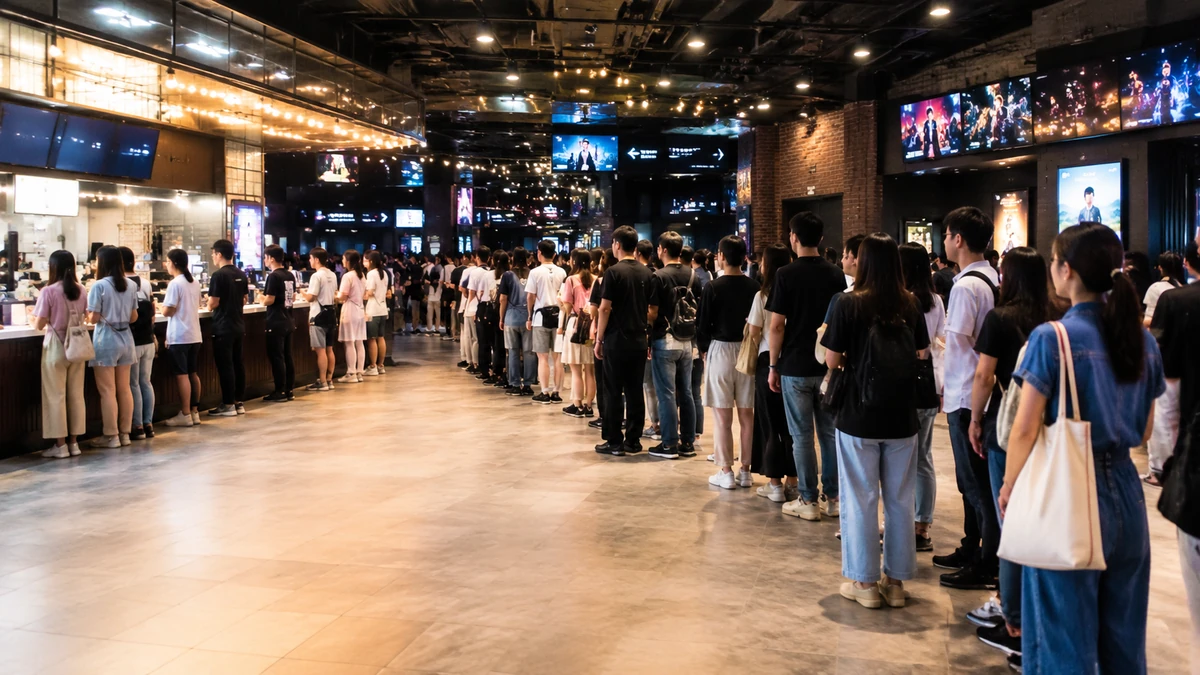
A government-backed discount aimed at the box office
South Korea is launching a large-scale ticket discount program designed to make moviegoing cheaper almost overnight, a move that speaks to a problem familiar far beyond Seoul: Even in a country known for its global entertainment exports, getting people back into theater seats has become harder when ticket prices feel high and home viewing is easier than ever.
Beginning at 10 a.m. on June 13, South Korea’s Ministry of Culture, Sports and Tourism and the Korean Film Council, or KOFIC, will distribute 2.25 million discount coupons worth 6,000 won each, according to the Yonhap News Agency. At current exchange rates, that is roughly equivalent to about $4.30 off a ticket. Each person can receive up to two coupons. Another 2.25 million coupons are scheduled for release in July, bringing the total planned giveaway to 4.5 million.
The headline number matters, but the policy’s deeper significance is less about the coupons themselves than what they target: the moment a would-be moviegoer decides whether a night at the cinema is worth the cost. In entertainment industries, especially film, audiences often say they want to support theaters, local filmmaking and the shared experience of watching on the big screen. But the deciding factor can be more practical than sentimental. It is often not, “Is there a good movie out?” but, “Is this affordable enough to go tonight?”
That is what makes this measure noteworthy. Instead of focusing on production subsidies, film festival promotion or prestige branding, the South Korean government is trying to intervene at the cash register. It is a demand-side strategy, one aimed directly at reducing what economists sometimes call price resistance: the point at which consumers decide an experience is simply too expensive to justify, even if they are interested.
For American readers, the closest comparison might be a mix of a public arts subsidy and a nationwide movie theater promotion rolled into one. Imagine if the federal government, working with the major theater chains, announced millions of limited digital discounts redeemable through AMC, Regal and Cinemark, while also including art-house and community theaters. That is roughly the scale and intent of what South Korea is attempting.
Why ticket prices matter so much in South Korea’s film market
South Korea has one of the world’s most dynamic movie cultures. It is the country that produced “Parasite,” the first non-English-language film to win the Academy Award for best picture, and filmmakers such as Bong Joon Ho and Park Chan-wook have become familiar names to American cinephiles. Korean dramas and K-pop may dominate international headlines under the broader banner of the Korean Wave, or Hallyu, but film remains a crucial part of the country’s cultural identity and export economy.
At the same time, the domestic theater business faces many of the same pressures that American exhibitors do. Streaming has changed audience habits. Families and younger viewers weigh the cost of a theater outing against what they already pay for subscription platforms. And once ticket prices rise above a certain psychological threshold, even highly engaged entertainment consumers start becoming selective. They may wait for strong reviews, choose only event films or skip the theater altogether unless the outing feels like a clear value.
That is especially relevant in South Korea, where moviegoing has long been both a mainstream pastime and a highly digitized consumer behavior. Online booking is widespread, mobile apps are routine and consumers are used to checking discounts, loyalty points and promotional offers before making a purchase. In that environment, a policy that lowers the visible final price can have an immediate effect, because it plugs directly into habits audiences already have.
The 6,000-won discount is substantial enough to be felt, not merely advertised. The government’s message is straightforward: If high prices have become one reason people hesitate, then lowering the price is the most direct signal possible. In policy terms, that kind of simplicity can be powerful. Instead of hoping broader support for the arts will trickle down to ticket buyers, the discount addresses the audience’s most immediate concern.
There is also a cultural dimension here. South Korea treats film not only as commercial entertainment but also as part of the national cultural ecosystem. That means the state is often more visibly involved in supporting film infrastructure than many Americans might expect. KOFIC, a public institution, plays a central role in the industry, helping with development, promotion and policy coordination. So while government involvement in moviegoing may sound unusual from a U.S. perspective, in the Korean context it fits into a longer tradition of seeing cinema as both industry and public culture.
How the coupon program works
The structure of the program reveals careful planning rather than a one-time publicity event. The government secured 27.1 billion won, or about $19 million, in supplementary budget funding to support a total of 4.5 million movie discounts. Only half of those will be released first, with the remaining half scheduled for July. By spacing out the distribution, officials appear to be trying to avoid a short-lived rush followed by a quick fadeout. Instead, they are creating two separate opportunities to stimulate demand over time.
That staggered release sends a mixed but useful message to audiences. On one hand, there is another chance coming in July, so missing the first round does not mean missing out entirely. On the other hand, these are not open-ended coupons that sit in an account indefinitely. Participating theaters have limited allotments, and unused coupons expire automatically once a theater’s supply is exhausted. In other words, they function less like a passive loyalty perk and more like a limited public benefit tied to timing and availability.
The main redemption channels are South Korea’s major multiplex chains: CGV, Lotte Cinema, Megabox and Cine Q. Users can access the discount through those companies’ websites and mobile apps, where up to two coupons per person will be automatically issued to members’ accounts. That kind of automatic digital delivery matters. It lowers friction. There is no lengthy application, no mailing process and no separate claims system. In a country where mobile-first consumer interfaces are standard, ease of access may be almost as important as the discount itself.
The two-ticket limit is also a notable design choice. It is enough to let someone see two different movies, or to let two people go together. That reflects a basic truth about moviegoing: It can be a solo activity, but it is often social. By setting the cap at two, policymakers encourage use without allowing a small number of users to hoard the benefit. It is a practical balance between access and distribution fairness.
For readers in the United States, this may sound somewhat similar to the logic behind limited digital offers on food delivery apps or live event platforms: The incentive works best when it is easy to claim, simple to understand and urgent enough to prompt action. The Korean government appears to be borrowing that consumer logic for a cultural policy goal.
Not just for blockbuster theaters
One of the more striking elements of the program is that it is not confined to the big multiplex chains. The discount can also be used at independent and art-house theaters, so-called small theaters, and “silver cinemas,” venues that often cater to older audiences. That broader eligibility matters because it signals that the policy is not only about boosting the next commercial hit. It is also about reducing barriers to film access more generally.
For Americans unfamiliar with the Korean theater landscape, the distinction is important. South Korea, like the United States, has large chains that dominate mainstream theatrical exhibition. But it also has smaller cinemas that play independent, artistic or specialized programming, sometimes with a stronger community or cultural mission than a strictly commercial one. Including them means the policy is not solely structured around blockbuster economics. It recognizes that film culture depends not just on ticket volume, but on the diversity of spaces where people watch movies.
The administration of the program also appears tailored to differences in theater infrastructure. Some of these smaller venues will offer the discount through their websites, but for theaters that cannot provide the coupon through an online system, it will be distributed on a first-come, first-served basis at the box office. That may sound like a minor operational detail, but it reflects a practical policy instinct: Do not design a program that only works for institutions with the most sophisticated digital systems.
In many countries, including the United States, public programs intended to be universal often end up favoring people and institutions that already have the best online access. South Korea’s approach here suggests an attempt to reduce that gap, at least somewhat. The rules are broadly standardized, but implementation varies according to the real-world capacity of different theaters.
Participating theater lists will be available on KOFIC’s website, which means audiences still need to verify where and how they can use the benefit. That may become one of the biggest variables in how successful the rollout feels on the ground. A generous program can still frustrate consumers if information is unclear, if inventory disappears too quickly or if redemption rules differ from theater to theater in ways users do not expect.
The real bargain: stacking discounts
Perhaps the most consumer-friendly part of the program is that these coupons can be combined with several existing discount systems. That is not always how promotions work. Frequently, one coupon cancels out another, leaving the user to choose the single best option. Here, the policy is designed to maximize the audience’s felt savings rather than merely advertise a formal discount.
According to the report, moviegoers at CGV, Lotte Cinema and Megabox can combine the 6,000-won coupon with “Culture Day” discounts on the second and last Wednesday of each month. “Culture Day,” for readers unfamiliar with the term, is a government-supported initiative in South Korea that encourages cultural participation by offering lower-cost access to certain activities on designated days. When stacked with the new movie discount, the final ticket price at those chains could drop to 4,000 won, or under $3.
That is the kind of price point that can change behavior. In the U.S., theater subscription plans and discount Tuesdays have shown that consumers respond quickly when the cost of going out dips low enough to feel impulsive rather than calculated. South Korea’s policy is trying to produce a similar effect, turning moviegoing from a higher-cost decision into something closer to an easy yes.
The coupons can also be used with discounts for people with disabilities, seniors, teenagers and early-morning screenings. Those categories suggest the government is not starting from scratch but building on an existing ecosystem of audience support. At the same time, there are limits. If stacking discounts pushes a ticket below 1,000 won, the final price is adjusted up to 1,000 won. And telecom membership discounts, a common perk in South Korea’s consumer economy, cannot be combined with the new offer.
That balancing act is revealing. The policy aims to create meaningful relief without essentially making tickets free. It also preserves some boundaries around what types of corporate and public discounts can be used together. In other words, this is not a giveaway without rules; it is a structured attempt to lower the practical threshold for attendance while keeping the pricing system workable for exhibitors.
What this says about Korean cinema, public policy and the post-streaming audience
The broader signal is unmistakable: South Korea’s government sees the challenge of getting people into theaters as significant enough to warrant direct intervention. That does not mean the industry is in collapse, nor does it guarantee a dramatic turnaround. But it does show that moviegoing remains a matter of public concern in a country where screen culture has both economic weight and symbolic importance.
There is a reason this matters beyond South Korea. Around the world, policymakers and entertainment executives are grappling with a similar question: What exactly will persuade audiences to leave home, pay for tickets and commit to a theatrical experience in an age of abundant digital convenience? Star power helps. Good reviews help. Franchise familiarity helps. But none of those matter much if the price feels out of step with what consumers believe the experience is worth.
South Korea’s answer, at least for now, is refreshingly direct. Change the price people actually see. Lower the barrier where the choice gets made. That does not solve every problem. A discount cannot guarantee that people will find appealing films, convenient showtimes or nearby theaters. It cannot reverse structural changes in media consumption on its own. And because each theater has a limited supply, actual access will still vary depending on where people live, how quickly they book and how well they understand the system.
That last point is important. This policy expands the opportunity to pay less, but it does not guarantee an equal outcome for all viewers. Urban audiences with strong digital access and proximity to major chains may find it easier to benefit than those relying on smaller venues or slower information channels. As with many public-facing digital programs, the details of execution will shape whether consumers experience the initiative as smooth and generous or competitive and confusing.
Still, even with those limitations, the measure is significant. It shows a government trying to support the cultural economy not only by helping make films, but by helping audiences reach them. That is a subtle but meaningful distinction. In film policy, supply-side support often gets more attention: funding creators, backing festivals, supporting exports. Here, the focus is on the viewer’s side of the equation.
For an American audience accustomed to hearing about the Korean Wave through smash-hit dramas, sold-out K-pop tours and Oscar-winning filmmakers, this program offers a different window into how South Korea thinks about culture. The global glamour is real, but so is the infrastructure underneath it: the budgeting decisions, distribution systems and audience access policies that determine whether cultural success remains sustainable at home.
The June 13 launch time, the 2.25 million first-round allotment, the planned July follow-up and the permissive discount-stacking rules all point to a policy with operational detail, not just symbolic intent. Whether it produces a measurable box-office bump remains to be seen. But as a statement of priorities, it is clear. South Korea is betting that one of the fastest ways to help its film market is to make seeing a movie feel possible again, not just desirable.
In a media environment where entertainment often feels global but viewing habits are increasingly private, that may be the most revealing part of the story. The Korean government is not merely promoting films as cultural products. It is trying to preserve the act of going to the movies as a public habit. And in an era when theaters from Los Angeles to Seoul are still trying to redefine their place, that is a message many countries will recognize.


0 Comments