A new kind of overseas support for Korean business
In Manila this week, South Korea offered a revealing look at how it is trying to protect and expand its companies’ footprint abroad. The message was not mainly about splashy export deals, ribbon cuttings or headline-grabbing factory announcements. Instead, it was about something less visible but often just as important in international business: whether companies believe the rules of the market will be applied fairly.
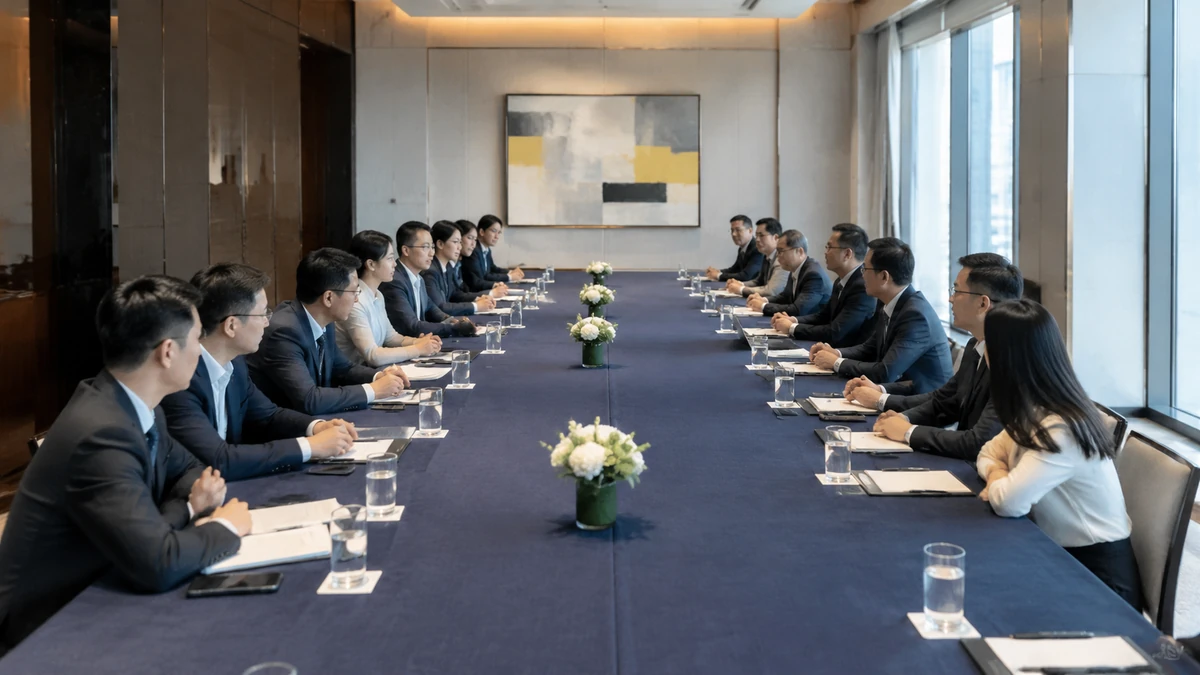
According to South Korea’s Fair Trade Commission, Chairman Joo Byung-kee met with representatives of Korean companies operating in the Philippines on Tuesday to hear what problems they are facing on the ground. He said Seoul would work to help Korean businesses compete fairly and without unjust discrimination in the local market. The meeting took place in Manila on the sidelines of the International Competition Network, a global gathering of antitrust and competition officials.
For American readers, the easiest comparison may be this: Imagine the chair of the Federal Trade Commission or a senior Justice Department antitrust official traveling overseas, sitting down with U.S. firms in sectors ranging from airlines to energy, and telling them Washington would help make sure they are not disadvantaged by opaque rules or uneven enforcement. It is not exactly trade diplomacy in the classic sense, and it is not corporate lobbying in the narrow sense either. It is something in between — an effort to use regulatory cooperation to make overseas business conditions more predictable.
That matters because companies rarely succeed abroad on price and technology alone. They also need confidence that regulators will apply competition rules consistently, that contracts will be enforced in a reasonably transparent environment, and that domestic political or commercial interests will not quietly tilt the playing field. In fast-growing markets, those questions can matter as much as labor costs or demand forecasts.
The Manila stop suggests South Korea is sharpening that part of its strategy. For years, Korean overseas expansion was often framed in familiar terms: exports, construction wins, manufacturing investments and cultural influence powered by the Korean Wave. What emerged this week was a more institutional approach — one that treats fair competition as business infrastructure, every bit as essential as ports, fiber-optic cables or financing.
Why competition policy matters to business far beyond the courtroom
Competition policy can sound abstract, especially to audiences more used to thinking about antitrust in terms of big-tech lawsuits or merger fights. In South Korea, however, the Fair Trade Commission is a central economic regulator, with influence over market behavior, monopolistic practices and business fairness. When its chairman talks about helping Korean firms abroad, he is speaking the language of market rules, not just diplomacy.
That distinction is important. Companies entering a foreign market face a long list of uncertainties: local regulations, licensing requirements, customs rules, labor issues, tax treatment, political shifts and informal business practices that may be difficult for outsiders to read. Even where the laws are clear on paper, businesses often worry about how those rules are interpreted and enforced. A regulation applied one way to a domestic company and another way to a foreign entrant can change an entire investment calculation.
Joo’s central message in Manila was that Seoul wants to help Korean firms compete under fair conditions, especially as cooperation between South Korea and the Philippines expands in areas such as energy and infrastructure. That is more than a statement of principle. In practical terms, it means the Korean government is signaling that complaints from its firms overseas should not be treated simply as isolated corporate frustrations. They can also be understood as issues of market access, regulatory fairness and competition policy.
In the United States, businesses often talk about the need for a “level playing field,” a phrase that sometimes gets overused in politics but still captures a real concern. Companies do not necessarily expect special treatment. What they want is consistency. They want to know that if they bid on a project, seek approval for a service or invest in a local partnership, the standards will be the same for everyone. That is especially true in sectors with heavy public oversight, including utilities, aviation, telecom and large-scale construction.
In that sense, fair competition is not just a legal principle. It is an economic asset. It lowers what businesses sometimes call “hidden costs” — delays, uncertainty, compliance confusion and the risk that decisions will be made arbitrarily. Reduced uncertainty can make it easier to invest, borrow, hire and plan. In a place like the Philippines, where major infrastructure and modernization efforts have created opportunities for foreign firms, predictable rules can be a deciding factor in whether companies commit for the long term.
The companies at the table show how broad Korea’s ambitions have become
The list of companies present at the Manila meeting helps explain why this story carries more weight than a routine business courtesy call. Attendees included HJ Shipbuilding & Construction, Hyundai Engineering & Construction, Korea Electric Power Corp., Korean Air, KT SAT, Hana Bank, Kolmar Korea Healthcare and the Manila office of KOTRA, South Korea’s state-backed trade and investment promotion agency.
That is a striking cross-section of the Korean economy. Shipbuilding and construction point to big-ticket infrastructure and industrial projects. Korea Electric Power signals the importance of energy generation and transmission. Korean Air represents logistics, cargo movement and the connective tissue that supports tourism and trade. KT SAT brings satellite communications and telecommunications infrastructure into the picture. Hana Bank reflects the role of financial services in underwriting expansion. Kolmar Korea Healthcare suggests consumer products and health-related demand are part of the story too.
Put differently, this is not about one Korean factory or one disputed contract. It is about the entire ecosystem that makes overseas business expansion possible. A port project can lead to construction contracts, energy demand, financing arrangements, logistics needs and communications build-outs. Once a market reaches that stage, companies are not just exporting goods into it; they are trying to become embedded in it.
That is part of a broader trend in how South Korea does business abroad. The country’s economic rise was once associated most strongly with cars, electronics and ships headed to global consumers. Today, Korean companies are increasingly selling integrated solutions — infrastructure plus financing, energy systems plus engineering, logistics plus digital networks. That model is more complicated, but it can also be more durable. It ties a country’s businesses into local development over years rather than months.
The presence of KOTRA alongside corporate executives and competition officials is also telling. KOTRA has long helped Korean businesses find leads, make local contacts and gather market intelligence. But as global commerce grows more regulated and more politically sensitive, basic trade promotion is no longer enough. Companies also need help navigating compliance, dispute risks and the practical effects of local competition policy. The Manila meeting underscored that shift. Supporting businesses abroad now means more than helping them make introductions. It means helping them understand and operate within the rules that govern the market.
Why the Philippines matters in Korea’s regional strategy
The Philippines occupies a notable place in South Korea’s view of Southeast Asia. It is a large, young, growing market with major needs in infrastructure, transportation, power and connectivity — all areas where Korean firms believe they have expertise. It is also a country with longstanding people-to-people ties to South Korea. Korean tourists, students, missionaries and business travelers have been a visible presence in the Philippines for years, and Korean consumer brands and pop culture have become increasingly familiar there.
For Americans who mostly encounter Southeast Asia through the lenses of supply chains, U.S.-China competition or military strategy, it is worth remembering that the region is also where middle powers like South Korea are working to build long-term commercial influence. Seoul is not trying to match Washington or Beijing in military weight. Instead, it often competes through industrial know-how, project delivery, financing partnerships and cultural familiarity.
The Philippines is a natural test case for that model. It has ambitious infrastructure needs, a large English-speaking population and a growing consumer base, but it also presents the kind of bureaucratic and regulatory complexity common in emerging markets. That makes it an important place for Korean companies — and an important place for Korean officials trying to make those companies feel secure enough to invest more deeply.
There is also a regional logic here. If Korean firms can show they can operate successfully in a country like the Philippines across multiple sectors, that creates momentum elsewhere in Southeast Asia. Success in infrastructure, energy or telecom in one market can become a reference point in another. For companies, such proof matters. For governments, so does the message that Korean industry can be a dependable partner, not just a low-cost vendor.
South Korea’s global image also helps. The Korean Wave, or “Hallyu” — the international popularity of Korean music, television, film, beauty products and food — has given the country a kind of soft power that many governments would envy. But cultural popularity alone does not win energy contracts or settle regulatory disputes. If anything, it can create an illusion that brand recognition automatically translates into business traction. The Manila meeting was a reminder that behind the glamorous export of K-pop and Korean dramas lies a much less glamorous but essential project: building institutional support for Korean capital abroad.
The MOU with Philippine regulators may be symbolic, but symbols matter
During the visit, Joo also signed a memorandum of understanding with Michael Aguinaldo, chairman of the Philippine Competition Commission. On its own, an MOU is not a contract, a court order or a guarantee that specific business disputes will disappear. Washington veterans know such agreements can range from highly consequential to largely ceremonial.
Still, dismissing them would miss the point. In cross-border business, formal channels of communication between regulators can matter even when they do not produce immediate headlines. They create a place to raise concerns, compare interpretations of rules, share information and sometimes prevent minor problems from turning into larger conflicts. For foreign investors, that can be reassuring.
The significance of the agreement lies less in what it does on day one than in what it makes possible over time. When companies run into barriers abroad, they often find that the hardest part is not identifying the problem but figuring out who can address it. A licensing holdup, an unexplained procedural discrepancy or a competition-related complaint can get trapped between legal systems, bureaucracies and informal power structures. A regulator-to-regulator relationship cannot solve every problem, but it can create a legitimate route for raising them.
That seems to be how South Korea wants to use the arrangement. The Fair Trade Commission said it plans to draw on the opinions gathered from companies at the meeting and use cooperation channels with Philippine authorities to help address those difficulties. Even without knowing the exact grievances raised in the room, that statement signals a shift toward follow-through. The point was not simply to hear complaints; it was to connect them to a policy mechanism.
In an American context, this resembles a broader trend in economic statecraft. Governments increasingly recognize that commercial competition does not stop at tariffs or free-trade agreements. It extends into standards-setting, competition enforcement, procurement rules and regulatory credibility. If a country wants its firms to win abroad, it must often do more than cheer them on. It has to help shape the conditions under which they compete.
What this says about South Korea’s changing economic playbook
The deeper significance of the Manila meeting is that it reflects a maturing Korean approach to globalization. In earlier eras, South Korea’s outward economic push was often described in terms of manufacturing prowess and export discipline. Those strengths remain real. But today’s global business environment is more fragmented, more regulated and more contested than the one that helped propel Korea’s earlier rise.
Supply chains are being redrawn. Economic security concerns shape policy in Washington, Beijing, Brussels and elsewhere. Infrastructure development increasingly intersects with national strategy. Competition policy has become more salient across advanced and emerging economies alike. In that environment, companies need government support of a more technical kind — not just the opening of doors, but the smoothing of regulatory friction after they walk through them.
That is what made the competition-policy framing in Manila so important. It showed Seoul treating fair competition not as a side issue, but as part of the foundation for commercial success. It also suggested that Korean officials see business complaints abroad as useful intelligence about how global markets are really functioning. If enough firms in enough sectors report similar problems, those are no longer isolated inconveniences. They become a policy pattern.
There is an echo here of how American officials have increasingly discussed economic competition in recent years. Whether in semiconductors, electric vehicles, telecom or clean energy, the U.S. government has moved beyond the assumption that markets alone will deliver strategically desirable outcomes. Korea, in its own way and on its own scale, appears to be making a parallel adjustment. It is not abandoning market principles. It is acknowledging that markets operate through institutions, and institutions matter.
There is also a defensive logic to this strategy. As Korean firms expand into more politically and commercially sensitive sectors overseas, they become more exposed to regulatory shocks, local rivalries and shifting interpretations of the rules. Helping them navigate those risks is one way for Seoul to protect the international value of industries it has spent decades building.
The opportunities are real, but so are the limits
It is important not to overstate what happened in Manila. The original account of the meeting did not specify the individual complaints raised by companies, nor did it identify a concrete project that will now move forward because of the talks. No one should assume that an MOU between competition authorities will suddenly translate into new contracts or resolved disputes by next quarter.
There are also natural limits to what one government can do for its companies in another sovereign country. Philippine regulators will make decisions based on Philippine law and Philippine priorities. Even the strongest bilateral ties do not eliminate political complexity, local business interests or bureaucratic inertia. In addition, competition authorities are only one part of the policy landscape. Tax agencies, procurement offices, line ministries, courts and local governments can all shape the real-world business climate.
And yet the meeting still matters, precisely because it was modest and concrete. Rather than promising dramatic outcomes, South Korean officials focused on building a channel, hearing field-level concerns and framing fairness as a practical business issue. That kind of incremental institution-building can be easy to overlook. It is also often how durable commercial relationships are actually made.
For multinational firms, uncertainty is not just an annoyance. It is a cost. It can delay investment decisions, raise financing burdens and scare off local partnerships. If South Korea can reduce even a small portion of that uncertainty for its companies, the gains may compound over time. A smoother market entry in one sector can make executives more willing to take risks in another. Confidence, once established, can become self-reinforcing.
The breadth of the attendee list also hints at another reality: Korean overseas expansion is increasingly “package-based.” Energy, infrastructure, telecom, logistics, finance and consumer services do not move in isolation. One sector’s foothold can create openings for another. That makes fair competition a shared interest across industries. It is the common foundation that allows a broader Korean commercial presence to take root.
Why international readers should pay attention
For global audiences, this story is about more than a single meeting in Manila. It offers a snapshot of how a major middle-power economy is adapting to a business landscape where institutional trust can be as valuable as engineering skill or brand power. South Korea is known worldwide for smartphones, semiconductors, K-pop and Oscar-winning films. Less visible is the bureaucratic architecture needed to convert that national strength into sustainable overseas business success.
That architecture is becoming more important, not less. Around the world, governments are taking a more active role in industrial policy, supply-chain security and competition enforcement. Cross-border business is increasingly shaped by conversations between regulators as much as by conversations between chief executives. The countries that understand that shift — and build mechanisms to support their firms accordingly — may be better positioned in the next phase of globalization.
South Korea’s move in the Philippines fits that pattern. It suggests Seoul sees global expansion as something that must be supported on multiple fronts: commercial, diplomatic, regulatory and institutional. For American readers, it is a useful reminder that the new geopolitics of business often unfolds in conference rooms and agency-to-agency agreements, not just at summit meetings or on container ships.
The immediate takeaway is simple. South Korea is signaling to its companies that if they venture into markets like the Philippines, they will not be left to navigate complicated competition environments entirely on their own. The larger takeaway is more strategic. As Korean business spreads across sectors and borders, Seoul appears determined to back it not only with trade promotion and diplomacy, but with a more sophisticated effort to shape the rules of the road.
That may not produce the instant drama of a megadeal announcement. But in the long run, it could prove just as important. Markets reward innovation and efficiency, but they also reward predictability. In Manila, South Korea made clear it wants to help provide both.
Comments
Post a Comment