South Korea Upholds 7-Year Prison Term in Drunken Wrong-Way Highway Crash That Left 6 Dead or Injured
A high-court ruling underscores South Korea’s hardening stance on drunk driving
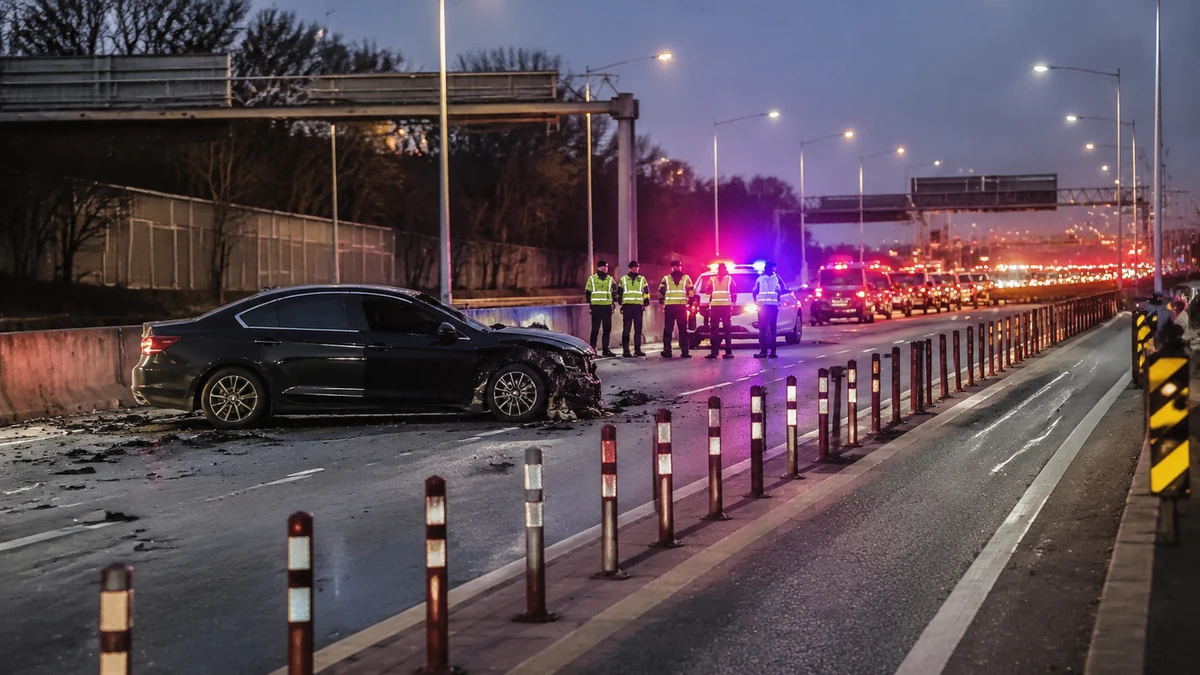
A South Korean appeals court has upheld a seven-year prison sentence for a 29-year-old Chinese national convicted in a drunken wrong-way crash on a highway near Seoul, a case that left six people dead or injured and renewed public attention on how the country treats one of its most feared traffic crimes.
The decision, handed down Tuesday by the Suwon District Court’s criminal appeals division, left intact the lower court’s ruling after rejecting appeals from both prosecutors and the defendant. In practical terms, that means the court found the original sentence neither too light nor too harsh, a signal that judges believed the seriousness of the offense had already been properly weighed.
According to South Korean media reports, the crash happened around 5 a.m. on Nov. 9 of last year on the Seohaean Expressway, a major roadway in Gyeonggi Province that funnels traffic toward Seoul. Prosecutors said the driver, identified only by the surname A, was heavily intoxicated, with a blood alcohol concentration of 0.157%, when he drove a Kia Carnival minivan the wrong way and caused the crash.
For American readers, the broad outline of the case will sound grimly familiar. Drunken driving is a recurring public safety crisis in the United States, and wrong-way crashes on high-speed roads are among the most catastrophic types of collisions because they often leave other motorists little or no time to react. But the case also offers a window into South Korea’s legal culture, where public outrage over alcohol-related driving deaths has intensified in recent years and courts have come under pressure to treat severe cases less as tragic mistakes and more as acts of reckless endangerment.
That distinction matters. In both Korea and the United States, the moral argument around drunk driving has shifted over time. It is no longer widely framed as a lapse in judgment by an otherwise ordinary person. Increasingly, it is described as a conscious decision that places strangers at mortal risk in a shared public space. Tuesday’s ruling fits squarely within that shift.
What the court affirmed was not simply punishment for drinking before getting behind the wheel. It affirmed accountability for what Korean law treats as “dangerous driving resulting in death or injury” — a more serious category than an ordinary traffic violation, especially when intoxication and severe harm are both present.
Why this case struck such a nerve
Even in a country where fatal traffic crashes have fallen over time, a wrong-way drunken-driving case on an expressway lands with unusual force. The setting matters. South Korea’s expressways are fast, densely used and central to everyday life, especially in the Seoul metropolitan area, a region of more than 25 million people where highways function much the way interstates do around Los Angeles, Chicago or the New York metro area.
A crash at 5 a.m. may sound, at first glance, like it occurred during a relatively quiet time. But early-morning highway driving can be especially dangerous. Trucks, airport traffic, shift workers and long-distance drivers are all common on the roads before sunrise. Visibility is limited. Fatigue may already be a factor. And when a vehicle appears from the wrong direction, the brain often takes a split second too long to process what it is seeing.
That is part of what makes wrong-way crashes so terrifying. Drivers are trained to watch for hazards entering from the side, slowing unexpectedly ahead, or cutting across lanes. They are not conditioned to expect headlights barreling toward them in their own lane on a divided expressway. By the time they understand what is happening, there may be no safe escape route.
South Korean media described the case in stark terms: six casualties, meaning a combination of deaths and injuries. Korean crime and court reporting often uses the phrase “dead or injured” in numerical shorthand, and while it can sound clinical in translation, the phrase carries heavy weight in local coverage. It signals that the consequences were not limited to damaged vehicles or momentary chaos. Human lives were permanently altered.
There is also a broader social context. South Korea has spent years wrestling with how to curb drunk driving, a problem that once drew periodic outrage but often ended, critics said, in sentences that did not fully reflect the devastation caused. That debate intensified after several high-profile cases involving child victims and repeat offenders, helping drive public demand for tougher laws and stiffer penalties.
As in the United States, the politics of road safety in South Korea are often shaped by individual tragedies that crystallize public anger. One especially notorious case can become a reference point in future debates, much as American readers may think of the role played by advocacy groups such as Mothers Against Drunk Driving in changing both social attitudes and the law. Korea has gone through its own version of that transformation, with grieving families, public campaigns and lawmakers pressing for legal reforms.
What the court appears to have been weighing
The defendant in this case was charged under South Korea’s Act on the Aggravated Punishment of Specific Crimes, as well as the Road Traffic Act. For readers unfamiliar with Korean law, that means the case was treated as more than a standard DUI. The aggravated-punishment statute is used when conduct is considered especially dangerous or socially harmful, and in traffic cases it can apply when impaired driving causes death or serious injury.
The legal language can sound formal, but the underlying idea is straightforward: not every drunk-driving offense is viewed the same way. A driver stopped at a checkpoint without causing harm is one thing. A driver who, while heavily intoxicated, enters a high-speed roadway in the wrong direction and causes mass casualties is another entirely.
The appeals court’s decision to leave the sentence unchanged suggests it accepted the trial court’s view that the danger inherent in the conduct had already been fully captured in the original ruling. That likely included several aggravating factors visible from the basic facts alone: the level of intoxication, the location on a highway, the wrong-way driving itself and the number of people killed or injured.
A blood alcohol concentration of 0.157% is far beyond the legal threshold in most jurisdictions. In the United States, 0.08% is the standard legal limit in every state, though penalties vary and some states impose harsher consequences at higher levels, often around 0.15%. In other words, the level reported in this case would be considered severe by American standards as well.
And then there is the issue of “dangerous driving,” a concept with an important cultural and legal significance in South Korea. Korean courts increasingly use the term to distinguish between unavoidable accidents and conduct that so clearly undermines safe road order that it cannot plausibly be reduced to mere error. Driving the wrong way on an expressway while extremely intoxicated falls squarely into that category.
In that sense, the court’s message appears to be less about symbolism than about classification. This was not treated as an unfortunate mishap with alcohol in the background. It was treated as a grave public-safety offense in which intoxication directly impaired judgment and control, producing foreseeable and catastrophic harm.
How South Korea’s view of drunk driving has changed
To understand why this ruling resonates, it helps to understand how South Korea’s public conversation around drunk driving has evolved. For years, Korean society, like many others, struggled with the tension between condemnation and tolerance. Drinking has long played a visible role in social and business life, especially in workplace culture, where after-hours dinners and rounds of alcohol historically functioned as part of team bonding and professional networking.
That does not mean drunk driving was ever accepted. It was not. But critics argued that social drinking norms sometimes dulled the stigma around getting into a car after “just a few drinks,” especially among older generations raised in a more permissive era. Over time, however, repeated tragedies changed the tone of the discussion.
South Korea toughened laws, lowered allowable blood alcohol limits and increased penalties, particularly for repeat offenders and cases involving injury or death. Public campaigns and media coverage helped reinforce the idea that driving after drinking is not simply irresponsible but socially intolerable. The result is a legal and cultural atmosphere in which severe DUI cases now often carry a broader public meaning: they test whether institutions are matching the country’s stated commitment to safety.
That is one reason appellate decisions matter. In any legal system, appeals can serve as a corrective, reducing sentences when lower courts overreach or increasing scrutiny when penalties seem too lenient. Here, both sides appealed, but neither prevailed. The outcome suggests the seven-year sentence landed in the range the court considered appropriate for the facts and the law.
American readers may wonder whether seven years is enough in a case involving multiple casualties. In the United States, penalties for DUI-related deaths vary dramatically by state and by the details of the offense, including prior record, number of victims and whether prosecutors pursue charges closer to manslaughter or murder. The Korean system likewise has its own sentencing framework and judicial practice. What matters here is that the court chose not to disturb the lower court’s judgment, indicating institutional agreement about the gravity of the conduct.
The same-day context is also notable. South Korean reports pointed to another drunk-driving ruling issued Tuesday in Daegu, where a separate court sentenced a man in his 60s to one year and two months in prison after he allegedly caused a crash while intoxicated, fled the scene and refused a police breath test. That defendant reportedly had prior drunk-driving-related convictions. Though the cases are different in scale, together they reinforce the impression that courts are treating alcohol-impaired driving as a recurring threat to community safety rather than an isolated lapse.
Nationality drew notice, but the legal issue was public safety
The defendant in the expressway case is a Chinese national, and in South Korea, as in many countries, nationality can quickly become a flashpoint in public discussion. Immigration, crime and fairness in the justice system are sensitive issues almost everywhere, and foreign defendants often attract outsized attention. But the legal heart of this case does not appear to turn on nationality.
The court’s focus, based on the reporting available, was on conduct and consequence: the level of intoxication, the act of driving the wrong way on a highway and the resulting deaths and injuries. That distinction is worth emphasizing because crime coverage can easily slide into narratives that center identity over action, especially when the defendant is not a citizen of the country where the offense occurred.
For American audiences, the parallel is easy to see. In U.S. news coverage, foreign nationality can become a political story even when it has no bearing on the facts needed to establish guilt or determine sentence. Responsible reporting requires resisting that drift. The public interest question here is not which passport the driver held. It is how a modern legal system assigns responsibility when someone makes an extraordinarily dangerous decision on a road shared by everyone else.
That broader framing matters in South Korea, where roads are not just infrastructure but a deeply shared civic space. In the Seoul region in particular, expressways connect residential suburbs, industrial zones, logistics corridors and the capital itself. What happens on those roads reverberates widely, economically and emotionally. A wrong-way drunken-driving crash is therefore not seen solely as a private criminal matter. It is also a breach of public trust in the most literal sense: a violation of the rules that allow strangers to move safely through common space.
Seen that way, the appeals ruling becomes about more than one defendant. It becomes part of a larger statement that road safety is not negotiable, and that catastrophic violations of that safety will be met with real prison time.
A broader snapshot of Korean society on the same day
One reason Korean local news can be revealing to outside readers is that the society pages often place punishment, prevention and public recognition side by side. On the same day this appeals court ruling was reported, other domestic stories focused on worker recognition and occupational safety education.
South Korea’s Labor Ministry, for example, awarded government honors to workers recognized for their contributions around Labor Day. Another public agency held an awards event tied to a short-form video contest explaining how to apply for industrial accident compensation, an effort meant to make worker protections more accessible and easier to understand.
At first glance, those stories may seem unrelated to a drunken-driving appeal. In fact, they help illuminate the broader civic framework in which this case sits. A society’s safety culture is not built only through punishment after something goes wrong. It is also built through education, public messaging, worker protections and institutional reinforcement of the idea that human well-being deserves active safeguarding.
That is true in the United States as well. Americans tend to encounter safety policy in fragments: seat belt campaigns, anti-drunk-driving ads, workplace hazard rules, public service announcements about distracted driving. But these efforts are all connected by the same underlying principle. A functioning society does not merely react to harm. It tries to prevent predictable harm, and it punishes conduct that recklessly creates it.
In that sense, Tuesday’s ruling is one piece of a larger Korean story about public responsibility. Courts punish dangerous conduct. Government agencies promote safer practices. Public institutions use awards, education and enforcement alike to shape norms. The connective tissue is the idea that safety is a collective good, not just an individual preference.
The unanswered question every such case leaves behind
Even with the appeal resolved, the most difficult question remains the one that legal rulings can never fully answer: what would actually prevent the next case? Prison terms can express moral blame, satisfy legal standards and perhaps deter some would-be offenders. But they do not restore lives, heal trauma or guarantee that another intoxicated driver will not make the same fatal choice.
That is as true in Seoul and Gyeonggi Province as it is in Houston, Atlanta or Philadelphia. Every society eventually runs into the same hard truth about drunk driving: the law matters, but the problem cannot be solved in the courtroom alone. Enforcement matters. Social norms matter. Access to late-night transportation matters. So do workplace cultures, personal accountability and the willingness of friends, coworkers and family members to intervene before someone gets into a car.
South Korea has some advantages in this regard. Taxis are widely available in major cities, public transportation is extensive and urban density can make it easier than in many parts of America to avoid driving after drinking. Yet serious cases still occur, particularly when people are traveling between regions, leaving nightlife districts at odd hours or making reckless decisions despite alternatives.
That is one reason wrong-way DUI crashes remain so haunting. They are not only violent; they are also, in most cases, eminently preventable. There is no mystery to the risk. There is no hidden defect in the social contract. The danger is obvious well before the engine starts.
For that reason, the significance of this week’s ruling lies partly in its clarity. South Korea’s judiciary, at least in this case, did not blur the line between mistake and reckless disregard. It reaffirmed a sentence that reflects the view that driving while severely intoxicated, on a highway, in the wrong direction, with deadly consequences, is exactly the kind of conduct the criminal law exists to confront.
For American readers looking at Korea from afar, that may be the clearest takeaway. The country’s courts are wrestling with the same public safety dilemma facing many democracies: how to define responsibility when personal choice collides with collective vulnerability. The names, roads and legal codes may differ. The central question does not. How much protection should the law give ordinary people using public roads? And what consequences should follow when someone shatters that safety in a way everyone knows can kill?
In Tuesday’s decision, South Korea offered one answer. Not the only answer, and perhaps not the final one in the larger social debate, but a firm one. Seven years stands. The crime is not treated as a lapse in etiquette or a regrettable traffic error. It is treated as a profound breach of public safety, with punishment to match.
Comments
Post a Comment