Why Fire Officials in South Korea Are Inspecting Apartment Construction Sites Before Residents Ever Move In
A routine inspection with broader meaning
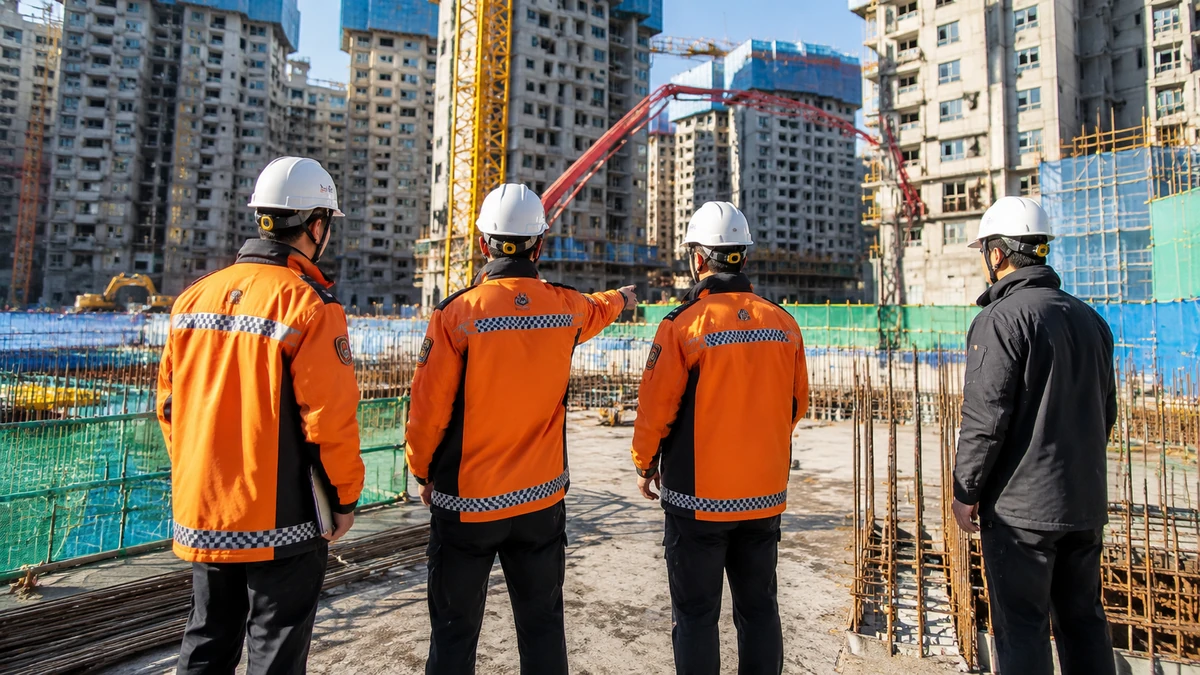
Fire officials in South Korea’s Gangwon province carried out an on-site safety inspection this week at a large apartment construction project in the coastal city of Gangneung, a move that may sound technical and routine but points to a much bigger public concern: how to keep fast-growing urban housing projects from becoming disaster zones before they ever open their doors.
According to local officials, the inspection focused on whether the construction site was actually following fire-safety rules in practice, not just on paper. That included checking whether fire watchers were stationed near welding and cutting work, whether basic safety protocols were being followed, whether temporary firefighting equipment was installed and maintained, and whether a round-the-clock monitoring system was functioning on site. Officials also reviewed whether workers and managers could quickly report a fire or other emergency and launch an effective initial response.
For American readers, the easiest comparison may be the kind of scrutiny that follows major warehouse fires, refinery accidents or deadly construction incidents in the United States, where investigators often find that the problem was not a total lack of rules, but a breakdown in enforcement, oversight or communication during high-risk work. In that sense, the Gangneung inspection reflects a universal truth of industrial safety: the most dangerous moment is often not when a building is open and occupied, but when it is half-finished, crowded with workers and materials, and changing by the hour.
What makes this story especially notable in South Korea is the type of project involved. The site under review was a large “common housing” development, a Korean term that generally refers to multi-unit residential buildings such as apartment complexes. In Korea, that means far more than a niche corner of the housing market. Apartments are the dominant form of urban living, especially in densely populated cities and suburbs. A large apartment project is not just another construction site; it is future everyday life being built in real time.
That helps explain why local fire authorities are treating construction safety as a public-interest issue rather than simply an internal matter for builders and subcontractors. The project may still be a worksite today, but in time it is meant to become a home for families, older residents, commuters and children. A fire or other disaster during construction would harm workers immediately, but it could also shake public confidence in the safety of the housing supply itself.
Seen that way, the inspection in Gangneung was about more than compliance. It was also a statement about prevention: that the safety of a community begins long before the ribbon cutting, and that public trust in housing starts with the conditions under which it is built.
Why apartment construction sites draw special scrutiny in Korea
To understand why officials singled out a large residential construction site, it helps to understand how central apartment living is in South Korea. In much of the United States, a single-family house remains the cultural default, even in fast-growing metro areas. In South Korea, especially in cities, apartment towers and multi-building residential complexes are the norm. They shape skylines, school districts, commuting patterns and family wealth in ways Americans might associate with suburban subdivisions, condominium booms and major mixed-use developments all at once.
That centrality gives apartment construction a social weight that goes beyond the economics of development. A large residential build in Korea is not only a private business project but also part of the public conversation about affordability, growth, neighborhood identity and quality of life. When something goes wrong on one of those sites, residents do not necessarily see it as an isolated workplace incident. They may see it as a warning sign about the safety of future homes, the reliability of local oversight and the priorities of the companies involved.
Construction sites are inherently hazardous everywhere, but large apartment projects can present especially complicated risks because so many kinds of work happen in the same place at the same time. Structural work, electrical installation, material deliveries, interior finishing and equipment setup can overlap in a compressed schedule. Pathways change. Personnel rotate. Temporary systems substitute for permanent ones. One subcontractor’s task can create hazards for another crew working a few floors away or just around the corner.
That kind of complexity is a major reason safety experts often focus on “hot work,” the industry term for activities such as welding, torch cutting or grinding that generate sparks or intense heat. These are common tasks on big job sites, but they are also among the most predictable triggers of fire. In an unfinished building filled with combustible materials, exposed surfaces and partial systems, a small lapse can escalate fast.
South Korea has its own history of high-profile industrial and public-safety disasters, and while this particular inspection was not tied to a specific accident, it fits into a broader national push toward prevention. Over the past decade, safety has become a charged public issue in Korea, not unlike the way major industrial accidents in the United States can reshape expectations around regulation and corporate accountability. In Korea, those debates often carry special urgency because high-density urban life means one site can affect workers, neighbors, traffic, businesses and future residents all at once.
That is part of what gives an inspection like this broader significance. Officials were not simply checking one property line. They were scrutinizing a place where labor risk, housing policy and public safety meet.
The three dangers officials appear most concerned about
The Gangwon fire authorities’ inspection centered on three related areas of concern, each of which reflects a practical lesson learned repeatedly across the construction industry: danger rarely comes from a single dramatic failure. More often, it grows out of ordinary tasks performed without enough backup, coordination or urgency.
The first concern was hot work. Officials specifically examined whether fire watchers were in place during welding and cutting operations and whether safety rules were being observed. A fire watcher, for readers unfamiliar with the term, is a designated person assigned to monitor an area where sparks or heat-producing work is taking place. That person is supposed to look for signs of ignition, keep firefighting equipment at hand and respond immediately if conditions change. It is a simple idea, but one that can make the difference between a close call and a catastrophe.
American regulators and insurers have long emphasized similar controls on construction and maintenance sites, especially after fires linked to roofing torches, welding arcs or metal cutting equipment. The logic is straightforward: when a task is known to be risky, familiarity can be the enemy. Workers may treat it as routine precisely because it happens every day. That is why officials in Gangneung appear to have focused not only on whether rules exist, but whether anyone is truly carrying them out in the field.
The second area was temporary firefighting facilities and ongoing monitoring. This is especially important on a construction site because the permanent safety infrastructure that residents or office tenants would eventually rely on may not yet be fully installed, connected or operational. Sprinklers may be incomplete. Alarm systems may not be functioning building-wide. Corridors and access points may be blocked or altered as work progresses. In that environment, temporary extinguishers, hoses, water supplies, alarms and patrol systems can serve as the entire first line of defense.
That makes maintenance just as important as installation. A fire extinguisher that is technically present but hard to access, poorly placed or ignored is not much protection. The same goes for site monitoring. A “constant surveillance system” may sound bureaucratic, but in practical terms it means knowing who is watching, what they are watching for, how quickly they can communicate a problem and whether anyone will act on the warning.
The third concern was emergency reporting and initial response. Officials checked whether workers could rapidly report a fire or other disaster and whether the first-response system was actually operating on site. That focus reflects one of the most important principles in emergency management: not every incident can be prevented, but many can be contained. The speed of the first phone call, the clarity of the chain of command and the ability of crews to act in the first few minutes can determine whether an accident remains localized or becomes a mass-casualty event.
Taken together, these three areas — hot work oversight, temporary fire protection and rapid reporting and response — form a basic safety net. None is glamorous. None guarantees perfection. But together they can sharply reduce the odds that a routine construction task turns into a deadly fire.
What the meeting with builders says about modern safety policy
The inspection did not stop at a walk-through. Fire officials also held a meeting with construction personnel to discuss risks associated with major stages of the project and to share examples of recent safety incidents on construction sites. That may seem like a small detail, but it says a great deal about how South Korean authorities are increasingly approaching safety enforcement.
Rather than framing safety only as a matter of punishment after a violation, the meeting suggested a more field-centered strategy: identify risks early, compare notes on how accidents actually happen, and push site managers to update their practices as conditions change. In other words, safety is not treated solely as a static checklist but as an operating discipline.
That is especially relevant on construction sites, where the physical environment can change in a matter of hours. A route that was clear in the morning may be blocked by midday. A lower-risk zone may become hazardous once new materials arrive or a different crew begins work. Temporary walls go up. Power sources shift. Ventilation changes. Equipment moves. Under those conditions, a one-time warning is often less useful than a continuous process of awareness and adaptation.
Gangwon Fire Headquarters Chief Oh Seung-hoon underscored that point by warning that large construction sites involve complex processes and constantly changing work environments, meaning a small moment of carelessness can trigger a major accident. He also emphasized the importance of dividing roles among workers during hot work and maintaining a monitoring system on site.
That emphasis on role allocation is worth noting. In many workplace accidents, the failure is not simply that nobody knew the rule, but that everybody assumed somebody else was responsible. Who is watching for sparks? Who clears combustible material? Who has authority to stop the task? Who calls emergency services? Who checks that temporary equipment is functional? If those responsibilities are vague, the system is weak no matter how many manuals exist.
For American readers, this is familiar territory. Occupational safety specialists in the U.S. routinely stress that culture matters as much as equipment. Hard hats, extinguishers and signage matter, but so do habits: whether crews speak up, whether supervisors pause a job when risk rises, whether deadlines are allowed to overwhelm judgment. The same appears to be true in Gangneung. The message from officials was not “never do dangerous work.” Construction, by nature, involves dangerous work. The message was closer to this: when dangerous work is unavoidable, it must be controlled deliberately, with clear roles and constant oversight.
That is a more realistic and, in some ways, more demanding standard. It asks not merely for compliance, but for operational discipline.
How Korea’s safety debate has shifted toward prevention
The Gangneung inspection also reflects a larger shift in South Korea’s public culture around disaster and industrial safety. In the past, many governments — not just Korea’s — have been criticized for acting forcefully only after tragedy strikes. Increasingly, however, Korean authorities are trying to show that prevention itself is a form of visible governance, even when its success is measured by what does not happen.
That can be a hard case to make politically. Ribbon cuttings, new development announcements and investment figures are easy to showcase. The absence of a fire is not. Yet that is exactly what makes inspections like this significant. They are interventions aimed at reducing risk in the present, even if there is no dramatic headline attached to the outcome.
In South Korea, this preventive approach carries special resonance because dense development compresses so many vulnerabilities into one place. A major construction fire in a city can disrupt surrounding businesses, frighten nearby residents, strain emergency services and cast a shadow over future occupancy. The impact is social as well as industrial.
There is also a deeper issue of trust. Because apartment living is so widespread in Korea, the public often sees residential construction through the lens of long-term safety and livability, not just engineering completion. People want to know that future homes are being built responsibly from the start. A serious incident during construction can raise questions that linger well beyond the cleanup: Were corners cut? Were inspections meaningful? Are developers moving too fast? Can local governments be relied upon to intervene before something goes wrong?
Those concerns are not uniquely Korean. Americans ask similar questions after bridge collapses, chemical spills, apartment fires or workplace deaths. But in Korea, where vertical living and large residential compounds are deeply woven into daily life, those concerns can feel especially immediate. The construction site is not remote from ordinary life; it is often situated next to it, shaping the neighborhood people already inhabit and the homes others expect to move into.
This is one reason local news about safety inspections can carry national and even international relevance. It speaks to a broader challenge facing developed and rapidly urbanizing societies alike: how to build quickly without normalizing risk, and how to keep safety from becoming secondary whenever housing demand, schedule pressure and economic incentives collide.
In that sense, the Gangneung case is not just a Korean story. It is a city story, a labor story and a governance story, one that would be recognizable in places from Miami to Seattle to Toronto.
The unfinished challenge: keeping safety from slipping after inspection day
If there is a clear takeaway from the inspection, it is that no single visit can eliminate the hazards of a large construction project. Safety on a site like this is not a one-day achievement. It has to hold through changing phases of work, shifting crews, deadline pressure and the ordinary erosion of vigilance that can set in when risky tasks become routine.
That is why the phrase “field-centered management,” emphasized by local officials, matters so much. It suggests that standards cannot remain fixed at the level of paperwork while the site itself evolves day by day. As construction progresses, the risks change with it. New materials arrive. Different subcontractors take over. Temporary systems are installed, moved or removed. Communication patterns shift as teams rotate in and out. Every one of those changes can open a gap between written policy and real-world execution.
Closing that gap is one of the hardest tasks in construction safety anywhere in the world. On paper, many of the principles inspected in Gangneung sound simple: assign a fire watcher, maintain temporary firefighting equipment, keep a monitoring system active, ensure rapid reporting and prepare for initial response. In practice, each one can be undermined by scheduling pressure, unclear supervision, worker turnover or poor coordination between contractors.
Anyone who has covered labor or infrastructure issues in the United States has seen versions of this problem. A policy exists, but the implementation is inconsistent. Equipment is available, but workers are rushed. Training is required, but not reinforced. Responsibility is shared so broadly that no one fully owns it. By the time an accident happens, the failure looks obvious in hindsight.
The significance of the Gangneung inspection lies partly in its attempt to catch those failures before the hindsight stage. By going on site, talking with construction personnel and examining whether safeguards are operational rather than merely documented, officials were trying to test the real condition of the safety system under working conditions.
That does not mean the challenge is solved. It means the challenge has been identified correctly. Safety in a large apartment build is not just about whether a completed tower meets code when residents move in. It is about whether the path to completion is managed with enough discipline to protect workers now and reassure the public later.
For global readers, that is the broader lesson. In an era of rapid urban development and rising demand for dense housing, the value of a project cannot be measured only by how impressive it looks when finished. It must also be measured by how responsibly risk is handled during the months and years before completion. The homes of the future should be safe not only when the lights turn on for the first residents, but while the building is still a maze of scaffolding, sparks, concrete and exposed wiring.
That is what South Korean fire authorities were really checking in Gangneung: not simply whether one site met a set of rules on one day, but whether the process of creating everyday life in a high-density society is being governed with the seriousness that public safety demands.
Comments
Post a Comment