South Korea’s Cold Noodle Warning Carries a Universal Lesson: Food Safety Often Comes Down to the Basics
A familiar summer dish becomes a public health warning
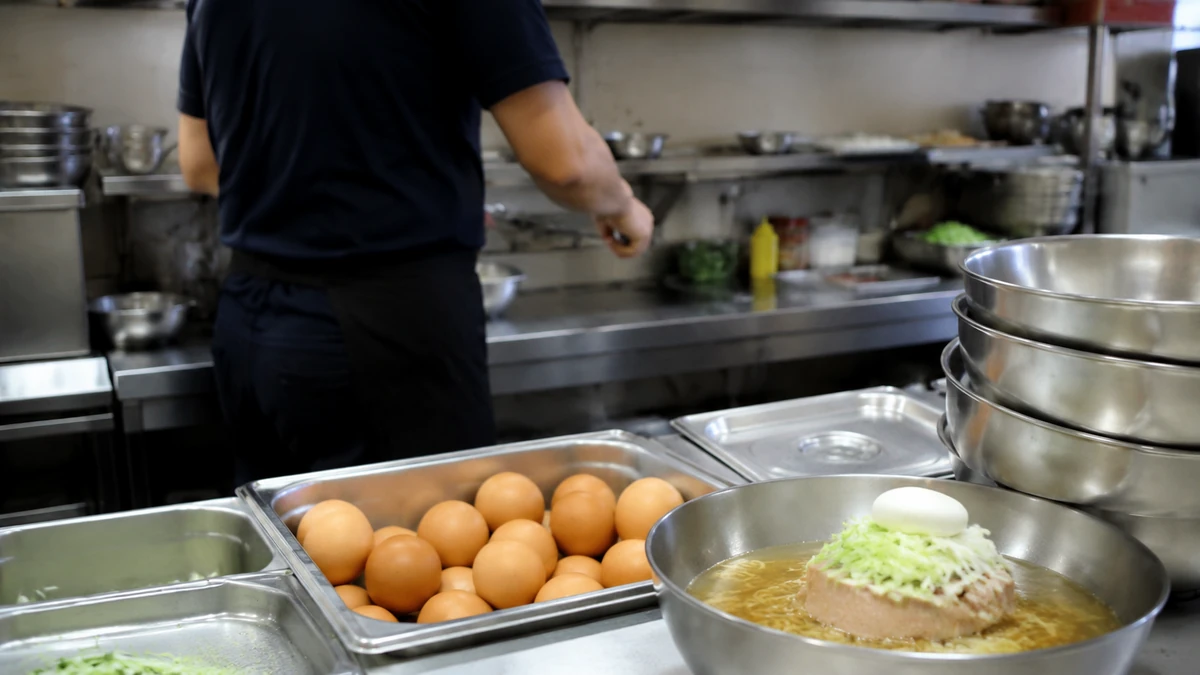
In South Korea, few foods are as closely tied to hot weather as naengmyeon, the cold buckwheat noodle dish that arrives in a stainless-steel bowl filled with chilled broth, sliced meat, cucumber and often half of a boiled egg. For many Koreans, it is comfort food, a seasonal staple and a quick restaurant meal so familiar that it can fade into the background of daily life, much the way Americans might think of a deli sandwich, a Cobb salad or a slice of pizza grabbed between errands.
That is exactly why a new government warning about naengmyeon restaurants has landed with such force.
South Korea’s Ministry of Food and Drug Safety said May 21, 2026, that it had urged businesses specializing in naengmyeon to strengthen hygiene controls during egg preparation after a series of suspected salmonella contamination cases linked to such restaurants. The ministry did more than issue a routine advisory. It also convened a meeting with naengmyeon restaurant operators and related industry associations, underscoring that officials view the matter not as an isolated scare involving a few unlucky diners, but as a broader food safety issue requiring immediate attention in kitchens across the sector.
The ministry’s warning focused especially on the handling of raw eggs, saying cross-contamination can occur when workers touch raw eggs and then prepare other food without washing their hands, or when tongs or other tools contaminated with egg liquid are reused for other ingredients. On paper, that may sound like kitchen 101. In practice, it is often where foodborne illness starts.
The significance of the warning extends far beyond one dish, one restaurant type or even one country. At a moment when public conversations about health often revolve around breakthrough drugs, wearable technology or hospital capacity, South Korea’s message is strikingly old-fashioned: Wash your hands. Separate your tools. Respect the chain of contamination that can travel from one ingredient to another in seconds. The problem, in other words, is not only what people eat. It is how food is handled before it reaches the table.
That lesson is as relevant in Seoul as it is in Chicago, Los Angeles or Atlanta.
Why naengmyeon matters in Korea
For readers outside Korea, naengmyeon may not be a household word, but it helps to understand where the dish sits in Korean food culture. Traditionally associated with the northern part of the Korean Peninsula, naengmyeon is now widely popular throughout South Korea and especially sought out during warmer months. Restaurants devoted to it can range from old family-run establishments to bustling chains, and the dish is common enough to be considered an everyday meal rather than a niche specialty.
There are several styles, but the broad idea is simple: chewy noodles, served either in a cold broth or mixed with a spicy sauce, then topped with garnishes that can include sliced beef, radish, cucumber and egg. The egg may seem like a minor detail. From a food safety perspective, it is anything but minor.
Because naengmyeon is assembled from multiple prepared ingredients at the final stage, the dish creates a kitchen environment where handling matters enormously. A worker may move quickly from one component to another — noodles, broth, garnishes, meat, egg — especially during a lunch or dinner rush. That kind of workflow is not unique to Korean cuisine. Americans see similar patterns wherever meals are built assembly-line style: salad bars, sandwich counters, burrito lines and brunch kitchens plating multiple items at once.
What makes the Korean warning especially notable is that officials singled out the point at which raw eggs or egg liquid can contaminate hands, utensils and surrounding ingredients. The concern is not that naengmyeon itself is inherently dangerous. The concern is that a familiar, frequently ordered dish can become a vehicle for illness when routine safeguards fail in routine settings.
That distinction matters. Food safety scares often create public anxiety around a particular cuisine or ingredient, even when the underlying problem is a preventable lapse in handling. Seen through that lens, South Korea’s message is not “be afraid of naengmyeon.” It is “do not let familiarity breed carelessness.”
The real issue is cross-contamination
The ministry’s warning zeroed in on a concept that public health officials everywhere talk about but that consumers do not always visualize clearly: cross-contamination. Put simply, it is the transfer of harmful bacteria or other contaminants from one surface, tool or ingredient to another. It sounds abstract until it is translated into the movements of a real kitchen.
A cook cracks raw eggs. Egg liquid gets on a gloved hand or bare hand. Without washing up, that same hand reaches for sliced cucumber, a ladle, a serving bowl or a garnish that will not be cooked again. Or a pair of tongs touches raw egg residue and is then used on finished food. That small lapse, repeated dozens of times in a busy service, can spread contamination far beyond the original ingredient.
Americans have heard versions of this warning for years involving raw chicken, uncooked hamburger or cookie dough. Public service campaigns remind people not to use the same cutting board for raw poultry and salad greens, and not to return cooked meat to the plate that held it before grilling. The Korean ministry’s message belongs to that same family of advice. It is basic, but “basic” does not mean unimportant. In food safety, the basics are often the whole game.
Salmonella is one of the most familiar foodborne pathogens in the United States and globally. It can cause diarrhea, fever, stomach cramps and, in severe cases, hospitalization. Young children, older adults and people with weakened immune systems may face greater risk. Eggs have long been recognized as one possible route of exposure, which is why both restaurant kitchens and home cooks are typically advised to handle them carefully and prevent contact with ready-to-eat foods.
What stands out in the South Korean case is how clearly the authorities framed the danger not as an exotic threat but as a byproduct of ordinary haste. A fancy new sterilization system did not headline the government response. Neither did a sweeping technological overhaul. Instead, the ministry emphasized handwashing and the separation of utensils, a reminder that high-volume food service can be undone by the smallest shortcuts.
That is a lesson that resonates well beyond Korea’s restaurant industry. It applies to any kitchen where speed is prized, staffing is tight and repetitive tasks can lull workers into autopilot. The bacteria do not care whether the food is Korean cold noodles, a diner breakfast or a catered office lunch.
Why the government called in the industry
One of the more revealing parts of the South Korean response was not the warning itself, but the decision to hold a meeting with restaurant operators and related associations. That kind of step suggests authorities are trying to do more than protect themselves bureaucratically by issuing a press release. They are signaling that this is an operational problem requiring buy-in from the businesses that prepare and serve the food.
In public health, there is an important difference between enforcement after harm occurs and intervention while risk is still building. The meeting appears to fall into the second category. Officials, faced with repeated suspected food poisoning cases, used the moment to restate the rules that can be put into practice immediately: wash hands after handling raw eggs, do not reuse contaminated tools and maintain clean separation between ingredients and workflows.
That may sound modest, but it reflects a larger philosophy of public health administration. In many countries, including the United States, food safety depends on a combination of inspection, training, compliance and culture. Regulations on paper matter. So do habits on the line during the lunch rush. If restaurant workers are under pressure, if procedures are not reinforced and if management treats sanitation as secondary to speed, then even well-known rules can be ignored.
By bringing in industry groups, South Korean officials also appeared to widen the frame from a handful of businesses to the entire category of restaurants that share similar kitchen setups and preparation patterns. That matters because food safety failures often become public only after several people get sick, but the risky practice may already be widespread. In that sense, the meeting functioned as both guidance and warning: This is not just someone else’s problem. Check your own kitchen now.
For American readers, there is a recognizable parallel in how local health departments and the Centers for Disease Control and Prevention handle recurring restaurant-linked illness concerns. Authorities may investigate outbreaks one by one, but they also use those cases to reinforce broad prevention messages to industry groups and the public. The logic is straightforward. The most effective outbreak is the one that never happens because a routine error was corrected in time.
South Korea’s response also reflects something outsiders sometimes miss about the country’s governance style in public health and consumer protection. The state often moves visibly and publicly on everyday quality-of-life issues, not just on major crises. That can include food labeling, sanitation rules and practical guidance aimed at businesses that form part of daily urban life. A bowl of noodles, in other words, is not too small a matter for official concern if enough people eat it and if a small lapse can create a large health risk.
The larger public health message is not about one menu item
It would be easy to misread the story as a niche warning tied to a Korean dish unfamiliar to many foreigners. That would miss the point. The deeper message is that foodborne illness frequently emerges from habits so ordinary that they barely register: a skipped handwash, a reused tong, a rushed transition from raw ingredients to finished plating.
That is what gives this story its wider relevance. In the American context, food safety stories often spike when there is a nationwide recall, a multistate outbreak or a heavily publicized contamination at a major brand. Those are important events, but they can inadvertently teach consumers to look for danger only in the dramatic and the large-scale. What the South Korean warning emphasizes instead is the mundane. Risk lives in repetition. It hides in the small acts performed hundreds of times a day.
That insight applies just as much in home kitchens as in restaurants. Anyone who cooks breakfast and then assembles a lunchbox, or cracks eggs into a mixing bowl and then reaches for produce, has confronted the same basic vulnerability. The line between “raw ingredient” and “ready-to-eat food” can disappear quickly when attention slips. Food safety experts have long argued that the home is no exception to public health principles, and the Korean warning reinforces that view.
There is also a consumer message here, though not one rooted in panic. Diners do not need to become suspicious of every bowl of naengmyeon or every restaurant dish that contains egg. But they may want to think more concretely about what cleanliness in a restaurant actually means. A sleek dining room, polished branding and social media popularity are not substitutes for safe handling behind the scenes. The most important signs of safety are often procedural, not decorative.
In that sense, the Korean case arrives at a time when many consumers around the world are more food-conscious than ever but not always more food-literate. People discuss ingredients, sourcing, organic claims and nutrition labels with increasing sophistication. Yet the simplest determinant of whether a meal is safe may still be whether a worker washed up after touching a contaminated ingredient. Public health has a way of flattening our assumptions. The basics remain undefeated.
What restaurants and diners can take from it now
The changes implied by the ministry’s warning are not especially complicated. That may be precisely why they are so important. In a busy restaurant, the hardest rules to maintain are often not the most technically advanced ones, but the most repetitive: wash hands every time; change tools every time; do not improvise when a safe sequence already exists.
For naengmyeon restaurants, the immediate expectations appear clear. Workers handling raw eggs should treat handwashing as a fixed step in the workflow, not a discretionary one. Tools contaminated by egg liquid should not be repurposed for other ingredients. Preparation lines should preserve separation so contamination does not jump from raw inputs to finished food. Under peak service conditions, managers may need to reinforce staffing, station design and supervision so these steps hold up even when orders pile up.
Those lessons translate easily into non-Korean settings. A brunch restaurant plating poached eggs, a bakery cracking dozens of eggs for batter, a fast-casual kitchen assembling salads and grain bowls — all face versions of the same challenge. The tools differ. The principle does not.
For diners, the most useful takeaway is neither alarm nor passivity. It is awareness. Food safety is not something consumers can fully verify from the table, but they can support a culture that values it. That may mean paying attention to visible hygiene practices, taking inspection grades seriously where they are posted and recognizing that restaurant safety depends on disciplined routines as much as culinary skill.
For home cooks, the message is even more direct because the control is immediate. Wash hands after handling raw eggs. Keep utensils separated if they have touched raw egg residue. Do not assume contamination is visible. It often is not. The same practical advice that South Korea’s food ministry delivered to a restaurant industry also applies to a family kitchen in any American suburb.
If there is a broader civic lesson in this episode, it is that public health often succeeds quietly. When systems work, the story is unremarkable: nobody gets sick, no outbreak trends online and dinner passes without incident. When officials intervene early and stress fundamentals, the news can seem almost too ordinary to command attention. But ordinary is exactly where prevention lives.
South Korea’s warning about naengmyeon restaurants therefore offers something larger than a cautionary note about a single dish. It is a reminder, relevant on both sides of the Pacific, that the front line of health protection is frequently found not in a laboratory or a hospital ward but at the prep counter. The hand that washes. The tong that gets replaced. The extra few seconds that break a chain of contamination before it reaches a customer.
That may not be dramatic. It is, however, how food safety works.
A Korean story with global relevance
For international readers, especially those who encounter Korean culture through K-pop, streaming dramas and beauty trends, this story offers a different window into modern South Korea. It is not about spectacle or export culture. It is about the practical mechanics of everyday governance: how officials respond when a common food is linked to a preventable health risk, and how a society built around dense urban life and busy dining culture tries to protect people in ordinary settings.
The country’s response also reflects a broader truth that Americans know well from their own experience with food recalls and restaurant inspections: trust in the food system is built one routine at a time. It does not depend solely on dramatic crackdowns or scientific breakthroughs. It depends on whether small rules are respected by people doing repetitive work under pressure.
That is why the message from Seoul deserves attention far beyond Korea. In an interconnected world, people are constantly sampling one another’s cuisines, habits and trends. But the most transferable lesson here is not culinary. It is procedural. Food safety begins in the unnoticed decisions that shape a meal before it is ever photographed, plated or served.
Naengmyeon may be the dish at the center of this latest warning. The underlying story could just as easily be told through eggs Benedict in New York, potato salad at a church picnic in Texas or a catered buffet in California. Different setting, same principle: a meal people trust can become a health risk when hygiene becomes optional.
That is the plainspoken, durable takeaway from South Korea’s latest food safety alert. In a world fascinated by the new, the most important health advice is sometimes the oldest. Clean hands. Separate tools. No shortcuts.
Comments
Post a Comment