After Nearly Three Years Away, MONSTA X Duo Shownu and Hyungwon Return With a K-pop Comeback Built on Patience, Not Speed
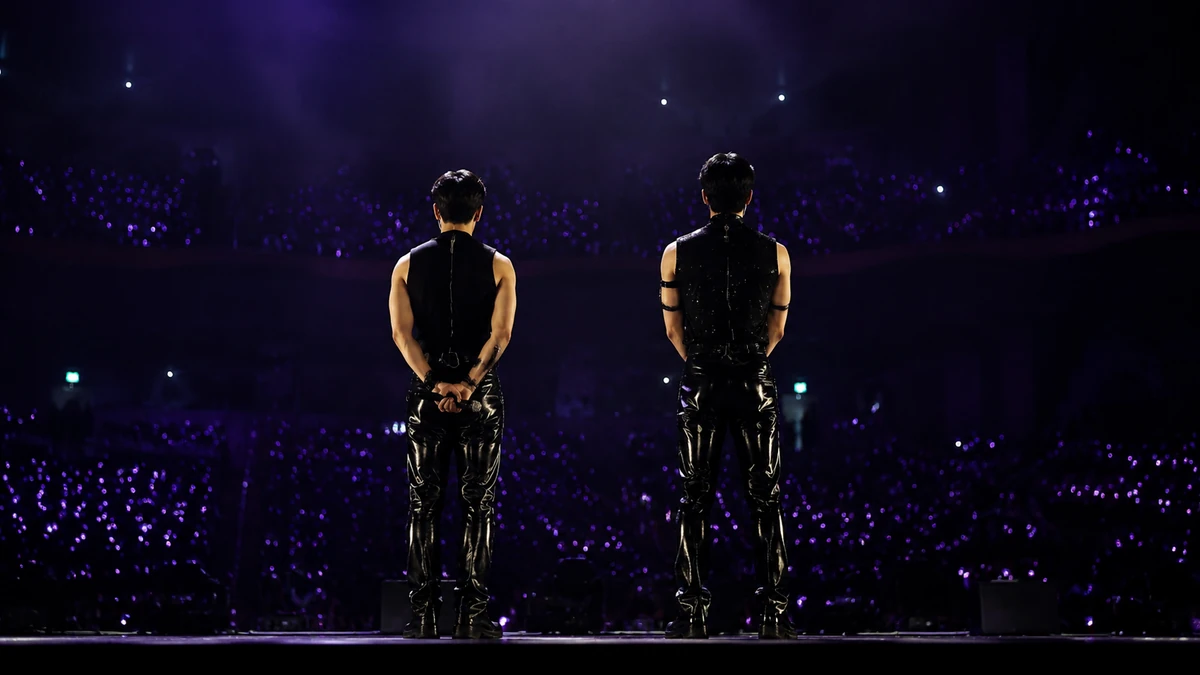
A return that means more than a release date
In K-pop, where the industry often moves at the speed of a social media refresh, nearly three years can feel like an eternity. That is what makes the return of Shownu and Hyungwon — the MONSTA X subunit known as Shownu X Hyungwon — notable beyond the usual comeback headlines. The pair are releasing their second mini-album, Love Me, on Monday at 6 p.m. in South Korea, marking their first unit release in 2 years and 10 months.
For American readers less familiar with the mechanics of K-pop, a “comeback” does not necessarily mean an artist disappeared completely. In Korean pop music, the term refers to a new promotional cycle tied to a fresh release, often including new music, music videos, televised performances and a coordinated media rollout. Likewise, a “unit” or “subunit” is a smaller team formed from members of a larger group, designed to highlight a different sound, chemistry or concept than the full group typically presents.
That framework matters here. Shownu and Hyungwon are not newcomers trying to establish themselves from scratch. They are members of MONSTA X, the long-running boy group known for muscular performance, polished choreography and a global fan base that stretches well beyond South Korea. But this return is significant because it is not simply about restarting a side project. It is about showing what these two artists sound like now, after a long stretch in which the K-pop market kept accelerating around them.
According to comments the two gave in Seoul ahead of the release, the long gap was not a case of inactivity. It was the result of timing, group priorities and sustained preparation. That distinction is crucial. In an industry that often rewards frequency — more songs, more videos, more fan engagement, more visibility — Shownu X Hyungwon are framing their comeback around a different value proposition: care, refinement and maturity.
Shownu said the album was made with extra attention because fans had waited so long. That may sound like a routine promotional line, but it gets at the heart of why this release stands out. The story here is not merely that they are back. It is that the delay itself has become part of the album’s meaning.
Why a nearly three-year gap matters in K-pop
To understand why the timing has become part of the narrative, it helps to understand the rhythm of the K-pop business. Major acts often release new material on tight cycles, sometimes multiple times a year. Those releases are supported by highly coordinated performance schedules, fan events, livestreams, variety show appearances and waves of digital content calibrated to hold attention in a crowded market. In the United States, pop stars can go years between albums without raising too many eyebrows. In K-pop, the expectation is usually more continuous.
That makes a 2-year-and-10-month gap between unit albums feel unusually long, especially for artists attached to a well-known group. But the delay also reflects a reality many Korean male idols must navigate: military service and group scheduling. South Korea requires most able-bodied men to complete mandatory military service, and that obligation shapes career timing in ways American audiences may not instinctively recognize. Releases, tours and even subgroup activities are often planned around who has enlisted, who has returned and how to maintain momentum without disrupting the larger group identity.
Shownu and Hyungwon said they had to prioritize MONSTA X’s full-group activities, including timing related to member I.M before his own military enlistment. That means the unit’s return was not abandoned so much as strategically deferred. In the K-pop system, subunits do not always operate independently of the flagship group. They are often woven into a broader long-term plan, one that balances artistic opportunity, fan expectations and practical realities.
For Western readers, an imperfect but useful comparison might be a side project formed by members of a major band who still have to work around the main act’s touring and recording schedule. The difference is that in K-pop, those logistics are intensified by a tightly structured promotional culture and, in the case of male performers in South Korea, the calendar pressure created by military service.
That is why this comeback carries more weight than a standard album drop. The long break suggests not drift but recalibration. It implies that what looked like absence on the surface was, in fact, a period of rearranging priorities and building something that would justify the wait.
What Shownu X Hyungwon are trying to say this time
The thematic center of Love Me is, fittingly, love. But by the duo’s own description, this is not a simple set of songs about infatuation or romantic certainty. Instead, the album explores how love changes over time — how attraction can coexist with doubt, how closeness can come with distance, and how relationships are often defined less by one dramatic confession than by emotional shifts that are harder to name.
That approach may sound familiar to American pop listeners, because ambiguity and emotional push-pull have become common terrain across modern R&B and pop songwriting. But in the context of idol music, it marks an effort to refine a familiar topic rather than just repeat it. Love has always been one of pop music’s most dependable subjects. The question is how artists frame it. Here, Shownu and Hyungwon appear to be leaning away from youthful fireworks and toward something cooler, more restrained and more adult.
The members themselves hinted at that perspective when they described the album in terms that suggest they are no longer interested in sounding young just for the sake of sounding energetic. In Korean entertainment coverage, age and experience often factor into how artists present their evolving image. When the duo refer to a charm that is no longer “young,” the point is not simply that they are older. It is that they want to express emotion differently — with more nuance, more hesitation, more atmosphere.
That is especially visible in the title track, “Do You Love Me,” which is built around uncertainty rather than declaration. Even the title is a question, not an answer. Instead of presenting love as a triumphant certainty, the song reportedly centers on the tension of needing reassurance while being unable to fully trust it. There is a push-and-pull at the core of the concept: wanting someone, doubting them, pulling them close, then bracing for disappointment.
That kind of emotional tension is often more compelling than a straightforward love song because it feels lived-in. It reflects the uneasy territory many people know well, where feelings are real but clarity is scarce. For a unit like Shownu X Hyungwon, whose appeal rests partly on composure and chemistry, that emotional register makes sense. They are not selling adolescent butterflies. They are selling atmosphere, ambiguity and control.
From performance-first K-pop to music meant to be heard closely
One of the more revealing parts of the rollout is Hyungwon’s emphasis on making music that works not only as performance, but as listening. That distinction may seem small, but it points to an important conversation within K-pop. The genre has become famous globally for visual scale — immaculate choreography, high-concept videos, fashion-forward styling and stagecraft so precise it can feel almost cinematic. Sometimes, that spectacle leads outside observers to assume the music itself is secondary.
Artists across K-pop have spent years pushing back on that idea, and Shownu X Hyungwon appear to be doing the same here. Their seven-track mini-album includes songs that are meant to express different shades of love rather than merely reinforce one loud, marketable hook. Hyungwon also participated in writing and composing four of the tracks, a detail that matters because it signals deeper creative investment from within the unit itself.
That kind of member involvement has become increasingly important in how K-pop acts establish credibility, especially with international audiences that are often eager to know who is shaping the music behind the polished packaging. For American readers, it may help to think of songwriting credits as part of the authenticity conversation that routinely surrounds pop and hip-hop in the United States. The standards are not identical, and K-pop operates under a different production model, but the underlying question is familiar: How much of the artist’s own voice is in the finished work?
Hyungwon’s role in writing and composing nearly half the album gives Love Me an additional layer of personal framing. It suggests the album is not simply a concept delivered from the outside, but one that the duo helped define from within. That matters even more for a subunit, which exists in part to spotlight the traits that might be less visible in a larger ensemble setting.
Another track, “Sincerely” — rendered from the Korean reporting around a song described as carrying a bright, refreshing mood — is also said to deal with love, but from a lighter angle. That points to one of the album’s bigger ambitions: not to flatten love into a single mood, but to treat it as a spectrum. If the title track captures tension and insecurity, the rest of the project seems designed to widen the emotional frame.
That is a smart move for a seven-song release. In the streaming era, mini-albums can easily become little more than a title track plus filler. But when they are thoughtfully sequenced, they can function as a compact emotional document — a collection of variations on a theme rather than a loosely assembled set of leftovers. Shownu X Hyungwon appear to be aiming for the latter.
What a subunit can reveal about MONSTA X
Subunits are a common feature of K-pop, but they can be easy to misunderstand from the outside. To some Western audiences, they may look like side quests designed to fill downtime. In practice, they often serve a more specific artistic purpose. A full group has to balance multiple voices, image roles and performance demands at once. A subunit narrows the lens. It can magnify chemistry, experiment with tone and carve out a more focused identity.
That is especially true for a group like MONSTA X, which has built much of its reputation on intensity. The group’s music and stage persona have often leaned into power, drive and high-impact performance. Shownu X Hyungwon, by contrast, offer a more distilled emotional texture. The scale is smaller, but the focus is sharper.
In that sense, the unit is not a diminished version of MONSTA X. It is a different one. It lets two members foreground a style that may sit adjacent to the group’s core identity without replacing it. That dynamic is one reason K-pop’s subunit system has proved so durable. It gives fans multiple entry points into the same broader act while allowing artists to explore nuances that might not fit the main group’s current direction.
The duo’s comments also reinforce another important point: unit activities and full-group activities are not necessarily in competition. In fandom culture, especially online, there can be a tendency to treat every scheduling choice as a zero-sum game. But the message from Shownu and Hyungwon is that the two lanes can coexist. They respected MONSTA X’s full-group timetable while continuing to prepare this release in parallel.
That may sound like inside baseball, but it has broader significance in the K-pop business. Groups that remain active over many years often survive not just through hit songs, but through careful balancing acts — between group and solo work, military obligations and public demand, artistry and schedule. The return of Shownu X Hyungwon is one example of how that balancing act can produce something with its own identity instead of feeling like a compromise.
Why this comeback resonates in a crowded global market
The larger K-pop market today is more international, more competitive and more narratively sophisticated than it was a decade ago. Success is no longer measured only by domestic chart performance or music show trophies in Seoul. It is measured by global streaming, touring power, festival appearances, brand visibility and the ability to sustain attention across multiple platforms and markets. The biggest acts now move through the same worldwide media ecosystem as American pop stars, even if the rules of engagement are not identical.
Within that environment, a comeback like this stands out precisely because it is not trying to overwhelm the market through sheer speed. The duo’s message is almost the opposite: the wait matters because the work matters. That is a subtle pitch in an era that often rewards constant presence over patient construction.
There is also a wider cultural point here. K-pop’s global rise has led many outside observers to focus on its largest spectacles — stadium tours, award-show appearances, blockbuster fandoms, viral choreography. Those stories are real, but they can flatten the genre into a single image of scale and intensity. Releases like Love Me help illustrate a different side of Korean pop: one in which the interesting story is not just who is biggest, but how artists evolve inside a highly structured system.
That kind of evolution is increasingly legible to Western audiences. As K-pop becomes more familiar in the United States, international listeners are learning to read not only the hooks and visuals, but the internal story lines — member participation, unit identity, military timing, tonal shifts and the difference between a commercial rush and a carefully staged return. In other words, the audience is catching up to the form.
For Shownu X Hyungwon, that creates an opening. Their comeback may not arrive with the mass-event scale of the industry’s most dominant global names, but it does not need to. Its significance lies in how clearly it articulates what this unit is for: not speed, not novelty for novelty’s sake, but a controlled, mature emotional palette inside one of K-pop’s most fast-moving ecosystems.
The message behind the wait
If there is a larger takeaway from this release, it is that waiting can become part of an artist’s argument. A long absence can look like lost momentum. It can also, if handled carefully, become evidence of intention. Shownu X Hyungwon are betting on the latter.
That bet is visible in the way they describe the album, in the way they explain the gap and in the creative choices attached to the project. The songs are built around different shades of love rather than one blunt emotion. The title track turns uncertainty into the central tension instead of treating it as a flaw to be resolved. Hyungwon’s writing and composing credits add a layer of authorship. And the duo are explicitly presenting the record as something to hear closely, not just watch from afar.
For fans, that helps transform the delay from a frustration into a rationale. The missing time becomes part of the album’s persuasive power. It says: this took longer because it needed to say something different.
That may be the strongest reason this comeback matters. Not because it is the loudest event on the K-pop calendar, and not because it reinvents the genre, but because it shows how a subunit can return with a clearer sense of self after time away. In an industry built on velocity, Shownu X Hyungwon are making a case for density — for emotional texture, for deliberate pacing and for the idea that sometimes the most meaningful return is the one that arrives after artists have had time to become more fully themselves.
Whether Love Me breaks through beyond the duo’s established audience remains to be seen. But as a statement of purpose, it already says plenty. It tells listeners that patience can be a creative strategy. It reminds the market that not every comeback has to win by arriving first. And it offers a useful window for global audiences trying to understand how K-pop works at a level deeper than its flashiest headlines.
That alone makes this more than a routine release. It makes it a story about timing, identity and the value of returning only when the music has something worth adding to the conversation.
Comments
Post a Comment