South Korea’s health minister makes a weekend hospital round to confront a growing worry: Where can a sick child go outside Seoul?
A weekend visit that signals a larger problem
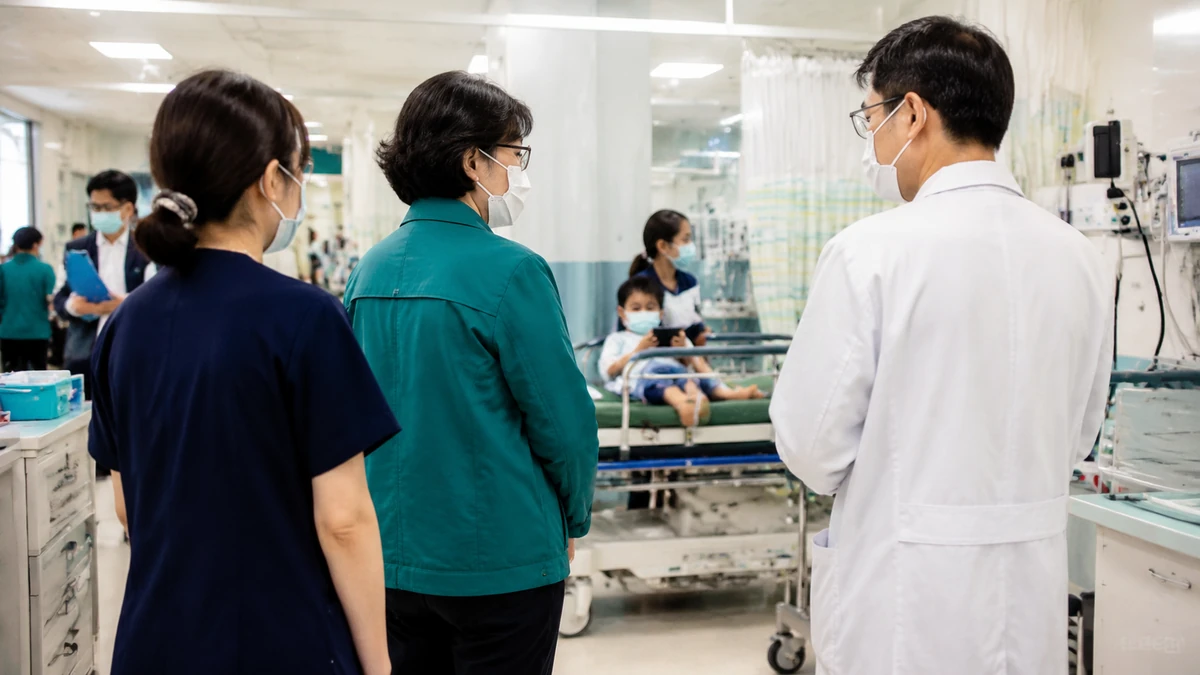
South Korea’s top health official spent part of a Saturday walking hospital corridors in Cheonan, a fast-growing city south of Seoul, asking a question that would sound familiar to many parents anywhere: If a child gets sick right now, where can that family actually go?
The visit by Health and Welfare Minister Jung Eun-kyeong on May 10 was, on its face, an inspection tour of pediatric care. But the symbolism mattered. Cabinet-level ministers do not spend weekend afternoons checking outpatient clinics and emergency systems unless the issue has become politically and socially urgent. In South Korea, pediatric care is no longer being treated as a narrow hospital-management issue. It is increasingly seen as a test of whether the country’s social safety net works in everyday life, especially outside the capital region.
According to the government’s account of the trip, Jung met with medical workers, local government officials, hospitalized patients and guardians. She first visited Soonchunhyang University Cheonan Hospital, where officials discussed how to keep the emergency care system stable and how to reduce gaps in children’s medical care outside the Seoul metropolitan area. She then went to Dujeong Leejin Hospital, a designated “Moonlight Children’s Hospital,” to examine how pediatric outpatient care was operating on a holiday afternoon and to hear what local clinics and community hospitals say they need from the government.
The practical question behind the visit was simple and unsentimental: When a child spikes a fever on a weekend, develops breathing trouble at night, or suddenly gets worse on a holiday, can the family find care quickly without defaulting to a crowded emergency room? That is the kind of problem parents feel in real time, and it is the kind of problem governments often struggle to solve because it sits at the intersection of staffing, geography, scheduling and money.
For American readers, the closest parallel may be the difference between having a pediatrician’s office open on a weekday morning and trying to find help on a Sunday evening when urgent care options are thin and the nearest children’s hospital may be an hour away. South Korea’s version of that problem is shaped by its own medical system and regional divides, but the anxiety is universal. The stakes are not abstract. In pediatric medicine, waiting times, travel distance and the availability of trained staff can change outcomes.
Jung’s visit made clear that the South Korean government wants to show it is treating those concerns as a matter of public infrastructure, not merely personal inconvenience.
Why pediatric care has become a bigger national issue in South Korea
Pediatric medicine can look deceptively small when viewed through raw patient counts alone. Children, after all, are not the majority of any aging society’s patients. But the field carries outsized importance because children’s symptoms can change quickly, guardians must make time-sensitive decisions on their behalf, and a child’s illness often turns one family’s routine upside down in a matter of hours.
That is especially true in South Korea, where low birthrates have transformed almost every conversation about the future. The country has one of the world’s lowest fertility rates, and successive governments have treated family policy, child care and women’s labor-force participation as urgent national concerns. In that context, whether parents can count on a functioning pediatric care network is not simply a health policy matter. It is bound up with broader questions about family life, regional equality and confidence in the state.
When Korean officials talk about pediatric care, they are increasingly talking about public trust. Parents want to know not only whether hospitals exist, but whether they are reachable at the times that matter most: nights, weekends and holidays. A system can look adequate on paper during weekday business hours and still fail families when the fever starts after dinner or the vomiting begins during a holiday travel weekend.
That helps explain why the ministry emphasized both emergency care and outpatient access in Cheonan. The challenge is not just treating severe cases. It is building a system that allows families to distinguish between a true emergency and a problem that still needs prompt, professional attention but can be handled outside the ER. Without that middle layer, emergency departments become the default catchall, which strains hospitals and heightens anxiety for everyone involved.
American audiences will recognize that pattern. In many U.S. communities, emergency rooms are used for ailments that could be treated elsewhere if after-hours pediatric options were more available and easier to understand. South Korea is wrestling with a similar tension, though in a national health system with different payment structures and different expectations about government coordination.
The political significance is also regional. Much of South Korea’s specialized medical care is concentrated in and around Seoul, the capital region that dominates the country’s economy, population and elite institutions. For years, that concentration has fed concerns that residents elsewhere face a quieter but persistent disadvantage: They may live in a city with hospitals, but not necessarily with the right pediatric staff, operating hours or emergency specialization when needed. The Cheonan visit put that concern front and center.
What the minister inspected in Cheonan
The choice of sites was deliberate. Soonchunhyang University Cheonan Hospital represents the higher-acuity end of care: a regional base where emergency services, pediatric expertise and coordination with government can be discussed at a system level. Dujeong Leejin Hospital represents the everyday access problem: the local place a parent might seek out on a holiday afternoon before a child’s condition deteriorates into something more dangerous.
By visiting both, Jung was effectively examining several layers of the pediatric system at once: serious emergencies and less severe illnesses, tertiary or larger hospital capacity and neighborhood-level outpatient access, government policy and family experience. That layering matters because a pediatric system works only when its parts connect. A regional emergency center cannot be the sole answer for every fever, stomach bug or minor respiratory complaint. At the same time, local clinics cannot carry the burden of more serious cases without reliable referral pathways and emergency backstops.
The timing added another layer of meaning. The visit took place on a weekend afternoon rather than during normal weekday hours. That is exactly when access can become most fraught for parents. In many countries, health systems look strongest when offices are open, administrative staff are on hand and transportation patterns are predictable. They look much more fragile when families need care outside business hours. By conducting the visit on a Saturday, the minister was not just surveying buildings; she was testing the system under the conditions when many families feel most vulnerable.
The discussions reportedly focused on maintaining a stable emergency care system and reducing pediatric care gaps in non-capital regions. Those are not isolated topics. Emergency departments depend on having enough trained personnel and equipment, but they also depend on the surrounding medical ecosystem. If neighborhood pediatric clinics are scarce, if after-hours outpatient options are limited, or if families do not know where else to go, emergency rooms absorb the pressure. That can mean longer waits, more stress on staff and less efficient use of medical resources.
The second stop, at a designated Moonlight Children’s Hospital, highlighted precisely that pressure point. The government says these hospitals are intended to give children access to outpatient care at night and on holidays. For an American audience, think of them as a specialized after-hours pediatric safety valve: not a full substitute for an emergency department, but a way to keep families from being forced into an all-or-nothing choice between staying home worried and heading straight to the ER.
That kind of institution can sound modest, but it addresses a problem that is anything but small. For parents, the hardest moment often comes before diagnosis, when symptoms are worrying but ambiguous. The availability of a real, open, local option can reduce panic, speed treatment and prevent unnecessary crowding at emergency facilities.
The “Moonlight Children’s Hospital” model, explained
The phrase “Moonlight Children’s Hospital” may sound unusual in English, but the idea behind it is straightforward. South Korea uses the designation for medical facilities that provide pediatric outpatient care during hours when ordinary clinics may be closed, particularly at night and on weekends or holidays. The goal is to create a bridge between regular office-based care and high-intensity emergency medicine.
In practical terms, that means parents dealing with a child’s ear infection, high fever, dehydration concerns or worsening cold symptoms may have somewhere to go besides a general emergency room. The model is designed to preserve ER capacity for truly urgent cases while still giving families prompt medical access. It is a form of structured after-hours care with an explicitly pediatric focus.
This matters because children are not just small adults. Drug dosing, symptom progression and physical responses can differ in important ways. Pediatric triage also requires communication with guardians who are often frightened and making quick judgment calls with imperfect information. A system built for adults does not automatically meet those needs well.
South Korean officials appear to be betting on a two-track approach. The first track is specialized pediatric emergency capacity for severe or time-sensitive cases. The second is a broader after-hours outpatient network for common but still pressing childhood illnesses. The Cheonan visit was a window into how those two tracks are meant to complement each other.
There is a distinctly Korean policy style embedded here as well: designation and targeted support. Rather than expecting every medical institution to provide the same services at the same level, the government identifies facilities that can perform specific functions and then backs them with policy support. In this case, that means assigning a formal role to hospitals capable of handling pediatric after-hours care or pediatric emergency treatment.
Whether the model is sufficient is another question. Designation alone does not create doctors, nurses or sustainable work schedules. But it does show how the government is trying to organize scarce medical capacity more intentionally. In that sense, Moonlight Children’s Hospitals are not simply clinics with a catchy name; they are an attempt to build a clearer map for parents navigating off-hour care.
For U.S. readers, it may be helpful to think of the Korean approach as a more centrally branded version of the challenge American families know through children’s urgent care centers, after-hours advice lines and hospital-affiliated pediatric walk-in services. The exact structure differs, but the underlying need is similar: make care discoverable and usable before every worried parent ends up in the emergency room.
The regional divide behind the policy push
If the most important word in this story is “pediatric,” the second may be “regional.” The South Korean government specifically framed the Cheonan discussions around easing pediatric care gaps outside the capital area. That is a crucial point in a country where national debates often turn on the imbalance between Seoul and everywhere else.
Cheonan, while not remote, sits in a region that captures this issue well. It is close enough to Seoul to be economically connected, but far enough to reflect the realities of communities that do not enjoy the same density of elite medical resources as the capital. In policy terms, it is the kind of place where government officials can study both urban demand and the strain created when specialized care is unevenly distributed.
The problem is not just whether a hospital exists. It is whether appropriate pediatric care is available at the right time, within a reasonable distance, with staff trained to treat children. A city may have medical buildings and still face a pediatric gap if local clinics are closing, specialists are scarce, or after-hours options are too limited to meet demand.
That is why the ministry’s focus extended beyond major hospitals to smaller community-level pediatric practices. Large hospitals cannot solve the entire problem on their own. Sustainable regional pediatric care depends on a layered ecosystem: neighborhood clinics to handle routine and moderately urgent needs, regional hospitals to manage emergency and more complex cases, and local governments to coordinate logistics and support.
The fact that Jung met not only doctors but also municipal or regional officials underscores that point. In South Korea, as in the United States, health access is often shaped by more than medicine alone. Transportation, staffing incentives, local budgeting and administrative coordination all influence whether a parent can get care quickly. A national ministry can set policy, but implementation is intensely local.
For American readers, the comparison might be the difference between a family living near a major pediatric hospital in Boston, Houston or Philadelphia and a family in a smaller city where options narrow dramatically after 5 p.m. The Korean debate is unfolding in a different health system, but the geography of anxiety is recognizable. Families in non-central regions frequently bear the burden of longer travel, fewer choices and more uncertainty.
That makes the Cheonan visit more than a photo opportunity. It sends a message that the government sees pediatric access outside Seoul as a national governance issue. Whether that message translates into durable improvements will depend on staffing, funding and institutional follow-through.
The challenge of staffing and sustainability
Any discussion of pediatric care eventually runs into the same hard question: Who is going to do the work, and under what conditions? South Korea’s Health and Welfare Ministry says it is supporting 14 specialized pediatric emergency medical centers nationwide, with dedicated doctors, equipment and facilities tailored to children’s emergency needs. That framework sounds robust, but frameworks are only as strong as the professionals willing and able to sustain them.
Pediatric care is labor-intensive, emotionally demanding and difficult to expand quickly. Emergency coverage is even more so. Staffing children’s services at night, on weekends and during holidays requires not just enough physicians, but enough nurses, technicians, administrative support and institutional funding to prevent burnout and service interruption. If those conditions are weak, the system can become brittle no matter how well designed it appears on paper.
That seems to be one reason the government emphasized maintaining a stable emergency care system rather than simply announcing more services. Stability suggests a recognition that continuity is itself a policy goal. Families do not just need a clinic that exists. They need one that will reliably be open, adequately staffed and connected to higher-level care when needed.
There is also the question of incentives. In many health systems, including the U.S., medicine is shaped by workforce preferences, compensation structures and quality-of-life considerations for clinicians. If too few pediatricians want to work in certain regions, or if the economics of community pediatrics become less attractive, care gaps can widen even when demand remains obvious.
The Korean government’s approach of designation and support may help concentrate resources where they are most needed. But long-term success will likely depend on whether those supports are substantial enough to keep both hospital-based and clinic-based pediatric services viable. That is especially true in non-capital regions, where recruitment and retention challenges can be sharper.
In that sense, the conversations Jung held with frontline providers may be as important as the public symbolism of the trip. Statistics can show how many centers are designated. They cannot fully capture what it feels like to run a pediatric service on a holiday afternoon, fielding worried families while trying to maintain staffing levels and make judgment calls about who must be sent to an emergency setting. Those practical realities often determine whether policy succeeds.
What this means for families, and what to watch next
For parents, the meaning of the Cheonan visit is immediate: the government is signaling that it understands pediatric access as an everyday quality-of-life issue, not merely a technical medical matter. Families want something basic but invaluable — confidence that there is a door open for their child when they need it. That confidence affects not just health outcomes, but the broader sense of whether a society is organized around ordinary people’s needs.
For South Korea, that matters at a time when family policy and social trust are under intense scrutiny. In a country worried about low birthrates, high living costs and the burdens of caregiving, pediatric access can become a proxy for something larger. Parents notice whether systems accommodate real life. Can they find treatment on a holiday? Can they avoid an unnecessary emergency room trip? Can they get help without traveling into the capital?
That is why this story resonates beyond one minister’s schedule. It points to a broader governing challenge: building public systems that work not only in theory, but at inconvenient hours, in non-central places and under the pressure of anxious families making fast decisions. Those are often the conditions under which trust is either strengthened or lost.
What comes next will matter more than the optics of a weekend inspection. The key tests are whether the government expands and stabilizes after-hours pediatric options, whether support for specialized pediatric emergency centers proves sufficient, and whether smaller regional practices see policy changes that make them more sustainable. Officials will also face pressure to show that access is improving not just in Seoul’s orbit, but across the country.
Jung’s visit to Cheonan offered a snapshot of a system under close watch. It also captured a broader truth about modern health policy, in South Korea and elsewhere: some of the most consequential questions are also the most basic. When a child gets sick, where can the family go? A government that can answer that clearly and reliably earns something more valuable than a headline. It earns trust.
Comments
Post a Comment