South Korea’s Park So-hyun wins in Goyang, showing the kind of staying power tennis careers are built on
A title that means more than one good week
In global tennis, the biggest headlines usually belong to Grand Slam champions, rising teenage phenoms or stars with multimillion-dollar endorsement deals. But the sport’s real foundation is built somewhere else: on smaller tournament courts, in long travel weeks, in three-set matches that test nerve as much as talent, and in careers shaped by persistence rather than flash. That is where South Korea’s Park So-hyun made her latest statement.
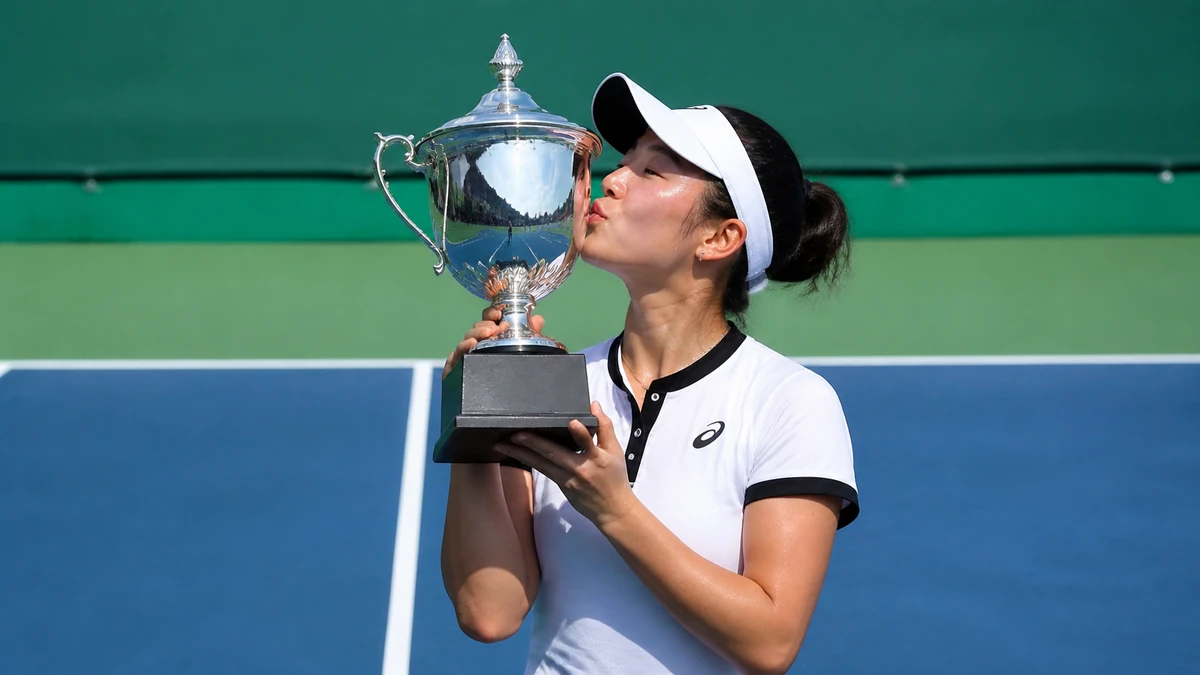
Park, ranked No. 279 in the world, won the women’s singles title at the International Tennis Federation event in Goyang, a city just northwest of Seoul in South Korea’s densely populated capital region. She defeated Japan’s Rinko Matsuda, ranked No. 586, 4-6, 6-3, 6-4 in the final, rallying after dropping the first set. On paper, it was one result at a lower-tier international event. In context, it was something more revealing: the 10th singles title of Park’s professional career, and another piece of evidence that she has become one of those players who keeps showing up, keeps winning matches and keeps putting herself in position for the next step.
That distinction matters in tennis, perhaps more than in almost any other sport. A baseball player can survive a slump while teammates carry the load. An NFL player may have only 17 regular-season games to define a year. In tennis, especially below the elite tier, players live from tournament to tournament, point to point, across different countries, surfaces and levels of support. A ranking like No. 279 does not make a player a household name in the United States, but it places her firmly inside a demanding international system where consistency is hard-earned and fragile.
Park’s win in Goyang also carried timing and symbolism. It was her first title since December, when she won an ITF W35 event in New Delhi, India. A roughly five-month gap between titles is not a long drought in professional tennis, but it is long enough to remind everyone how difficult it is to return to the winner’s circle. Players outside the top tier do not simply defend status; they rebuild momentum over and over again. In that sense, Park’s victory was not about sudden arrival. It was about confirmation.
That is one reason the result resonated in South Korea. The country has produced globally recognized sports stars in golf, soccer, baseball and figure skating, and in tennis it has had notable names, especially on the men’s side, including Chung Hyeon and Kwon Soon-woo. But the week-to-week labor of Korean tennis often unfolds outside the brightest international spotlight. Park’s title offered a reminder that the sport’s health is not measured only by major-tournament breakthroughs. It is also measured by players who keep building, keep competing and keep making progress in the layers beneath the top.
A comeback in the final, and a familiar kind of pressure
The final itself was not smooth or easy, which in some ways made the result more meaningful. Park lost the first set 6-4, a sign that the match had arrived with all the tension usually attached to championship tennis. Finals have a way of disrupting rhythm. A player can feel the finish line, and that awareness often complicates everything from shot selection to serve placement. Against Matsuda, Park had to deal with both the resistance of an opponent and the emotional swings that come when a title is on the line.
She responded the way experienced professionals often do: not with panic, but with adjustment. Park took the second set 6-3 to level the match, then closed out the decider 6-4. The score line suggests a match of shifting control rather than dominance, and that is usually where composure becomes decisive. Coming back after losing the opening set requires more than clean ball-striking. It demands tactical patience, the ability to accept that the match may not look pretty, and enough emotional steadiness to reset after setbacks.
In singles, that burden is especially personal. There is no pitching change, no timeout huddle, no teammate to absorb a bad stretch. Tennis players have to manage momentum alone, inside their own heads, often in silence except for the sounds of the court and the occasional reaction from the crowd. For that reason, comeback wins in finals can tell observers as much about a player’s maturity as about her forehand or movement.
Park’s rally from one set down was the kind of performance coaches value because it suggests a player can solve problems under pressure. American sports fans often talk about “closing ability” in basketball or “late-game execution” in football. Tennis has its own version, and it usually appears in moments like these: a player loses control early, makes just enough corrections, and then trusts her competitive instincts when the match tightens again in the third set.
It is tempting to reduce lower-level tournament results to numbers and rankings. But the drama of a comeback like this matters because rankings alone cannot fully capture how a player is competing. Park did not simply win another title. She won it by absorbing a setback, changing the direction of the match and carrying the pressure of a final all the way through the finish.
Why a 10th singles title matters in the tennis economy
There is a reason the number attached to this victory stood out. A 10th career singles title is not the kind of statistic that guarantees international fame, but it is the kind that commands respect within the sport. It suggests that a player’s success is not a fluke, not a lucky week, not a brief spike. It points instead to repeatable competitiveness, which is one of the hardest things to establish in professional tennis.
The ITF circuit operates as an essential proving ground. For American readers, it may help to think of it as something like the developmental ecosystem beneath the biggest leagues: not exactly the minor leagues in a formal team-sport sense, but a place where careers are forged, rebuilt and tested. Players at this level are chasing ranking points, prize money, confidence and opportunities to move into larger events on the WTA calendar. The glamour is limited. The stakes are not.
Travel on the circuit can be relentless. One month might take a player to India, another to Japan, another to a domestic event at home, all with different conditions and competitive fields. Court surfaces, weather, scheduling and recovery routines can change constantly. Financial pressures can be real, especially for players who are not yet earning top-tier prize money. Against that backdrop, reaching 10 career singles titles says something clear: Park has learned how to navigate the grind.
Her current ranking, No. 279, reinforces that point. Rankings in that range place players in a difficult middle ground. They are accomplished enough to win internationally and to threaten for upward movement, but they are still outside the secure comfort zone of the sport’s biggest events. For players there, each tournament can function like a small referendum on progress. A title does not transform everything overnight, but it can help stabilize momentum and keep the long-term climb alive.
Park’s return to winning form after a title in New Delhi late last year also suggests she has avoided the kind of prolonged slump that can stall careers. In tennis, the difference between a player on the rise and a player stuck in place is often not brilliance but repeatability. Can she string together solid weeks? Can she re-enter title contention after a disappointing run? Can she keep her level high enough that winning feels like a realistic possibility rather than a distant memory? In Goyang, Park offered favorable answers to those questions.
That is why this title landed as more than a local sports item. It fit into a larger truth about the sport: the athletes most likely to keep climbing are often the ones who learn to win repeatedly in places far from the global spotlight. Park’s 10th singles crown belongs squarely in that category.
Why the win resonates in South Korea
The result also carried a national layer of meaning. Park became the first South Korean player to win the women’s singles title at this tournament since Han Na-lae in 2016, ending a long stretch without a home winner in the event. That may sound like a narrow statistic, but in a country that closely watches signs of domestic progress in international sports, it matters.
Winning at home can be complicated. Familiar surroundings do not automatically make a title easier. If anything, home events often come with a different kind of pressure: expectations from local fans, media attention and the symbolic weight of representing the host nation well. Many athletes describe home competition as both comforting and demanding, much like American Olympians often do when major events are held on U.S. soil. The crowd support can help, but it also raises the emotional stakes.
For South Korean tennis, Park’s title offered a welcome image of continuity. Korea’s sports culture is often associated abroad with globally visible success stories — think figure skater Kim Yuna, soccer star Son Heung-min or the country’s pipeline of LPGA talent. But another important part of the system exists beyond superstardom: a network of local governments, corporate teams and institutional support structures that help athletes continue professional careers. Park competes for the Gangwon State Sports Council, part of a model in which municipal or provincial organizations support athletes in Olympic and non-team sports.
That structure may be unfamiliar to many American readers. In the United States, elite athletic development often moves through school sports, college programs, private coaching and professional circuits. In South Korea, public institutions and company-backed teams have long played a major role in sustaining athletes, especially in sports that do not generate massive commercial revenue on their own. The arrangement can provide stability while still demanding results.
Park’s success, then, can be read in two ways at once. It is the achievement of an individual player who has kept improving. It is also an example of how South Korea’s broader sports ecosystem continues to produce competitors capable of winning on the international circuit. Those systems do not always attract headlines abroad, but they matter deeply in determining which countries remain competitive across a wide range of sports.
There is also a cultural element in how this victory is likely to be discussed inside South Korea. Korean sports coverage often places emphasis not just on breakthrough talent but on diligence, discipline and step-by-step growth. Park’s latest title fits comfortably in that frame. She is not being presented as a surprising new face. She is being recognized as proof that persistence itself has value — a message with particular appeal in a society where steady effort is often admired as much as raw brilliance.
Park’s own words reflect a familiar Korean sports ethic
After the match, Park said she was especially happy because the title marked her 10th international tournament singles win and a domestic victory that had been a long time coming. She added that she would continue working toward her goals step by step and hoped to show even better performances in the future.
That phrase — “step by step” — may sound ordinary in English, but it carries particular weight in Korean sports language. Athletes in South Korea frequently frame success in terms of gradual improvement, humility and continued effort rather than sweeping personal declarations. That is partly a matter of convention and media training, but it also reflects a broader cultural comfort with incremental progress over self-celebration.
American fans are used to a wider range of postgame styles. Some athletes lean into swagger. Others speak in polished corporate phrases. Some deliver the kind of emotionally raw television moment that instantly goes viral. In South Korea, athletes more often emphasize gratitude, responsibility and the sense that one result is part of a larger journey. Park’s reaction fit that pattern.
What makes that notable is not that it was modest, but that it matched the substance of her career. “Step by step” is easy to say after a win. It means more when the résumé supports it. Ten singles titles, spread across years and different tournaments, form the kind of record that is almost defined by accumulation. This is not the profile of a player living off one magic week. It is the profile of someone building a career brick by brick.
That mindset can be crucial for players trying to move higher in the rankings. Tennis punishes emotional overreaction. A breakthrough run can be followed by an early loss the next week. A career-best ranking can quickly slip if points are not defended. The players who last are often the ones who treat progress as a process rather than a single dramatic event. Park’s comments suggested she understands that reality well.
For fans, there is also something appealingly grounded about this kind of response. It leaves room for ambition without turning one result into a final destination. In an age when sports narratives often rush to crown the next sensation, Park’s words pointed in a quieter direction: keep working, keep improving, keep going. For a player navigating the demanding middle tiers of international tennis, that may be the most realistic and most powerful approach available.
What this win says about Korean women’s tennis now
Park’s title arrives at a moment when South Korean sports can seem crowded with bigger stories. There are the global draws of K-pop and Korean entertainment, which have expanded the country’s cultural footprint far beyond Asia. There are headline athletes in golf and soccer. There is always a strong domestic appetite for baseball and increasingly sophisticated attention to international competition. In that environment, a tennis title at an ITF event may look modest from a distance.
Inside the sport, though, results like this matter a great deal. They thicken the base of the pyramid. They signal that a nation is still producing players who can compete beyond its borders. And they create pathways for future breakthroughs, even if those breakthroughs do not happen immediately. Tennis development is rarely linear. Many players spend years in the sport’s in-between spaces before a ranking jump or a memorable run pushes them into wider visibility.
For Korean women’s tennis, Park’s latest title is encouraging precisely because it reflects continuity rather than a one-off surprise. It suggests there is still life, ambition and resilience in the system. That may not be as flashy as a Cinderella run at the U.S. Open, but it is how sustainable progress usually looks in real time.
There is also a broader lesson here for international readers who may mostly encounter South Korean sports through its biggest stars. A country’s athletic strength does not come only from a few famous names. It also comes from the players just below the global celebrity line — the ones who keep training, traveling and competing until their résumé becomes impossible to dismiss. Park, at least for this week in Goyang, represented that layer of excellence.
Her win over Matsuda was a comeback, a home-court success and a milestone all at once. It ended with a trophy, but the larger meaning lies in what that trophy represents: staying power. Tennis careers are often narrated through explosive ascents and painful declines. Park’s story, at least right now, points to something more durable and perhaps more relatable — the athlete who keeps returning to contention because she has built a game, and a mentality, sturdy enough to do it again.
For American readers accustomed to seeing tennis mostly through the lens of New York, Wimbledon or star-driven streaming highlights, that may be the most useful context of all. The sport is sustained by competitors like Park So-hyun, whose biggest achievements may not always unfold on center stage but whose steady accumulation of wins tells the truest story about what professional tennis demands. In Goyang, Park did not just win a final. She reinforced the idea that in tennis, as in so many careers, longevity and resilience are accomplishments in their own right.
Comments
Post a Comment