South Korea’s president condemns seizure of Gaza aid ship carrying Korean activist, tying citizen safety to international law
A new South Korean president puts a distant conflict at the center of national policy
South Korean President Lee Jae-myung issued one of his sharpest foreign policy rebukes since taking office this month, condemning the seizure of a Gaza-bound aid vessel carrying a South Korean activist and framing the episode as both a matter of citizen protection and a test of international norms.
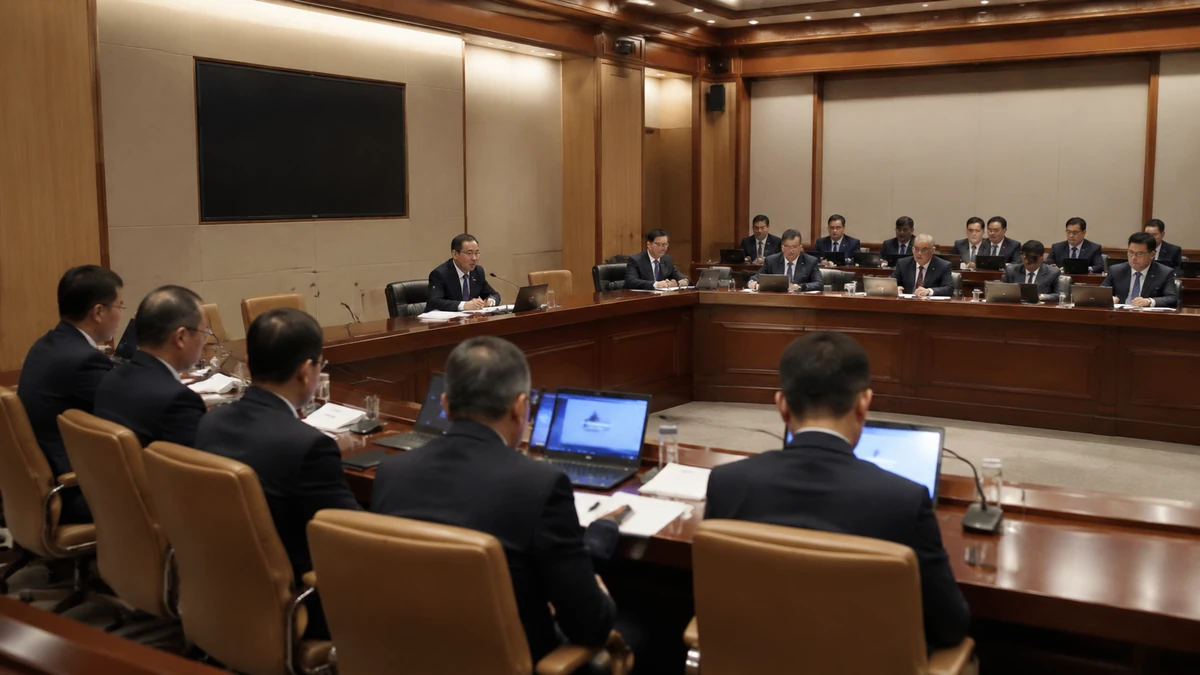
Speaking at a Cabinet meeting that also doubled as an emergency economic review session, Lee said Israel was violating what he described as the “minimum international norms” expected of states. The remarks, reported by Yonhap News Agency, were striking not only for their tone but for the setting. In South Korea, as in the United States, a president’s choice to raise an overseas incident in a high-level domestic policy meeting sends a signal: This is no longer a niche diplomatic issue. It is a matter of state responsibility.
At the center of the dispute is a flotilla attempting to approach Gaza with humanitarian aims, and the fact that a South Korean national was aboard when Israeli forces intercepted the vessel. Lee’s response suggested that, whatever debates may surround the activist mission itself, the South Korean government sees the detention or seizure involving one of its citizens as a line that demands immediate attention.
For American readers, the basic political logic may sound familiar. U.S. presidents have often drawn a distinction between whether they approve of an American citizen’s conduct abroad and whether they still have a duty to protect that person’s legal rights and physical safety. Lee appears to be making a similar argument: A government does not have to endorse every action of its citizens overseas in order to insist that another country treat them lawfully.
That distinction matters in South Korea, where public expectations of the presidency are unusually broad. The office functions with powers and visibility that often combine the roles Americans might divide among the White House, State Department and parts of a national security apparatus. When a president speaks directly about a Korean citizen caught in a foreign conflict, it is understood at home not just as commentary but as an instruction to the state to act.
Lee’s intervention also reflects the reality of South Korea’s global footprint. This is a country of major exporters, frequent international travelers, far-flung business networks and a growing diplomatic profile. When conflict erupts abroad, Seoul can no longer assume that distance will insulate it from the consequences.
More than consular protection, a public argument about rules
What makes Lee’s remarks especially notable is that he did not present the case merely as a consular problem, the dry diplomatic term for assisting citizens abroad. Instead, he explicitly linked the safety of a South Korean national to the legitimacy of the force used against the vessel and to broader questions of international law and humanitarian principle.
According to the account provided by Yonhap and statements from the presidential office, Lee argued that even if the activist voyage ran counter to South Korean government guidance or recommendations, that would be an “internal matter.” In other words, whether the citizen exercised poor judgment, ignored travel advice or chose a politically charged mission is separate from the question of whether a foreign state had lawful grounds to seize the ship and detain those on board.
That is a careful but important line. Governments often face criticism at home when citizens abroad place themselves in danger, especially in war zones. The temptation can be to distance the state from the citizen’s choices. Lee instead appears to have chosen a dual-track message: The South Korean government may not validate the activist’s decision, but it also will not allow that decision to erase the government’s duty of protection.
For an American audience, the legal and moral architecture of that argument is recognizable. The U.S. government has repeatedly insisted, across administrations, that citizens detained abroad are entitled to due process, humane treatment and diplomatic advocacy even when Washington strongly disagrees with what those citizens were doing. South Korea is now making a comparable point in its own vocabulary.
The language from Lee’s office reinforces that this was intended as a formal challenge, not an emotional outburst. Presidential officials described the remarks as part of a process of inquiring into the legality of the seizure and arrests involving a ship carrying a South Korean citizen. They said the comments were also meant to underline the importance of humanitarian concerns, international humanitarian law, and the safety and protection of Korean nationals.
That framing is significant because it places Seoul on ground that is broader than bilateral diplomacy with Israel. It suggests the government wants the case understood through standards that the wider international community claims to share, including rules governing civilians, humanitarian access and the use of force at sea. For a mid-sized democracy with growing global ambitions, the choice of language matters. South Korea is signaling that it wants to speak not only in the language of national interest, but also in the language of international order.
Why the Gaza issue carries unusual political weight in Seoul
The war in Gaza is geographically distant from the Korean Peninsula, but it has become harder for South Korea to treat crises in the Middle East as someone else’s problem. The country depends heavily on global trade routes, imported energy and stable international markets. It also has citizens working, traveling and engaging in civil society efforts around the world. What happens in the Middle East can affect shipping, oil prices, domestic politics and diplomatic relationships all at once.
That helps explain why Lee raised the ship seizure during a meeting that included an emergency economic review. In Washington, Americans are used to hearing presidents connect war overseas to gas prices, shipping disruptions or wider strategic stability. Seoul is increasingly doing the same. A conflict thousands of miles away can still land squarely on the desk of a South Korean president because the modern Korean economy is deeply tied to global flows of goods, fuel and people.
There is also a domestic political layer. South Korean governments are often judged by how quickly and visibly they respond when citizens get caught up in danger abroad. Public anger in such cases can be intense, especially if the government appears slow, passive or overly deferential to another country. Lee’s comments therefore serve two audiences at once: international actors who may need to hear Seoul’s legal objections, and a domestic public that expects its leaders to defend Koreans overseas.
That does not mean the politics are simple. South Korea is a U.S. ally that has traditionally tried to manage a complicated web of partnerships without overcommitting itself rhetorically on every global flashpoint. On issues involving Israel and the Palestinians, as with many American allies, Seoul has generally preferred cautious language. A sharp presidential criticism of Israeli actions therefore stands out.
It also reflects a change in South Korea’s self-image. Over the past two decades, the country has evolved from being seen primarily as a front-line state focused on North Korea into a broader global player. It is a major economy, a military power, a pop culture exporter and an increasingly visible participant in discussions on democracy, development and international governance. With that status comes pressure to say more when global norms appear to be at stake.
Lee’s choice to elevate the matter suggests that South Korea no longer sees citizen protection in distant conflict zones as a secondary diplomatic chore. It is becoming part of a larger test of whether Seoul can act like the kind of country it says it is: globally connected, legally minded and unwilling to separate humanitarian concerns from strategic interests.
The Netanyahu warrant reference raises the stakes
Among the most diplomatically sensitive elements of Lee’s remarks was his reference to the International Criminal Court warrant issued for Israeli Prime Minister Benjamin Netanyahu. The ICC, based in The Hague, is the world’s permanent tribunal for prosecuting individuals accused of grave international crimes. Mentioning that warrant in the context of a detained South Korean national was a loaded choice.
For one thing, it expands the frame. A consular dispute involving one citizen on one vessel could, in theory, have been handled quietly through back channels, embassy contacts and routine legal inquiries. By invoking the ICC, Lee connected the episode to a larger international debate about accountability, legitimacy and the enforcement of global rules. That makes the message harder to compartmentalize.
For another, references to the ICC are politically charged in a way American readers will understand. Just as U.S. officials have often had to weigh the diplomatic implications of citing international legal bodies in disputes involving allies, South Korea is navigating the tension between legal principle and strategic caution. Israel is not simply another foreign government. It is a state closely tied to U.S. regional policy, and Seoul must always think about how its positions ripple through alliance politics.
Still, Lee’s office appears to be trying to keep the emphasis on universal principles rather than ideological alignment. Officials have stressed humanitarian concerns and the safety of a South Korean citizen, not broad geopolitical partisanship. That may be a deliberate attempt to avoid the appearance that Seoul is taking a wholesale side in one of the world’s most polarizing conflicts. Instead, it is arguing that even amid deep political disagreements, states remain bound by baseline rules.
That is a nuanced position, but it is not cost-free. Once a head of government publicly raises questions about international legality and references an ICC warrant involving another nation’s leader, the dispute is no longer just about one ship. It becomes part of a much larger argument over whether international law still restrains state behavior in wartime, or whether power politics ultimately eclipses legal norms.
In that sense, Lee’s comments may resonate beyond South Korea. Many middle powers, from Europe to Asia to Latin America, have struggled with how to speak about Gaza without either collapsing into vague platitudes or appearing to take an absolute geopolitical side. Seoul’s answer, at least in this case, is to organize its message around three pillars: the safety of its citizen, the requirements of humanitarian law and the credibility of international norms.
A careful balancing act: criticizing the seizure without endorsing the mission
One of the most politically sophisticated aspects of Lee’s response is the way it separates judgment of the activist mission from judgment of the state action taken against it. That distinction may sound technical, but it is central to how democracies protect both governmental authority and individual rights.
Lee’s reported statement that ignoring government advice is “our internal problem” carries an unmistakable message. South Korea is not necessarily blessing the decision of a citizen to participate in a high-risk aid flotilla headed toward one of the world’s most militarized conflict zones. The government reserves the right to say that such conduct was unwise, imprudent or contrary to official guidance.
But that same government is insisting that the citizen does not forfeit protection simply because officials dislike or disapprove of the choice. In practice, that means Seoul can maintain domestic order and discourage risky private activism while still demanding explanations from a foreign military for a seizure and detention.
That balance is important in South Korean politics because the country is highly polarized, and foreign policy controversies can quickly get absorbed into partisan narratives. If Lee had spoken as though the activist mission itself were unquestionably righteous, critics could accuse him of ideological grandstanding. If he had focused only on the activist’s defiance of government advice, critics could say he abandoned a citizen in danger. By holding the two questions apart, he reduces the room for either critique.
His office’s follow-up messaging appears designed to reinforce that separation. Presidential staff cast the issue as one of legal validity, humanitarian consideration and citizen safety. The effect is to translate a potentially explosive political moment into the language of institutions and principles.
American readers have seen similar patterns at home. When U.S. citizens have been arrested abroad, administrations often avoid endorsing the conduct that led to trouble while still insisting on fair treatment, access to counsel and lawful procedures. The principle is older than any single case: Governments cannot make protection contingent on political agreement with the citizen in need of help.
In South Korea, that principle may carry extra symbolic force because the presidency is often judged on whether it acts decisively in moments of perceived national vulnerability. Lee’s message tells the public that the government can disapprove, investigate and perhaps even criticize the citizen’s actions later. First comes the obligation to ensure that the citizen is safe and that the foreign state involved is held to account under accepted rules.
What this says about South Korea’s place in the world
In one sense, this is a story about a single incident at sea. In another, it is a revealing snapshot of how South Korea increasingly sees itself. The country is no longer content to behave as if international crises are relevant only when they involve North Korea, major-power rivalry in East Asia, or immediate military threats to the peninsula.
Instead, Seoul is acting more like a nation that believes global disorder anywhere can have consequences for its citizens and for the principles it wants to uphold. That does not make South Korea a great power in the traditional sense, but it does make it a country more willing to speak in what might be called the grammar of global public order: human rights, humanitarian law, legality, proportionality and civilian protection.
That shift has been visible in other arenas too. South Korea has sought a larger voice on supply chains, democracy, development aid, technology standards and global security conversations. It is also a nation whose cultural exports, from K-pop to film and television, have made it far more legible to the world than it once was. With visibility comes expectation. Countries that want influence are also expected to articulate values when difficult cases arise.
Lee’s statement suggests that his administration understands that equation. The significance lies not just in the criticism of Israel, but in the structure of the message itself. He tied the immediate interests of “our citizens,” to use the phrase emphasized in the Korean account, to universal ideas such as international law and humanitarianism. That is how states communicate when they want their position to resonate beyond their own electorate.
There is also a practical dimension. If South Korea wants its citizens protected around the world, it has an interest in defending norms that constrain arbitrary detention, excessive force and unlawful seizure. Small and medium-sized powers, perhaps more than superpowers, often rely on stable rules because they cannot impose outcomes by sheer force. In that sense, Lee’s stance is not just moral positioning. It is also a statement of national interest.
Whether this episode leads to a sustained diplomatic clash remains unclear. Much will depend on the treatment of those aboard the vessel, the explanations provided by Israel, and the broader evolution of the Gaza conflict. But even before the next move, Seoul has already established the terms on which it wants the matter judged.
It has said, in effect, that this is not merely about whether one activist voyage was wise. It is about whether a state may seize a ship carrying a South Korean national without satisfying standards of legality and humanitarian concern. It is about whether a government can condemn a citizen’s risky decision while still defending that citizen’s rights. And it is about whether a country better known in the United States for semiconductors, Hyundai cars, Oscar-winning films and chart-topping pop music is prepared to speak with greater confidence on the rules that should govern international life.
For Americans trying to understand South Korea beyond the familiar shorthand of K-pop and North Korea, that may be the most important takeaway. Seoul is increasingly behaving like a nation that sees itself not simply as a regional actor but as a stakeholder in the broader international order. In the Gaza ship seizure, President Lee chose to say so out loud.
The bigger question now: principle, precedent and follow-through
The immediate facts of the case may evolve, and governments often refine their language as more information becomes available. But the more enduring issue is the precedent this moment could set for South Korean diplomacy under Lee’s presidency.
If Seoul follows through consistently, this episode could mark the beginning of a more assertive doctrine on overseas citizen protection in conflict zones, one grounded in public appeals to international law rather than quiet diplomacy alone. That would not necessarily mean louder rhetoric in every case. It would mean a clearer willingness to define the treatment of Korean nationals abroad as a matter linked to universal rules, not just bilateral convenience.
There are risks to that approach. Publicly anchoring diplomatic disputes in legal principle invites scrutiny of consistency. If South Korea speaks forcefully in this case, observers will ask whether it will do the same in others involving different partners, different conflicts or different political sensitivities. Principles, once invoked, create expectations.
Yet that is also the source of their power. By setting out a standard before all the facts and outcomes are known, Lee is doing something many governments avoid: establishing the framework first and accepting that future actions will be measured against it. In democratic politics, that can be dangerous. In diplomacy, it can also be clarifying.
For now, what is clear is this: South Korea has chosen not to treat the seizure of a Gaza-bound aid ship carrying one of its citizens as a minor or technical consular problem. Its president has elevated it into a test of how a modern democracy protects its people abroad while speaking in the vocabulary of international norms. That combination of national duty and universal language is what gives the story significance far beyond Seoul.
And it is why this episode, though rooted in a single incident involving a single vessel, may say something larger about the kind of role South Korea intends to play on the world stage in the years ahead.
Comments
Post a Comment